
SUI Futures Trading: How to Play the Breakout Without Liquidation

 Prefer us on Google


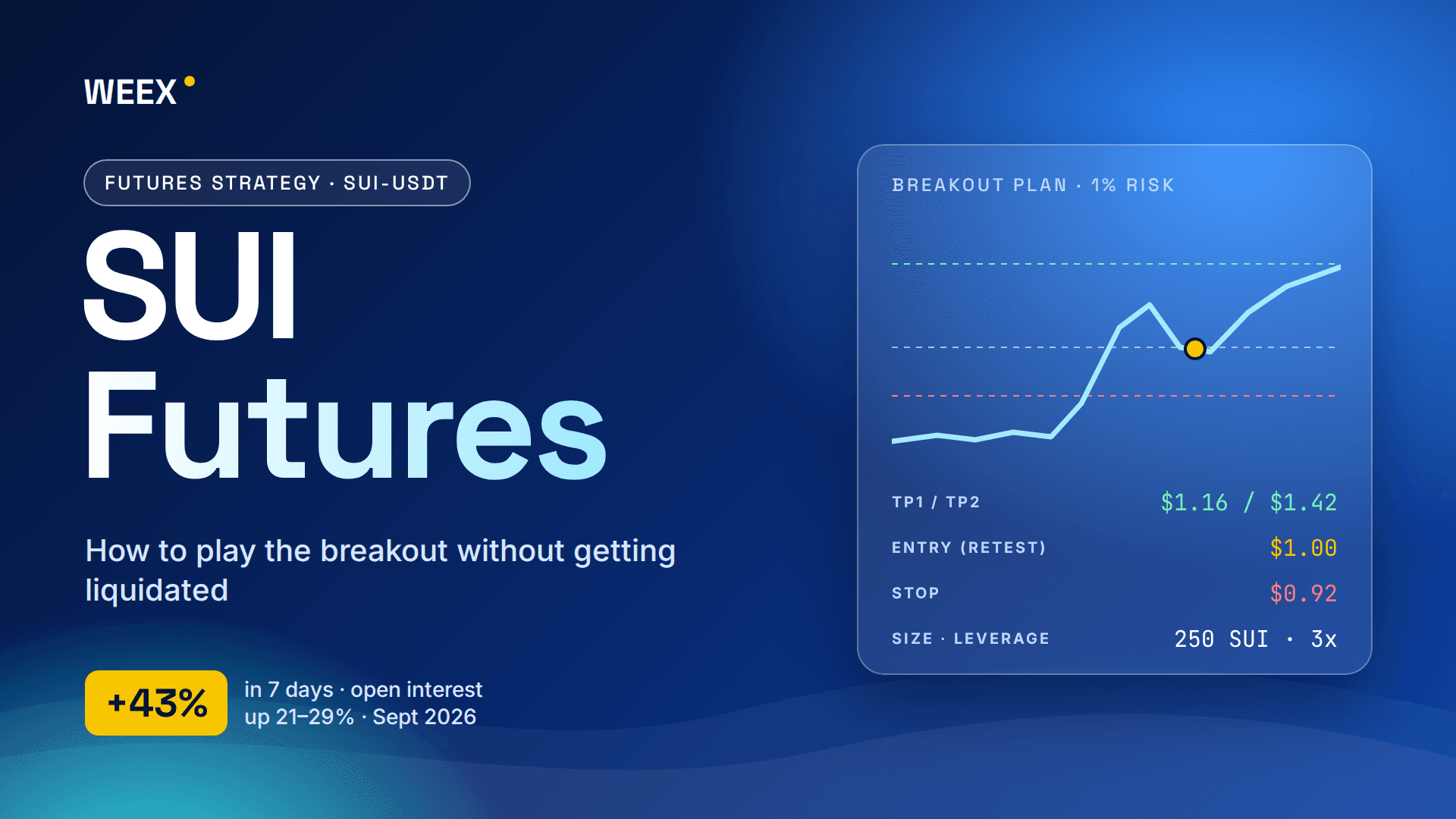
SUI futures turned into one of the busiest altcoin trades of September 2026. SUI broke a nine-month downtrend, climbing from the $0.68–$0.70 range to a high near $1.08. That was a gain of about 43% in seven days, and futures open interest rose between 21% and 29% during the move. For futures traders, the useful question now is how to trade what comes next without being shaken out. This guide covers why SUI broke out and what open interest says about the rally. It then gives a step-by-step breakout plan with exact sizing, explains why high leverage fails on a coin this volatile, and lists the signals that would cancel the trade.
Why SUI Broke Out: The Drivers Behind the 43% Week
Three catalysts arrived in the same week:
- Raoul Pal's endorsement. The macro investor publicly called Sui his "highest-conviction position" for an economy of autonomous AI agents, pointing to its programmable transaction blocks.
- Hashi goes live. The Hashi protocol lets bitcoin serve as programmable collateral on Sui without leaving the Bitcoin blockchain. It gives Sui a direct pitch to BTC holders who want to use their coins in DeFi.
- Rotation into Layer 1s. When the bitcoin short squeeze sent BTC above $85,000 on Sept 21, capital spread into large-cap altcoins. SUI gained 21.4% that day, the most of any major coin.
Protocol updates support the story too. Gasless stablecoin transfers went live at the protocol level, and the Sui Foundation has bought back 609,800 SUI so far this year using stablecoin yield. As of Sept 23, SUI traded near $0.96, up about 5% on the day and pulling back from the $1.08 high.
What Open Interest Says About the SUI Rally
Open interest (OI) is the total value of futures contracts still open. Read together with price, it shows who is driving a move:
- Price up, OI up: new money is opening positions. This is what SUI showed around Sept 21, with price up 21–26% and OI up 21–29%. The trend has fuel, but those new positions will eventually have to close.
- Price up, OI down: shorts are being forced out. The move is a squeeze and tends to fade once short covering ends.
- Price down, OI up: new shorts are piling in. If price then turns up, they become fuel for a squeeze.
- Price down, OI down: longs are exiting or being liquidated, and the market is clearing out leverage.
The SUI breakout was built on new positions, which is healthier than a pure squeeze. The catch is that many of those new longs entered between $1.00 and $1.08. If SUI slips back below $1.00, that group becomes forced sellers. Before entering, check the funding rate on the WEEX SUI-USDT perpetual. If funding is strongly positive, longs are crowded and paying for the privilege.
A SUI Futures Breakout Plan, Step by Step
A breakout-and-retest plan waits for price to pull back to the broken level and hold it before entering. It is slower than chasing a green candle, but the stop has a logical place to sit. Here is the plan with round numbers:
- Define the level. The $1.00–$1.05 zone is the key area. It is where SUI broke out, and it has rejected price several times. Wait for a pullback into it that holds on the 4-hour close.
- Set the invalidation. Put the stop at $0.92, below the retest zone and back inside the old range. If price trades there, the breakout has failed.
- Set the risk budget. On a $2,000 account, risking 1% means $20.
- Size the position. Entry at $1.00 with a stop at $0.92 is $0.08 of risk per SUI. $20 ÷ $0.08 = 250 SUI, a $250 notional position.
- Choose leverage last. At 3x isolated, the position needs about $83 of margin. The simplified liquidation price for a long is entry × (1 − 1/leverage + maintenance margin), about $0.67, far below the $0.92 stop. Your stop will always act first.
- Plan the exits.
- Take half off at $1.16, the first resistance level above the recent high: a $0.16 gain, or 2R.
- Trail the rest toward $1.42–$1.50.
- Move the stop to breakeven once TP1 fills.
With these numbers a full loss costs $20, while TP1 alone returns about $20 on half the position ($0.16 × 125 SUI). The trade rewards being right more than it punishes being wrong. On the WEEX SUI-USDT perpetual, you can attach the stop and both take-profits to the order when you open it.
-- Price
Why High Leverage Fails on SUI
The WEEX SUI-USDT contract offers up to 200x leverage. That is the platform's maximum, not a recommended setting. Here is what the same $1.00 long looks like at different leverage:
- 3x: liquidation near $0.67, a 33% drop away.
- 10x: liquidation near $0.905, a 9.5% drop away, which is inside SUI's normal weekly range.
- 50x: liquidation near $0.985, a 1.5% drop away. SUI moved about 5% on a quiet day this week and 21% on a busy one.
At 50x, the position would probably be liquidated by an ordinary intraday wick before the trade idea had any chance to play out. The better way to think about it is that leverage only reduces the margin you post. It never changes how much you lose at the stop, which the position size sets. Choose the size from your stop, then use as little leverage as that size needs. For a broader grounding in futures mechanics, WEEX's crypto futures trading guide covers margin modes and order types.
What Would Invalidate the SUI Breakout?
A breakout trade needs clear conditions for getting out. For SUI, any of these would argue for staying flat or closing early:
- A 4-hour close back below $0.92. The breakout has failed, and the $0.68–$0.70 base is back in play.
- Price rising while open interest falls. The rally is now short covering, not new demand.
- Funding staying sharply positive while price stalls. Longs are paying more and getting nothing for it, which is a common setup before a long squeeze.
- A BTC reversal below $84,000. SUI's breakout came with the BTC squeeze. If bitcoin loses that support, high-beta altcoins usually fall harder.
- Momentum overextended with no pullback. RSI was above 70 on Sept 23. Buying an extended candle without a retest turns a plan into a chase.
The SUI futures setup is attractive because the story, the chart and new money all point the same way. It turns dangerous when traders use leverage that SUI's normal volatility cannot support. Trade the level, size from the stop, and let the exits carry the trade.
FAQ
1. Why is SUI going up in September 2026?
SUI rose about 43% in a week. The drivers were Raoul Pal naming it his top AI-economy position, the launch of Hashi (which lets BTC be used as collateral on Sui), rotation into Layer 1s after bitcoin's Sept 21 squeeze, and gasless stablecoin transfers going live.
2. What leverage should I use for SUI futures?
Start from your stop-loss, not the leverage slider. In the example above, 3x keeps the liquidation price far below a logical stop, while at 50x a 1.5% dip is enough to liquidate the position. SUI regularly moves more than that in a day.
3. What does rising open interest mean for SUI?
When price and open interest rise together, new positions are entering and the move has fuel. Those positions also become potential forced sellers if price falls back through their entry zone, around $1.00–$1.08 in this case.
4. Is SUI futures trading riskier than spot?
Yes. Spot SUI can fall but not be liquidated. A futures position can be closed at a loss of its entire margin on a move smaller than SUI's typical daily swing, and it pays or receives funding while open.
Risk Warning
Crypto futures carry high risk. A leveraged SUI position can lose its entire margin within minutes. Altcoin perpetuals like SUI-USDT can have thinner order books than BTC or ETH, which means more slippage in fast markets. Stops may fill below their trigger price, and funding payments change as positioning shifts. Catalysts such as endorsements and protocol launches can reverse sharply as sentiment changes. The trade plan in this article is an educational example, not a recommendation. Crypto assets are volatile, and you may lose part or all of the capital you commit.
This content is provided for general informational purposes only and doesn't constitute financial, investment, legal, or tax advice. Any events, rewards, online promotions, or related information mentioned herein should not be considered a recommendation, solicitation, or invitation to purchase, sell, trade, or otherwise deal in any crypto assets. Crypto assets are highly volatile and may result in loss. The availability of WEEX services, products, and related events may vary by region. You are responsible for ensuring that your participation is in accordance with applicable local laws and regulations.
You may also like
Bitcoin Short Squeeze Explained: Inside the $648M Sept 21 Wipeout
BTC Futures Trading on WEEX: Claim BTC Rewards Before Sep 25

TOKEN2049 Singapore Events 2026: Side Events, VIP Lounges and What to Do During TOKEN2049 Week

What Is Magma Finance (MAGMA) and How Does It Work?

What Is Walrus (WAL) and How Does It Work?

Best Crypto Futures Trading Platforms in October 2025
What is OVERTAKE (TAKE) Coin? A Comprehensive Guide
What Is Sui and How Does It Work?
Ethereum Futures Trading: How to Size ETH Positions and Read PnL
INJ Meridian Upgrade: What Activates Sept 24 and What to Watch
Why Is PEPE Up Today? The Meme Coin Liquidity Signal Explained

Crypto Leverage Trading: What 400x Leverage Actually Costs You
Funding Rate Crypto: What BTC and ETH Are Paying Right Now
Crypto Liquidation: The Exact Price That Wipes Out Your Position
XPL Unlock on Sept 25: How to Long or Short Plasma Futures Safely
NEAR Futures Take-Profit and Stop-Loss: Managing a Parabolic Move
ARB Futures After a 60% Week: Leverage, Isolated Margin and PnL
Bitcoin Funding Rate After a $648M Short Squeeze: What Longs Pay
Stop Loss in Crypto Futures: How to Set TP/SL That Survives Wicks
Bitcoin Futures After the Fed Hike: How to Trade BTC Above $80K
NEAR Price Jumps 80% in a Week: What Confidential Intents Changed
NVDA Perpetual Futures: Trading Nvidia 24/7 After the Fed Hike
ZEC Futures Trading: Leverage Lessons From Zcash's $1,400 Squeeze
Micron Earnings Sept. 30: Order Types and TP/SL on MU Perpetuals
Lumentum (LITE) Perpetual Futures: Why 25x Leverage Is the Limit
Lighter (LIT) Futures: Cross vs Isolated Margin on a 17% Range
SOL Perpetual Contracts: Mark Price, Index Price and Liquidation
XRP Futures: How to Long or Short XRP After the Clarity Act Vote
How to Test a Trading Strategy on WEEX Demo Before Going Live
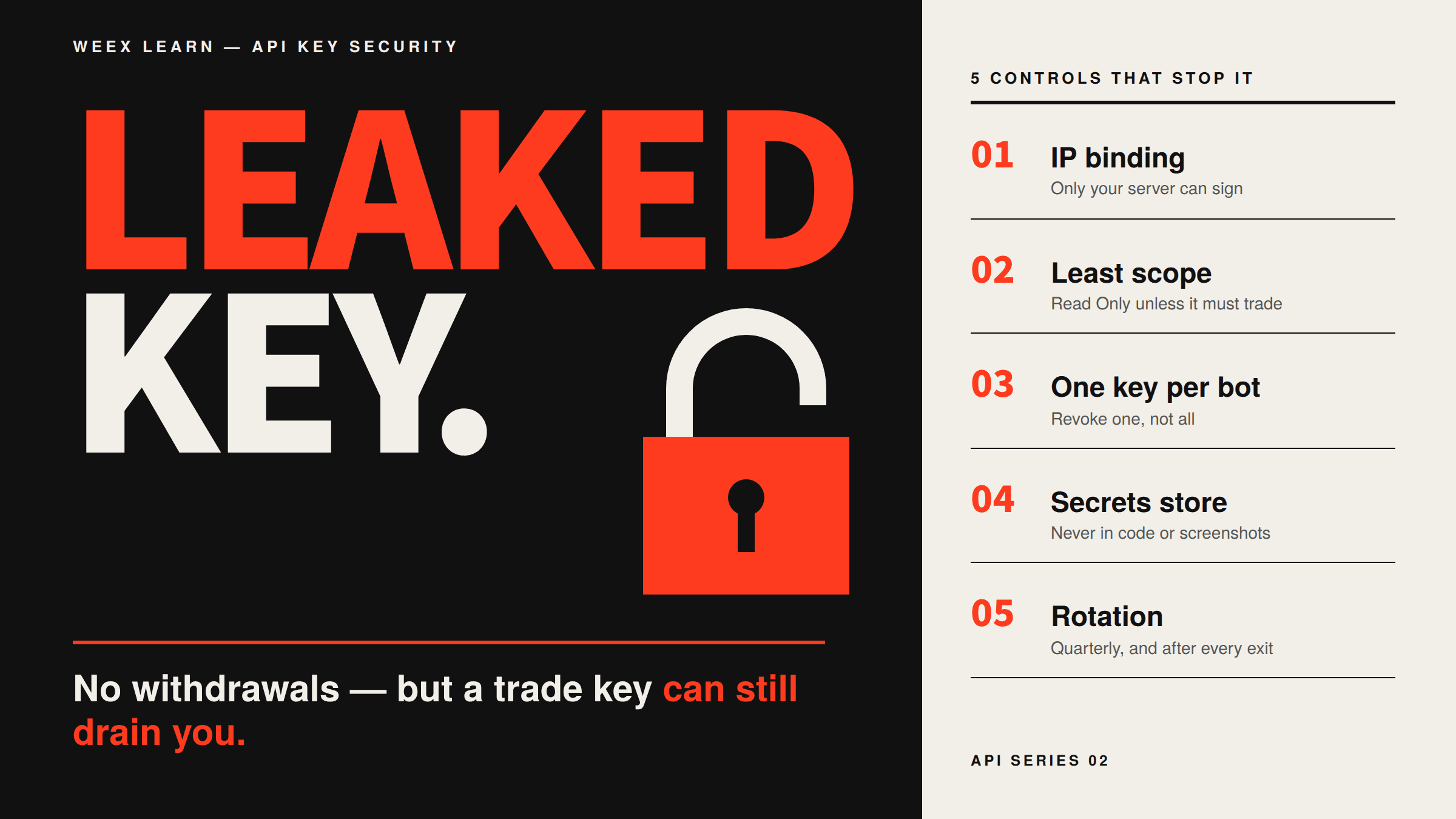
WEEX API Key Security: What a Leaked Key Can Still Do to You
Bitcoin Short Squeeze Explained: Inside the $648M Sept 21 Wipeout
BTC Futures Trading on WEEX: Claim BTC Rewards Before Sep 25
TOKEN2049 Singapore Events 2026: Side Events, VIP Lounges and What to Do During TOKEN2049 Week
What Is Magma Finance (MAGMA) and How Does It Work?
What Is Walrus (WAL) and How Does It Work?
Best Crypto Futures Trading Platforms in October 2025
Contents
Popular coins
Latest articles


