
About ERC-8004: Everything You Need to Know


Original Title: "Everything You Need to Know About ERC-8004"
Original Author: KarenZ, Foresight News
From everyday tasks to professional scenarios, AI agents are fully emerging into our lives. An era of "Agent Economy," where intelligent agents autonomously collaborate, has progressed from concept to reality.
Behind the excitement, however, a looming question remains: How can trust be established when two AI agents that have never interacted before need to collaborate? Similar to hiring a stranger as a contractor, who would check references, review past feedback, and verify qualifications, interactions between AI agents also require a reliable trust mechanism.
Against this backdrop, the ERC-8004 standard has emerged. Defined as a "trustless intelligent agent" technical standard, it serves as a unified "trust infrastructure" for the chaotic AI agent world, transforming AI agents from mere code programs into accountable, trustworthy economic participants.
What Is ERC-8004?
Simply put, ERC-8004 is a technical standard running on Ethereum, with the core objective of providing AI agents with a cross-platform, verifiable "identity + reputation + attestation" system.
The key members leading the development of this standard include Marco De Rossi, Head of MetaMask AI; Davide Crapis, AI Lead at the Ethereum Foundation; Jordan Ellis, Software Engineer at Google; and Erik Reppel, Engineering Lead at Coinbase. In the draft stage, feedback was gathered from over 80 teams, solidifying industry-wide consensus.
ERC-8004's core design is quite straightforward, relying on three on-chain "registries" (Agent Identity, Reputation, and Attestation) to support the entire trust system. These three registries are all "singleton contracts" — meaning that only one is deployed on each blockchain, and all AI agents share the same set of rules, ensuring standardization. We can think of these three registries as an AI agent's "digital ID," "credit profile," and "skill certification report," working together to address the core trust issue in AI agent interactions.
Identity Registry: AI Agent's "Digital ID"
When each AI agent registers, they are assigned a unique "Agent ID," which is essentially an ERC-721 NFT, serving as the AI agent's "digital ID."
This "ID card" contains key information — through a metadata file called a "proxy card," it records the AI agent's name, capabilities (such as "help you manage DeFi investments," "automatically generate copy"), how to contact it (supported communication protocols), its receiving wallet address, and identity systems like DID/ENS.
What's more, this identity is portable. Regardless of which platform the AI agent is working on, as long as it carries this NFT, its identity information can be quickly recognized. Plus, NFT ownership is transferable, fully controlled by the agent's owner, secure and flexible.
Reputation Registry: AI Agent's "Credit History"
Having just an identity is not enough; whether it can perform tasks and how reliable it is are key.
The reputation registry serves as the AI agent's "credit history," permanently recording every work performance on-chain, tamper-proof and undeletable.
How does it work? After having an AI agent complete a task, you can submit an evaluation, including quantitative values such as normal operation time, success rate, response quality, "efficient," "accurate" labels, and even attach an off-chain detailed evaluation link. All feedback will be permanently linked to that AI agent's identity, open for public query.
Validation Registry: AI Agent's "Skill Certification Report"
For some low-risk tasks, such as checking the weather or writing short copy, checking the reputation record might be sufficient. But for high-risk scenarios, like managing large DeFi assets, medical diagnostic assistance, positive reviews are not enough; a more authoritative "endorsement" is needed — this is the role of the validation registry.
This registry allows third-party entities (such as professional validation nodes, oracles) to independently validate the AI agent's work and record the validation results on-chain. There are many validation methods, such as using zero-knowledge proofs (zkML) to verify if the AI's computation process is correct, using a trusted execution environment (TEE) to ensure computation security, and introducing cryptographic economic penalty mechanisms.
In short, with this "skill certification report," the trustworthiness of an AI agent in high-risk scenarios will be significantly enhanced. However, this registry has not yet been deployed to the Ethereum mainnet. As the final part of a trust loop, it will promote the realization of a two-way trust guarantee where "agents dare to take orders, and users dare to make payments."
Why is ERC-8004 So Important?
Some may ask, with many AI agent platforms available today, why do we need a standard like ERC-8004?
The answer is quite clear: without a unified standard, the AI Agent Economy will always be "fragmented," unable to achieve true scalability and autonomy. Its importance is mainly reflected in the following aspects:
· Building a decentralized "Trust Layer": ERC-8004 can drive the establishment of a public trust marketplace, building a decentralized trust system from multiple dimensions such as "agent attributes," "past performance," and "task accuracy," to solve the trust interaction dilemma;
· Promoting the development of "Agent-to-Agent" and "Human-to-Agent" economies: By enabling discovery and transferable reputation, AI agents developed by different companies, different organizations can discover, hire, and make instant payments to each other without permission, breaking down collaboration barriers.
In addition, ERC-8004 will promote Ethereum to become the "Financial Layer" of AI: With the explosive growth of AI agent numbers, the high-frequency micropayments between them will bring significant transaction volume. ERC-8004 ensures that these economic activities take place within the Ethereum ecosystem, greatly increasing the network effect of ETH.
Overall, the importance of ERC-8004 lies in transforming AI from an "isolated tool" into an "economic participant," endowing AI agents with identity and reputation, and providing standardized infrastructure for the upcoming trillion-dollar AI agent economy.
ERC-8004 Ecosystem Overview: Who are the current players?
ERC-8004 launched on the Ethereum mainnet at the end of January 2026 and has also gone live on the Polygon, BNB Chain, Base, Monad, Scroll, Arbitrum, Mantle, Taiko, Gnosis Chain, Avalanche C-Chain, Celo, and MegaETH (launched on February 10) networks. The entire ecosystem now covers multiple areas such as agent frameworks, browsers, verification infrastructure, identity resolution, DeFi, and more.
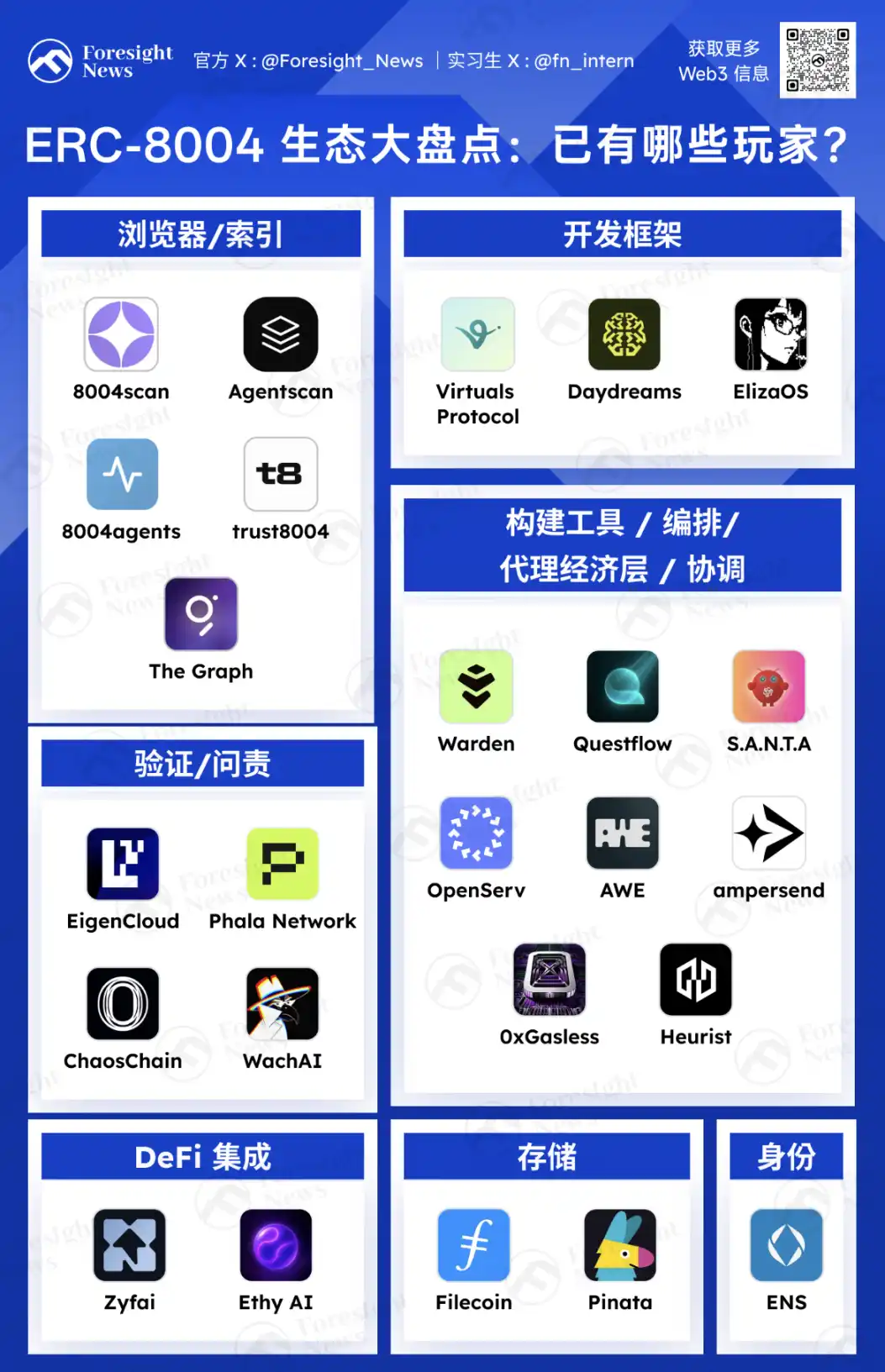
Browsers / Indexers
These tools serve as the core retrieval entry point of the ERC-8004 ecosystem, providing basic services such as agent discovery, information retrieval, reputation data aggregation, etc.
8004scan
8004scan is an ERC-8004 ecosystem AI agent discovery and token reputation data tool that supports searching throughout the registry by agent name, description, skills, agent ID, or 0x address. The search results are presented in a structured manner, displaying ratings, feedback, verification information, and more.
https://www.8004scan.io/
Agentscan
Agentscan is an agent discovery and tracking tool built by the Web3 identity portal Alias. Alias was previously selected for the YZi Labs MVB Season 8 accelerator program, utilizing zero-knowledge proof technology, combining self-discovery, artificial intelligence models, and identity currency.
https://agentscan.info/
8004agents
8004agents is a comprehensive tool that integrates ecosystem news aggregation with agent discovery.
https://8004agents.ai/
trust8004
trust8004 is also an open-source browser for ERC-8004 AI agents.
https://www.trust8004.xyz/
The Graph
The Graph released an ERC-8004 subgraph across 8 chains in early February, creating a unified cross-chain trust directory. For example, an agent on Base can immediately verify the reputation of an agent on Arbitrum through subgraph queries.
Storage
These projects focus on file storage and hosting, supporting agent registration, metadata, etc., stored on-chain or on IPFS.
Filecoin
Filecoin Pin stores ERC-8004 agent registration and verification files on the Filecoin Onchain Cloud with cryptographic proofs. The Ethereum agent-building community can use Filecoin Pin to store agent identity, reputation, and metadata on-chain.
Pinata
Pinata is a cryptographic file storage project, whose IPFS API supports uploading files to public or private IPFS and simplifies the process of hosting proxy cards and registering files on IPFS.
https://pinata.cloud/
Development Framework
These projects provide developers with a standardized proxy development, deployment, and operation toolkit, reducing the barrier to entry for the ERC-8004 standard and driving the scalable implementation of ecosystem applications.
Virtuals Protocol
The Virtuals Protocol integrates ACP with ERC-8004, aiming to transform verifiable proxies into true economic participants, enabling on-chain hosting, inter-proxy transactions, and real-time registration of daily proxy transactions. All proxies that have completed Virtuals ACP certification will be automatically registered on-chain via ERC-8004.
https://app.virtuals.io/
Daydreams
Daydreams.Systems focuses on building autonomous proxies and applications on the x402 payment rail, with the ecosystem primarily consisting of the open-source proxy framework Daydreams, Daydreams Router (enabling AI model request routing through instant USDC settlement), the autonomous proxy operation platform LUCID, and the native proxy search engine XGATE.
Among them, the open-source Agent Commerce Kit in LUCID builds proxies using composable modules, supporting x402, A2A, ERC-8004, and related business protocols. This is a stack for building proxies participating in task markets, enabling proxy-to-proxy communication, and facilitating payments and receipts via x402. XGATE allows operators to quickly discover proxies.
https://x.com/daydreamsagents
ElizaOS
ElizaOS is an open-source decentralized AI Agent framework (formerly ai16z). Currently, ElizaOS's Eliza Cloud under development serves as the infrastructure for the proxy economy, supporting the construction, operation, and scalable expansion of autonomous proxies. ElizaOS is also achieving decentralized proxy discovery and coordination between proxies through ERC-8004, leveraging the x402 protocol for low-friction payments.
https://x.com/elizaOS
Verification / Accountability
EigenCloud
The EigenCloud supports an ERC-8004 Agent with Verifiable Execution (TEE), Inference Verifiability, and x402 Payment Capability.
https://x.com/eigencloud
Phala Network
The Phala Network is a decentralized computing network focused on Trusted Execution Environment (TEE). Phala offers an AI Agent template that allows developers to deploy an Agent compliant with the ERC-8004 standard in one click. Phala leverages TEE technology to provide encrypted proofs (Attestation) to the ERC-8004 "Verification Registry," proving that the Agent's code runs in a secure environment and has not been tampered with.
https://github.com/Phala-Network/erc-8004-tee-agent
ChaosChain
ChaosChain is an AI Agent Accountability Layer that introduces a comprehensive system called "Proof of Agenthood (PoA)" to measure and reward Agent contributions, providing each Agent with verifiable on-chain identity, process integrity, and adjudication outcomes.
ChaosChain is launched through a collaboration of Ethereum ecosystem developer Nethermind, decentralized AI science protocol Hetu, and Web3 AI cloud company Hyperbolic.
https://x.com/Ch40sChain
WachAI
WachAI transforms the ERC-8004 Registry into a dynamic, accountable Agent workflow system.
https://x.com/Wach_AI
Identity
ENS
The Open Agent Standard requires open identity, which is a crucial step to make Self-Sovereign Agents discoverable, verifiable, and composable in the ENS domain system.
https://x.com/ensdomains
Tooling / Orchestrating / Agentomics / Coordination
Warden
Warden is an AI Agent Infrastructure Protocol that achieved a $200 million valuation in a $4 million strategic round in January 2026, with participation from 0G, Messari, Venice.AI, among others.
Warden announced that its Warden Studio, launched in January, enables creators to build and deploy AI agents in under a minute and monetize them, integrating ERC-8004 for identity and x402 for payments, creating a verifiable trustless infrastructure.
https://x.com/wardenprotocol
Questflow
Questflow focuses on building an orchestration layer for a multi-agent economy, allowing AI agents to autonomously research, take actions, earn rewards on-chain, support multi-agent collaboration, cross Web2/Web3 service integration, and achieve agent-to-agent payments and monetization through the x402 protocol.
https://x.com/questflow
S.A.N.T.A
S.A.N.T.A, launched by Questflow, is a self-sovereign network task agent cluster that uses A2A, ERC-8004, and x402 protocols to build the x402 Facilitator Router. Agents can coordinate with each other, trigger real transactions, and achieve cross-chain trustless interactions.
https://x.com/santavirtuals
OpenServ
OpenServ supports faster agent application development with the help of the SERV engine, a visual agent builder, native x402 and ERC-8004 integrations, and its proprietary reasoning framework, BRAID.
https://x.com/openservai
AWE
AWE is an AI multi-agent large-scale collaboration infrastructure, recently launching AgentBeat, an analytics hub designed specifically for ERC-8004 agents. As agents run on-chain and earn fees, AgentBeat reveals true activity, validation, and decentralization status.
https://x.com/awenetwork_ai
ampersend
ampersend is a control layer for the agent economy, building a wallet for agents and a dashboard for users. The dashboard allows users to set rules and budgets, automatically top up agents daily, control each agent and its spending, and monitor activity. ampersend is built on top of the latest open protocols and on-chain standards (such as x402 and A2A) and integrates ERC-8004. ampersend is currently in closed beta testing.
https://www.ampersend.ai/
0xGasless
0xGasless is an AI agent financial layer, backed by InfraBuidl and Avalanche Foundation in June 2025. The 0xgasless/agent-sdk provides a toolkit for developers looking to integrate the latest standards for agent identity, reputation management, and validation (ERC-8004) and combines with the x402 protocol to enable agents to interact with paid APIs and services.
https://0xgasless.com/
Heurist
Heurist is building a full-stack AI infrastructure, including Heurist Cloud (AI model access through a simple API), Heurist Mesh (agent marketplace), and Heurist Chain (ZK Layer-2 for agent payments). Mesh agents went live on the ERC-8004 registry at the end of January.
https://x.com/heurist_ai
DeFi Integration
Zyfai
Zyfai is a DeFi proxy solution that autonomously adjusts its portfolio to achieve the highest risk-adjusted return. Each rebalance generates a zero-knowledge proof to confirm correct execution and is stored in the ERC-8004 Verification Registry.
https://x.com/ZyfAI_
Ethy AI
Ethy AI is an automated trading tool that also operates a proxy and workflow marketplace where users can discover, reuse, and combine proxies created by other users. Ethy AI has leveraged Virtuals ACP and x402 for native payments and incentive mechanisms between proxies within workflows. By integrating ERC-8004, the Ethy marketplace has evolved into a trust-based proxy marketplace where reputation is built through actual usage and directly reflected in the product.
https://x.com/ethy_agent
Summary
The introduction of ERC-8004 has provided a core trust infrastructure for the decentralized development of AI agent economies.
Of course, ERC-8004 itself does not handle payments; it only deals with "who is who and how reliable." To truly form a closed-loop economy between agents (discovery → cooperation → payment → feedback to update reputation), an efficient machine-to-machine micropayment layer is still needed. The community and infrastructure projects generally see ERC-8004 + x402 as a complementary loop in the agent economy.
With the completion of multi-network deployments and the continued adoption of ecosystem projects, a new era of a trustworthy AI agent autonomously collaborating and creating value digital economy is accelerating. However, on the path to a mature agent economy, there are still some key challenges to be addressed.
You may also like

Morning Report | BitMine increased its holdings by 126,971 ETH last week; trader Eugene announced his exit from the crypto market

Wang Chuan: How can one not feel anxious after the neighbor Old Wang made thirty times profit by investing in storage stocks? (Seven) - A quarter-century cycle

Cryptocurrency CEXs are flocking to sell US stocks, and traditional brokerages are facing an "uninvited guest."

$75 billion in foreign capital has fled, and South Korean retail investors have absorbed it all using leverage

Japan’s Three Megabanks Plan Joint Stablecoin Issuance in Fiscal 2026
MUFG, SMBC, and Mizuho reportedly plan to jointly issue fiat-pegged stablecoins in fiscal 2026, signaling Japan’s growing push into bank-led digital payment infrastructure.

Humanity Discloses H Token Dual-Chain Attack Details, With Losses on Ethereum and BSC Exceeding $36 Million
Humanity said the H token attack across Ethereum and BSC caused more than $36 million in losses after leaked ProxyAdmin keys enabled malicious contract upgrades and token minting.
White House Discusses CLARITY Act With Law Enforcement Ahead of Senate Vote
The White House discussed the CLARITY Act with law enforcement ahead of a Senate vote, focusing on illicit finance risks and developer protections.

Bitcoin Trading Guide 2026: Strategies for Experienced Traders

What Is XAUT and PAXG? Why Tokenized Gold Is Booming in 2026

Will the SpaceX IPO Hurt Bitcoin? Here's What Traders Are Watching

Foreign selling in the South Korean stock market accelerates, with cumulative net sales reportedly reaching $75 billion this year
On June 9, The Kobeissi Letter, citing Goldman Sachs data, reported that global investors are selling South Korean stocks at an unusually rapid pace. In the latest trading session, foreign investors sold about $801 million worth of Kospi constituent stocks again; total foreign outflows last week reached about $10 billion, and the market has been in net foreign selling on nearly every trading day over the past month. According to the data cited in the report, foreign investors have sold about $75 billion worth of South Korean stocks so far this year. Meanwhile, South Korean retail and institutional investors together recorded roughly $69 billion in net buying over the same period, suggesting that the market’s main buying support has come from domestic capital rather than returning overseas funds. The information currently disclosed still mainly comes from The Kobeissi Letter’s retelling and Goldman Sachs data summaries, while public details on the statistical period and the specific definition of “selling” remain relatively limited.

Fortune Warns of Strategy’s Financing Structure Risks as Bitcoin Premium Narrows
Fortune warned that Strategy’s Bitcoin treasury model faces growing financing risks as MSTR’s net asset premium narrows and preferred stock dividend pressure increases.

Ferrari Challenge Le Mans: Carl Moon to Dominate in WEEX Livery

Sahara AI Responds to SAHARA’s Sharp Drop: No Contract or Product Security Issues Found, Internal Investigation Underway
Sahara AI responded to SAHARA’s 60% price drop, saying no token contract or product security issues have been found and an internal investigation is underway.

WEEX Deposit/Withdrawal Dynamic Island: Your Asset Status, Always in Sight
Scaling Crypto Derivatives: The Digital Asset Infrastructure Behind High-Volume Trading
In the fast-moving digital asset ecosystem, derivatives platforms face an extreme architectural test. High-leverage futures markets demand more than just standard security—they require absolute operational precision, zero-latency matching engines, and ironclad structural scalability, all while navigating intense market volatility.
As global platforms scale to meet these demands, the industry is shifting away from rigid, monolithic setups toward a more agile, "decoupled" infrastructure philosophy.
The Blueprint for High-Volume Copy TradingFor elite global exchanges like WEEX (founded in 2018), this architectural choice becomes critical when scaling high-volume retail features like social copy trading. When thousands of users automatically mirror the real-time strategies of elite traders simultaneously, it triggers sudden, monumental spikes in concurrent transactional volume.
To prevent execution latency or settlement bottlenecks during these peak volatility events, a platform's primary engine must remain entirely dedicated to risk management, copy-trade synchronization, and order matching.
The Architectural Rule: New-generation platforms must separate front-end user execution engines from heavy backend infrastructural overhead to eliminate operational friction.
By separating these layers, platforms can maintain complete sovereignty over their trading environments and user experiences while strategically aligning with institutional-grade infrastructure ecosystems. This strategic framework allows modern exchanges to leverage advanced Digital Asset Custody infrastructure such as Cobo’s behind the scenes, ensuring that backend wallet management scales elastically alongside trading spikes.
Capitalizing on Market Momentum and 400× LeverageIn a derivatives arena where platforms offer up to 400× leverage on perpetual contracts, capital efficiency and market agility are core business metrics. To capture market momentum, an exchange needs the ability to rapidly expand its asset offerings, supporting everything from legacy crypto assets to sudden, trending altcoins across a massive library of trading pairs.
Adopting a flexible, scalable Wallet-as-a-Service (WaaS) solution such as Cobo’s could completely rewrite the development timeline for high-growth exchanges. Instead of spending months of engineering capital building out custom backend wallet architectures for every new blockchain network, platforms can deploy localized infrastructure in days.
This agility allows platforms to instantly scale their listings to over a thousand trading pairs without compromising security or delaying time-to-market. It mirrors the exact operational advantages seen during high-velocity market events, similar to how advanced wallet infrastructure empowers platforms during sudden asset surges; allowing exchanges to pass that speed and liquidity directly to their global user base.
A Mature Foundation for GrowthThe synergy between trusted infrastructure ecosystems and global trading platforms represents the natural evolution of a maturing crypto market. As WEEX continues to scale its global spot and derivatives offerings for over 6 million users, adopting robust backend paradigms proves that platforms no longer have to compromise between cutting-edge trading velocity and uncompromised structural security.

Get Paid to Onboard? Try WEEX’s New Homepage with Rewards for Registration, Deposit & Trade
WEEX Custom Layout: Build Your Perfect Trading Workspace in Seconds
Morning Report | BitMine increased its holdings by 126,971 ETH last week; trader Eugene announced his exit from the crypto market
Wang Chuan: How can one not feel anxious after the neighbor Old Wang made thirty times profit by investing in storage stocks? (Seven) - A quarter-century cycle
Cryptocurrency CEXs are flocking to sell US stocks, and traditional brokerages are facing an "uninvited guest."
$75 billion in foreign capital has fled, and South Korean retail investors have absorbed it all using leverage
Japan’s Three Megabanks Plan Joint Stablecoin Issuance in Fiscal 2026
MUFG, SMBC, and Mizuho reportedly plan to jointly issue fiat-pegged stablecoins in fiscal 2026, signaling Japan’s growing push into bank-led digital payment infrastructure.
Humanity Discloses H Token Dual-Chain Attack Details, With Losses on Ethereum and BSC Exceeding $36 Million
Humanity said the H token attack across Ethereum and BSC caused more than $36 million in losses after leaked ProxyAdmin keys enabled malicious contract upgrades and token minting.


