
Recovering $70,000 in Lost Funds: The "Fragile Logic" Behind Bitcoin's Rebound


Original Title: Bitcoin rockets over 15% to get above $70,000 but options markets are now pricing in a scary new floor
Original Author: Gino Matos, CryptoSlate
Original Translation: Deep Tide TechFlow
Abstract: After experiencing a violent rebound from $60,000 to over $70,000 within 24 hours, Bitcoin seems to have regained lost ground. However, the underlying logic shows that this is not due to strong spot buying but rather forced repositioning and short squeeze triggered by macro market warming. This article delves into the causes of this "panic tumult" in early February 2026: from the liquidity tightening expectations following Trump's appointment of Kevin Warsh to the pressure of miners' profits hitting a historical low. Despite the price returning above $70,000, options traders are heavily betting on a second dip to $50,000-60,000 by the end of February, revealing the market's fragile sentiment and complex financial game under the facade of a "violent rebound." The following is the main text:
Bitcoin skyrocketed from $60,000 to above $70,000 in less than 24 hours, erasing a brutal 14% decline that tested all the "buy the dip" narratives in the market.
This speed of reversal—a 12% surge in a single day, bouncing back 17% from the intraday low—is intense enough to feel like settling dust after a reckoning. However, the mechanism behind the rebound tells another story: it is more of a combination of cross-asset stability and forced position rebalancing, rather than large-scale spot demand being belief-driven.
Meanwhile, the derivatives market is still filled with bearish protection positions, with pricing indicating that $70,000 might just be a pit stop rather than a true bottom.
Liquidation Wave Meets Macro Pressure
On February 5, the market opened around $73,100, briefly surged, then collapsed all the way down to a close at $62,600. According to CoinGlass data, the single-day decline led to about $1 billion in leveraged Bitcoin positions being liquidated.
This figure alone illustrates the chain reaction of forced selling, but the broader environment is actually worse.
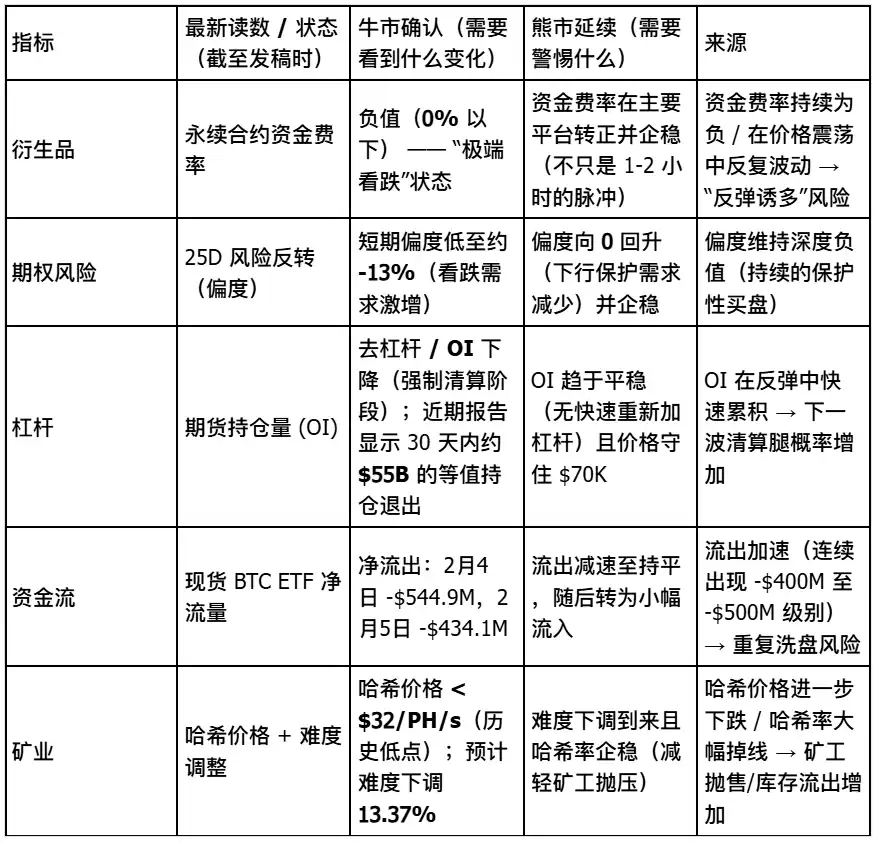
According to CoinGlass data, the Bitcoin futures Open Interest has dropped from around $61 billion to $49 billion last week, indicating deleveraging in the market before the final shakeout.
The triggering factor was not the cryptocurrency itself. Media reports have characterized this selloff as a deterioration of risk sentiment, primarily driven by tech stock selloff and precious metals volatility—silver plummeted as much as 18% to around $72.21, dragging down all related risk assets.
Research from Deribit confirms this cascading effect, pointing out extreme bearish sentiment in derivatives: negative funding rates, inverted implied volatility term structure, and a 25-delta Risk-reversal skew compressed to around -13%.
This is a typical state of "extreme fear," where position layouts amplify price swings in both directions.
Adding fuel to the fire is the policy narrative. According to Reuters, the market reacted strongly to President-elect Donald Trump's selection of Kevin Warsh as the Federal Reserve chairman, with traders interpreting it as a signal of future balance sheet contraction and liquidity tightening.
Meanwhile, miners are facing significant profit pressure. As reported by TheMinerMag, the Hash price has dropped to below $32 per PH/s, and the network difficulty is expected to decrease by around 13.37% in two days. However, this relief mechanism has not yet taken effect before the price broke the support level.
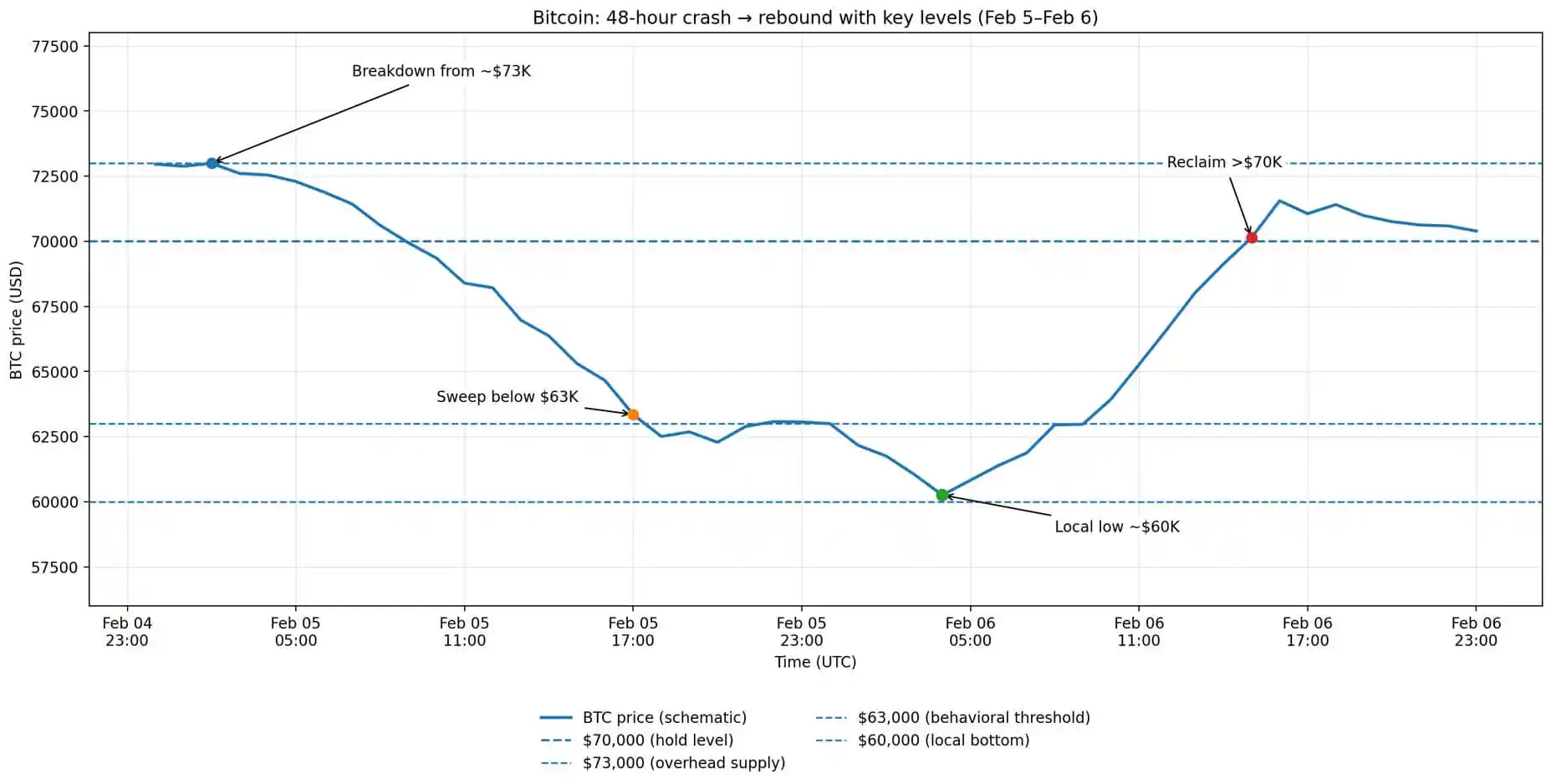
Bitcoin's price action in the past 48 hours illustrates a collapse from $73,000, a stop-loss sweep below $63,000, a local bottom near $60,000, and a subsequent rebound above $70,000.
Macro Reversal and Squeeze Mechanism
Opening on February 6 at the previous day's closing price, the price then dropped to an intraday low near $60,000, followed by a wild rally to a high of $71,422. After three failed attempts to break that level, the price fell back below $70,000.
The catalyst did not originate from within the crypto industry but from a sharp turn in cross-asset trends. Wall Street performed strongly: the S&P 500 rose 1.97%, the Nasdaq rose 2.18%, the Dow Jones Industrial Average rose 2.47%, and the Philadelphia Semiconductor Index (SOX) surged 5.7%.
The metal prices surged aggressively, with gold up 3.9% and silver up 8.6%, while the U.S. Dollar Index fell by 0.2%, signaling a more accommodative financial environment.
Bitcoin followed this shift with a mechanistic swing. The correlation was quite evident: when tech stocks stabilized and metals rebounded, Bitcoin was lifted through a common risk exposure.
However, the violence of this rebound also reflected the derivatives positioning. A near -13% skew, negative funding rates, and an inverted volatility structure created a condition where any macro tailwind could trigger short-covering and forced deleveraging.
This rebound was fundamentally liquidity-driven, amplified by the unwinding of overcrowded short positions.
Nevertheless, forward-looking signals still lean bearish. Data from Derive shows a significant concentration of open put options from $60,000 to $50,000 strike price expiring on February 27.
Sean Dawson of Derive told Reuters that the demand for downside protection is "extreme." This is not a hindsight analysis but rather traders explicitly hedging against the risk of the next leg down even post-rebound.
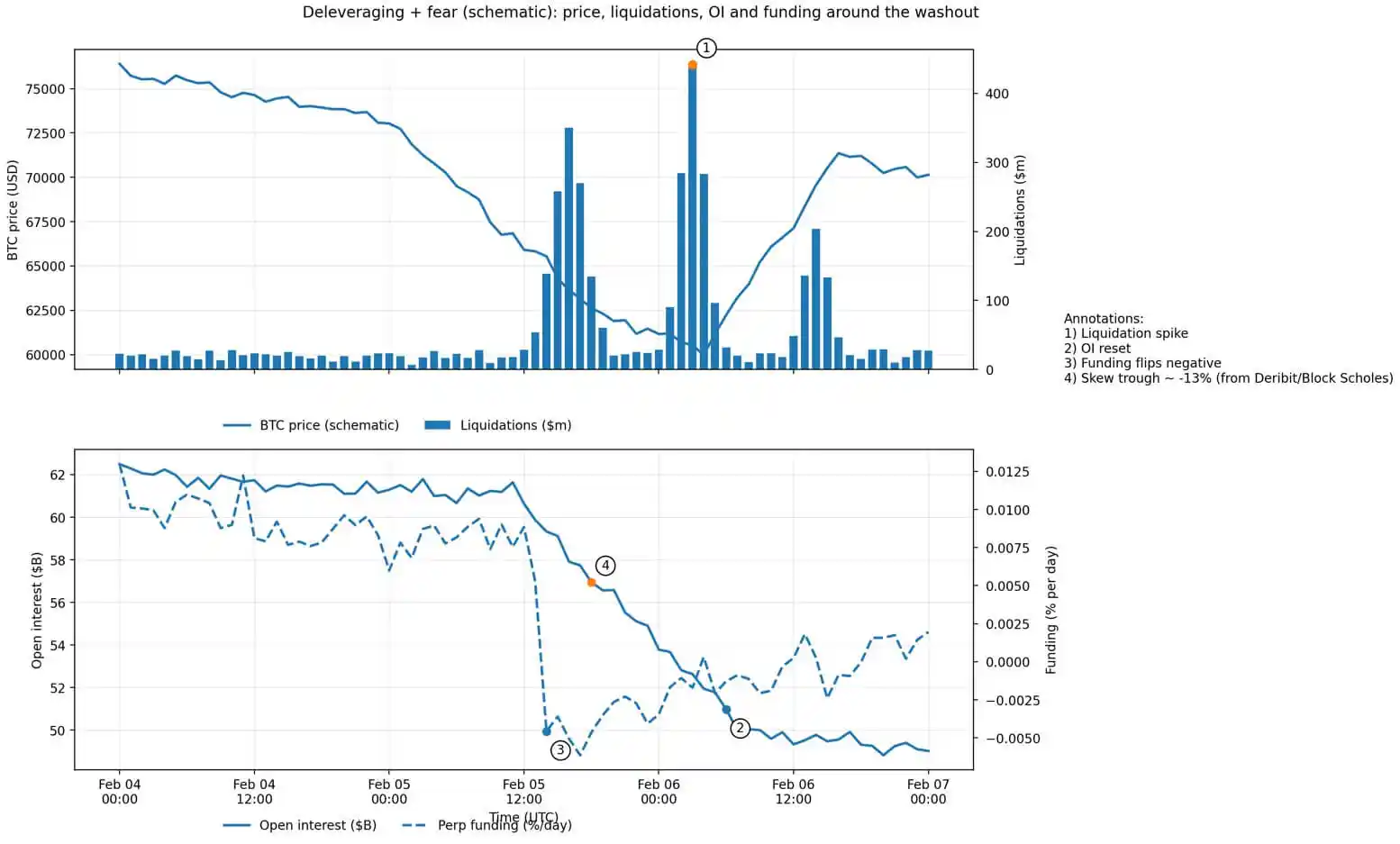
Bitcoin deleveraging chart, showing a spike in liquidations, a reset of open interest from $62 billion to $49 billion, negative funding rates, and skew reaching -13%.
Can $70,000 Hold? Analytical Framework
The rationale for holding $70,000 rests on three conditions.
First, the macro rebound needs to sustain, tech stocks must continue to stabilize, and U.S. bond yields and the dollar should not tighten again. This rebound is a clear cross-asset linkage, and if U.S. stocks turn south again, Bitcoin won't stand alone.
Second, leverage needs to keep cooling off without new forced liquidations. The open interest has significantly dropped, lowering the risk of a "free fall."
Third, as the difficulty adjustment kicks in, miner pressure needs substantial relief. If the price holds within the adjustment window, the anticipated 13.37% difficulty drop should alleviate marginal selling pressure, stabilizing the hash rate.
On the other hand, the arguments for another washout have three main points:
First, the option skew remains tilted to the downside. The largest put options at the end of February are concentrated between $60,000 and $50,000, which is a forward-looking signal embedded in market implied probabilities rather than lagging sentiment.
Second, derivative signals remain fragile. Extreme skew, recent frequent occurrence of negative funding rates, and an inverted volatility structure are more in line with a "Relief rally" characteristic within a fear regime rather than a trend reversal.
Third, ETF flow data continues to show outflows. As of February 5, Bitcoin ETFs saw a monthly net outflow of $690 million. While data for February 6 has not been released, the existing pattern indicates that institutional allocators have not shifted from "De-risking" to "Re-engagement" yet.
Signal Board
The Significance of $70,000
The price level itself holds no magic. Its significance lies in being above the Glassnode-defined on-chain absorption cluster of $66,900 to $70,600.
Holding above $70,000 signifies that the cluster has absorbed enough supply to temporarily stabilize the price. However, maintaining this level requires not only technical support but also a return of spot demand, unwinding of derivative hedging positions, and stabilization of institutional flows.
The bounce from $60,000 is real, but its composition is crucial. If macro conditions change, cross-asset stability could also reverse.
The forced unwinding of positions has created a mechanical bounce, which may not necessarily translate into a sustained trend. Options traders still reflect a significant probability of dropping to $50,000-$60,000 within the next three weeks.
Bitcoin has reclaimed $70,000 but is currently consolidating below that level. This suggests a pause before the next test, with the success of the next test hinging on the sequential occurrence of three conditions: maintenance of macro risk appetite, slowing down or reversal of ETF outflows, and normalization of derivative sentiment.
The market has seen a violent pullback, but the futures curve and flow data indicate that traders have not yet begun to bet on its sustainability. $70,000 is not the endgame; it merely sets the baseline for determining the outcome of the next phase of the battle.
You may also like

Morning Report | BitMine increased its holdings by 126,971 ETH last week; trader Eugene announced his exit from the crypto market

Wang Chuan: How can one not feel anxious after the neighbor Old Wang made thirty times profit by investing in storage stocks? (Seven) - A quarter-century cycle

Cryptocurrency CEXs are flocking to sell US stocks, and traditional brokerages are facing an "uninvited guest."

$75 billion in foreign capital has fled, and South Korean retail investors have absorbed it all using leverage

Japan’s Three Megabanks Plan Joint Stablecoin Issuance in Fiscal 2026
MUFG, SMBC, and Mizuho reportedly plan to jointly issue fiat-pegged stablecoins in fiscal 2026, signaling Japan’s growing push into bank-led digital payment infrastructure.

Humanity Discloses H Token Dual-Chain Attack Details, With Losses on Ethereum and BSC Exceeding $36 Million
Humanity said the H token attack across Ethereum and BSC caused more than $36 million in losses after leaked ProxyAdmin keys enabled malicious contract upgrades and token minting.
White House Discusses CLARITY Act With Law Enforcement Ahead of Senate Vote
The White House discussed the CLARITY Act with law enforcement ahead of a Senate vote, focusing on illicit finance risks and developer protections.

Bitcoin Trading Guide 2026: Strategies for Experienced Traders

What Is XAUT and PAXG? Why Tokenized Gold Is Booming in 2026

Will the SpaceX IPO Hurt Bitcoin? Here's What Traders Are Watching

Foreign selling in the South Korean stock market accelerates, with cumulative net sales reportedly reaching $75 billion this year
On June 9, The Kobeissi Letter, citing Goldman Sachs data, reported that global investors are selling South Korean stocks at an unusually rapid pace. In the latest trading session, foreign investors sold about $801 million worth of Kospi constituent stocks again; total foreign outflows last week reached about $10 billion, and the market has been in net foreign selling on nearly every trading day over the past month. According to the data cited in the report, foreign investors have sold about $75 billion worth of South Korean stocks so far this year. Meanwhile, South Korean retail and institutional investors together recorded roughly $69 billion in net buying over the same period, suggesting that the market’s main buying support has come from domestic capital rather than returning overseas funds. The information currently disclosed still mainly comes from The Kobeissi Letter’s retelling and Goldman Sachs data summaries, while public details on the statistical period and the specific definition of “selling” remain relatively limited.

Fortune Warns of Strategy’s Financing Structure Risks as Bitcoin Premium Narrows
Fortune warned that Strategy’s Bitcoin treasury model faces growing financing risks as MSTR’s net asset premium narrows and preferred stock dividend pressure increases.

Ferrari Challenge Le Mans: Carl Moon to Dominate in WEEX Livery

Sahara AI Responds to SAHARA’s Sharp Drop: No Contract or Product Security Issues Found, Internal Investigation Underway
Sahara AI responded to SAHARA’s 60% price drop, saying no token contract or product security issues have been found and an internal investigation is underway.

WEEX Deposit/Withdrawal Dynamic Island: Your Asset Status, Always in Sight
Scaling Crypto Derivatives: The Digital Asset Infrastructure Behind High-Volume Trading
In the fast-moving digital asset ecosystem, derivatives platforms face an extreme architectural test. High-leverage futures markets demand more than just standard security—they require absolute operational precision, zero-latency matching engines, and ironclad structural scalability, all while navigating intense market volatility.
As global platforms scale to meet these demands, the industry is shifting away from rigid, monolithic setups toward a more agile, "decoupled" infrastructure philosophy.
The Blueprint for High-Volume Copy TradingFor elite global exchanges like WEEX (founded in 2018), this architectural choice becomes critical when scaling high-volume retail features like social copy trading. When thousands of users automatically mirror the real-time strategies of elite traders simultaneously, it triggers sudden, monumental spikes in concurrent transactional volume.
To prevent execution latency or settlement bottlenecks during these peak volatility events, a platform's primary engine must remain entirely dedicated to risk management, copy-trade synchronization, and order matching.
The Architectural Rule: New-generation platforms must separate front-end user execution engines from heavy backend infrastructural overhead to eliminate operational friction.
By separating these layers, platforms can maintain complete sovereignty over their trading environments and user experiences while strategically aligning with institutional-grade infrastructure ecosystems. This strategic framework allows modern exchanges to leverage advanced Digital Asset Custody infrastructure such as Cobo’s behind the scenes, ensuring that backend wallet management scales elastically alongside trading spikes.
Capitalizing on Market Momentum and 400× LeverageIn a derivatives arena where platforms offer up to 400× leverage on perpetual contracts, capital efficiency and market agility are core business metrics. To capture market momentum, an exchange needs the ability to rapidly expand its asset offerings, supporting everything from legacy crypto assets to sudden, trending altcoins across a massive library of trading pairs.
Adopting a flexible, scalable Wallet-as-a-Service (WaaS) solution such as Cobo’s could completely rewrite the development timeline for high-growth exchanges. Instead of spending months of engineering capital building out custom backend wallet architectures for every new blockchain network, platforms can deploy localized infrastructure in days.
This agility allows platforms to instantly scale their listings to over a thousand trading pairs without compromising security or delaying time-to-market. It mirrors the exact operational advantages seen during high-velocity market events, similar to how advanced wallet infrastructure empowers platforms during sudden asset surges; allowing exchanges to pass that speed and liquidity directly to their global user base.
A Mature Foundation for GrowthThe synergy between trusted infrastructure ecosystems and global trading platforms represents the natural evolution of a maturing crypto market. As WEEX continues to scale its global spot and derivatives offerings for over 6 million users, adopting robust backend paradigms proves that platforms no longer have to compromise between cutting-edge trading velocity and uncompromised structural security.

Get Paid to Onboard? Try WEEX’s New Homepage with Rewards for Registration, Deposit & Trade
WEEX Custom Layout: Build Your Perfect Trading Workspace in Seconds
Morning Report | BitMine increased its holdings by 126,971 ETH last week; trader Eugene announced his exit from the crypto market
Wang Chuan: How can one not feel anxious after the neighbor Old Wang made thirty times profit by investing in storage stocks? (Seven) - A quarter-century cycle
Cryptocurrency CEXs are flocking to sell US stocks, and traditional brokerages are facing an "uninvited guest."
$75 billion in foreign capital has fled, and South Korean retail investors have absorbed it all using leverage
Japan’s Three Megabanks Plan Joint Stablecoin Issuance in Fiscal 2026
MUFG, SMBC, and Mizuho reportedly plan to jointly issue fiat-pegged stablecoins in fiscal 2026, signaling Japan’s growing push into bank-led digital payment infrastructure.
Humanity Discloses H Token Dual-Chain Attack Details, With Losses on Ethereum and BSC Exceeding $36 Million
Humanity said the H token attack across Ethereum and BSC caused more than $36 million in losses after leaked ProxyAdmin keys enabled malicious contract upgrades and token minting.


