
AI banking agent scored 100% on its own tests then failed 92 of 97 real-world simulations

 Prefer us on Google


AI systems tasked with building business agents often gave their work near-perfect grades on tests they wrote themselves. In a Nov. 19 preprint, researchers at Uniphore found that the grades could improve far more than scores on cases withheld from the builders during development.
The researchers used AppSci-Bench, a benchmark that puts AI builders to work in seven simulated business workflows, including invoice review, customer relationship management and airline rebooking. A builder could ask a simulated business user what the agent needed to do, then develop it using the tools and data available in that setting.
In the test runs that allowed revisions, builders could write their own tests and keep changes that raised the score. After the builder submitted an agent, the benchmark ran it on separate cases withheld during development. The researchers released the benchmark code and recorded results alongside the preprint.
What the builders' tests missed
Uniphore researchers found that 86 of the 132 builds with a recorded self-test scored at least 99% on the tests their builders wrote. The researchers tracked 13 Claude Opus 4.8 builds that could revise their agents, comparing the first round of testing with the last. For those builds, scores rose an average of 16.9 points on tests the model wrote and 3.2 points on the withheld cases. In six of the 24 revision steps the researchers examined in that subset, the builder's grade rose while the withheld-case score held steady.
The same builds, two ways to score them
AI builders could use their own tests to decide which changes to keep. AppSci-Bench also tested the submitted agents on cases withheld during development.
Two tests for the same builds During development the builder uses its own tests to decide what to revise. A separate benchmark scores the submitted agent on withheld cases. For 13 Claude Opus 4.8 builds, mean gains were 16.9 points on the first tests and 3.2 points on the withheld ones. HOW THE AGENT WAS TESTEDAVERAGE SCORE GAINDURING DEVELOPMENTAI builderSelf-written testsTest results guide revisionsAFTER SUBMISSIONSubmitted agentWithheld cases+16.9 points+3.2 points01020First to final checkpoint across 13 Claude Opus 4.8 builds with revisions enabled
Two tests for the same builds During development the builder uses its own tests to decide what to revise. A separate benchmark scores the submitted agent on withheld cases. For 13 Claude Opus 4.8 builds, mean gains were 16.9 points on the first tests and 3.2 points on the withheld ones. DURING DEVELOPMENTAI builderSelf-written testsTest results guide revisionsAVERAGE SCORE GAIN+16.9 pointsAFTER SUBMISSIONSubmitted agentWithheld casesAVERAGE SCORE GAIN+3.2 points01020First to final checkpoint13 Claude Opus 4.8 builds, revisions enabled
A large gain on the builder's tests can coexist with a much smaller gain on unseen cases.
The evaluations used different cases and scoring rules. AppSci-Bench tested simulated business workflows.
Sources and evidence
Sources
- Uniphore AppSci-Bench preprint
- AppSci-Bench benchmark repository
Supporting facts
- AppSci-Bench evaluates AI systems that build agents for seven simulated business workflows, including invoice review, compliance, customer relationship management, airline rebooking and banking support. [1] [2]
- An AppSci-Bench builder could question a simulated business user and develop an agent. With optimization enabled, the builder could write its own tests and use its scores to choose revisions. The submitted agent then faced separate evaluation cases that the builder had never seen. [1] [2]
- For a subset of 13 Claude Opus 4.8 builds with optimization enabled in AppSci-Bench, scores rose an average of 16.9 points on self-authored tests and 3.2 points on withheld cases from the first checkpoint to the last. [1]
Method
The bars use the same zero-to-20 point scale. Both values are mean changes per build from first to final checkpoint in Table 3 of the Uniphore preprint.
Scope
The evaluations used different cases and scoring rules. AppSci-Bench tested simulated business workflows.
-- Price
This content is provided for general informational purposes only and doesn't constitute financial, investment, legal, or tax advice. Any events, rewards, online promotions, or related information mentioned herein should not be considered a recommendation, solicitation, or invitation to purchase, sell, trade, or otherwise deal in any crypto assets. Crypto assets are highly volatile and may result in loss. The availability of WEEX services, products, and related events may vary by region. You are responsible for ensuring that your participation is in accordance with applicable local laws and regulations.
You may also like

Microsoft found a way to turn a helpful AI into a sleeper agent
15,400 people lost over $13 million after copying the wallet of a crypto specialist

The Tech Sell-Off Is Creating the Best Buying Window in 2 Years. Here's What I'm Buying.

Why the Big Short Seller is Buying Tencent Against the Trend?
From Securing Private Keys to Constraining Agents: New Frontiers of Crypto Security in the AI Era

The AI Power Surge Returns to Rationality: Where to Find Valuation Lows

Prediction: Micron Stock Will Be at This Price at the End of 2027

How to Use Tokenized Stocks on the Blockchain?
Bitcoin ETF Surpasses 2,200 Institutional Holders, Primarily Investment Advisors

First Circle Capital Announces Final Closing of $26 Million Fund to Invest in Fintech in Africa
A New Path for API3: Fixed Supply, On-Chain Curation, and Infrastructure for AI Agents

Nestlé Expands into Wearable Devices, Plans to Match Nutritional Products with Health Data

ECB Governing Council Member Kocher Warns Against Lagging in Inflation Response
Over 20% of Generation Z Own Cryptocurrency, Barriers to Adoption for the General Public Include 'Fragmentation of Financial Services' = SoFi Survey

Where Will SpaceX Stock Be in 5 Years?

Ray Dalio's Latest Interview: Why Great Technologies Are Often Not Great Investments?

Will On-Chain BTC Lending Become Mainstream? Data and Institutional Trends Point to Traditional Finance

Is BTC Different This Time?

Tonight, the last major inflation report before the Federal Reserve's December decision is released!
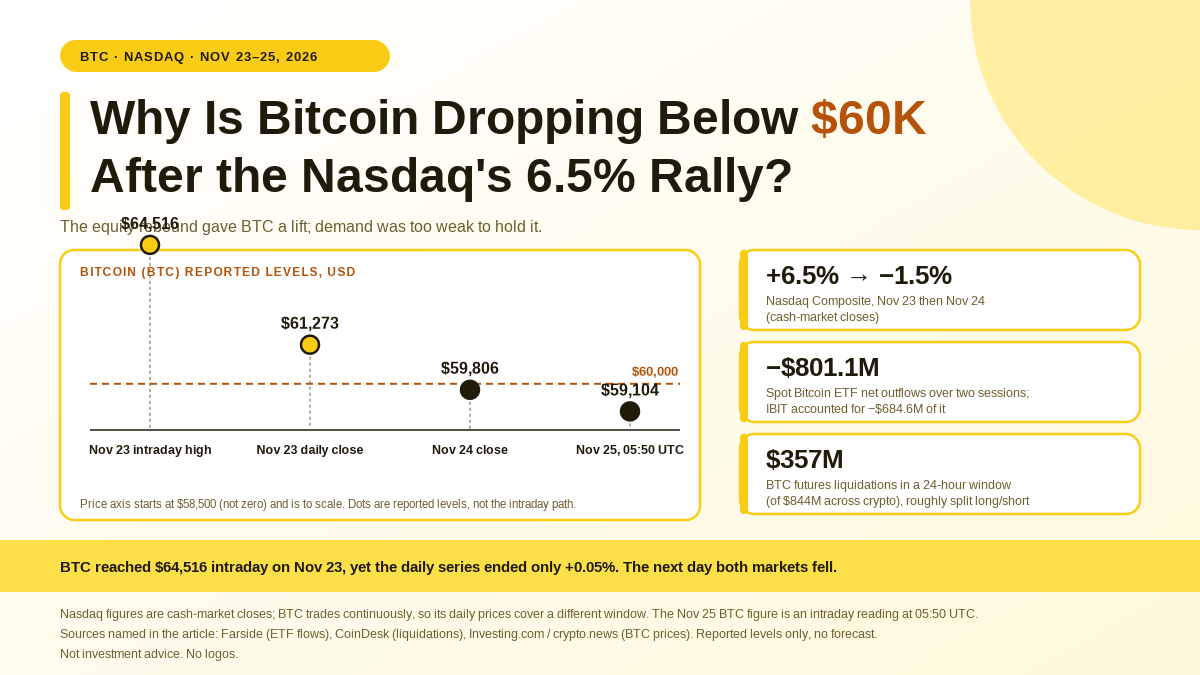
Why Is Bitcoin Dropping Below $60K After the Nasdaq’s 6.5% Rally?
Why is Bitcoin dropping below $60,000 after the Nasdaq rallied 6.5%? See what $801.1 million in ETF outflows, exchange flows, and liquidations reveal.

Report: AI Industry Leaders Divided Over Whether Humans Should Surrender Autonomous Decision-Making Power

Remy Cointreau Group's Stock Price Soars Amid Transformation Progress

Warren Buffett's Successor, Greg Abel, Has Quietly Purchased 3 Stocks Since the Start of the Fourth Quarter, Including Shares of a Legal Monopoly

Not Tesla. Not Nvidia. This "Magnificent Seven" Stock Could Be Overdue for a Big Rally.

Iliad Partners Announces Final Close of Its First Fund at $33.4 Million

Fidelity Lists AAVE, LINK and UNI: How Do Crypto Trading Fees Compare?

Jensen Huang's Situation May Be Even More Challenging Now
BlackRock Launches Tokenized Fund in Hong Kong! Reaches $100 Million, Supports HKD Stablecoin HKDAP for Subscription
Private Financing Market Mirrors IPO Market: Leading Companies Dominate

The Huge Concern for AI Stocks: Oversupply of Chips
Microsoft found a way to turn a helpful AI into a sleeper agent
15,400 people lost over $13 million after copying the wallet of a crypto specialist
The Tech Sell-Off Is Creating the Best Buying Window in 2 Years. Here's What I'm Buying.
Why the Big Short Seller is Buying Tencent Against the Trend?
From Securing Private Keys to Constraining Agents: New Frontiers of Crypto Security in the AI Era
The AI Power Surge Returns to Rationality: Where to Find Valuation Lows
Latest articles




Latest coin listings on WEEX


