
Algorithmic Trading and Cryptocurrencies: How Do Robots React to Volatility?

 Prefer us on Google


Cryptocurrencies can experience significant price fluctuations within minutes. Unlike traditional stock markets, crypto exchanges generally operate 24/7, including weekends. This continuous activity fosters the development of automated systems capable of monitoring prices and executing orders without constant human intervention. But how do these robots react when a market becomes particularly unstable?
Why Does Cryptocurrency Volatility Attract Algorithms?
Bitcoin, Ethereum, and other cryptocurrencies respond to numerous factors. Economic decisions, movements of large investors, and geopolitical events can trigger sudden fluctuations. The available liquidity also influences the magnitude of these movements.
According to the European Systemic Risk Board, Bitcoin recorded a 138% increase in 2024, while Ethereum gained 47% during the same period (1). These developments illustrate the importance of the fluctuations that major digital assets can experience.
Algorithms particularly seek to exploit:
- Rapid price changes;
- Price discrepancies between platforms;
- Volume changes;
- Trends identified by indicators;
- Imbalances between buyers and sellers.
However, these opportunities come with significant risks. A favorable variation can quickly reverse and lead to losses.
How Does a Cryptocurrency Trading Robot Work?
An automated program analyzes market information according to predefined rules. It can trigger a purchase when a price exceeds a threshold or close a position when certain conditions arise.
The Trading Robot relies on this logic of automation. Several platforms and financial intermediaries, including AvaTrade, offer environments to explore various automated strategies. Their operation depends on the available tools, the assets involved, and the parameters chosen by the user.
A robot can monitor multiple markets simultaneously. It applies programmed instructions without needing to wait for an investor to check their screen.
However, this speed does not guarantee profitability. A program can execute an ineffective strategy with as much precision as a relevant strategy.
How Do Robots React to a Sudden Price Drop?
When a cryptocurrency rapidly loses value, algorithms can adopt several behaviors. Some automatically trigger sales to limit their exposure. Others seek buying opportunities after a significant drop.
The reaction primarily depends on the programmed strategy.
The main automated strategies include:
- Trend following: the robot seeks to follow a bullish or bearish movement;
- Mean reversion: it anticipates a price return to a reference value;
- Arbitrage: it looks for price discrepancies between multiple markets;
- Automatic risk management: it reduces or closes certain positions based on defined thresholds.
The problem arises when multiple programs react simultaneously. Automatic sales can temporarily exacerbate a decline, especially when liquidity becomes insufficient.
-- Price
Is Execution Speed Always an Advantage?
Algorithms can execute orders much faster than individual investors. This capability becomes particularly useful when prices fluctuate significantly.
However, speed does not guarantee execution at the desired price. During periods of volatility, the order book may lack liquidity. A transaction may then occur at a less favorable price than expected.
This phenomenon, known as slippage, poses a significant risk for automated strategies.
A robot must therefore take several parameters into account:
- The depth of the order book;
- Transaction fees;
- The spreads between buy and sell prices;
- Position sizes;
- Execution speed;
- Liquidity conditions.
A profitable strategy during simulations can become unprofitable when these costs increase.
Exceptional Events Put Robots to the Test
Platform hacks, unusual transactions, and movements of large portfolios can trigger reactions that are difficult to anticipate. An algorithm designed for normal conditions may not necessarily recognize the source of a sudden change.
An article dedicated to the Binance hack: Ethereum fees surge to $56.4 million with a significant ETH purchase illustrates the issues raised by exceptional transactions, particularly concerning network fees and the activity of arbitrage robots. It remains essential to distinguish between transaction fees, execution costs, and asset price movements.
Security incidents also pose a risk to the entire ecosystem. According to Chainalysis, over $3.4 billion in cryptocurrencies were stolen in 2025, with a strong concentration of losses from a few major attacks (2).
These events can lead to chain reactions. Some robots reduce their exposure, while others attempt to exploit the price discrepancies caused by unusual transactions.
Why Do Predefined Strategies Show Their Limits?
The main weakness of an algorithm lies in its dependence on the rules that govern it. A strategy developed during a period of stability may become unsuitable when conditions change.
For example, a program may view a rapid decline as a buying opportunity. If this decline results from a major crisis, it risks accumulating losing positions.
Automated strategies face three main difficulties:
- Regime changes: a lasting trend can give way to an unstable period;
- Historical data: they do not account for all future events;
- Technical issues: a connection interruption or programming error can disrupt execution.
The Bank for International Settlements also emphasizes that using similar algorithmic models can reinforce collective behaviors and amplify certain market movements.
Can Arbitrage Robots Benefit from Imbalances?
Arbitrage robots seek price differences between platforms or liquidity pools. They can buy an asset on one market and sell it on another when the spread covers the fees.
These operations can help bring prices closer together. However, their profitability depends on execution speed, competition, and transaction costs.
An analysis published by Bitquery on an incident affecting the Binance ecosystem in October 2026 indicates that robots and other traders who exploited certain imbalances retained approximately $59.9 million after deducting network fees and tips to validators (3).
This example shows that exceptional movements can create opportunities for certain stakeholders. It also reminds us that these operations require appropriate infrastructure and carry considerable risks.
How to Limit the Risks of Automated Trading?
Automation can improve execution discipline, but it does not replace a risk management strategy.
Before using a robot with real funds, several precautions remain important:
- Test the strategy on historical data;
- Use a simulation environment;
- Define a maximum exposure;
- Set stop-loss thresholds;
- Monitor fees and liquidity;
- Regularly check results;
- Verify the permissions granted to connected tools.
It is also essential to avoid entrusting all your capital to a single program. A technical error or an unexpected market shift can quickly jeopardize a strategy.
Robots thus transform the way investors interact with cryptocurrencies. They accelerate analysis and execution but cannot anticipate every event. Their effectiveness primarily depends on the quality of the defined rules and their adaptation to real conditions.
This content is provided for general informational purposes only and doesn't constitute financial, investment, legal, or tax advice. Any events, rewards, online promotions, or related information mentioned herein should not be considered a recommendation, solicitation, or invitation to purchase, sell, trade, or otherwise deal in any crypto assets. Crypto assets are highly volatile and may result in loss. The availability of WEEX services, products, and related events may vary by region. You are responsible for ensuring that your participation is in accordance with applicable local laws and regulations.
You may also like

Cardano’s police evidence system could bring 1.5 million annual transactions

Confidence at Zero! Goldman Sachs Interprets Hedge Fund Positions: 'Surrender Liquidation', Largest Loss Since the Pandemic

47% Top Tax Rate Approaches: Seven Tax Reduction Strategies for Australian Crypto Investors
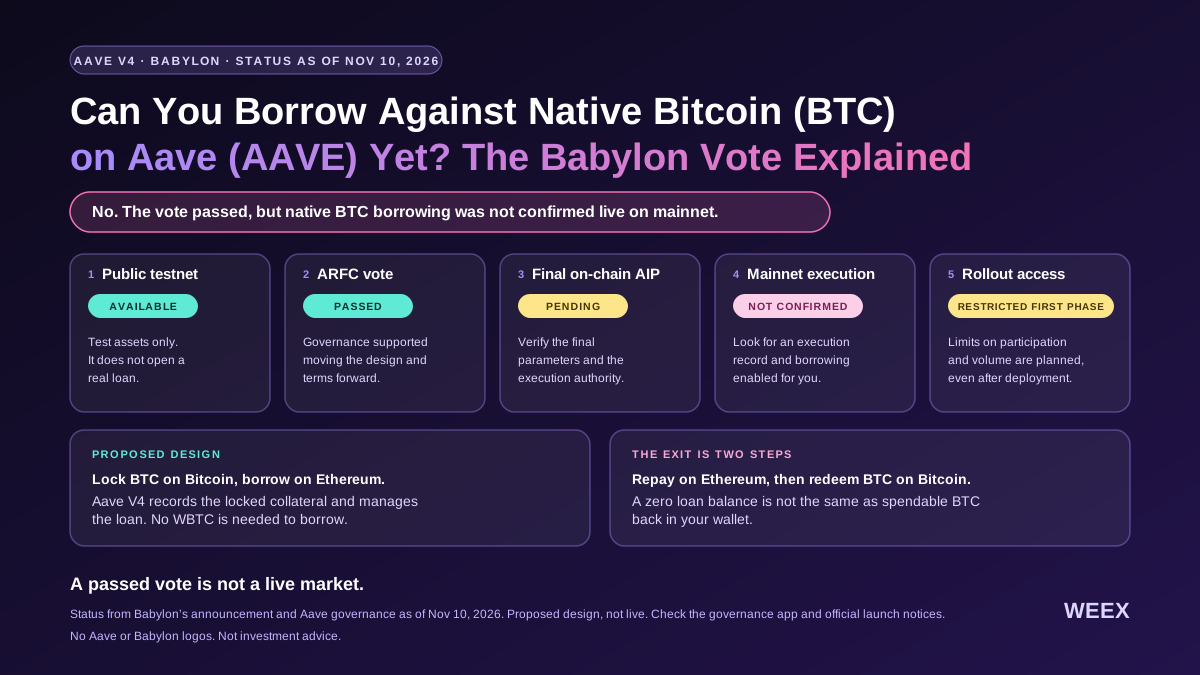
Can You Borrow Against Native Bitcoin (BTC) on Aave (AAVE) Yet? The Babylon Vote Explained
Can you borrow against native Bitcoin on Aave yet? See what the Babylon vote approved, what still needs to launch, and how BTC liquidation would work.

PIEVERSE Price Up Nearly 80% in a Week: Futures Activity, the November 14 Unlock and What Is Confirmed
PIEVERSE rose about 79% in seven days with futures volume far above spot. See what is confirmed about the November 14 unlock and the WEEX Lucky Eggs campaign.

Hong Kong Approves Crypto Asset Reporting Rules - Fintech World

NVDA Stock Falls 4.3% After Board Opens Investigation: What Is Confirmed and What Is Not
NVDA closed at $178.67 on November 9, 2026, down about 4.3%, after Nvidia’s board confirmed an independent investigation. Other claims come from media reports. WEEX’s Lucky Eggs campaign runs until November 25.

Chainalysis Report: Why Did Western Europe Withstand the Global Crypto Market Chill?

Four Security Strategies from the Wallet Theft Incident

Global Outage: Your Cryptos Are Not Disappearing

Did Strategy buy Bitcoin? Saylor reignites speculation

A New Chapter in the History of Rug Pulls in Crypto

From Binance Incubator to Nasdaq: Injective's Eight Years

tBTC Cross-Chain Bridge Resumes On-Chain Operations, Threshold Network Confirms Adequate Reserves

FinCEN Withdraws Proposed Crypto Travel Rule Expansion in Separate November Move

Finnish Startup Uses Heat from Bitcoin Miners to Heat 30 Homes

Analysis: The Logic of BTC's Periodic Recovery Remains Unshaken, Losses and Panic Have Been Fully Released
Undervalued Opportunities in the Crypto Market: Funding Rates Can Be Traded Separately

Centrifuge Launches Schroders Emerging Market Bond Fund Tokenization Product on Solana

FinCEN and the Federal Reserve Withdraw Proposal to Adjust Cross-Border Transfer Rules
US sanctions hit 41 companies accused of keeping Prince Group’s scam network running

Zcash’s new security fund is 99.7% old money

Despite the decline, Bitcoin has not lost the game against gold
U.S. Congresswoman Maxine Waters Announces Candidacy for Chair of House Financial Services Committee! Aims to Establish Strict Yet Fair Rules for Legitimate Cryptocurrency Businesses
Greece ends years of crypto tax uncertainty with new 10% levy on Bitcoin profits

U.S. Treasury and Federal Reserve Withdraw Proposal to Lower Cross-Border Travel Rule Threshold to $250

Beyond APY: Saying Goodbye to Black Box Trust and Reassessing the Security Logic of ETH Staking
South Korea’s GOPAX halts crypto trading, withdrawals after hacking threat

What is the real challenge for South Korean exchanges now that the regulatory framework is in place?

Cipher Agrees to Cover $359 Million Over Budget for Barber Lake Project
Cardano’s police evidence system could bring 1.5 million annual transactions
Confidence at Zero! Goldman Sachs Interprets Hedge Fund Positions: 'Surrender Liquidation', Largest Loss Since the Pandemic
47% Top Tax Rate Approaches: Seven Tax Reduction Strategies for Australian Crypto Investors
Can You Borrow Against Native Bitcoin (BTC) on Aave (AAVE) Yet? The Babylon Vote Explained
Can you borrow against native Bitcoin on Aave yet? See what the Babylon vote approved, what still needs to launch, and how BTC liquidation would work.
PIEVERSE Price Up Nearly 80% in a Week: Futures Activity, the November 14 Unlock and What Is Confirmed
PIEVERSE rose about 79% in seven days with futures volume far above spot. See what is confirmed about the November 14 unlock and the WEEX Lucky Eggs campaign.
Hong Kong Approves Crypto Asset Reporting Rules - Fintech World
Latest articles


Latest coin listings on WEEX


