
Another Michael Saylor: An Engineer, Entrepreneur, and Sci-Fi Enthusiast's Thirty Years

 Prefer us on Google


Saylor may seem like he suddenly discovered Bitcoin in 2020, but if we look back at the first half of his life, it appears he has been preparing for Bitcoin for thirty years.
In February 2026, Las Vegas, at the Bitcoin for Corporations conference.
The lights dimmed, and a huge Bitcoin sign lit up, with thousands cheering. Michael Saylor took the stage, impeccably dressed, with a determined expression. He didn’t have much of an opening statement and quickly mentioned that number he has repeated countless times:
21 million.
Then came Digital Energy, Digital Property, Digital Capital. An abstract network originally composed of code, cryptography, and consensus mechanisms transformed in his words into a grand narrative about wealth, freedom, and the future. The audience raised their phones, cheering along with his rhythm.
This is the Michael Saylor we are familiar with today. Everything began after 2020 when he suddenly started buying Bitcoin on a large scale, becoming one of the most famous and staunch advocates of Bitcoin in the industry.
If we only look at the timeline, it resembles an entrepreneur who stumbled upon a new technology late in his career and staked his company and reputation on it.
But quite the opposite.
If we rewind to before 2020, we find that Saylor seems to have been preparing for Bitcoin for thirty years.
He started as a child from an Air Force family, entering MIT to study aerospace engineering and the history of science and technology, researching complex systems; at 24, he founded MicroStrategy, taking a software company from zero to public; in 1998, he reached the peak of the capital market during the height of the internet bubble, only to watch billions of dollars in wealth evaporate two years later. After that, he began studying mobile internet, software networks, and how technology changes entire industry structures.
These experiences may seem unrelated, but they gradually shaped a very unique person: an engineer who believes in discipline and execution, an entrepreneur eager to build great companies, and a child who was obsessed with science fiction and accustomed to imagining worlds that did not yet exist.
This might be another entry point to understanding the later Saylor.
A Child from a Military Family
Michael Saylor was born in 1965 in Lincoln, Nebraska. His father was a U.S. Air Force officer, so his childhood did not stay fixed in one place but moved between various Air Force bases across the U.S., until the family eventually settled near Wright-Patterson Air Force Base in Dayton, Ohio.
The first lesson from a military family was not complex: discipline, order, and doing things well.
Saylor later summarized his father's attitude towards work in a very simple phrase: "If you're going to do something, do it right."
If you are going to do something, do it well. This idea sounds ordinary but closely resembles how Saylor approaches tasks later on. His almost stubborn demands regarding numbers, models, products, and even capital allocation are hard to completely separate from this upbringing.
His mother provided something entirely different. Phyllis Ann Saylor worked day and night to support the family, and on Sunday mornings at 5:30, she would get up to help her son deliver newspapers. She did not limit her expectations of her child to just "finding a stable job" because of their ordinary family conditions. Instead, she constantly told her son that he would do great things. Saylor later recalled this experience, saying, "If your parents tell you you will do great things, you will do great things." This phrase, combined with his father's "do it right," forms an interesting combination: one side is a strong self-demand (Discipline), and the other is a firm expectation of being able to accomplish great things (Ambition).
Another influence that entered Saylor's world early on was books.
He was obsessed with reading from a young age, especially science fiction. As a child, his parents would give him pocket money to buy books, and he quickly read one after another; by his teenage years, he had read a large number of works by Isaac Asimov, Robert Heinlein, and others. For children of that era, science fiction provided not just entertainment but a very special training in imagination: it required you to temporarily accept a world that does not exist in reality and then think about what the relationships between technology, society, and people would look like in that world.
Later, whenever Saylor talked about the future, he always carried this sci-fi perspective. He was accustomed to placing a technology within a larger system rather than just discussing what it can do today. Airplanes, software, the internet, mobile devices, and later Bitcoin all seemed to share a common question in his mind: if this technology truly matures and has a sufficiently large network effect, what will it ultimately change?
This counterfactual thinking can be clearly felt in Saylor's expressions. The Bitcoin he discusses is never:
"What is Bitcoin today?"
But rather:
"If we assume Bitcoin is global digital property, what would the world look like?"
This way of thinking actually predates Bitcoin by many years.
Studying at MIT: From Airplanes to Complex Systems
When Saylor entered MIT, he initially wanted to follow a rather traditional, even somewhat romantic path as an engineer. He loved airplanes, aerospace, and once hoped to become a fighter pilot, even dreaming of becoming an astronaut. However, MIT's training gradually shifted his attention from the airplane itself to more complex systems.
He ultimately earned degrees in aerospace engineering and Science, Technology and Society, while receiving training in computer simulation and systems analysis. His thesis, "A Mathematical Model of a Renaissance Italian City State," was not a simple engineering problem but a mathematical model of a city-state during the Renaissance. He studied what constitutes a society, how power is distributed, how rules affect systems, under what circumstances systems are stable, and under what circumstances they collapse.
Why would an aerospace engineering student at MIT study a city-state from hundreds of years ago? The answer may lie in the topic itself: Saylor has always been interested not just in a single component but in a system composed of countless variables.
This is also the way of thinking that recurs when he studies companies, the internet, and even Bitcoin. A company is not just a product; it is a system composed of products, customers, employees, capital, and competitors; an internet platform is not just a website; it is a system formed by users, data, network effects, and capital; and the truly important moment for a new technology is often not when it is just born, but when it begins to change the way the original system operates.
After graduating from college, Saylor entered the consulting industry, building computer models for large companies like DuPont, Dow, and Exxon for strategic decision-making. The work during that period seemed far from the later famous MicroStrategy, but it actually laid a very clear foundation: he began to get used to transforming complex realities into models and then understanding the possible outcomes through those models.
This is a typical engineer's mindset, and Saylor's later investment and capital allocation decisions retained traces of this for a long time.
MicroStrategy: An Engineer Enters the Business World
In 1989, 24-year-old Saylor co-founded MicroStrategy with MIT alumnus Sanju Bansal. The company initially focused on enterprise data analytics and business intelligence software, helping large enterprises extract information from increasingly large databases and turning that information into business decisions.
This business seems very familiar today, but in the 1990s, it was at the forefront of a rapidly forming market. Enterprises began to digitize on a large scale, and database sizes grew larger, but the real question was not "Is there data?" but "How to find useful information from the data?" What MicroStrategy did was essentially transform the originally scattered and dormant data within enterprises into an infrastructure that could participate in decision-making.
The company quickly gained large enterprise clients and went public in 1998. That year was during the height of the internet bubble, where the capital market's imagination for software companies was almost limitless. MicroStrategy's IPO was priced at $12, and on its first day of trading, it closed at $21.12, a 76% increase. At just 33 years old, Saylor quickly became one of the most watched young entrepreneurs in the Washington area.
At that time, reports showed a Saylor who was completely different from today. He wore a suit, spoke about enterprise software, databases, and business intelligence at investor meetings, trying to convince investors that MicroStrategy was not just a software company but part of the next generation of enterprise information infrastructure. Later, media quoted him saying, "We're not just entrepreneurs, we're industrialists." This phrase is quite interesting.
Because today’s Saylor is often defined as a Bitcoin evangelist, but if we go back to the 1990s, he resembled a typical tech entrepreneur: believing that technology could change industries and believing he could personally build the organizations and infrastructure needed for that change. At that time, his stage was not a Bitcoin conference but enterprise software and Nasdaq.
And the capital market would soon show him another side.
2000: Wealth Can Disappear in a Day
In March 2000, MicroStrategy announced it would restate its previous financial results, leading the U.S. Securities and Exchange Commission to file civil charges against the company and three executives regarding issues of revenue and profit recognition. MicroStrategy's stock had previously soared from its IPO, peaking at $333. Following the announcement, the stock plummeted sharply, ultimately losing most of its value from the heights of the dot-com bubble.
For Saylor, this was not just a stock price crash.
That year, he witnessed the rapid evaporation of the vast wealth he had accumulated in the capital markets, and he truly experienced for the first time that there is not always a simple causal relationship between capital markets and business operations. A company can have excellent technology, real customers, and significant growth potential, yet the market can redefine its value in a very short time; once the pricing in the capital markets changes, the wealth, reputation, and judgment that an entrepreneur has accumulated can quickly lose their original significance.
Complicating matters, this crisis was not merely a market fluctuation. MicroStrategy's financial reports indeed had issues, and the company later restated its performance for the relevant years, with the SEC taking enforcement actions against the company and its executives. Saylor did not leave MicroStrategy; instead, he stayed to rebuild the company.
This experience can easily be simplified in his personal biography as that of an "internet bubble survivor," but it actually provided him with a very important lesson: technology, business, and capital markets are three distinct systems that influence each other but do not operate under the same set of rules.
In 1998, the capital markets could rapidly assign a huge valuation to a software company based on a story about the future; two years later, the same market could just as quickly take that valuation away. Saylor experienced both directions firsthand.
He did not give up on technology or leave business operations. MicroStrategy rebuilt itself after the bubble, and Saylor's focus gradually shifted from "how to run a software company" to a larger question: What will the next technological revolution be?
2012: Seeking the Next Technological Revolution in The Mobile Wave
In 2012, Saylor published "The Mobile Wave." At first glance, the title suggests it is merely a book about the technological trends of mobile internet, but what truly captivated him was not the phone itself, but the structural changes happening behind mobile technology.
In his observation, more and more things that originally belonged to the physical world were being reorganized by software. Maps, cameras, music players, contact lists, media, payments, and even human identities could all enter a software network. Once technology forms a network, the question shifts from "how good is this product" to "how large can this network scale?"
Years later, in a SALT interview in 2021, Saylor reflected on "The Mobile Wave," noting that what he truly observed was the "dematerialization" of the real world by software networks—many things that relied on physical forms were redefined by software, data, and networks. He particularly emphasized the scale advantages of companies like Google, Facebook, Apple, Amazon, and Microsoft, because once a software network has enough users, its marginal costs can continuously decrease while the network itself becomes increasingly valuable.
From this perspective, "The Mobile Wave" is actually an early version of the later Bitcoin philosophy.
Not because Saylor was already discussing Bitcoin at that time, but because his fundamental question had not changed: if a new technology forms a sufficiently large network, will it ultimately change the way the entire industry is organized?
The answer in 2012 was the mobile internet.
In 2020, Bitcoin came into his view.
And there is a noteworthy detail in between.
"The Mobile Wave" provided Saylor with a good investment return. He believed that the most successful company in the mobile internet era was Apple, and he astutely pointed out that Apple was the first company in history to deliver a new feature to a billion people overnight. Therefore, he personally invested $25 million in the stocks of these internet giants, earning a 20-fold return. However, MicroStrategy did not massively allocate its balance sheet to these new technology assets based on the trends described in the book. Years later, he reflected on this experience, stating that if he saw such a massive technological wave again, he would not just write a book.
This time, he would buy.
And not just for himself, but he would have the company buy as well.
Looking back, this statement almost serves as a preview of 2020.
2019: Two Types of Saylor in One Body
By 2019, MicroStrategy had become a mature software company operating for thirty years. It had stable enterprise clients, mature products, and a considerable cash reserve, which was enough to be considered successful in the eyes of ordinary people. The company was still advancing its cloud business, restructuring its sales system, optimizing IT systems, and continuously improving products like HyperIntelligence.
However, the success perceived by others did not satisfy Saylor.
He began to invest significant energy into re-evaluating the company: restructuring IT systems, redesigning business processes, adjusting organizational and sales systems, trying to make this thirty-year-old machine more efficient. This was a very typical "conscientious" mindset, directly linked to Saylor's upbringing. His father was an Air Force officer, instilling in him the core beliefs of discipline, responsibility, and doing things well. For such a manager, a business is like a complex machine: if something goes wrong, find the fault; if efficiency is lacking, optimize the process; if the organization is not good enough, redesign it. The problem is usually not that the direction is wrong, but that the execution is not good enough.
But Saylor also possessed another force, stemming from his mother. She did not give him a sense of responsibility for existing systems, but rather a confidence in possibilities—you can do great things. Years later, Saylor summarized these two tendencies as conscientiousness and openness: the former leans towards incremental improvement, while the latter allows a person to question whether the problem lies not in our execution but in the fact that what we are doing may no longer be good enough.
This was precisely the contradiction Saylor faced in 2019.
One Saylor was striving to fix MicroStrategy, while another Saylor began to doubt that perhaps what truly needed changing was not the machine itself, but the direction in which it was operating.
These two forces ultimately did not extinguish each other but converged in 2020.
That answer ultimately became Bitcoin.
2020: Engineers Start to Bet
In 2020, with the Federal Reserve flooding the market with money and the company sitting on $500 million in cash, Saylor judged that inflation would eventually erode purchasing power, publicly describing cash as "melting ice cubes." After months of research, he concluded that gold, bonds, and stocks could not keep up with the money printing, and that Bitcoin's fixed limit of 21 million coins was the only escape.
On August 11, MicroStrategy announced it would use $250 million to purchase 21,454 Bitcoins at an average price of less than $12,000, becoming the first publicly traded company to adopt Bitcoin as a reserve asset. In September of the same year, it added another $175 million, and in December, it bought another $50 million, subsequently issuing $650 million in convertible bonds to continue buying Bitcoin. Saylor also disclosed that he personally held 17,732 Bitcoins at an average price of $9,882. He wrote on Twitter that now-famous quote:
Bitcoin is a network of digital hornets serving the goddess of wisdom, feeding on the fire of truth, becoming smarter, faster, and stronger behind the wall of cryptographic energy.
In February 2021, he changed his Twitter avatar to laser eyes, officially taking on the role of "Bitcoin's chief evangelist." In June of the same year, the company issued $500 million in junk bonds (bonds with lower credit ratings and higher interest rates) to continue accumulating Bitcoin, marking Wall Street's first encounter with someone issuing bonds specifically to buy Bitcoin.
The past Saylor would study technology, write books, analyze trends, and make personal investments; by 2020, he began to directly incorporate his judgments into the company's capital allocation policies, which was no longer an ordinary company investment.
It began to become part of the company's identity.
Looking back, 2020 seems to be a very clear dividing line in Saylor's life. Before that, his thirty years of experience revolved around "building": studying engineering, researching complex systems, founding a software company, going public in the capital markets, suffering a heavy blow during the dot-com bubble, then rebuilding the company, and researching the next technological revolution.
After 2020, he began to do something else.
He began to believe.
More accurately, he began to publicly, continuously, and almost obsessively express a long-term belief in Bitcoin, ultimately transforming that belief into the strategy of a publicly traded company.
This is where the Saylor we know today began to emerge.
But if we only start to understand him from here, it is easy to reverse the entire story: as if an ordinary software entrepreneur suddenly discovered Bitcoin in 2020 and became a believer.
In reality, the timeline is exactly the opposite.
What Bitcoin encountered was a person who had been preparing for thirty years.
Another Saylor
Today's Saylor easily creates the illusion that he has always been the one standing on stage talking about 21 million.
But before Bitcoin, his life could easily have been written as another book.
There were no laser eyes, no "digital energy," and no endless Bitcoin tweets. There was a child growing up on an Air Force base, a stack of dog-eared science fiction novels, an engineering lab at MIT, mathematical models about Italian city-states, a software company built from scratch, and the scars left by the capital markets when the internet bubble burst in 2000.
There is no obvious straight line connecting these experiences.
But when you look at them together, you can see something very stable: Saylor has always had a strong interest in technology, systems, networks, and how the future will be reorganized. He can shift from aerospace to enterprise software, from enterprise software to mobile internet, and then from mobile internet back to Bitcoin; on the surface, he seems to be constantly changing his research focus, but the underlying issues have not changed much.
How will a new technology change the structure of the old world?
In 2020, Bitcoin provided a new answer.
And Saylor is no longer just an observer.
He began to place his bets.
From this moment on, the Saylor we are familiar with today truly came into being.
-- Price
This content is provided for general informational purposes only and doesn't constitute financial, investment, legal, or tax advice. Any events, rewards, online promotions, or related information mentioned herein should not be considered a recommendation, solicitation, or invitation to purchase, sell, trade, or otherwise deal in any crypto assets. Crypto assets are highly volatile and may result in loss. The availability of WEEX services, products, and related events may vary by region. You are responsible for ensuring that your participation is in accordance with applicable local laws and regulations.
You may also like

National Day Holiday DeFi News Review: Hyperliquid Plans to Enter Options Market, Uniswap Pilots Compliant Liquidity Architecture

US Moves $470 Million in Crypto: What Does This Signal?

Researcher Calls for Crypto Industry to Enter 'Bunker Mode' to Protect Against AI and Quantum Attacks

$2.39 Billion Investment in Bitcoin ETFs, Spot Demand Remains Negative

Elon Musk Net Worth Trillion Dollars: Will He Be a Trillionaire Again?
What Does a Rising VIX Mean for the Stock Market? A 2026 Investor Guide

Why Is VIX Rising Today? What VIX Means for Stocks and Bitcoin

The Real Estate Market Is Dead In Spain. Long Live Bitcoin.

Why Hyperliquid's Prediction Market HIP-4 Can't Keep Up with Polymarket?
Why Is iExec RLC (RLC) Crypto Rising Today? Privacy Demand, Multichain Migration, and the Volume Test
Why is iExec RLC rising today? Examine RLC volume, confidential-computing utility, token supply, bridge migration, and the adoption evidence to watch.

How to Join WEEX Alpha Suite at TOKEN2049 Singapore 2026: Dates, Location and Registration
Find out how to join WEEX Alpha Suite at TOKEN2049 Singapore 2026, including the event dates, location, registration details, and who can attend.

Bitcoin Fear and Greed Index: How It Works
Samsung Electronics Files Patent for Smart Contract Cryptocurrency Wallet

Bitcoin: Strategy Acquires Another 334 BTC, Raising Its Reserve to 848,000

SNDK Stock Fell 3.8% After a 650% Rally: Does a Single-Digit P/E Make Sandisk Cheap or Just Cyclical?

Oil Futures Hold Above $100 After Houthis Claim Aramco Attacks: What Is Confirmed and What Is Not

MSTR Stock Slips After Strategy Buys Just 334 Bitcoin: Why It Spent More on Preferred Shares Than on BTC

INTC Stock Drops After TSMC Terafab Talks: Is Intel's Biggest Outside Endorsement at Risk?

Who Will Aave Hand Its Brand Over To? The DAO Asset Ownership Dispute Behind the Foundation Proposal
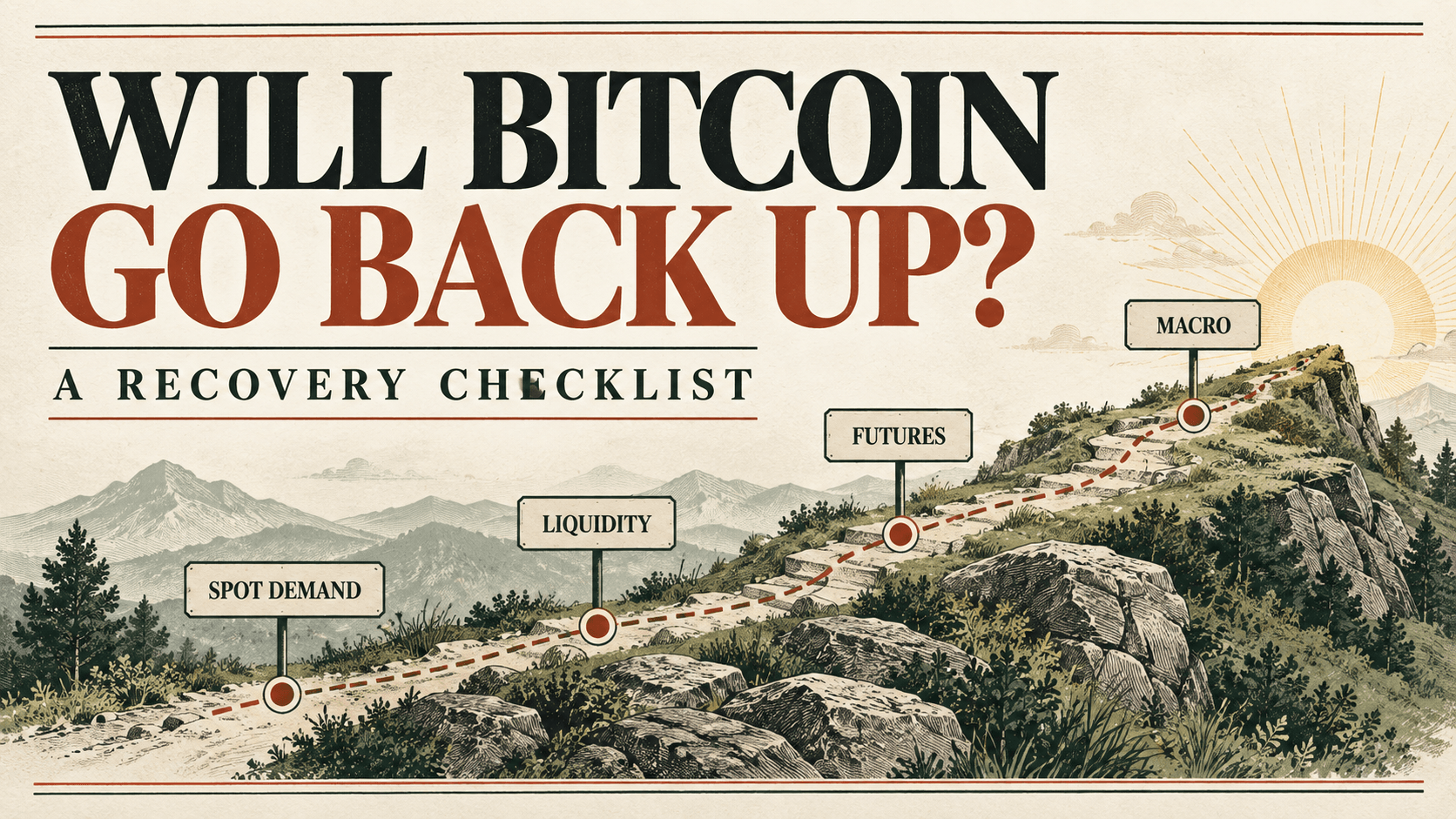
Will Bitcoin (BTC) Go Back Up in 2026? How to Tell a Real Recovery From a Short-Covering Bounce
Will Bitcoin go back up in 2026? Learn how spot demand, ETF flows, crypto liquidity, futures positioning and macro conditions shape a real BTC recovery.

Hyperliquid's Perpetual Futures Listed on Bloomberg Terminal, Increasing Institutional Investor Interest
NSE Stock Price Hits a New Low After IPO: Can National Stock Exchange Shares Recover?
National Stock Exchange of India shares traded near ₹1,741 on October 5, close to a post-listing low of about ₹1,735 and roughly 2.5% below the ₹1,785 IPO price. The stock has now spent more than a week under its issue price, and a recovery depends on retail demand, derivatives volumes and the broader Indian market.

Trump Creates Super Intelligence Force: What Changes in the AI Race
Home-jacking crypto: they threaten to kill a pregnant woman's baby in England

Bitcoin Exchange Withdrawal Rate Declines, Signaling Long-Term Holding

Bitcoin Miners Sign Their Best Month Since January

NFT: Porsche abandons its Web3 project around the 911

Former The Arena Advisor Accuses ROVE of Salary and Token Quota Arrears

Movement of Old Ethereum and Limited Exchange Reserves
Plunging GPU prices threaten AI hosts, and new hedges step in
National Day Holiday DeFi News Review: Hyperliquid Plans to Enter Options Market, Uniswap Pilots Compliant Liquidity Architecture
US Moves $470 Million in Crypto: What Does This Signal?
Researcher Calls for Crypto Industry to Enter 'Bunker Mode' to Protect Against AI and Quantum Attacks
$2.39 Billion Investment in Bitcoin ETFs, Spot Demand Remains Negative
Elon Musk Net Worth Trillion Dollars: Will He Be a Trillionaire Again?
What Does a Rising VIX Mean for the Stock Market? A 2026 Investor Guide


