
ARTEX AI tool breaches networks in under 3 hours, FBI warns

 Prefer us on Google


The FBI has warned that hackers have used the ARTEX artificial intelligence framework to gain privileged access to networks in under three hours, with financial institutions and technology suppliers among the targets.
Summary
- Some ARTEX intrusions have progressed from initial targeting to privileged access in under three hours.
- Microsoft recorded attempted sign-ins to more than 2,250 tenants after the ConnectWise compromise.
- Barracuda said an attacker searched compromised servers for cryptocurrency wallet credentials and seed phrases.
- Amazon documented deepfake attempts against crypto exchanges, including recorded failures of server-side identity checks.
In a Nov. 13 advisory, the FBI described attacks involving ARTEX across financial services, government, defense, healthcare and other industries since at least August. The bureau cited the theft of personal information belonging to approximately 67,000 people in South Korea.
Originally built for authorized penetration testing, the framework lets operators give AI agents instructions in ordinary language. The agents then work through tasks that would otherwise require an attacker to perform multiple steps manually.
ARTEX attacks exploit trusted access to customer networks
Microsoft's Oct. 21 investigation attributed a campaign to Storm-0940, a China-state-aligned group that used ARTEX against hundreds of organizations. Some attacks reached privileged cloud access within the three-hour window cited by the FBI.
Following the ConnectWise compromise, attackers used stolen application credentials to attempt sign-ins to more than 2,250 Microsoft 365 tenants. Microsoft identified follow-on activity in multiple customer environments, including reconnaissance and changes to application credentials, identities and privileged roles.
The tenant figure describes attempted access, rather than 2,250 confirmed successful breaches. In a separate password-spraying operation against 327 accounts across eight organizations, Microsoft recorded more than 151,000 failed logins without observing a successful authentication.
Google's Oct. 30 research described ARTEX activity affecting organizations in the United States and Europe, including semiconductor, telecommunications and enterprise software businesses. Researchers observed both financially motivated attackers and suspected espionage groups using the framework.
Although the activity could be fast, Google found repeated errors and heavy logging. In one intrusion, agents generated 240 log events, with signs that separate agents were interfering with one another's work.
Barracuda attacker searched for crypto wallet material
A Nov. 11 account from Barracuda described an intrusion that began with a cloud access key previously supplied to an AI vendor. The security company had not retired the key after the vendor finished its work.
After the vendor's development environment was compromised in October, the attacker apparently obtained the key and used it to enter Barracuda's cloud environment on Nov. 1.
Over roughly 44 hours, the intruder reached around 10 cloud accounts, following credentials from one system to another. Barracuda said the sequence, identifying traces and built-in credential-hunting routines matched ARTEX, while stressing that the tool alone did not identify the attacker.
On compromised servers, the attacker searched for Ethereum keystore files, extended private keys and seed phrase files. Barracuda said no wallet material existed on those systems.
The company acknowledged its failure to revoke the vendor's access: "That is on us."
Amazon finds crypto exchange identity checks under attack
Amazon's Nov. 13 findings described another crypto-related campaign involving attempts to bypass identity verification at two exchanges using deepfake video and altered identity documents.
The evidence came from agent records sent to Amazon's decoy systems between Oct. 3 and Nov. 5. Amazon assessed ARTEX involvement with moderate confidence; it could not confirm activity against every organization referenced in the records.
For one verification vendor, the server rejected every recorded deepfake attempt, even when the agent completed the required face-movement sequence. Separate agent sessions worked simultaneously on video generation, verification, and other account-related tasks.
Another campaign collected credentials for AI services and fed stolen keys back into the attackers' infrastructure to pay for further AI processing. Amazon said the observed techniques relied on familiar weaknesses, including exposed credentials, unpatched software and unauthenticated interfaces.
-- Price
Credential theft has prompted customer resets elsewhere
As crypto.news previously reported on Nov. 3, GitBook instructed customers to replace integration secrets after an AI-agent attack accessed infrastructure credentials. Potentially exposed information included API tokens, Git Sync secrets, and questions submitted to GitBook Assistant.
In South Korea, Everspin said it had detected ARTEX-related attempts in financial service environments while announcing an AI identity partnership involving SBI Holdings and KB Kookmin Card in October. The partners planned to examine user consent, spending limits, and delegated permissions before introducing automated payments commercially.
This content is provided for general informational purposes only and doesn't constitute financial, investment, legal, or tax advice. Any events, rewards, online promotions, or related information mentioned herein should not be considered a recommendation, solicitation, or invitation to purchase, sell, trade, or otherwise deal in any crypto assets. Crypto assets are highly volatile and may result in loss. The availability of WEEX services, products, and related events may vary by region. You are responsible for ensuring that your participation is in accordance with applicable local laws and regulations.
You may also like

Unocoin Estimates $200,000 Loss as Backup-Key Finding Explains Wallet Transfers

Matt Hougan has a positive outlook on Bitcoin and altcoins

Win an iPhone 18 Pro Max on WEEX? 201 Lucky Eggs Explained

Tesla Autopilot Team Veterans Found Simulation Startup Valued at $1 Billion

CoW Swap Launches on Solana, Supporting USDC and Wrapped SOL Exchange

CoW Swap Launches Alpha Version, Supporting USDC and wSOL Exchange
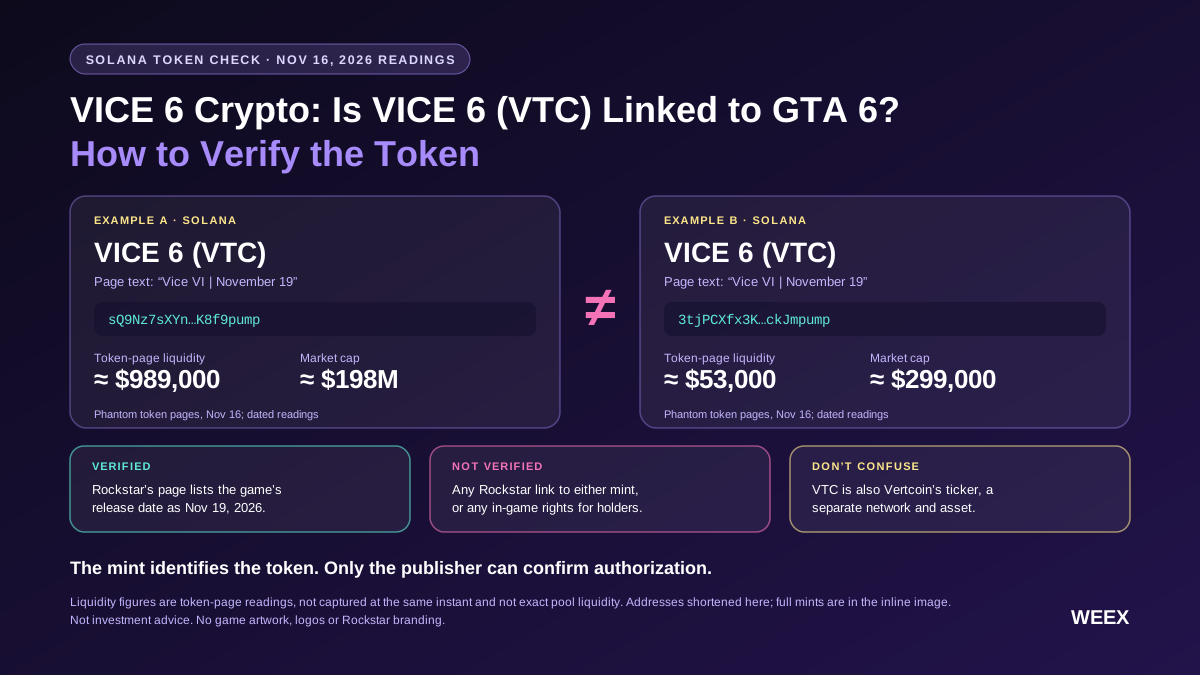
VICE 6 Crypto: Is VICE 6 (VTC) Linked to GTA 6? How to Verify the Token
Is VICE 6 crypto linked to GTA 6? Compare two Solana tokens using VTC, verify their mint and pool addresses, and see what Rockstar has confirmed.
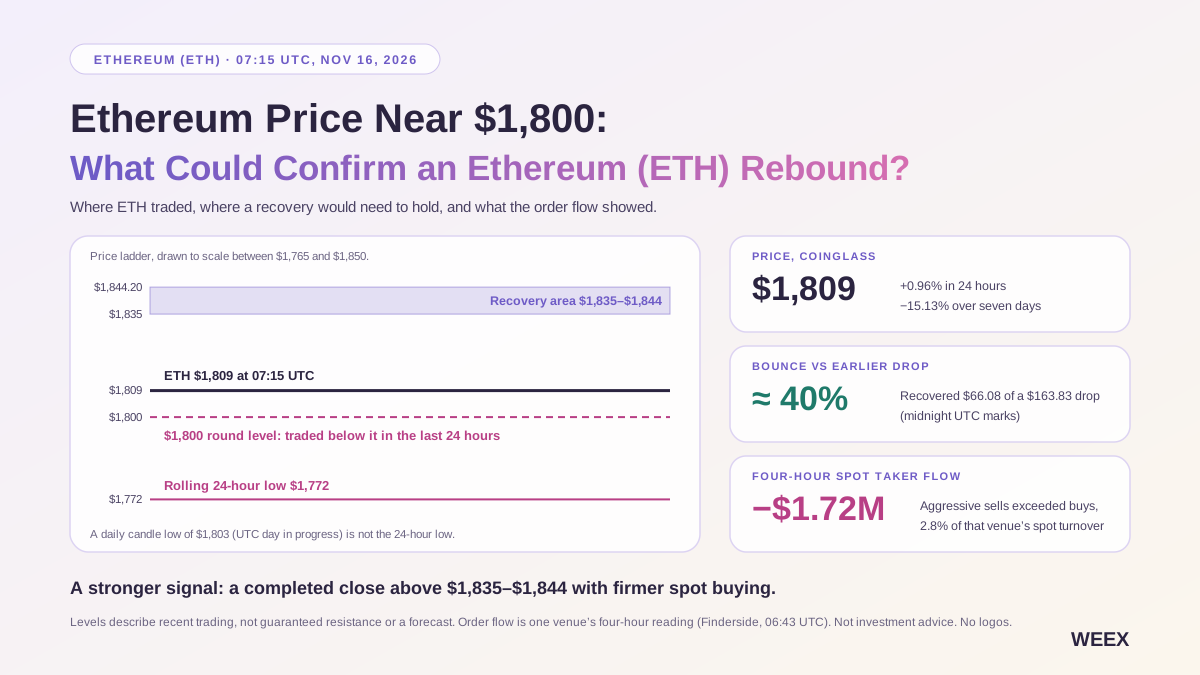
Ethereum Price Near $1,800: What Could Confirm an Ethereum (ETH) Rebound?
Ethereum traded near $1,800 on November 16. See what four-hour spot order flow, futures positioning, and Friday’s ETF flows say about an ETH rebound.
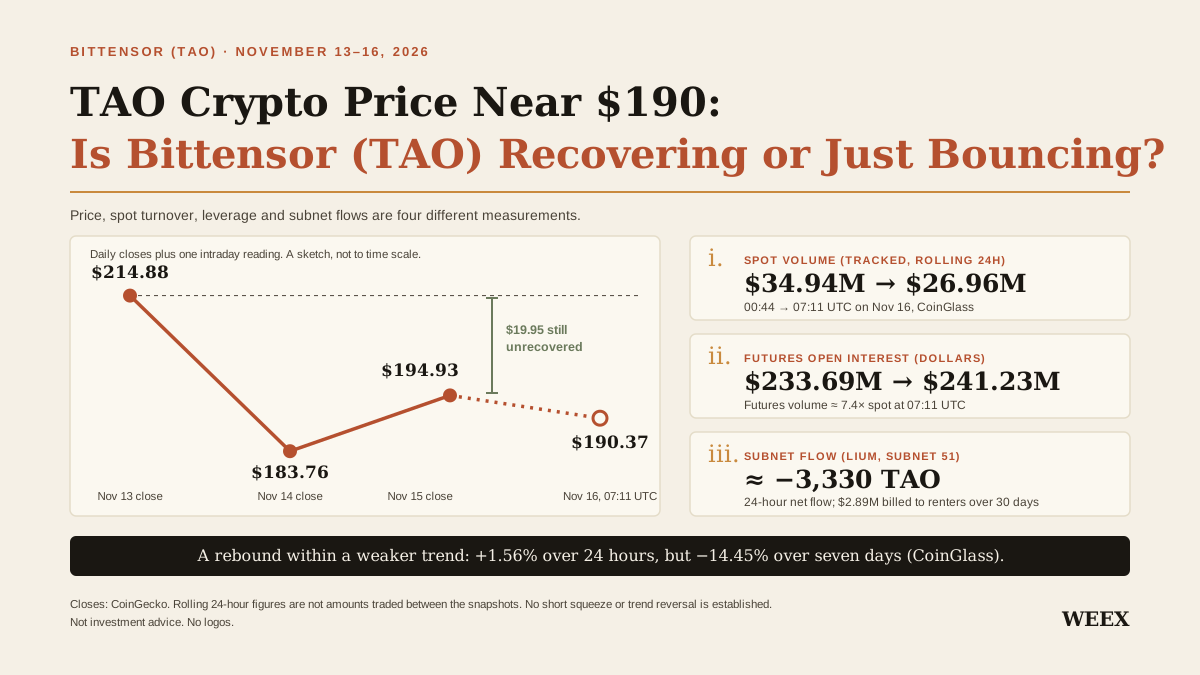
TAO Crypto Price Near $190: Is Bittensor (TAO) Recovering or Just Bouncing?
TAO bounced near $190. Compare spot volume, futures positioning, and Bittensor subnet flows to see what would confirm a more durable recovery.
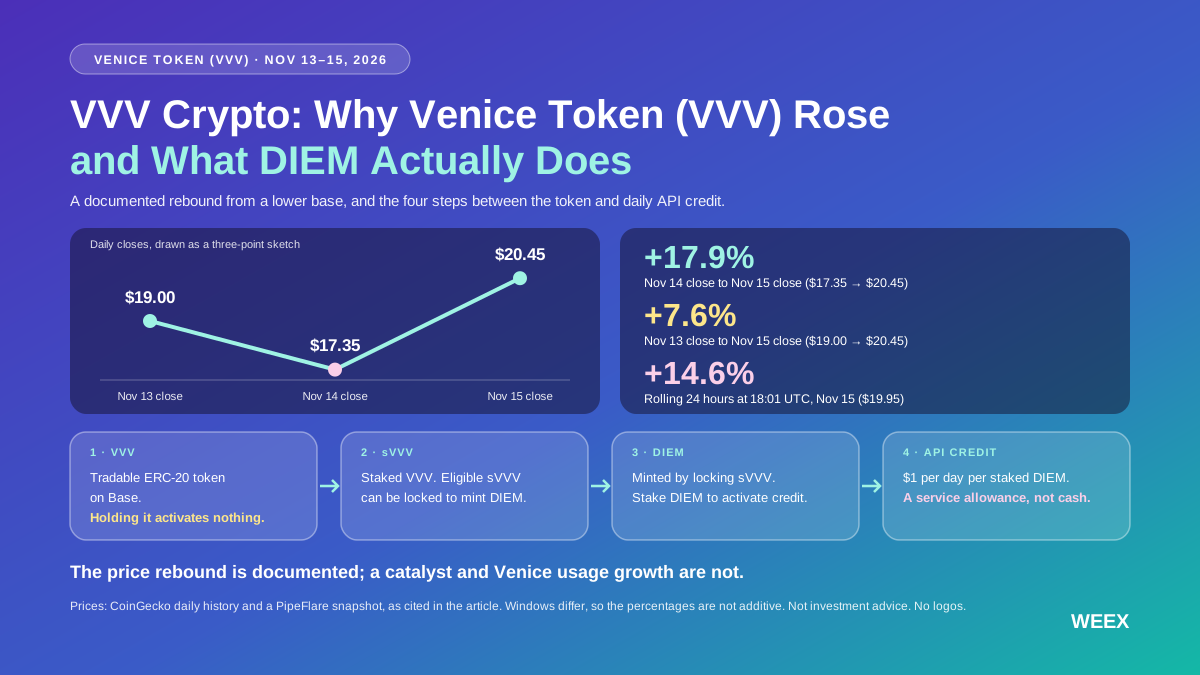
VVV Crypto: What Is Venice Token, Why Venice Token (VVV) Rose and What DIEM Actually Does
Venice Token rose about 14.6% in one November 15 snapshot. Learn what the data shows, how VVV staking works, and what DIEM’s daily API credit buys.
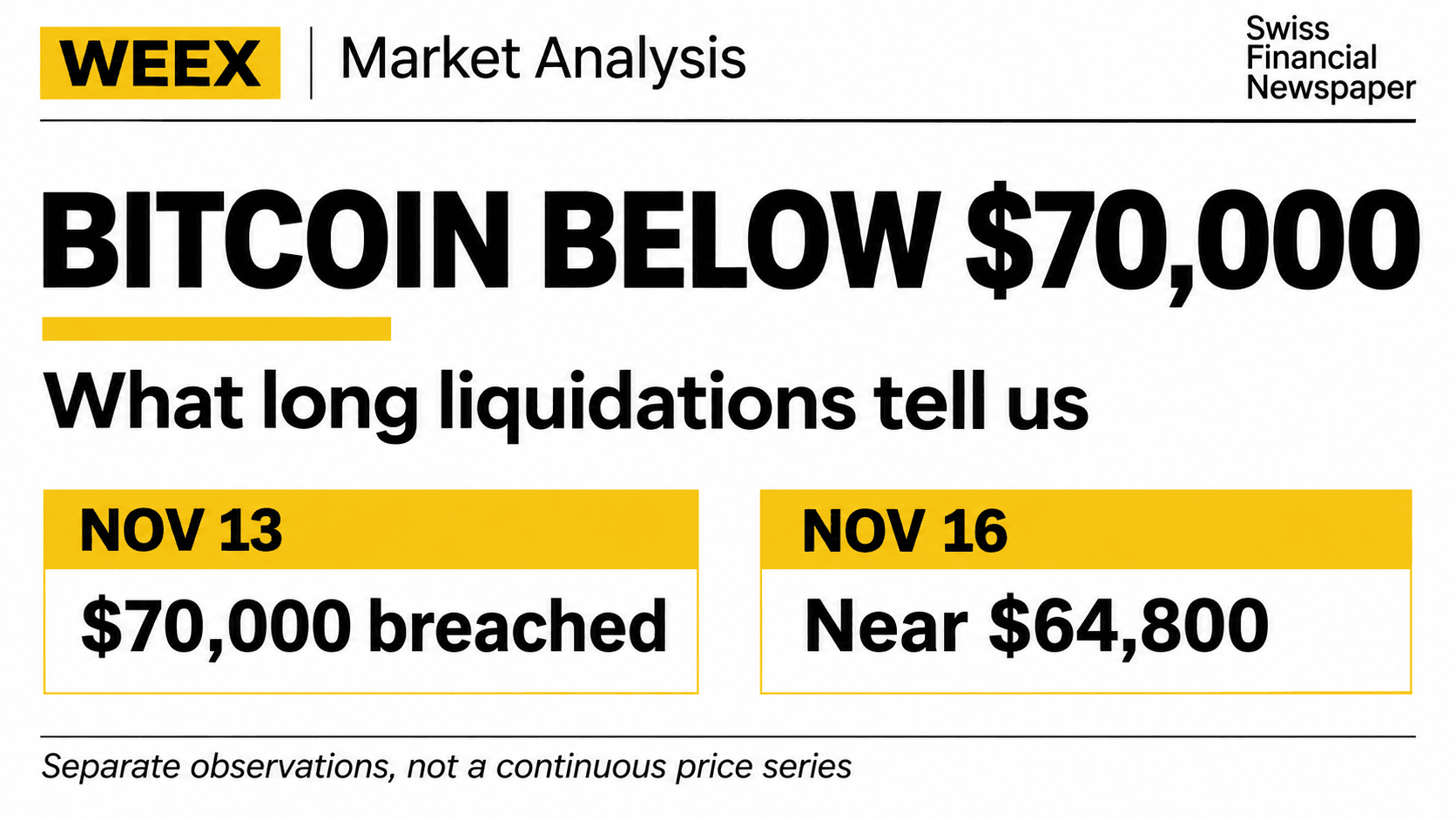
Why Did Bitcoin (BTC) Drop Below $70,000? What Long Liquidations Tell Us
See why Bitcoin fell below $70,000 on November 13, how long liquidations amplified the decline, and what to watch before calling a rebound. If you already plan to trade, you can check whether your activity qualifies for the WEEX Lucky Eggs event, scheduled to run through November 25, 2026 (UTC+8).

WEEX Lucky Eggs: How to Earn Daily Egg Cracks and Win Every Time
Learn how to earn daily WEEX Lucky Eggs from qualifying futures trading volume, check your progress, and understand what “Win Every Time” means.

Meta’s Internal Prediction App Uses Points, Not Cash — and That Distinction Matters

US Signs Silicon Peace Agreement with Eight Nations

Three Questions Every Investor Should Ask About Any Management Team

NuScale Stock Has Lost More Than Half Its Value in 2026, Its Worst Year Since 2023. Here's What Happened the Year After That One.

From 'Patching' to 'Eliminating Entire Classes of Bugs': How to Build Internet Resilience?

5 Dividend Stocks With High Yields That Are Safer Than You Might Think

MiCA gave crypto a passport, but customers still face borders
Regeneron Has $16 Billion in Net Cash and Trades Near 20 Times Earnings. Is It the Cheapest Big Biotech?

Unocoin halts all services after hackers bypass BitGo freeze

Can the Anthropic IPO Save the AI Rally?

Hyperliquid Q3 Revenue Reaches $190.9 Million, Kraken Parent Company Sees 12% Decline in Earnings

Guoyin Financial Leasing Plans to Purchase Computer Equipment for 981 Million Yuan
‘Roadmap is Complete,' Cardano Founder Charles Hoskinson Says

In Anthropic's Doomsday Narrative, There Is No Room for Jensen Huang

What Investment Signals Are Released as the 'Big Three' of AI New Cloud Submit Their Reports?

RWA Weekly: NYSE to Use Avalanche for Settling Tokenized Stocks; Goldman Sachs, Citigroup Commit Approximately $270 Million to Joint Stablecoin Project

BNY Mellon Adds to Invesco Galaxy Bitcoin ETF: What Changes with the Custody Filing?

Ethereum Foundation Launches Universal Ethereum Signer App
Unocoin Estimates $200,000 Loss as Backup-Key Finding Explains Wallet Transfers
Matt Hougan has a positive outlook on Bitcoin and altcoins
Win an iPhone 18 Pro Max on WEEX? 201 Lucky Eggs Explained
Tesla Autopilot Team Veterans Found Simulation Startup Valued at $1 Billion
CoW Swap Launches on Solana, Supporting USDC and Wrapped SOL Exchange
CoW Swap Launches Alpha Version, Supporting USDC and wSOL Exchange
Latest articles


Latest coin listings on WEEX


