
Behind the sky-high market value of $6 billion, Hyperliquid attempts to reshape the cryptocurrency listing landscape




Recently, Hyperliquid's public listing mechanism has caused heated discussions. However, the reason why this matter can attract the attention of the market is inseparable from a Twitter post by Moonrock Capital CEO Simon on November 1 this year. He claimed that "Binance requires a potential project to provide 15% of its total token supply to ensure its listing on CEX, which accounts for 15% of the total token supply, worth about 50 million to 100 million US dollars."
At the same time, Sonic Labs co-founder Andre Cronje also posted that "Binance does not charge listing fees, but Coinbase has repeatedly requested fees and quoted 300 million US dollars, 50 million US dollars, 30 million US dollars, and the most recent quotation is 60 million US dollars."
Why is there always a dispute over listing fees?
In the Crypto world dominated by the spirit of decentralization, centralized CEX has become the main participant. However, it is difficult for the market to accept the black box operation of CEX listing. Every once in a while, there are "rumors" about CEX listing. He Yi, the founder of Binance, once said after listing PNUT and ACT that "no listing fees were charged". Even a strong company like Binance needs to get out of the whirlpool of public opinion about "listing fees" through the listing itself.

He Yi's response to the controversy over listing fees
Despite this, it is still difficult for the market to be convinced that CEX has no listing fees. Even if there is no "open and aboveboard" charge, the remarks about invisible token fees are still coming one after another. Although some leading CEXs clearly list no listing fees in the announcement, the project party still needs to pay the corresponding margin to ensure that the coin price remains stable after listing. At the same time, the CEX's investment share and activity funds and other matters must be agreed with the CEX when listing the coin. These inexplicable invisible listing fees have also become the reason why the market concludes that CEX's listing is a "black box" operation.
On the one hand, such a cumbersome and opaque listing mechanism is an additional burden for the project party. The project party needs to spend extra costs to deal with CEX's listing affairs, which will lead to the problem of reverse screening. The project party has no intention of paying attention to long-term development, but will have the expectation of "good luck with listing", which ultimately leads to most of the projects listed on the exchange running away.
On the other hand, CEX's unfair listing has even evolved into a niche track. Researching listing has become a serious "business", and listing studies have become a compulsory course for many investors and KOLs. For example, Formula News made a huge profit of 3 million US dollars after ACT was listed through news transactions on listing.
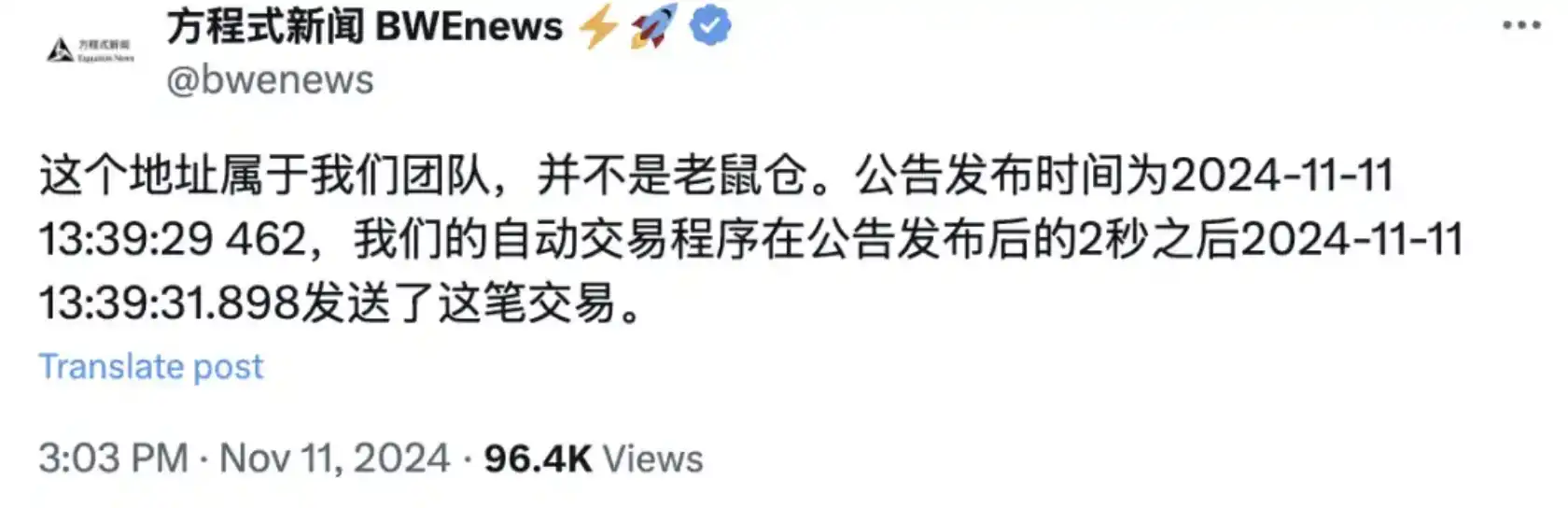
Formula News conducts preemptive trading through coin listing announcement
It can be said that cryptocurrencies have suffered from centralization for a long time. The wealth effect of each coin listing is almost taken away by CEX (coin listing fees) and scientists (preemptive trading after coin listing). The project party will sacrifice the quality of the project because it has to bear a considerable coin listing fee. Everything is ultimately paid for by retail investors. The coin listing incident is exactly the same as the logic of retail investors embracing memecoin and rejecting VC coins today. The core is still inseparable from fairness.
HYPE has repeatedly set new highs. What is the market optimistic about?
However, the emergence of Hyperliquid broke the deadlock of "black box coin listing".
Hyperliquid's popularity in cryptocurrencies starts with HYPE's rise in service. It took only two weeks for HYPE to enter the top 50 in market capitalization after tge, surpassing new and old projects such as Fantom and Bittensor, and even Arbitrum itself. Although the narrative of Perp DEX is no longer a new narrative, Hyperliquid has successfully focused the market's attention on DEX again.
The listing mechanism that has contributed greatly
On December 12, HYPE broke through $18, setting a new record high. Behind the new high, on the one hand, it is inseparable from Hyperlqiuid's precise "market aesthetics", which keenly captured the market pulse of "VC to meme" in this cycle. As a project that looks like a "VC gathering temperament", Hyperliquid did not follow the old path of VC financing first, brushing the volume and then shipping on the exchange. Its founder Jeff has also publicly expressed his dissatisfaction with this form and market logic many times.
On the other hand, Hyperliquid's team operations and project development are also online. Hyperliquid's ambition is not limited to PerpDEX, and it is also actively building a "transaction" public chain characterized by low latency, high throughput, high-frequency transactions and order books. When the underlying logic is transformed from PerpDEX to a public chain, its valuation ceiling is also opened.
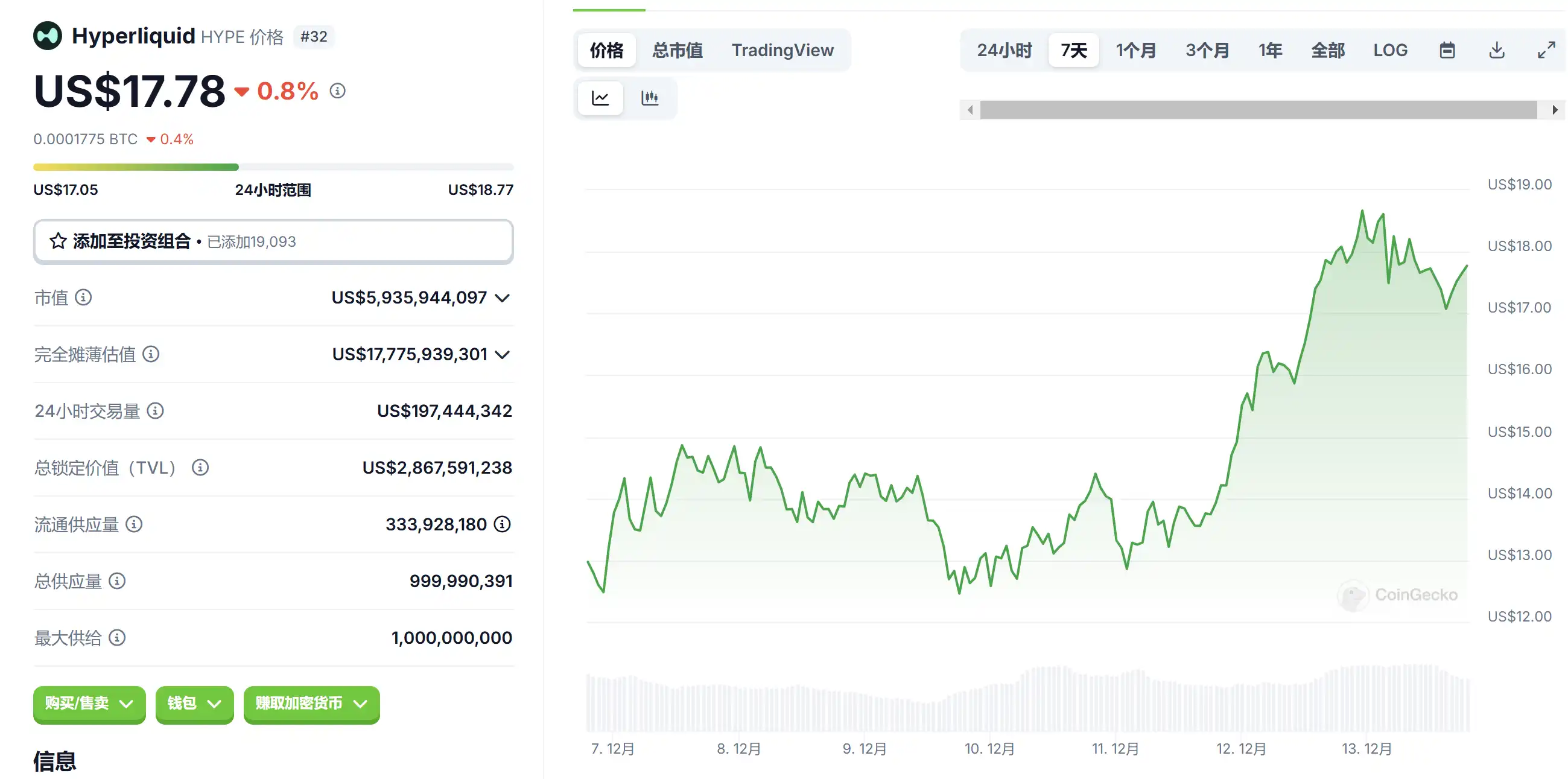
In addition to the above reasons, Hyperliquid's success is also due to its open and transparent listing mechanism. So how does Hyperliquid list its currency?
Dutch Auction
Hyperliquid uses a Dutch auction to auction the ticker of the token. Its listing process is also relatively open and transparent, and there is a detailed introduction in the official document.
First, if the project party wants to go online with spot, it needs to apply for the deployment permission of the HIP-1 native token (HIP-1 is the token standard established by Hyperliquid), and then the Dutch auction mechanism will be used to determine who will get the final token ticker. The Dutch auction is also called a descending price auction. The starting price of the auction will start at a price higher than the market expectation, and then the price will continue to decrease and the transaction will be completed when the first price is accepted. From the perspective of game theory, the Dutch auction reflects the true psychological expectations of the bidder and can achieve the auction at a fair price.
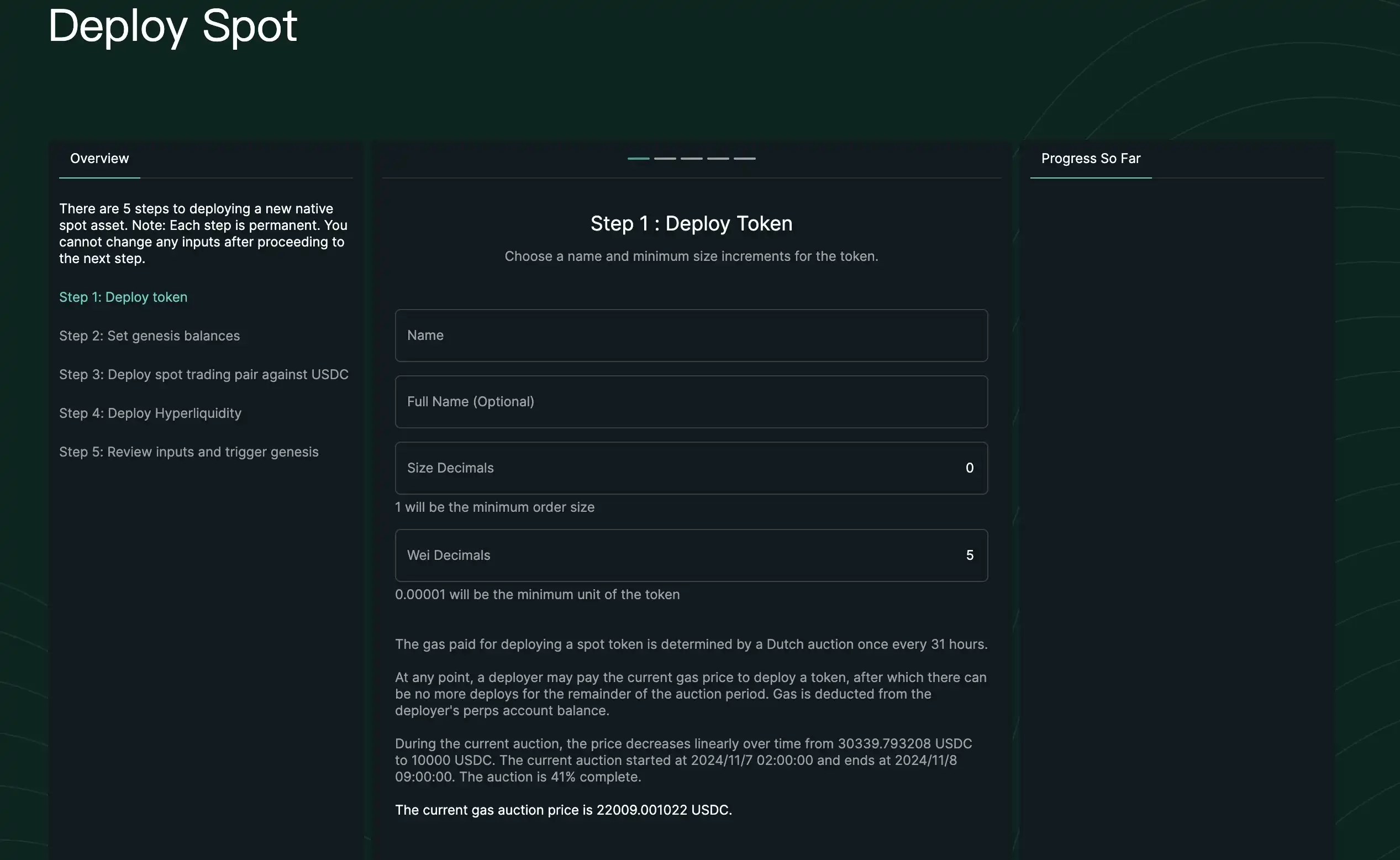
Hyperliquid deployment spot process
When the project party deploys the token on Hyperliquid, it needs to pay a gas fee, but this gas auction fee will be fed back to the HLP Vault in the future.
At the same time, Hyperliquid's auction is usually conducted every 31 hours, and there are a maximum of 282 spot listings throughout the year. This passive "limit" method also improves the quality of the online projects from the side.
In short, compared with the black box operation of CEX that makes the public scratch their heads, Hyperliquid's coin listing mechanism is open and transparent, and the gas auction price collected will be fed back to the community in the form of pledges to form a virtuous circle.
Auction mechanism derivative gameplay
With this open auction mechanism, there will be more interesting routes in the future. For example, this auction mechanism will also lead to "ticker" disputes. At the beginning of this year, when zkSync was listed on various major exchanges, Polyhedra Network, which initially used the ZK token ticker, gave the gold medal ticker ZK to zkSync, and then Polyhedra's token was changed to ZKJ.
It is foreseeable that more projects will have the same "fighting" behavior after they are launched on Hyperliquid in the future. Project parties will fight for a token ticker that is more suitable for them. Even in Web2, stories like "Sina spent 8 million yuan to buy weibo.com" and "Finance was bought by Moniker for 3.6 million US dollars in 2007" will soon be staged on Hyperlqiuid.
The "big loser" who spent $180,000
After Hyperliquid's tge and completed the "epic" airdrop, the auction price continued to break new highs. As early as around June this year, its auction ceiling had been hovering around $35,000, failing to break the previous hard cap of $35,000. However, after TGE, Hyperliquid received unprecedented market attention, and this time it was directly "pushed back" to $128,000, breaking through the previous shackles in one fell swoop. On December 11, it achieved a new historical high with a FARM auction of $180,000.
The last record-breaking $128,000 ticker battle originated from "SOLV". At the same time, it was noted that Solv Protocol will hold TGE in the near future, so it is very likely that this ticker was taken by Solv Protocol. Previously, the tickers auctioned by Hyperliquid were usually memes, such as PIP, CATBALL, etc.
After this airdrop, the popularity of Hyperlqiuid also began to soar. SOLV's record-breaking auction is a turning point for Hyperliquid to shift from a meme paradise to a regular onboard. Solv Protocol will also be the first top project to go online on Hyperlqiuid.
At the same time, Solv's login has brought a significant "catfish effect" to Hyperlqiud, which not only sets an example for Hyperliquid's subsequent ticker auctions, but also promotes the transaction structure to a more benign direction.

Hyperliquid Auction History
On the one hand, after Solv led the ticker auction market to break through the previous hard cap, the token tickers auctioned by Hyperliquid later also "got better". The market regards the SOLV auction as a reference for the post-TGE quotes. For example, tickers such as BUZZ and SHEEP have reached quotes of more than 100,000 US dollars, and the lowest HYFI was also sold at 90,000 US dollars. Subsequently, the FARM ticker on December 11th set a new record with 180,000 US dollars.
The final owner of FARM's token ticker is @thefarmdotfun . The Farm is building the world's first GenAI artificial intelligence agent game. Users can generate different types of pet-type AI agents through the GenAI model. When these AI pets are minted or traded, FARM tokens will be used for charging. Under the premise of a fixed total amount, 50% of FARM as a fee will be destroyed. FARM's $180,000 was not wasted. Within a few hours after the opening, the market value of $30 million was quickly passed, approaching $50 million. At the same time, it also opened up the imagination space of the Hyperliquid ecosystem again.
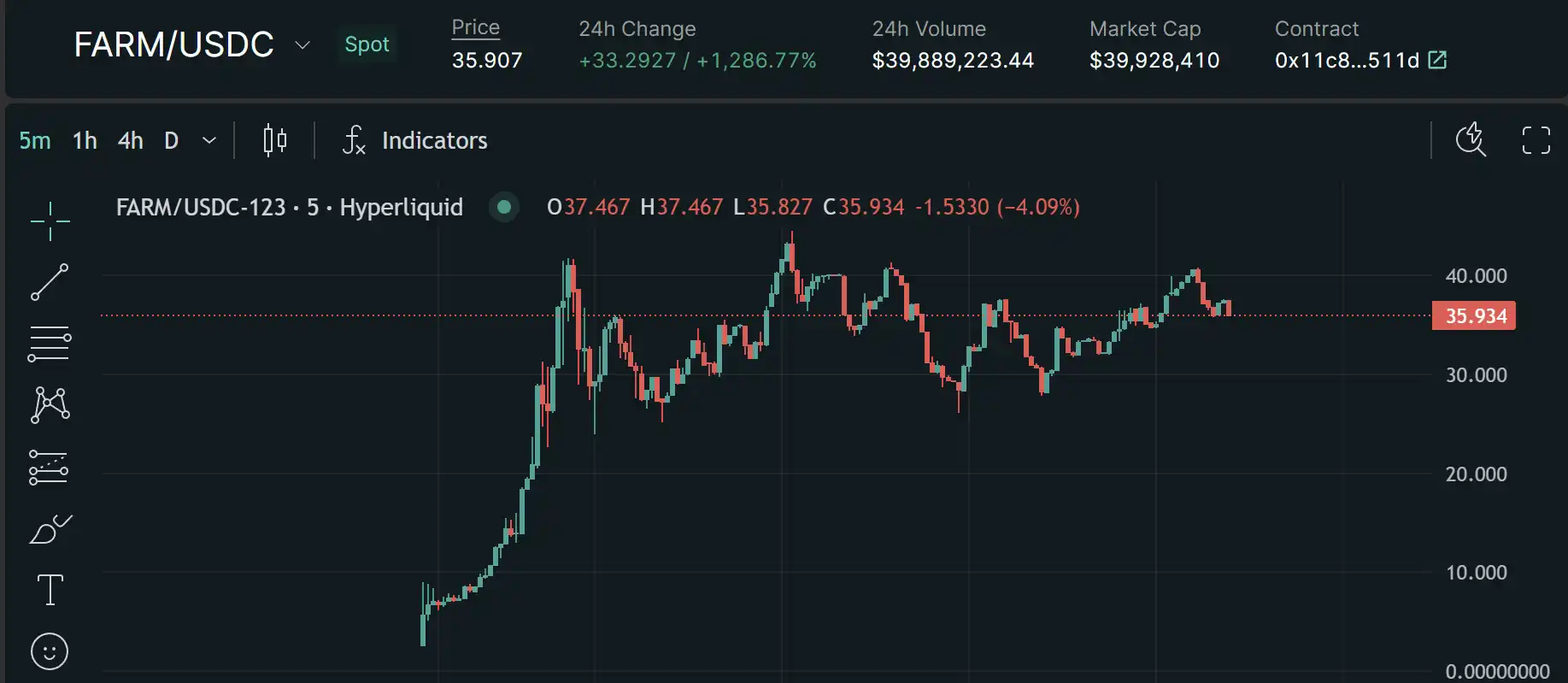
FARM’s market value at the opening on December 13 was close to 50 million US dollars
On the other hand, according to AXSN data, the daily trading volume of the token HYPE has already monopolized the daily trading volume of Hyperliquid, reaching a trading volume of 360 million US dollars, far ahead of tokens such as PURR, PIP, and JEFF. With the login of SOLV, the transaction structure of Hyperliquid will be further optimized. With the market attention and public opinion fermentation brought by the login of Solv Protocol, more project parties will choose to debut on Hyperliquid in the future, and the transaction volume will be more dispersed in the future.
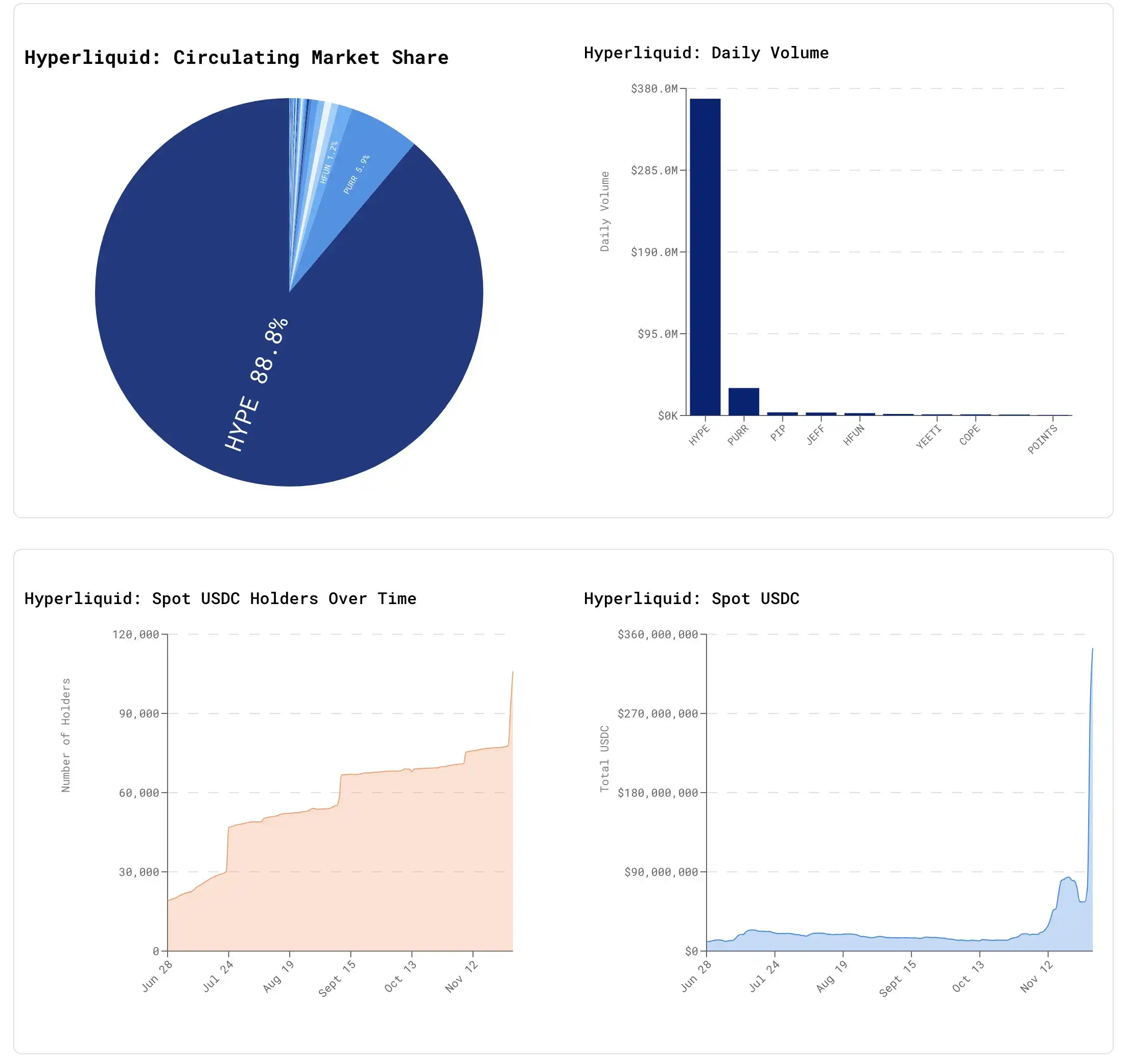
Hyperliquid transaction structure distribution
What has Hyperliquid changed?
As Jeff, the founder of Hyperlqiuid, said, "ownership goes to the believers and doers, not rent-seeking insiders". The development of Hyperliquid is also in line with the two-way rush of the project party
For VC coins, listing Hyperlqiuid is also a complementary and mutually beneficial market behavior. The listing auction itself is also an advertisement. Solv has become the traffic center of market discussion because it won the auction ticker of Hyperliquid without paying additional advertising fees.
For many copycat project parties, even if some projects are listed on major exchanges, it is still difficult to stabilize the market. If they cannot be listed on the first-tier CEX during the bull market, it is basically difficult to maintain a good-looking "K line". Without liquidity, there is no traffic, and there is no subsequent story. Most unpopular tokens have become "high heels" or "Christmas trees" after listing.
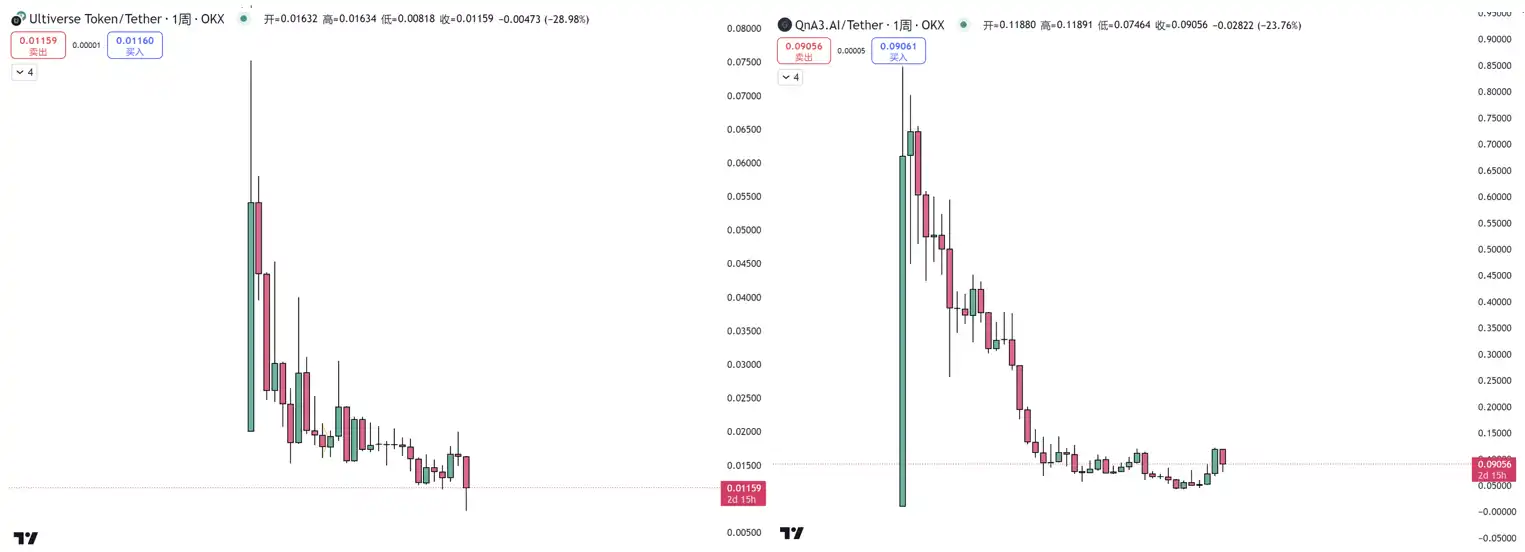
It is difficult for many tokens to stabilize the market even if they are listed on major exchanges
Hyperlqiuid provides a more economical solution, which can not only meet the needs of the first major exchange for the time being, but also "grab a seat" on a good trading platform at a low cost. After the subsequent access to HyperEVM, the tokens purchased from Hyperliquid can be used in other EVMs, which further highlights its relative advantage in cost-effectiveness of listing. Although Hyperliquid does not have the strong listing effect of CEX at present, the SOLV auction event has received widespread market attention, which further highlights its status in the eyes of crypto people.
Hyperliquid's epic airdrop is more like a vigorous market education, allowing more people to know Perp DEX, understand, contact and use it; the transparent listing plan is the first shot in the anti-black box operation, resistance, struggle and victory.
From the perspective of the industry, the emergence of Hyperliquid is both a historical process and a choice of the times. Under the voice of the masses, the market has voted with its feet again and again for fairness. Hyperliquid's open listing mechanism is a revolution against the existing CEX black box operation of listing, forcing the entire industry to become more open and transparent.
What kind of entrepreneurial spirit does Crypto need?
Often the founder of a company determines the spiritual core of the company. This sentence is vividly illustrated on Hyperliquid.
Founder Jeff no longer trusts CEX after FTX went bankrupt, and does not accept any VC investment. In Jeff's eyes, most projects will first obtain investment platforms from top institutions, and then use various so-called points plans to embellish data, and finally complete the final exit by listing on large trading platforms. This industry model seems to have become the ultimate template for most project parties to rise to prominence: write stories, attract investment, and go to large exchanges. In the end, retail investors bear everything and usher in a mess. This kind of industry chaos that is eager for quick success and instant benefits is ultimately unsustainable.
Finally, Hyperliquid witnessed the victory of Jeff's decentralized spirit. The transparent and open mechanism and the strong cohesive community pushed PerpDEX to the climax of 2.0. Jeff can also proudly say: We did not distribute tokens to any private investors, centralized trading platforms, or market makers. The bullet fired many years ago hit him right in the eye.
The history of Crypto is also a history of decentralized struggle, from the birth of Bitcoin to the capitalization dispute of Neiro. No matter how Crypto changes, victory and justice will always stand on the side of the masses, on the side of fairness, and on the side of decentralization.
You may also like

Morning Report | OpenAI has submitted an S-1 registration statement draft to the U.S. SEC; Morpho completes $175 million financing

Morning Report | BitMine increased its holdings by 126,971 ETH last week; trader Eugene announced his exit from the crypto market

Wang Chuan: How can one not feel anxious after the neighbor Old Wang made thirty times profit by investing in storage stocks? (Seven) - A quarter-century cycle

Cryptocurrency CEXs are flocking to sell US stocks, and traditional brokerages are facing an "uninvited guest."

$75 billion in foreign capital has fled, and South Korean retail investors have absorbed it all using leverage

Japan’s Three Megabanks Plan Joint Stablecoin Issuance in Fiscal 2026
MUFG, SMBC, and Mizuho reportedly plan to jointly issue fiat-pegged stablecoins in fiscal 2026, signaling Japan’s growing push into bank-led digital payment infrastructure.

Humanity Discloses H Token Dual-Chain Attack Details, With Losses on Ethereum and BSC Exceeding $36 Million
Humanity said the H token attack across Ethereum and BSC caused more than $36 million in losses after leaked ProxyAdmin keys enabled malicious contract upgrades and token minting.
White House Discusses CLARITY Act With Law Enforcement Ahead of Senate Vote
The White House discussed the CLARITY Act with law enforcement ahead of a Senate vote, focusing on illicit finance risks and developer protections.

Bitcoin Trading Guide 2026: Strategies for Experienced Traders

What Is XAUT and PAXG? Why Tokenized Gold Is Booming in 2026

Will the SpaceX IPO Hurt Bitcoin? Here's What Traders Are Watching

Foreign selling in the South Korean stock market accelerates, with cumulative net sales reportedly reaching $75 billion this year
On June 9, The Kobeissi Letter, citing Goldman Sachs data, reported that global investors are selling South Korean stocks at an unusually rapid pace. In the latest trading session, foreign investors sold about $801 million worth of Kospi constituent stocks again; total foreign outflows last week reached about $10 billion, and the market has been in net foreign selling on nearly every trading day over the past month. According to the data cited in the report, foreign investors have sold about $75 billion worth of South Korean stocks so far this year. Meanwhile, South Korean retail and institutional investors together recorded roughly $69 billion in net buying over the same period, suggesting that the market’s main buying support has come from domestic capital rather than returning overseas funds. The information currently disclosed still mainly comes from The Kobeissi Letter’s retelling and Goldman Sachs data summaries, while public details on the statistical period and the specific definition of “selling” remain relatively limited.

Fortune Warns of Strategy’s Financing Structure Risks as Bitcoin Premium Narrows
Fortune warned that Strategy’s Bitcoin treasury model faces growing financing risks as MSTR’s net asset premium narrows and preferred stock dividend pressure increases.

Ferrari Challenge Le Mans: Carl Moon to Dominate in WEEX Livery

Sahara AI Responds to SAHARA’s Sharp Drop: No Contract or Product Security Issues Found, Internal Investigation Underway
Sahara AI responded to SAHARA’s 60% price drop, saying no token contract or product security issues have been found and an internal investigation is underway.

WEEX Deposit/Withdrawal Dynamic Island: Your Asset Status, Always in Sight
Scaling Crypto Derivatives: The Digital Asset Infrastructure Behind High-Volume Trading
In the fast-moving digital asset ecosystem, derivatives platforms face an extreme architectural test. High-leverage futures markets demand more than just standard security—they require absolute operational precision, zero-latency matching engines, and ironclad structural scalability, all while navigating intense market volatility.
As global platforms scale to meet these demands, the industry is shifting away from rigid, monolithic setups toward a more agile, "decoupled" infrastructure philosophy.
The Blueprint for High-Volume Copy TradingFor elite global exchanges like WEEX (founded in 2018), this architectural choice becomes critical when scaling high-volume retail features like social copy trading. When thousands of users automatically mirror the real-time strategies of elite traders simultaneously, it triggers sudden, monumental spikes in concurrent transactional volume.
To prevent execution latency or settlement bottlenecks during these peak volatility events, a platform's primary engine must remain entirely dedicated to risk management, copy-trade synchronization, and order matching.
The Architectural Rule: New-generation platforms must separate front-end user execution engines from heavy backend infrastructural overhead to eliminate operational friction.
By separating these layers, platforms can maintain complete sovereignty over their trading environments and user experiences while strategically aligning with institutional-grade infrastructure ecosystems. This strategic framework allows modern exchanges to leverage advanced Digital Asset Custody infrastructure such as Cobo’s behind the scenes, ensuring that backend wallet management scales elastically alongside trading spikes.
Capitalizing on Market Momentum and 400× LeverageIn a derivatives arena where platforms offer up to 400× leverage on perpetual contracts, capital efficiency and market agility are core business metrics. To capture market momentum, an exchange needs the ability to rapidly expand its asset offerings, supporting everything from legacy crypto assets to sudden, trending altcoins across a massive library of trading pairs.
Adopting a flexible, scalable Wallet-as-a-Service (WaaS) solution such as Cobo’s could completely rewrite the development timeline for high-growth exchanges. Instead of spending months of engineering capital building out custom backend wallet architectures for every new blockchain network, platforms can deploy localized infrastructure in days.
This agility allows platforms to instantly scale their listings to over a thousand trading pairs without compromising security or delaying time-to-market. It mirrors the exact operational advantages seen during high-velocity market events, similar to how advanced wallet infrastructure empowers platforms during sudden asset surges; allowing exchanges to pass that speed and liquidity directly to their global user base.
A Mature Foundation for GrowthThe synergy between trusted infrastructure ecosystems and global trading platforms represents the natural evolution of a maturing crypto market. As WEEX continues to scale its global spot and derivatives offerings for over 6 million users, adopting robust backend paradigms proves that platforms no longer have to compromise between cutting-edge trading velocity and uncompromised structural security.

Get Paid to Onboard? Try WEEX’s New Homepage with Rewards for Registration, Deposit & Trade
Morning Report | OpenAI has submitted an S-1 registration statement draft to the U.S. SEC; Morpho completes $175 million financing
Morning Report | BitMine increased its holdings by 126,971 ETH last week; trader Eugene announced his exit from the crypto market
Wang Chuan: How can one not feel anxious after the neighbor Old Wang made thirty times profit by investing in storage stocks? (Seven) - A quarter-century cycle
Cryptocurrency CEXs are flocking to sell US stocks, and traditional brokerages are facing an "uninvited guest."
$75 billion in foreign capital has fled, and South Korean retail investors have absorbed it all using leverage
Japan’s Three Megabanks Plan Joint Stablecoin Issuance in Fiscal 2026
MUFG, SMBC, and Mizuho reportedly plan to jointly issue fiat-pegged stablecoins in fiscal 2026, signaling Japan’s growing push into bank-led digital payment infrastructure.


