
Beware of Scams and Malicious Pools in On-Chain Dog Projects

 Prefer us on Google


Recently, the risks associated with dog tokens have noticeably increased. We are accustomed to the ups and downs, but the main concern is to avoid scams.
For instance, clicking on a scam link.
Crypto KOLs @insidecalls and @cladzsol recently revealed that during their routine chain scanning, they clicked on a meme coin homepage, only to be greeted by a hacker disguised "Cloudflare verification" prompt, instructing them to perform a ctrl V operation, which was actually a malicious script. After following the prompt to "complete verification," the victim's on-chain funds were stolen, with @cladzsol losing approximately $600,000 in assets.
BlockBeats has compiled findings that on several popular meme coin display pages recently, their homepages redirect to "Cloudflare verification" pages, which are actually phishing links. If users follow the prompts, their computer systems will download and execute malicious scripts, leading to asset losses.
This phenomenon is currently very prevalent, likely related to the delayed reviews by mainstream trading aggregation platforms like DexScreener. The current display logic of these platforms is to directly reference the "official website" or social media links filled in the token metadata. These fields can be updated by token creators or those claiming "community takeover" later. Hackers are exploiting this review loophole to turn meme coin display pages into new phishing attack "fishing grounds."
Another issue that has been discussed recently is the Uniswap V4 pool problem.
The trading aggregator 0x released an analysis report titled "Uniswap v4 hooks were a mistake." They pulled 84,163 hooks from 6 chains for inspection, and the results were shocking: over half (54.2%) were malicious contracts, and 26.4% were suspected to be malicious.
This malice results in retail investors losing money; for example, if they buy $1,000 worth of tokens, possibly $200 ends up in these hook addresses, akin to MEV attacks.
So how can retail investors protect themselves?
Set Low Slippage
This is likely the best defense for retail investors on-chain. With low slippage, malicious hooks cannot profit. Some low market cap tokens may indeed fail to execute with low slippage, but those with slightly larger market caps should be cautious.
Confirm "Minimum Received"
The estimated amount is simulated off-chain, and in front of malicious hooks, it can always turn into a blank check.
Check the minimum received amount; if this number falls below your psychological threshold, it’s best to cancel the transaction.
There are also some suggestions from Uniswap officials, but they are basically useless, stating to use the official Uniswap front end because it has a hook whitelist, and malicious ones won't pass the review. But who would trade on the Uniswap front end that has a poor user experience?
In summary, everyone should pay more attention while trading. The on-chain opportunities are abundant, but preserving capital is more important.
-- Price
This content is provided for general informational purposes only and doesn't constitute financial, investment, legal, or tax advice. Any events, rewards, online promotions, or related information mentioned herein should not be considered a recommendation, solicitation, or invitation to purchase, sell, trade, or otherwise deal in any crypto assets. Crypto assets are highly volatile and may result in loss. The availability of WEEX services, products, and related events may vary by region. You are responsible for ensuring that your participation is in accordance with applicable local laws and regulations.
You may also like

Exclusive Interview with Frontier Technology Investor Zheng Di: SEC's 'Innovation Exemption' Opens the Door to a Compliant Bull Market, Which Assets Are Potential Stocks?

XRPL to Implement Major Upgrade on October 5: Adding Permission Delegation Feature
67% of the wealthy own digital assets, but the crypto adoption gap remains huge
How to Rewrite Internet Rules When Everyone Has an Indefatigable Agent

The End of the Blank Prompt: Why Trading AI Needs a Playbook
Cardano proposal slashes fees by 55%, but it comes with a cost for small pools

The Evolution of AI: The Boundaries and Truth of Recursive Self-Improvement (RSI)
The Quantum Issue: You Never Really Know The Future

Security and fees hold back deeper crypto use among wealthy investors: Nexo report
Bitcoin Developers Concerned About Mining Subsidy

VVV Hits All-Time High: Founder’s Perspective on Models, Privacy, and Crypto

XRPL fixes critical pre-mainnet flaw, but client apps remain at risk

Glassnode Indicates Shift Towards Altcoin Season
Crypto: Kalshi accused of inflating its volumes with thousands of identical orders

HODLing ETH: Should You Choose Staking for Yield or Collateralized Lending?

SEC Clarity Meets Fed Rate Hike: How WEEX TradFi Lucky Eggs S2 Taps Into Cross-Market Opportunities

How Significant Are Changes in Overseas AI Investment?
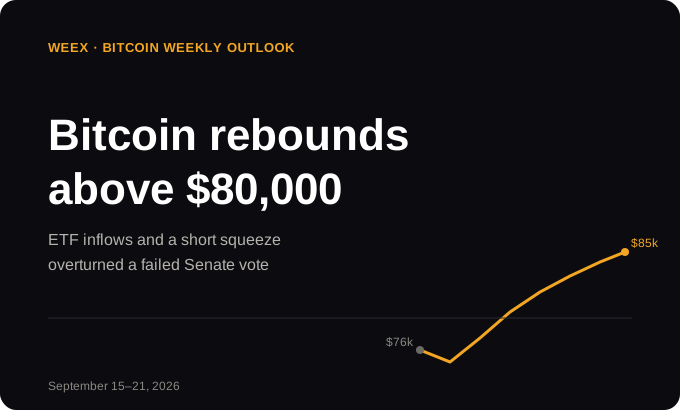
WEEX Bitcoin Weekly Outlook: Why Did Bitcoin Rebound Above $80,000 After the CLARITY Act Vote?
Bitcoin rebounded above $80,000 as SEC and CFTC action, renewed ETF inflows, and a short squeeze outweighed the failed CLARITY Act vote.
$8 Makes a Comeback, This Time X Money Rewrites the Logic of NFT Issuance
AMD Jumps Nearly 10%, Market Cap Tops $1 Trillion| WEEX TradFi Daily Brief (September 22, 2026)
Global markets on September 22 focus on a repair in AI-compute pricing. On September 21 the three major equity indexes closed higher. AMD rose nearly 10% and its market cap crossed $1 trillion for the first time, while Intel and Arm also surged. Brent crude fell about 3.4% to $100.34 and the 10-year Treasury yield eased to about 4.96%, lowering discount-rate pressure on long-duration tech. Bitcoin briefly broke above $87,000 and total crypto market cap returned above $3 trillion. Investors next watch consumer and housing earnings plus PMI flash prints.
Balancer Community Proposes Fork and Rebirth

The Answer to Dreamforce 2026: AI Agent, Has It Finally Turned from Demo to Revenue?
Ethereum: BitMine Approaches 5% of Total ETH Supply
Bitcoin's $84K rally isn't saving miners as difficulty signals already flash caution
ZEC's Largest Mining Company Moves to US Stock Market After Mining 70,000 ZEC in Six Months

Validators Vote on Batch V1.1 After Security Overhaul

Aptos Validators Decrease by 40% in Two Years, Concentration of Validator Nodes Shifts to Europe and America

SEC Takes Action: Who Can Handle "Compliant ICOs"?

TRON Weekly Industry Report: Regulatory and Interest Rate Pressures Fail to Dampen BTC Bullish Sentiment, Detailed Analysis of PayFi High-Performance Payment Infrastructure Axon Finance
When AI Agents Accelerate into Intranets: The Main Battlefield of Cybersecurity Has Changed
Exclusive Interview with Frontier Technology Investor Zheng Di: SEC's 'Innovation Exemption' Opens the Door to a Compliant Bull Market, Which Assets Are Potential Stocks?
XRPL to Implement Major Upgrade on October 5: Adding Permission Delegation Feature
67% of the wealthy own digital assets, but the crypto adoption gap remains huge
How to Rewrite Internet Rules When Everyone Has an Indefatigable Agent
The End of the Blank Prompt: Why Trading AI Needs a Playbook
Cardano proposal slashes fees by 55%, but it comes with a cost for small pools




