
BlackRock Bitcoin ETF Outflows: $19 Million Exited from IBIT, Only 0.03%

 Prefer us on Google



Nineteen million dollars. This is the amount of redemptions recorded on September 11, 2026, from BlackRock's iShares Bitcoin Trust (IBIT), the largest outflow of the day among all Bitcoin spot ETFs listed in the United States. The BlackRock Bitcoin ETF outflows come at a time when the entire category is struggling to maintain the momentum of previous months, and the data deserves careful consideration as it tells more about the mechanics of the funds than a shift in sentiment towards Bitcoin.
Key Points
- IBIT recorded redemptions of $19.23 million on September 11, 2026, the largest among U.S. Bitcoin spot funds that day.
- This figure represents approximately 0.03% of the fund's assets under management, which exceed $60.6 billion.
- In the four trading days between September 8 and 11, U.S. Bitcoin spot ETFs lost a total of about $463 million.
- Since its launch in January 2024, IBIT has accumulated approximately $64 billion in cumulative net inflows.
- Redemptions technically go through Coinbase Prime, the custodian of the fund.
The IBIT Redemption and the Context of the Week
The data from September 11 is not isolated. It is part of a sequence of four sessions, from September 8 to 11, during which the entire category of U.S. Bitcoin spot ETFs surrendered about $463 million. A week earlier, however, the trend was the opposite: nearly $987 million had flowed in the opposite direction, with a single day, September 3, able to attract about $730.9 million. The contrast between the two weeks shows how quickly institutional sentiment can flip on these products.
September 10 was the worst session of the block, with $282.6 million exiting Bitcoin spot ETFs in a single day. ARKB from ARK 21Shares absorbed the largest portion, about $164.3 million, while Grayscale's GBTC, BlackRock's IBIT, and Fidelity's FBTC completed the list of funds with significant redemptions. During the same period, the price of Bitcoin slid from about $77,362 to $76,816, a movement consistent with the cautious mood of institutional investors.
Why BlackRock Is Not Selling Bitcoin on Its Own Initiative
One point that is often misunderstood: BlackRock does not decide to liquidate Bitcoin. The company acts as an intermediary. When ETF shareholders choose to redeem their shares, the fund is mechanically obligated to sell the equivalent in underlying Bitcoin to generate the liquidity necessary to reimburse those exiting.
These redemptions technically go through Coinbase Prime, which serves as the custodian of IBIT. So when it is read that "BlackRock has sold Bitcoin," what has actually happened is that a combination of institutional and retail investors has decided to close their positions, and the fund's infrastructure has simply executed what it is designed to do.
-- Price
IBIT Remains the Undisputed Leader of the Category
Despite the redemption on September 11, IBIT's position in the Bitcoin spot ETF market does not change. Since its launch in January 2024, the fund has accumulated about $64 billion in cumulative net inflows, leading the category both in total flows and in assets under management. With over $60 billion in AUM by mid-September 2026, IBIT ranks among the largest ETFs overall, not just in the crypto sector: most ETFs never reach a billion dollars in management, a milestone that IBIT surpassed in its first week of trading in 2024.
Competing products like those from Fidelity, ARK Invest, and Bitwise have carved out their own niches, but none have approached the scale of IBIT. The combination of BlackRock's brand recognition among institutional allocators and competitive fee structures has created a flywheel effect: greater size generates more liquidity, and more liquidity generates further size.
The Fed Factor Behind the Redemption Wave
Markets are pricing in about an 87% probability of a 25 basis point rate hike at the FOMC meeting on September 16. Higher rates tend to strengthen the dollar and increase the opportunity cost of holding non-yielding assets like Bitcoin, and Treasury yields have risen in line with these expectations, adding pressure on riskier assets.
Changes in expectations regarding Federal Reserve monetary policy are reshaping how investors view risky assets in general. When rate expectations shift, institutional investors tend to rebalance their portfolio allocations across the board, and Bitcoin, as a high-volatility component of many portfolios, is often cut first during risk-off rotations. The alternation between periods of inflow and outflow throughout 2026 follows this pattern, attributable to institutional rebalancing and profit-taking strategies. For a fund the size of IBIT, $19 million remains an accounting detail; for smaller Bitcoin spot ETFs with lower AUM, an equivalent outflow would be felt much more acutely.
FAQ
Did BlackRock sell Bitcoin on its own during the redemptions on September 11?
No. BlackRock operates as an intermediary and sells Bitcoin only when investors redeem ETF shares.
How significant was the $19.23 million redemption for IBIT?
The $19.23 million redemption represented about 0.03% of IBIT's assets under management, a marginal impact for a fund of this size.
What drives the cycles of inflows and outflows in Bitcoin ETFs in 2026?
They are driven by institutional portfolio rebalancing and profit-taking strategies, influenced by changes in Federal Reserve monetary policy.
Which custodian manages IBIT's Bitcoin redemptions?
Coinbase Prime acts as the custodian through which IBIT's redemptions are processed.
This content is provided for general informational purposes only and doesn't constitute financial, investment, legal, or tax advice. Any events, rewards, online promotions, or related information mentioned herein should not be considered a recommendation, solicitation, or invitation to purchase, sell, trade, or otherwise deal in any crypto assets. Crypto assets are highly volatile and may result in loss. The availability of WEEX services, products, and related events may vary by region. You are responsible for ensuring that your participation is in accordance with applicable local laws and regulations.
You may also like

Why Did Sui (SUI) Crypto Price Jump 44%? Crypto OI and Leverage Explain the Rally
See why Sui (SUI) jumped 44%, how crypto OI and leverage amplified the rally, what the pullback means, and how to trade SUI on WEEX.

Circle expands CCTP to EURC and cirBTC on Arc

Bitcoin, Sports, and Politics: Predictive Markets Target $10 Trillion

AI Agent Jev Expects On-Chain Innovation Through Automated Judgment

The End of the Blank Prompt: Why Trading AI Needs a Playbook

Stablecoins hold nearly $200 billion in US debt, but money funds bought the surge
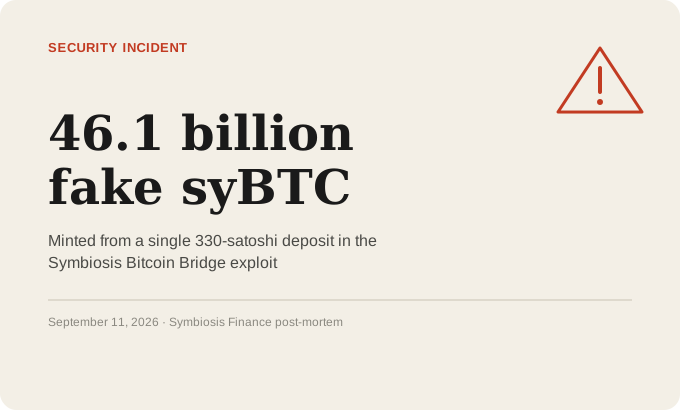
How Did a Hacker Create 46 Billion Fake Bitcoin in the Symbiosis Exploit? Decodes Bitcoin Hacker With WEEX Now
How two Symbiosis bridge bugs let a hacker mint 46.1 billion unbacked syBTC, drain Bitcoin pools and expose critical bridge risks.

CFTC's Selig Emphasizes the Need to Prepare for the Era of Large-Scale Tokenization in the U.S.

The IMF opens an office in Venezuela to supervise an economy that has already migrated to USDT

SOXL Stock Jumped 12% Yesterday: Three Companies Explain the Entire Move

Bitcoin's Hashrate Rises as Miners Reactivate Their Machines

Bitcoin 2x Leveraged ETF Launches on Cboe, But Doesn't Buy Bitcoin: Here's Why

Crypto: The ECB Enters the Tokenized Bond Market
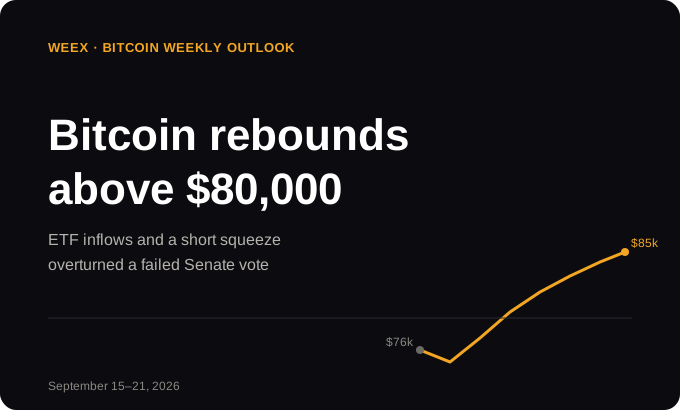
WEEX Bitcoin Weekly Outlook: Why Did Bitcoin Rebound Above $80,000 After the CLARITY Act Vote?
Bitcoin rebounded above $80,000 as SEC and CFTC action, renewed ETF inflows, and a short squeeze outweighed the failed CLARITY Act vote.
Coldcard whitehats move 52.37 BTC to recovery trust

Bitcoin's Rise Does Not Mean the Bull Market Has Returned; Don't Create Stories for Yourself
Deutsche Bank: Markets May Underestimate Rate Peaks After Central Banks' Coordinated Rate Hikes
Hyperliquid Opens Market for Bitcoin Volatility

Tom Lee Discusses Entry into Digital Asset Bull Market and AI Fund Movements

Micron Stock Price Target: Do the $1,500 to $2,000 Estimates Still Make Sense
Micron price targets range from $1,295 consensus to $1,500- lus individual calls, while options pricing implies an 11% swing on September 30 earnings, the actual results will settle which
![[ETH Letter] Ethereum Aims to Activate Sepolia Testnet on October 6](/public-static/26_2e1840f602.png?format=avif)
[ETH Letter] Ethereum Aims to Activate Sepolia Testnet on October 6
Fypher Partners with Korea Medical Tourism Promotion Association for Digital Dollar Payment
TapeOut Ecosystem Overview: From NAND, LATCH to On-Chain Application Ecosystem
[Coin Crime] "If you give us Tether, we will give you oil" - Polish state-owned company falls victim to international fraudsters

Why real-time election odds are misleading prediction market crypto traders

What is PCE and Why September 30 is Important for Cryptocurrencies
Bitcoin: JPMorgan Sees BTC Outperforming Gold

U.S. Treasury Sanctions BitBank Over Iranian Sanctions-Evasion Network
Brazil blocks stablecoins from key cross-border payment rail as $1.1 trillion market faces new limits
RISEx Proposes 20% Retention Condition for Stolen Funds
Why Did Sui (SUI) Crypto Price Jump 44%? Crypto OI and Leverage Explain the Rally
See why Sui (SUI) jumped 44%, how crypto OI and leverage amplified the rally, what the pullback means, and how to trade SUI on WEEX.
Circle expands CCTP to EURC and cirBTC on Arc
Bitcoin, Sports, and Politics: Predictive Markets Target $10 Trillion
AI Agent Jev Expects On-Chain Innovation Through Automated Judgment
The End of the Blank Prompt: Why Trading AI Needs a Playbook
Stablecoins hold nearly $200 billion in US debt, but money funds bought the surge




