
The End of the Blank Prompt: Why Trading AI Needs a Playbook

 Prefer us on Google


Summary: Trading AI should not assume that users are well-versed in expert-level questioning. Scenario-based playbooks provide AI systems with clear roles, relevant context, and explicit outputs. This reduces the cost of entry and facilitates understanding, evaluation, and responsible use of the product.
For many, the first screen of an AI product is the most daunting. It is a blank text box.
"Ask anything" seems open and simple. However, in reality, it places the burden of work on the user. Users must decide what questions to ask, which market details are important, how much context to provide, and how to judge the answers. In trading, where language affects actual decision-making, this is a demanding starting point.
The blank prompt assumes that users already know how to convert uncertain market conditions into useful instructions. Experienced traders may be able to do this, but new users often cannot. They may ask broad questions like "What should I trade today?" and receive answers that are too general, too conditional, or easily misinterpreted as advice. Alternatively, they may not ask anything at all.
This is not a lack of curiosity; it is a product design issue.
Trading AI becomes more useful by starting from a playbook rather than a blank prompt. A playbook is a structured, scenario-based workflow. It includes tasks like "Check breakout setups," "Compare two market conditions," "Create a trade journal," or "Summarize risks before placing an order." Users select tasks, and the system provides the necessary questions, context, and output formats to complete them.
As a result, it does not make AI less flexible. It makes AI one with a clear pathway to tasks.
For traders who want to turn broad ideas into reproducible processes, Phemex's Beginner's Trade Framework shows how to define objectives, markets, triggers, risk boundaries, and exit conditions. A playbook-driven AI experience allows for easier initiation and revisiting of the same structure.
Not Investment Advice: This article discusses product design and trading workflows for educational purposes. It does not provide investment recommendations. Trading digital assets involves risks, including the loss of principal.
Blank Prompts Are Not Neutral
Blank prompts can aid exploration. They allow users to articulate in their own words and pursue unfamiliar questions. However, they are not neutral interfaces. They favor those who already understand the domain, know which variables are important, and can evaluate answers before acting.
In trading, this threshold is even higher. Useful requests may require details like assets, timeframes, product types, current positions, intended trading durations, risk tolerance, and relevant event contexts. Omitting any of these details can change the meaning of the answers. Asking too much can bury decisions in data, while asking too little can lead to general answers that do not fit the situation.
This creates invisible costs: prompt literacy. Users must learn how to express their requests before accessing the value that the product claims to provide. The product may appear competent, but its capabilities remain behind a language barrier.
That barrier can produce uneven results. Two users may ask about the same market, but one may receive different levels of support because they know to ask for deactivation levels, compare timeframes, or inquire about assumptions. The difference may not necessarily be market knowledge; it could be knowledge of how to operate the interface.
The question for product teams is not whether users should be allowed to type freely. They should be allowed. The question is whether free-form prompting should be the only route to useful work. In the case of trading AI, it should not.
The Role of the Trading AI Playbook
The Trading AI Playbook is a guided workflow for recurring user scenarios. It provides a starting structure while leaving room for users to select relevant markets, timeframes, and preferences.
Instead of starting from empty fields, users can choose from one of the following playbooks:
- Understanding Price Movements: Explain market movements using specified timeframes, market data, and known catalysts.
- Check Chart Setups: Identify conditions that invalidate support and resistance, trend structures, and stated theses.
- Pre-Order Planning: Transform trading ideas into written objectives, entry conditions, position size assumptions, and exit conditions.
- Comparing Market Scenarios: Explain what supports bullish, bearish, or neutral interpretations without predicting outcomes.
- Review Completed Trades: Create journal entries that separate execution quality from profit and loss.
These are not fixed answers. They are task frames. Each requests a specific type of work from the system and informs the user of the necessary information. A good playbook does not tell traders what to believe; it visualizes the reasoning process.
Playbooks Reduce Start-Up Costs
The first advantage is simple. Users do not need to invent prompts from scratch.
When someone selects "Check breakout setups," the product can ask for the market, timeframe, monitored levels, and desired holding period. It can then return a structured review, including met conditions, missing conditions, points to consider for invalidation, and questions the user should verify. Users no longer need to guess what analysts need to know.
This reduces the cognitive load at the moment users are most likely to abandon the product. It also creates a more consistent experience. The system receives the context needed for tasks, reducing the reasons to fill gaps with general language or assumptions.
For beginners, it can transform an intimidating tool into a guided first step. For experienced traders, it can reduce repetitive prompting. Both types of users save time, but in different ways.
Value is not just convenience. Structured starts change the quality of interactions. When inputs are explicit, users can notice if the timeframe is wrong, if positions are missing, or if important assumptions have not been verified. The interface teaches the shape of healthy questions as tasks progress.
-- Price
Products Become Reliable and Easier to Evaluate
Blank prompts make it difficult to know what the system is designed to do. Broad claims like "Ask AI about trading" leave users to discover the limits of the product through trial and error. This incurs costs in any domain, and it is particularly inappropriate in financial workflows.
Playbooks make functionality readable. They name tasks that AI can assist with and show expected outputs before users spend time interacting. Traders can confirm that one workflow explains market movements, another organizes plans, and yet another supports post-trade reviews. This is clearer than presenting a single input box with no implied standards for good answers.
Readability also supports appropriate use. Playbooks can preemptively state their purposes and boundaries. Market analysis is not a price guarantee. Setup reviews are not order instructions. Journals are not performance forecasts. While this does not eliminate risk, it helps users distinguish between assistance and authority.
The same structure provides better feedback to product teams. If users abandon the "Pre-Order Planning" playbook before completion, the team can identify where the workflow is asking too much. If users repeatedly change the timeframe after seeing the output, it may indicate a design issue. Free-form prompts may contain useful signals, but it is difficult to compare and improve on a large scale.
Playbooks Are Product Interfaces, Not Rigid Scripts
There is a common concern that templates make AI feel restrictive. Poor templates do that. A good playbook does the opposite. It removes routine friction and allows users to focus on judgment.
Design should be incremental. Start with recognizable scenarios, ask only for the information necessary to begin, and allow users to refine results in natural language. Users might choose to "understand price fluctuations," select assets and time frames, and then add "whether the movement was in line with scheduled macro events." The playbook provides a basic structure, while prompts offer nuance.
Workflows should make uncertainty explicit. If the system lacks current data, it should say so. If users do not specify a time frame, it should ask for that instead of silently making a choice. If questions depend on individual risk tolerance, it should frame decisions rather than invent universal answers.
In that sense, the playbook is not an attempt to make trading deterministic. It is a way to ensure the system does not pretend to be so.
Exploring the Cryptocurrency Market
From Chat Interface to Decision-Making Workspace
The most useful trading AI might look like a decision-making workspace rather than a typical chat window. Conversations are still important, but they exist within tasks that have known inputs and outputs.
Consider a pre-trade planning playbook. The output can be more than just paragraphs; it can become a structured record.
| Section | What the Playbook Captures |
|---|---|
| Trading Objective | The market behavior the user is attempting to evaluate. |
| Market Context | Assets, products, time frames, and relevant event conditions. |
| Evidence | Specified charts, data, or news conditions that support the idea. |
| Unresolved Questions | Missing information or assumptions that need verification. |
| Review Notes | The user's final rationale and observations after the outcome. |
This format is valuable for making interactions reusable. Users can return to the record later, compare it with other plans, and learn whether the process aligned with the outcomes. AI is not just generating answers; it is helping create a persistent context.
For Phemex, scenario-based workflows help bridge the gap between market information and the trader's own processes. It can support education, research, preparation, and review without implying that generated answers should replace independent judgment.
Design Principles for a Useful Trading Playbook
Not every scenario deserves its own template. Playbooks should be built around repeatable tasks with clear user goals and recognizable input sets. The best ones tend to follow several principles.
Start from Tasks, Not Features
"Using chart analysis" describes a feature. "Check whether the planned entry still fits the stated setup" describes a task. Tasks anchor workflows to user needs and make success easier to measure.
Ask for Context at the Right Time
Do not present a long form before users select a task. However, do not wait until the output to discover that core context is missing. Ask for the minimum necessary input early and provide optional fields for deeper analysis.
Indicate Sources of Assumptions and Uncertainty
When the system identifies its time frame, data foundation, and unanswered questions, the answers become more useful. This gives users something to verify rather than a polished conclusion with hidden assumptions.
Keep Control of Conclusions with the User
Products can organize facts, identify conditions, and create records. Uncertain market analysis should not be framed as commands. Clear labels and user confirmation fields help maintain that distinction.
Design for Modifications
Markets change, and users learn. Playbooks should facilitate updates to time frames, thesis modifications, or note additions while retaining the original record. Modifications are part of the workflow and do not indicate that the tool has failed.
Blank Prompts Still Have Their Place
The goal is not to eliminate open-ended conversations. Some questions may not fit pre-built flows, and users should be able to explore them. Better models are combinations. An obvious set of starting playbooks alongside blank prompts for questions outside of those.
Over time, free-form questions can also provide information to the playbook library. If many users ask similar questions with similar missing contexts, it is evidence of scenarios worth designing. Product teams can convert recurring prompt patterns into guided workflows and then refine those workflows based on completion and return usage.
This approach treats prompting as a learning loop rather than a prerequisite. Users do not need to master the product's language on day one. The product gradually welcomes them at the point where tasks begin.
The End of Blank Prompts as Product Gates
"Knowing how to ask questions" should not be the entry fee for useful trading AI. Users need assistance at the point where market conditions become decision-making, and that assistance works best when the system understands the tasks it is asked to perform.
The playbook provides that starting point. It reduces the effort to begin, clarifies what the system can do, provides context to users, and gives a structured way to review outputs. It does not eliminate market uncertainty or replace trader responsibility. It makes interactions more understandable.
Blank prompts remain useful as options. They should no longer be the entirety of the product.
This content is provided for general informational purposes only and doesn't constitute financial, investment, legal, or tax advice. Any events, rewards, online promotions, or related information mentioned herein should not be considered a recommendation, solicitation, or invitation to purchase, sell, trade, or otherwise deal in any crypto assets. Crypto assets are highly volatile and may result in loss. The availability of WEEX services, products, and related events may vary by region. You are responsible for ensuring that your participation is in accordance with applicable local laws and regulations.
You may also like

Cardano proposal slashes fees by 55%, but it comes with a cost for small pools

The Evolution of AI: The Boundaries and Truth of Recursive Self-Improvement (RSI)

The Quantum Issue: You Never Really Know The Future

Security and fees hold back deeper crypto use among wealthy investors: Nexo report

Bitcoin Developers Concerned About Mining Subsidy

VVV Hits All-Time High: Founder’s Perspective on Models, Privacy, and Crypto

XRPL fixes critical pre-mainnet flaw, but client apps remain at risk

Glassnode Indicates Shift Towards Altcoin Season

Crypto: Kalshi accused of inflating its volumes with thousands of identical orders

HODLing ETH: Should You Choose Staking for Yield or Collateralized Lending?

SEC Clarity Meets Fed Rate Hike: How WEEX TradFi Lucky Eggs S2 Taps Into Cross-Market Opportunities

How Significant Are Changes in Overseas AI Investment?
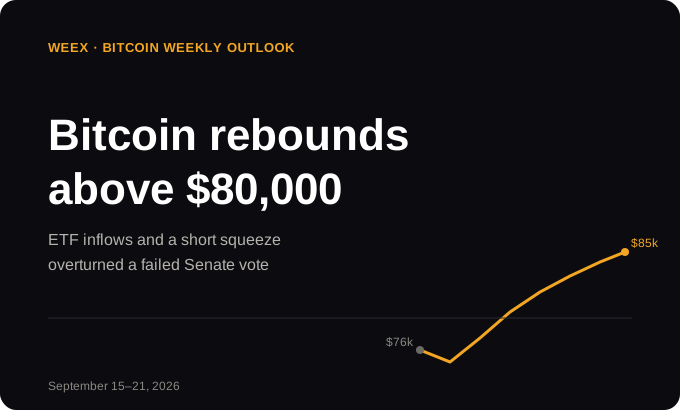
WEEX Bitcoin Weekly Outlook: Why Did Bitcoin Rebound Above $80,000 After the CLARITY Act Vote?
Bitcoin rebounded above $80,000 as SEC and CFTC action, renewed ETF inflows, and a short squeeze outweighed the failed CLARITY Act vote.

$8 Makes a Comeback, This Time X Money Rewrites the Logic of NFT Issuance
AMD Jumps Nearly 10%, Market Cap Tops $1 Trillion| WEEX TradFi Daily Brief (September 22, 2026)
Global markets on September 22 focus on a repair in AI-compute pricing. On September 21 the three major equity indexes closed higher. AMD rose nearly 10% and its market cap crossed $1 trillion for the first time, while Intel and Arm also surged. Brent crude fell about 3.4% to $100.34 and the 10-year Treasury yield eased to about 4.96%, lowering discount-rate pressure on long-duration tech. Bitcoin briefly broke above $87,000 and total crypto market cap returned above $3 trillion. Investors next watch consumer and housing earnings plus PMI flash prints.
Balancer Community Proposes Fork and Rebirth

The Answer to Dreamforce 2026: AI Agent, Has It Finally Turned from Demo to Revenue?
Ethereum: BitMine Approaches 5% of Total ETH Supply
Bitcoin's $84K rally isn't saving miners as difficulty signals already flash caution
ZEC's Largest Mining Company Moves to US Stock Market After Mining 70,000 ZEC in Six Months

Validators Vote on Batch V1.1 After Security Overhaul

Aptos Validators Decrease by 40% in Two Years, Concentration of Validator Nodes Shifts to Europe and America

SEC Takes Action: Who Can Handle "Compliant ICOs"?

TRON Weekly Industry Report: Regulatory and Interest Rate Pressures Fail to Dampen BTC Bullish Sentiment, Detailed Analysis of PayFi High-Performance Payment Infrastructure Axon Finance

When AI Agents Accelerate into Intranets: The Main Battlefield of Cybersecurity Has Changed
How to Earn Crypto Futures Trading Rewards on WEEX: Daily Lucky Eggs S2

ZetaChain, Linera, Switchboard Cease Operations
WEEX Futures Trading Rewards in Sep 2026: Win Up to 10,000 USDT

The Next Phase of Ethereum from the EF Protocol AMA

TapeOut Ecosystem Overview: From NAND, LATCH to On-Chain Application Ecosystem
Cardano proposal slashes fees by 55%, but it comes with a cost for small pools
The Evolution of AI: The Boundaries and Truth of Recursive Self-Improvement (RSI)
The Quantum Issue: You Never Really Know The Future
Security and fees hold back deeper crypto use among wealthy investors: Nexo report
Bitcoin Developers Concerned About Mining Subsidy
VVV Hits All-Time High: Founder’s Perspective on Models, Privacy, and Crypto
Contents
Latest articles


Latest coin listings on WEEX


