
BlackRock says Bitcoin volatility fell to 35–40

 Prefer us on Google


BlackRock has said Bitcoin ETFs are increasingly serving as financial tools for large holders seeking collateral, options access and portfolio flexibility as Bitcoin volatility has fallen toward the 35--40 range.
Summary
- BlackRock's Jay Jacobs says Bitcoin volatility has compressed from roughly 80 to 35--40 amid participation.
- IBIT's current creation basket is worth about $1.7 million, closely matching Jacobs' stated threshold today.
- Jacobs says some large Bitcoin holders prefer ETF wrappers because shares can support collateralized borrowing.
- BlackRock now offers IBIT, ETHA, ETHB, and BITA across spot, staking, and income-focused crypto strategies.
- SEC rules have permitted in-kind creations and redemptions for authorized crypto ETP participants since 2025.
The Pomp Podcast published a Sept. 17 interview with Jay Jacobs, BlackRock's U.S. Head of Equity ETFs, covering the growth of the iShares Bitcoin Trust ETF, or IBIT, the development of crypto-linked options and BlackRock's expanding Bitcoin and Ethereum product lineup.
During the interview, host Anthony Pompliano described Bitcoin as having moved from roughly 80 volatility to 35--40. Jacobs did not identify one cause, saying ETPs, options, deeper liquidity and an expanding base of long-term holders had all contributed to the decline.
JUST IN: BlackRock exec says Bitcoin ($BTC) volatility has been cut in half.
The shift? From "get-rich-quick narrative" to "collateral narrative."
Major institutions don't use the word collateral lightly.
That's institutional positioning language. pic.twitter.com/hV7H5BRhvj --- Wizzy (@WizzyOnChain) September 20, 2026
You might also like: BlackRock may eventually launch altcoin ETFs: Geraci
Bitcoin ETFs give large holders more financial options
Jacobs said BlackRock initially expected institutional custody to be the main reason long-term Bitcoin holders would move coins into an ETF structure. Client conversations showed another use case: placing Bitcoin exposure inside conventional financial accounts made it easier to use that wealth within lending and derivatives markets.
According to Jacobs, holders with a large percentage of their wealth in Bitcoin sometimes want liquidity for property, vehicles or other spending without simply selling their exposure. An ETF position can potentially be pledged to lenders that accept ETF shares as collateral, while options can be used to hedge risk or generate income.
The distinction is important in the mechanics of the product. IBIT itself does not issue home or car loans, and BlackRock does not guarantee that an investor can borrow against its shares. A bank, broker or other lender determines whether it will accept ETF shares as collateral and on what terms.
Traditional lenders have already expanded such services. JPMorgan accepting Bitcoin as collateral, the bank has moved digital assets further into its secured-lending framework, following earlier efforts involving crypto-linked ETFs.
Jacobs characterized this ability to connect Bitcoin wealth with traditional lending, hedging and portfolio tools as part of the asset's financialization.
IBIT's structure now supports in-kind creation and redemption by authorized participants. The SEC approved in-kind processes for crypto ETPs in July 2025, reversing the cash-only approach initially required when U.S. spot Bitcoin ETFs launched.
SEC Chairman Paul Atkins said at the time that in-kind transactions could make the products "less costly and more efficient."
In-kind transactions do not mean ordinary retail holders can walk into BlackRock and exchange a small amount of Bitcoin directly for IBIT shares. Creation and redemption activity takes place through authorized participants using large baskets.
BlackRock's lates IBIT data put one creation basket at approximately $1.73 million as of Sept. 17, containing 22.65 BTC. Jacobs described the practical threshold during the podcast as roughly $1.5 million, after falling substantially from earlier levels.
BlackRock links lower Bitcoin volatility to deeper markets
Pompliano asked Jacobs whether Bitcoin's volatility decline came from Wall Street participation, ETFs or the derivatives market built around the asset.
Jacobs said BlackRock does not have a single explanation. ETPs created more ways to obtain exposure, while options gave market participants additional tools for complex positions and risk management. A deeper pool of participants and liquidity can reduce some price swings, in his view.
Long-term buyers form another part of BlackRock's explanation. Jacobs said more investors now hold Bitcoin strategically, providing a different source of demand from shorter-duration traders.
His view on future volatility remains an assessment, not a guaranteed outcome. Bitcoin can still experience sharp moves, while derivatives and leverage can amplify volatility during periods of rapid liquidation.
Jacobs argued that lower volatility has not changed what BlackRock sees as Bitcoin's underlying investment characteristics. In periods when investors worry about governments, geopolitical instability or fiat currency debasement, Bitcoin "should benefit," he said, while noting that such conditions can place pressure on conventional assets.
The statement represents BlackRock's investment view. It does not establish that Bitcoin will consistently rise when stocks or bonds decline, and correlations between asset classes can change across market cycles.
IBIT remained BlackRock's largest crypto ETP by a wide margin. BlackRock reported approximately $59.87 billion in IBIT net assets as of Sept. 17, with 1.382 billion shares outstanding and a 0.25% sponsor fee. The product tracks the CME CF Bitcoin Reference Rate-New York Variant.
BlackRock is building staking and income products around crypto
BlackRock's current crypto strategy extends beyond simple spot exposure, though it remains concentrated on Bitcoin and Ethereum.
Jacobs said the firm has concentrated on the two assets because Bitcoin and Ethereum represent most of the digital-asset market by capitalization. BlackRock has not followed an approach of launching products for every large cryptocurrency.
For Ethereum, the firm offers ETHA for spot exposure and the iShares Staked Ethereum Trust ETF, ETHB, which combines ether price exposure with staking rewards from a portion of the trust's holdings.
BlackRock's official ETHB page showed net assets slightly above $1 billion as of Sept. 10. The product carried a 30-day staking rewards rate of 1.54% at that date, while the stated sponsor fee is 0.25%.
As crypto.news reported when BlackRock launched ETHB, the product began trading in March as BlackRock's first U.S. Ethereum ETP incorporating staking.
BlackRock has taken a separate approach to investors seeking income from Bitcoin.
The iShares Bitcoin Premium Income ETF, ticker BITA, launched in June. The translated interview notes referred to the product as "BIDA," but BlackRock's official ticker is BITA.
BITA holds Bitcoin exposure through spot BTC and IBIT, then writes call options primarily on IBIT to collect premiums. BlackRock said when it launched the fund that the strategy generally targets calls covering approximately 25% to 35% of the portfolio.
Its product page showed a 13.25% distribution rate as of Sept. 9 and a 0.65% sponsor fee. Distribution rates can change and are not guaranteed returns.
Ascrypto.news previously reported in its analysis of BITA, selling covered calls can create monthly income but limits participation in some Bitcoin upside when prices rise sharply.
Jacobs said the strategy grew from requests by clients who wanted Bitcoin exposure but had portfolios structured around cash flow. Spot Bitcoin itself pays no coupon or dividend, leaving options premiums as one way an ETF can create distributable income.
-- Price
AI now sits beside crypto in BlackRock's thematic framework
The interview moved from Bitcoin into BlackRock's approach to artificial intelligence, where Jacobs described AI adoption as a macroeconomic variable increasingly relevant to U.S. equity markets.
He said BlackRock examines AI across utilities, power infrastructure, data centers, semiconductors, model developers, software and applications instead of treating it solely as a technology-sector theme.
Supply timelines differ sharply across that chain, according to Jacobs. He estimated that a new copper mine can require four to eight years to reach production and that semiconductor fabrication facilities can take roughly four years to become operational.
Those timing estimates were used to explain BlackRock's investment framework, not to establish a forecast for commodity prices or AI-company returns.
The asset manager offers several products tied to different parts of that infrastructure. Jacobs pointed to its actively managed AI strategy BAI, infrastructure and power exposure, data-center real estate and copper-related investments as examples of how ETF structures can divide the AI supply chain into investable groups.
His comments on fund design extended to the number of ETFs available in the U.S. market. Jacobs said investors should examine holdings, structure, taxation and market-making arrangements instead of relying only on product names.
BITA provides one example of the structural differences he cited. The fund uses a partnership structure, so BlackRock says investors are expected to receive a Schedule K-1 for U.S. tax reporting. IBIT, despite offering exposure to the same underlying asset, does not use BITA's covered-call income strategy.
BlackRock's June launch materials said BITA can sell calls against approximately 25% to 35% of its Bitcoin exposure, while the remaining position retains exposure to Bitcoin price movements. Its options strategy is actively managed and can change as market conditions and portfolio positioning change.
This content is provided for general informational purposes only and doesn't constitute financial, investment, legal, or tax advice. Any events, rewards, online promotions, or related information mentioned herein should not be considered a recommendation, solicitation, or invitation to purchase, sell, trade, or otherwise deal in any crypto assets. Crypto assets are highly volatile and may result in loss. The availability of WEEX services, products, and related events may vary by region. You are responsible for ensuring that your participation is in accordance with applicable local laws and regulations.
You may also like

The End of the Blank Prompt: Why Trading AI Needs a Playbook
Cardano proposal slashes fees by 55%, but it comes with a cost for small pools

The Evolution of AI: The Boundaries and Truth of Recursive Self-Improvement (RSI)

The Quantum Issue: You Never Really Know The Future

Security and fees hold back deeper crypto use among wealthy investors: Nexo report

Bitcoin Developers Concerned About Mining Subsidy

VVV Hits All-Time High: Founder’s Perspective on Models, Privacy, and Crypto

XRPL fixes critical pre-mainnet flaw, but client apps remain at risk

Glassnode Indicates Shift Towards Altcoin Season

Crypto: Kalshi accused of inflating its volumes with thousands of identical orders

HODLing ETH: Should You Choose Staking for Yield or Collateralized Lending?

SEC Clarity Meets Fed Rate Hike: How WEEX TradFi Lucky Eggs S2 Taps Into Cross-Market Opportunities

How Significant Are Changes in Overseas AI Investment?
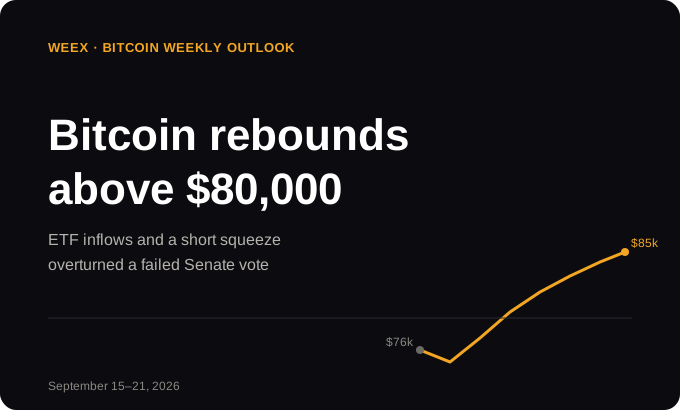
WEEX Bitcoin Weekly Outlook: Why Did Bitcoin Rebound Above $80,000 After the CLARITY Act Vote?
Bitcoin rebounded above $80,000 as SEC and CFTC action, renewed ETF inflows, and a short squeeze outweighed the failed CLARITY Act vote.

$8 Makes a Comeback, This Time X Money Rewrites the Logic of NFT Issuance
AMD Jumps Nearly 10%, Market Cap Tops $1 Trillion| WEEX TradFi Daily Brief (September 22, 2026)
Global markets on September 22 focus on a repair in AI-compute pricing. On September 21 the three major equity indexes closed higher. AMD rose nearly 10% and its market cap crossed $1 trillion for the first time, while Intel and Arm also surged. Brent crude fell about 3.4% to $100.34 and the 10-year Treasury yield eased to about 4.96%, lowering discount-rate pressure on long-duration tech. Bitcoin briefly broke above $87,000 and total crypto market cap returned above $3 trillion. Investors next watch consumer and housing earnings plus PMI flash prints.
Balancer Community Proposes Fork and Rebirth

The Answer to Dreamforce 2026: AI Agent, Has It Finally Turned from Demo to Revenue?
Ethereum: BitMine Approaches 5% of Total ETH Supply
Bitcoin's $84K rally isn't saving miners as difficulty signals already flash caution
ZEC's Largest Mining Company Moves to US Stock Market After Mining 70,000 ZEC in Six Months

Validators Vote on Batch V1.1 After Security Overhaul

Aptos Validators Decrease by 40% in Two Years, Concentration of Validator Nodes Shifts to Europe and America

SEC Takes Action: Who Can Handle "Compliant ICOs"?

TRON Weekly Industry Report: Regulatory and Interest Rate Pressures Fail to Dampen BTC Bullish Sentiment, Detailed Analysis of PayFi High-Performance Payment Infrastructure Axon Finance

When AI Agents Accelerate into Intranets: The Main Battlefield of Cybersecurity Has Changed
How to Earn Crypto Futures Trading Rewards on WEEX: Daily Lucky Eggs S2

ZetaChain, Linera, Switchboard Cease Operations
WEEX Futures Trading Rewards in Sep 2026: Win Up to 10,000 USDT

The Next Phase of Ethereum from the EF Protocol AMA
The End of the Blank Prompt: Why Trading AI Needs a Playbook
Cardano proposal slashes fees by 55%, but it comes with a cost for small pools
The Evolution of AI: The Boundaries and Truth of Recursive Self-Improvement (RSI)
The Quantum Issue: You Never Really Know The Future
Security and fees hold back deeper crypto use among wealthy investors: Nexo report
Bitcoin Developers Concerned About Mining Subsidy
Contents
Latest articles


Latest coin listings on WEEX


