
Buying Bitcoin without betting on a rally may not pay

 Prefer us on Google
Buying Bitcoin while hedging against a price drop can earn a return without a rally. But November 10 pricing offered about $119 per BTC before costs, less than the roughly $135 needed to finance the purchase for 17 days in an illustrative borrowing calculation.
The strategy, known as cash-and-carry, pairs a Bitcoin purchase with a futures sale. It seeks to earn the premium between the two markets as their prices converge. Its attraction depends on the cost of funding and maintaining both positions.
The comparison uses CME's November futures settlement and Coinbase's price during the settlement window. It implies about 3.48% gross annualized carry, against a 3.88% overnight financing benchmark.
A small Bitcoin premium
CME's preliminary bulletin No. 217, dated November 10, lists the November Bitcoin futures settlement at $73,805 per BTC.
Coinbase's BTC-USD candle beginning at 20:59 UTC closed at $73,685.73. That minute corresponds to 2:59--3:00 p.m. Central Standard Time, aligning with CME's stated daily settlement window.
Subtracting the Coinbase close from the futures settlement gives a $119.27 premium, or about 0.16% of the spot price. Using the 17-day calendar-date difference to November 27 expiry and a simple 365-day annualization produces the following sensitivity:
| Coinbase spot proxy | Spot price | Futures premium per BTC | Gross annualized carry |
|---|---|---|---|
| Minute close | $73,685.73 | $119.27 | 3.48% |
| Minute high | $73,687.79 | $117.21 | 3.42% |
| Minute low | $73,648.99 | $156.01 | 4.55% |
The range shows how much a short-dated annualized figure can move with a relatively small change in spot price.
These remain pricing proxies. Coinbase's candle close is a single venue's last trade within the minute, while CME's daily settlement methodology uses a volume-weighted futures price. A trader would need executable prices for both legs, at sufficient size, to establish an actual opportunity. Pairing the minute's lowest spot trade with the futures settlement does not demonstrate that both prices were simultaneously available.
CME's own BasisWatch methodology uses a separate 60-second spot marker.
Borrowing can swallow the reward
The New York Fed's dated SOFR observations show 3.88% effective November 9. SOFR measures overnight borrowing secured by Treasury securities. A Bitcoin trading desk's funding rate, collateral requirements and access to credit can differ materially.
There is also a convention difference. The carry calculation above uses a 365-day year. The New York Fed's money-market methodology uses actual calendar days divided by 360.
For illustration, financing the entire $73,685.73 spot purchase for 17 days at a constant 3.88%, using that 360-day convention, would cost approximately $135.01. Against the $119.27 gross premium, that leaves a $15.74 shortfall before trading and other costs.
Using the minute's low instead would leave roughly $21 per BTC after the same financing assumption, before other costs. That is a small remaining allowance, and it depends on a more favorable spot input than the closing-price proxy.
Future overnight rates, borrowing spreads, execution costs and collateral income remain unknown. An investor using its own cash would face an opportunity-cost decision rather than this hypothetical loan bill.
Margin adds another demand on capital. CME futures are marked to market daily. If Bitcoin rises, the short futures position can require cash payments even while the spot holding gains value elsewhere. The investor needs sufficient liquidity to maintain the hedge.
The 3.48% figure measures gross carry against the spot purchase price. Return on margin uses a different denominator again, and looking only at the futures deposit would omit the capital supporting the long position.
An ETF version also requires its own calculation using share prices and hedge ratios. Fund fees and premiums or discounts to net asset value affect the economics. For example, IBIT lists a 0.25% annual sponsor fee; buying its shares would not reproduce the Coinbase spot leg exactly.
December policy risk
The macro backdrop gives financing costs particular relevance. The October CPI release, published November 10, showed consumer prices rising 0.4% month over month, with core prices up 0.3%, both seasonally adjusted.
Before the release, Governor Christopher Waller said a core reading around 0.3% or higher would warrant considering a 50-basis-point December rate increase. Those were his conditional views, rather than a committee decision.
The November futures contract expires before the Fed's December 8--9 meeting. A December increase therefore would not become an already-incurred financing cost on a position completed at November expiry. Policy expectations can still affect present funding conditions and the economics of rolling into later contracts.
What would bring buyers in
US spot Bitcoin ETFs recorded $95 million in net outflows on November 10, following $201 million on November 9, according to Farside's completed daily rows.
Those totals establish continued aggregate redemptions. They do not identify investors' strategies or connect a particular ETF holding to a futures hedge.
The available CFTC financial futures report covers positions as of November 3, a week before the CPI session. It cannot establish how traders responded to November 10 prices. Its trader categories also lack a complete account-level view of corresponding spot and ETF holdings.
Evidence consistent with new carry demand would combine executable futures premiums that leave room after actual funding costs, additional spot or ETF exposure, and corresponding futures hedges. Comparable pricing across subsequent sessions would help distinguish a persistent incentive from a fleeting observation.
Bitcoin can also recover through stronger directional spot demand from buyers willing to take outright price risk. Cash-and-carry is one possible source of support, with its own financial hurdle.
For this hedged Bitcoin trade, the buying decision turns on the premium left after funding, execution and the cash needed to keep both positions open.
This content is provided for general informational purposes only and doesn't constitute financial, investment, legal, or tax advice. Any events, rewards, online promotions, or related information mentioned herein should not be considered a recommendation, solicitation, or invitation to purchase, sell, trade, or otherwise deal in any crypto assets. Crypto assets are highly volatile and may result in loss. The availability of WEEX services, products, and related events may vary by region. You are responsible for ensuring that your participation is in accordance with applicable local laws and regulations.
You may also like

Google Launches Gemini Decisions API Charging $0.10 per Million Input Tokens with 150-250 ms End-to-End Latency

Two U.S. Senators Demand Answers on Insider Trading Prevention Measures in Trump White House's Prediction Market

Britain should ask crypto founders what would have kept them here

PNC lets businesses accept USDC without keeping the crypto

Thousands of Bitcoin nodes gave anonymous strangers a pass around security limits

Hedera Council adds Apex Group, servicer of $3.5T in assets

Kaspa developer targets ownerless prediction market by end-2026
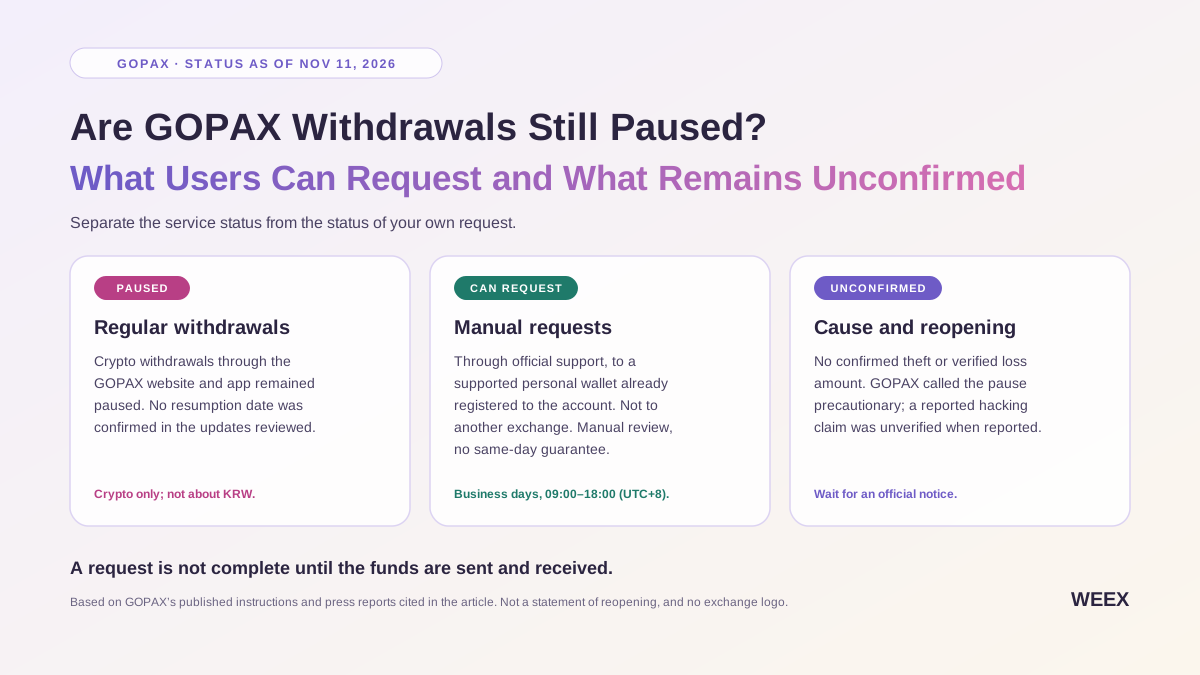
Are GOPAX Withdrawals Still Paused? What Users Can Request and What Remains Unconfirmed
Check the latest GOPAX withdrawal status, which wallets qualify for manual requests, and how to tell whether your crypto withdrawal has been sent.
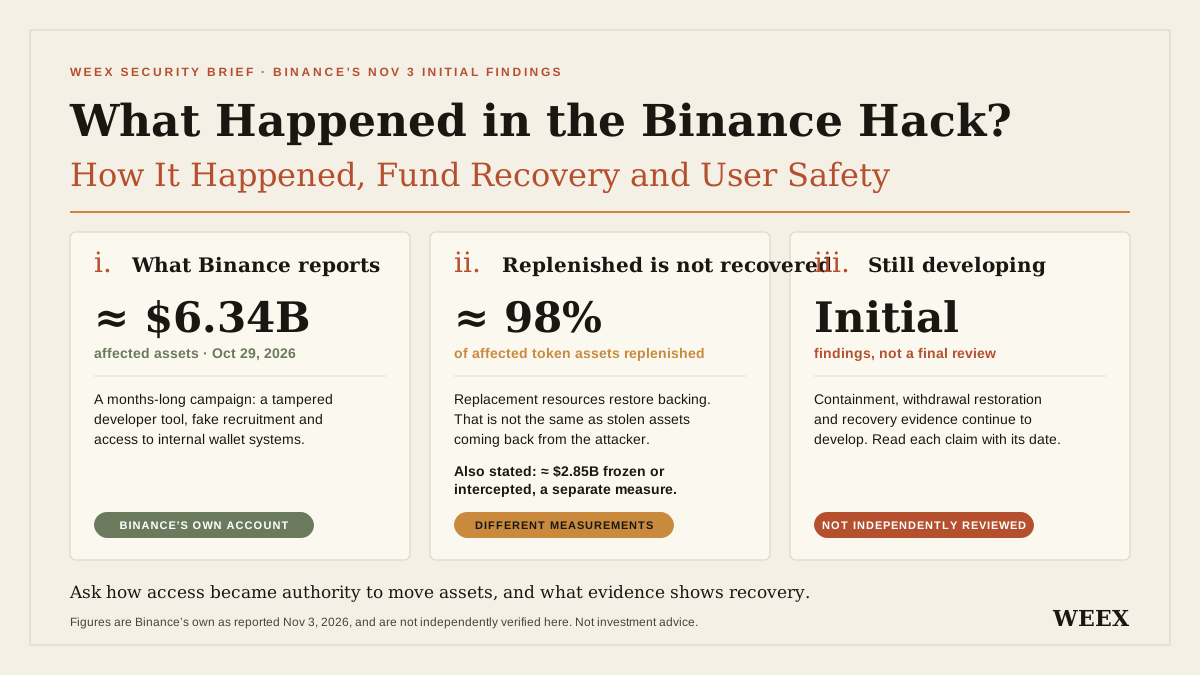
What Happened in the Binance Hack? How It Happened, Fund Recovery and User Safety
What happened in the Binance hack? Review the attack timeline, latest fund replenishment, recovery limits and practical steps to protect your account.

Hoskinson says he cannot run Cardano like a CEO. Who is accountable for its growth?

Why Pronostyx Is Building Prediction Markets for Questions the Big Platforms Ignore

Former Cointelegraph CEO Joins Phase as Co-Founder and CEO

Alta raises $47.5M for blockchain backed by crypto skeptic Jack Zhang

U.S. Mortgage Rates Surge After Four Weeks of Decline

Decrypt Becomes First News Publisher to Offer Perps Trading, Powered by Solana's Phoenix

How Far Can AI Trading Go Amid the Anti-Data Center Wave? It Depends on GPU Leasing Prices
XRPL lending protocol gains validator support as vault vote advances

Tech Veteran: Anthropic IPO Will Be the Peak of AI Market in US Stocks, Will 'Aggressively Buy Chinese AI' If Conditions Allow

Moody's Projects Global Credit Deterioration by 2027 and Warns of the Impact of Rates and AI

CPI Higher Than Expected in the U.S.: What It Means for Investors

EWY ETF Volatility: Semiconductor Concentration, Rebound, and Fund-Flow Risks

AI Agents Do More Than Just Place Orders: The Next Entrepreneurial Opportunity Lies in Matching and Trust
Exodus Reports $8.3M Quarterly Loss as Wallet Platform Expands Payments Business

USAR Stock: Rare-Earth Commercialization, Quarterly Losses, and Funding Risks

Hims & Hers (HIMS) Falls After Earnings: Margins, Subscribers, and Guidance

IWM ETF Outlook: Small-Cap Rebound, Fund Positioning, and Credit Risk

SOXL Sell-Off and Rebound: 3x Leverage, Fund Flows, and Semiconductor Risk

Something strange is happening with Bitcoin. It is neither digital gold nor a tech company for Wall Street

TQQQ Outlook: Triple-Leverage Swings, Rebound Potential, and Decay Risk

US card debt hits $1.29 trillion as Bitcoin loans expose a collateral divide
Google Launches Gemini Decisions API Charging $0.10 per Million Input Tokens with 150-250 ms End-to-End Latency
Two U.S. Senators Demand Answers on Insider Trading Prevention Measures in Trump White House's Prediction Market
Britain should ask crypto founders what would have kept them here
PNC lets businesses accept USDC without keeping the crypto
Thousands of Bitcoin nodes gave anonymous strangers a pass around security limits
Hedera Council adds Apex Group, servicer of $3.5T in assets
Latest articles





Latest coin listings on WEEX


