
CFTC Exempts Wallet and Software Developers from Broker Registration

 Prefer us on Google


CFTC Expands No-Action Letter for Wallet and Software Developers
The Commodity Futures Trading Commission (CFTC) of the United States has expanded its no-action letter (a policy of refraining from enforcement actions) to exempt passive software providers and wallet developers that connect users to regulated derivative markets from broker registration requirements.
This new interim measure comes amid stalled discussions on the CLARITY bill in the Senate, providing a broader legal framework for developers in the cryptocurrency and prediction markets.
Background and Scope of the Expanded Relief Measures
The no-action letter expands the relief previously granted in March of this year (2026) to Phantom Technologies, a company specializing in cryptocurrency wallets, to all passive software developers that meet the criteria.
In March, Phantom became the first passive software provider to receive no-action relief from the CFTC. We're grateful to the CFTC for working with us to chart a new path for non-custodial software providers to connect people with regulated markets, all while the provider never holds users' funds or makes decisions about their trades.
Now the CFTC has opened that same path to other software providers, and that's a win for the whole industry. This is how it should work: software built to protect consumers, paired with regulated partners, giving more people safe access to the financial services they want 🤝.
--- Brandon Millman (@BChillman) September 17, 2026
The measures apply to passive interfaces and self-managed wallets that connect users to regulated markets such as registered futures commission merchants (FCMs), introducing brokers (IBs), and designated contract markets (DCMs). Patrick Wilson, legal advisor at the Solana Policy Institute, noted that this policy allows developers to have clearer standards for connecting to regulated markets without being overly treated as introducing brokers.
Strict Conditions and Ten Limitations for Exemption
To benefit from this exemption, developers must adhere to strict conditions. The most significant requirement is that the software must be entirely "passive."
Absence of Discretion:
Developers cannot execute trades, decide on routing methods, or issue explicit buy/sell signals; users must have complete control over all transactions.Prohibition of Custody:
Developers are not allowed to directly hold users' funds or assets backing derivative positions; funds must be under the management of a clearinghouse.Limitations on Fee Structures:
Receiving variable kickbacks or rewards based on trading volume is generally prohibited.
Additionally, the CFTC staff letter outlines ten detailed activity restrictions and conditions. These include ensuring that principals do not fall under legal disqualification, maintaining records related to risk disclosures, and notifying the CFTC in case of insolvency. It is also essential to maintain an environment where users can access regulated markets directly without going through the software.
Interim Approach and Future Outlook
This decision was made just days after the Senate voted down the CLARITY (Cryptocurrency Market) bill. While calls for legal certainty are increasing, this measure remains a staff-level no-action from the committee and does not legally bind the entire commission or other departments.
CFTC Chairman Michael Selig has indicated a willingness to use existing legal authority to bring clarity to the market, expressing a desire to elevate such interim views into formal rules in the future. On the same day, the SEC (Securities and Exchange Commission) announced an innovation exemption for tokenized stocks, continuing to explore flexible practical responses from various regulatory authorities amid legislative stagnation.
-- Price
This content is provided for general informational purposes only and doesn't constitute financial, investment, legal, or tax advice. Any events, rewards, online promotions, or related information mentioned herein should not be considered a recommendation, solicitation, or invitation to purchase, sell, trade, or otherwise deal in any crypto assets. Crypto assets are highly volatile and may result in loss. The availability of WEEX services, products, and related events may vary by region. You are responsible for ensuring that your participation is in accordance with applicable local laws and regulations.
You may also like

100 believers, 10 ETH: How should early-stage crypto projects raise funds?

Bitcoin: ECB Scrutinizes Retail Sentiment on Reddit Using AI

Patch Released for Ethereum Gloas Fork

US Treasuries Face Largest Weekly Sell-Off Since Trump Tariffs as Market Bets on Fed Rate Hike

Who Will Succeed Nvidia as the Next 'Victim' After the Democrats Take Control of Both Houses?

Anthropic Yet to Go Public, Crypto Players Already Cashing In

Interpretation of FATF Report on Scam Compound Funds: Virtual Assets Become Core Money Laundering Channels

How Much Is Anthropic Really Worth?
Research Reveals 3D Spatial Navigation Map of Hand in the Brain to Aid Brain-Machine Interface Development

Michael Dempsey: Crypto Venture Capital Stagnates, Talent Shifts to AI

Yen Fluctuations Highlight Current Trading Difficulties, Investors Have Huge Divergence on Long-term Outlook

Bloom Energy vs. Constellation Energy: On-Site Power or Grid Power, Which Wins the Data Center?

Former Polychain Partner Launches Startup: Enters Tokenized Real Estate, Secures $50 Million Seed Round Funding to Create the 'S&P 500' of Real Estate
Seminar: The History of Hyperliquid and On-Chain Finance Guest: Takuya Fujita (11/18 19:30 @ Gentosha)
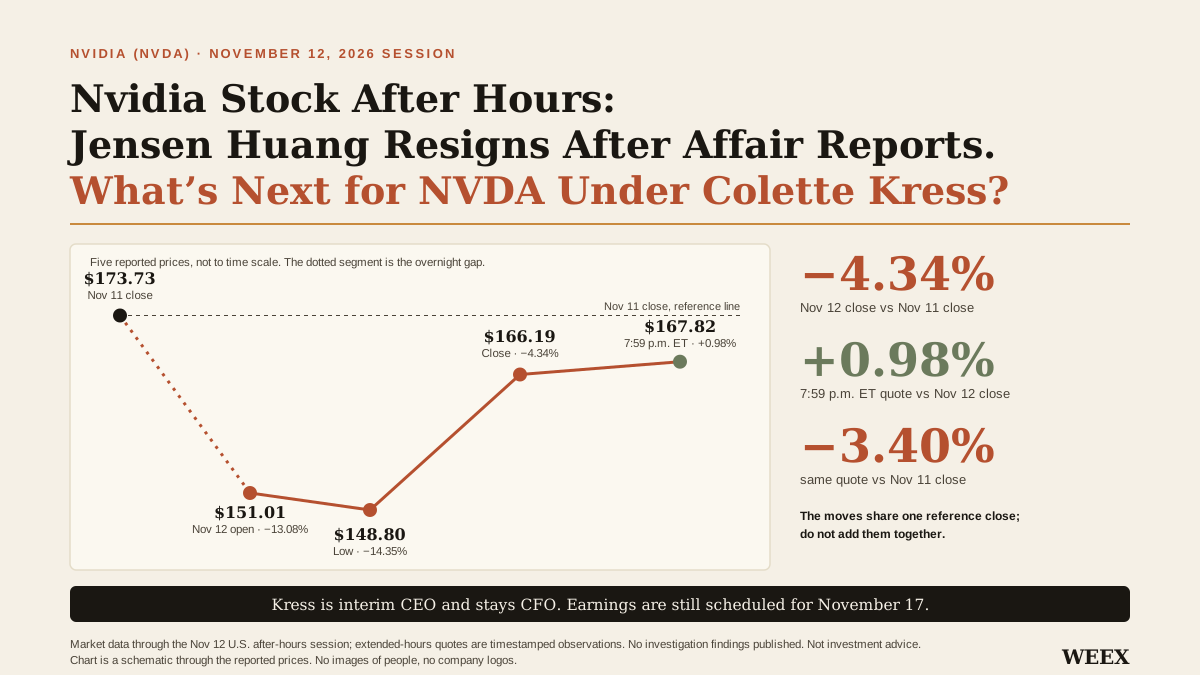
Nvidia Stock After Hours: Jensen Huang Resigns After Affair Reports. What’s Next for NVDA Under Colette Kress?
Nvidia fell 4.34% after Jensen Huang resigned, then rose 0.98% after hours. See what Colette Kress’s appointment means for NVDA and November 17 earnings.

Jensen Huang's Sudden Departure Raises Questions: Did the White House Intervene? Is a Return Possible?
In-Depth Interview | Fu Peng: I Have No Faith in BTC

Cerebras Conference Call: Secures Major Deal with Microsoft, HBM Shortage Becomes an Opportunity, WSE-5 Chip to Enter Mass Production Next Summer

SoundHound AI Stock Is Down Almost 60% in 2026, but Wall Street Thinks It Can Soar 155% By the End of 2027. Here’s Why It Could Be One of the Best Buys Amid the Tech Sell-Off.
What is being said at the tables: the market begins to see 2027 as an all-or-nothing scenario

Kalshi Negotiates New Round of Financing, Valuation Expected to Reach $65 Billion

Republican Senator Wants to Freeze AI Data Center Boom as Congress Pushes to Expand It

Why the Path to Quantum Resistance Runs Uphill for Bitcoin Wallet Makers
Pimco CEO Warns: AI Companies Risk Borrowing "Too Much" ($10 Trillion)

Silver ETF vs. Silver Miners ETF: Which Has Held Up Better This Year?

Why AMD Shares Are Surging and What a $10,000 Investment in the Stock Could Be Worth in 3 Years

Cardano Academy launches practicum with on-chain credentials
Warren Buffett Doesn't Follow His Own S&P 500 Advice. Should You?

A $776 Car Payment Is a Warning for Ford and General Motors

2 Chip Stocks to Buy Instead of Nvidia Right Now
100 believers, 10 ETH: How should early-stage crypto projects raise funds?
Bitcoin: ECB Scrutinizes Retail Sentiment on Reddit Using AI
Patch Released for Ethereum Gloas Fork
US Treasuries Face Largest Weekly Sell-Off Since Trump Tariffs as Market Bets on Fed Rate Hike
Who Will Succeed Nvidia as the Next 'Victim' After the Democrats Take Control of Both Houses?
Anthropic Yet to Go Public, Crypto Players Already Cashing In
Latest articles




Latest coin listings on WEEX


