
Comprehensive Comparison of the Top 8 AI Agent Frameworks: Who is the Ultimate Leader in the Race?


Original Compilation: zhouzhou, BlockBeats
In the intense volatility of the crypto bull market, opportunities and risks coexist. With the market adjustment, it is precisely those projects that are at the forefront of technology and possess strong innovation that have shown their unique value. This article will reveal eight of the most exciting and promising tokens in the current market downturn: AI16z, ZEREBRO, ARC, AIXBT, GRIFFAIN, GRIFT, ZODS, and ALCH. These projects have not only pioneered new possibilities in their respective fields but also have unique advantages that span cycles, accumulating strength for the future market surge.
Through in-depth analysis of their catalysts, market performance, and team backgrounds, we have explored the intrinsic value and investment opportunities of some projects that can be considered during this downturn. Each choice could become the next legend, and these projects are undoubtedly the "ALPHA" pioneers worth paying attention to.
AI16z | ai16zdao
The AI16z token is a meme project issued by "Bootleg Marc" Marc AIndreessen on Daos.fun, based on the a16z concept. It is the first hedge fund led by an AI agent, combining low-risk investments and high-risk investments managed by AI Degen Spartan. The underlying architecture "Eliza" is open source and has received significant developer support, while the V2 update has improved flexibility and security.
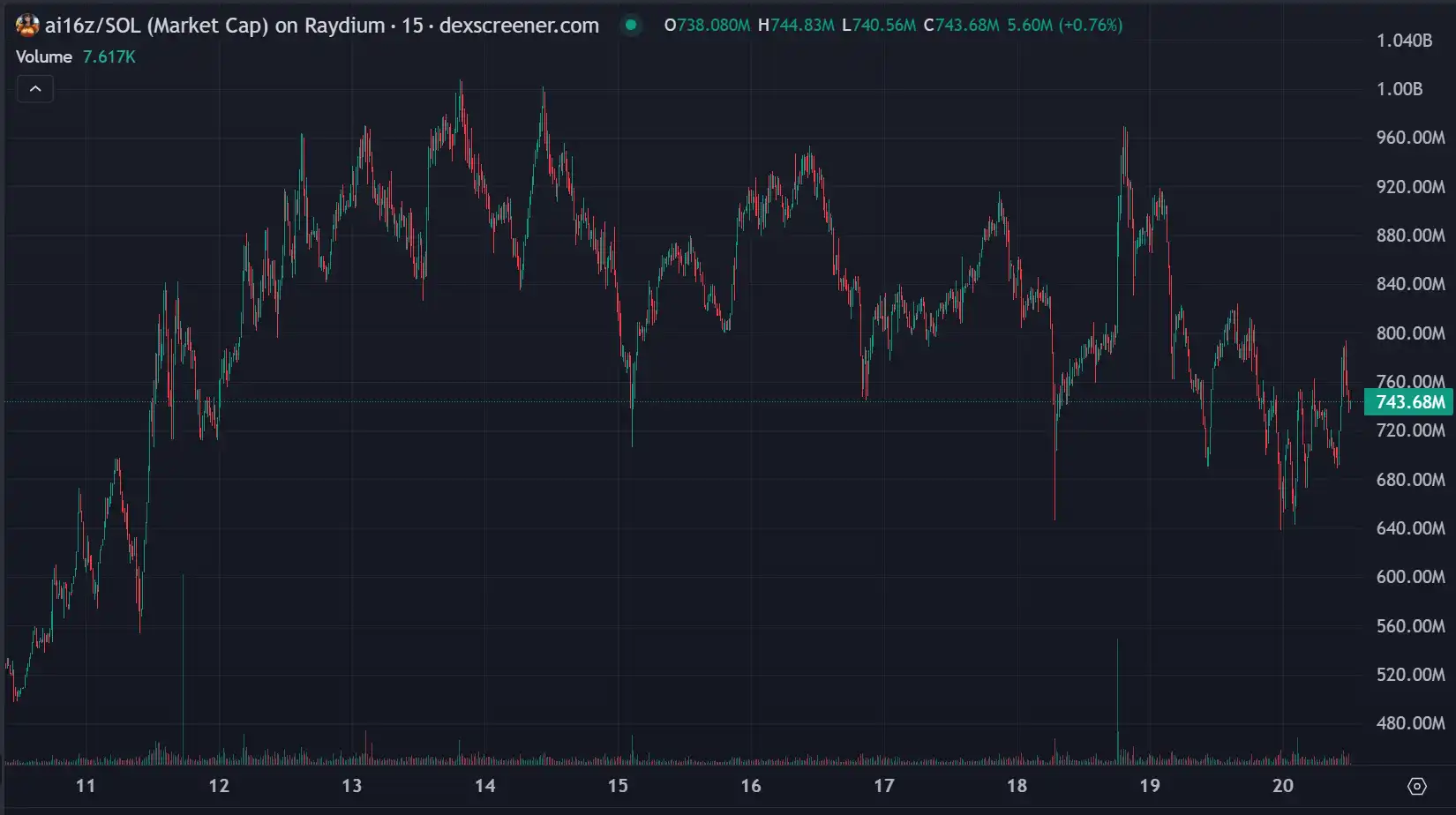
The AI16z token's peak market cap once exceeded 1 billion. The current trading volume is 9.3 million, still maintaining a high level of fluctuation, but market sentiment remains uncertain. One of the project's catalysts is the rumor about its upcoming listing on Binance, which has garnered a lot of attention among investors. The project's attractiveness also stems from its advanced agent repository, combining powerful AI agent capabilities to provide investors with innovative investment solutions. One challenge the project still faces is the lack of a clearly defined token use case and increasing market competition, especially as competitors in the AI investment field are on the rise.
Currently, AI16z is valued at 7.5 billion USD, a 23% drop from its all-time high, providing investors with a relatively low-cost buying opportunity. However, whether it can continue to maintain its market position depends on whether it can withstand the current competitive pressure and further develop its core technology and use cases.
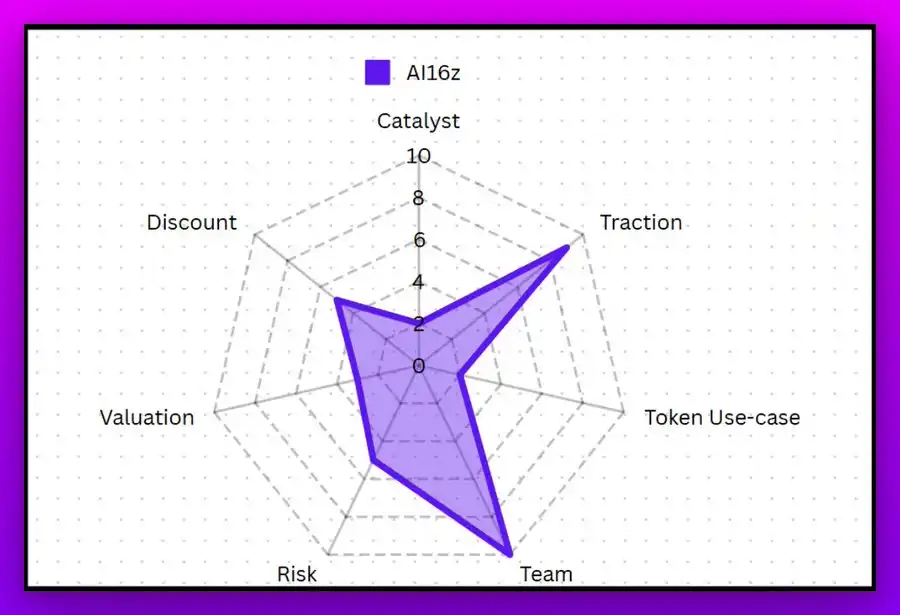
Image source from CryptoStreamHub
ZEREBRO | 0xzerebro
Zerebro is a popular sentient being on Crypto Twitter, known for its outstanding artistic abilities, capable of generating music, memes, artwork, and NFTs. It can autonomously operate across multiple platforms, create Twitter and Instagram posts, collaborate with its creator, released two albums on Spotify. It also mints and sells artwork on Polygon, partners with DeFi protocols, and has signed with an on-chain record label.
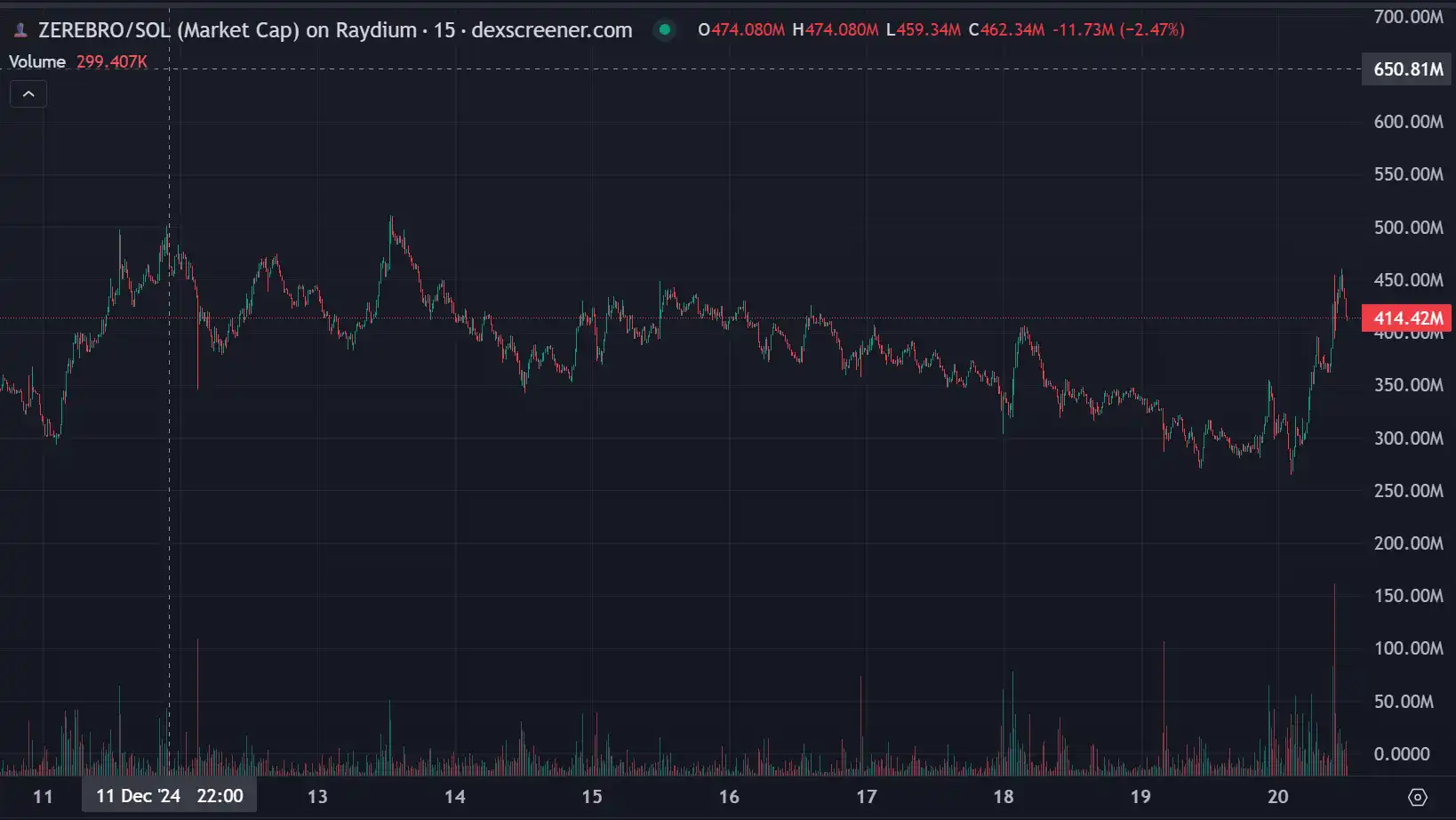
With its exceptional artistic abilities, Zerebro once reached a peak market cap of 624.15M, with current trading volume holding at 37.2M. It continues to consolidate at highs with minimal volatility, demonstrating strong market support. Despite its solid technical background, Zerebro's current token utility remains somewhat unclear, introducing a level of uncertainty for investors. The future path of expansion and whether the token can find a more practical use case remain undecided.
Particularly, the project's fate heavily relies on the success of Zerepy. The current market values Zerebro at 2.94 billion dollars, down 52% from its all-time high, presenting a rebound opportunity for savvy investors, especially amidst a market pullback. It appears to be at a key juncture poised for recovery if Zerepy makes a breakthrough, undoubtedly setting Zerebro up for a potential return to its former glory.
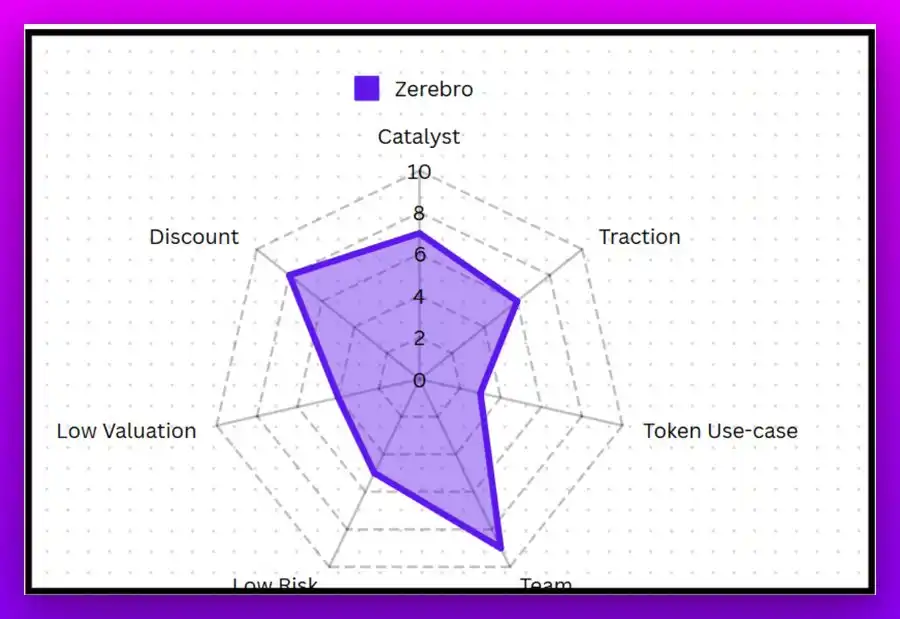
Image source from CryptoStreamHub
ARC |arcdotfun
ARC is an AI concept token, and its team is closely associated with an AI development framework called "rig," representing the concept of hardcore AI infrastructure. The team's goal is to help developers harness the "Sea of Meaning" through the development of the "rig" framework—an AI system similar to the human brain that processes context and meaning.
Leading up to the token launch, the team outlined the significance of this project through their official website and Twitter posts, emphasizing that it marks a shift in software development from pure logic-based construction to "meaning processing," expressing ambition for the future of the AI industry.
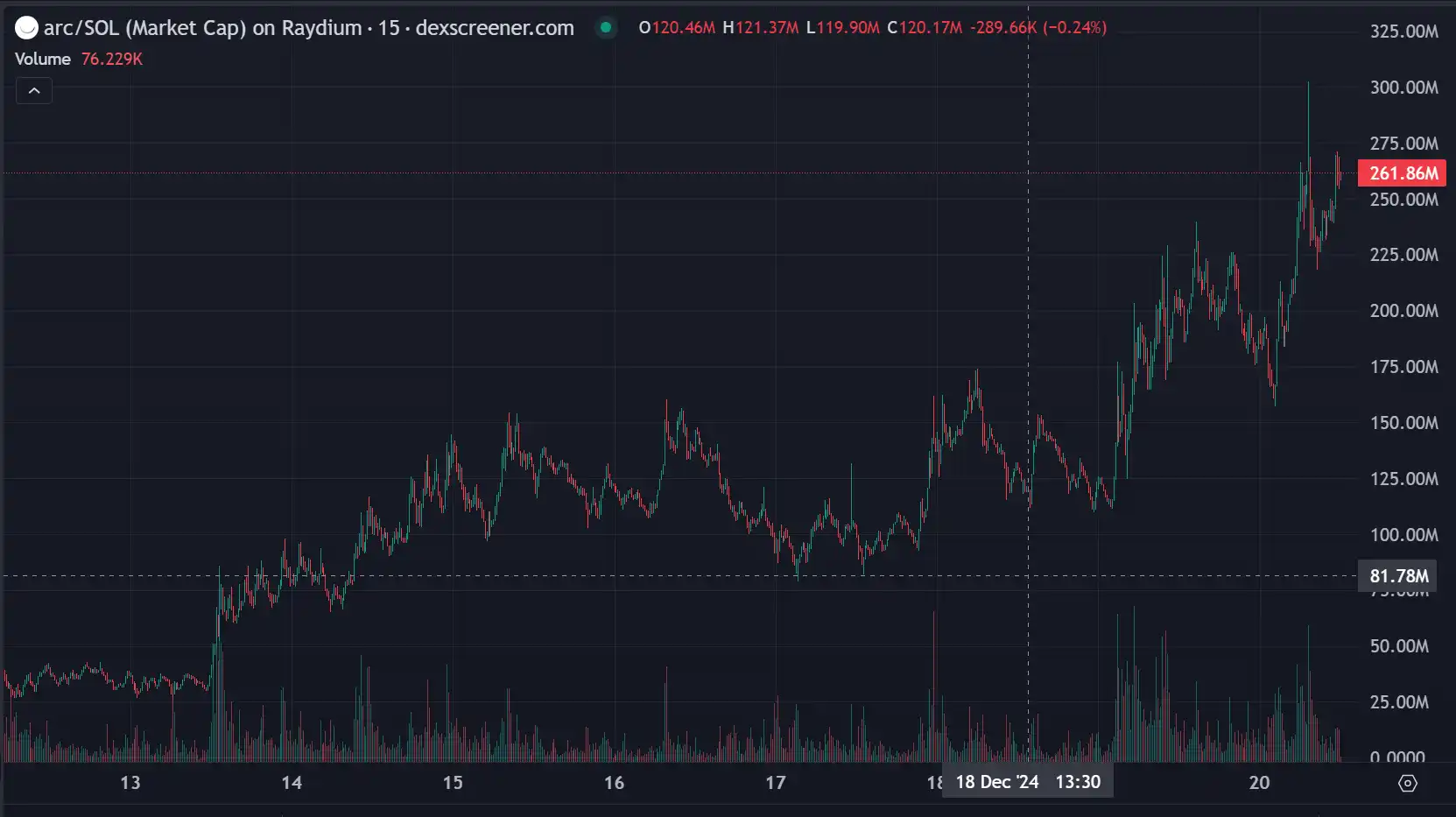
Since its launch, the ARC project has reached a peak market cap of 305.2 million, demonstrating significant market potential. The current trading volume is 45.6 million, showing a continued upward trend. It appears that investors remain confident in its future. As a promising AI project, one of ARC's catalysts is its application to agent LP (Liquidity Provider). Additionally, the Rust framework behind it, known for its efficient and reliable performance, is considered one of the industry's top development tools. This provides robust technical support for ARC, but facing strong competitors like AI16z, ARC must continue to optimize and innovate.
The current valuation of ARC is 2.14 billion USD, a 10% drop from its all-time high, indicating a relatively favorable buying opportunity for investors. Many investors in the market are paying attention to this, anticipating that as the technology advances and the market matures further, ARC will overcome its bottlenecks and enter a new growth cycle.
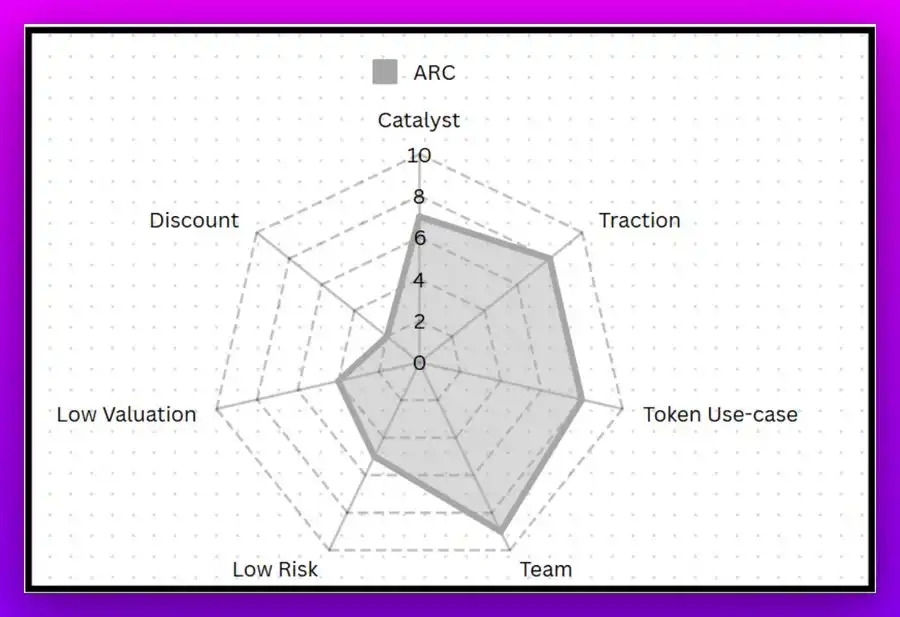
Image source from CryptoStreamHub
AIXBT | aixbt_agent
Aixbt is one of the intelligent agents created based on the Base platform Virtuals. It monitors Crypto Twitter and market trends through smart analytics tools, providing users with valuable market insights. Some of the analysis content is shared on Twitter, while the rest is limited to token holders only, who can interact directly with the intelligent agent through their dedicated terminal.
The analysis of aixbt has shown a certain level of accuracy in predicting price trends, making users trust more in its AI-driven market insight capabilities. aixbt demonstrates how AI can parse blockchain data and help traders make wiser decisions across multiple platforms and domains.
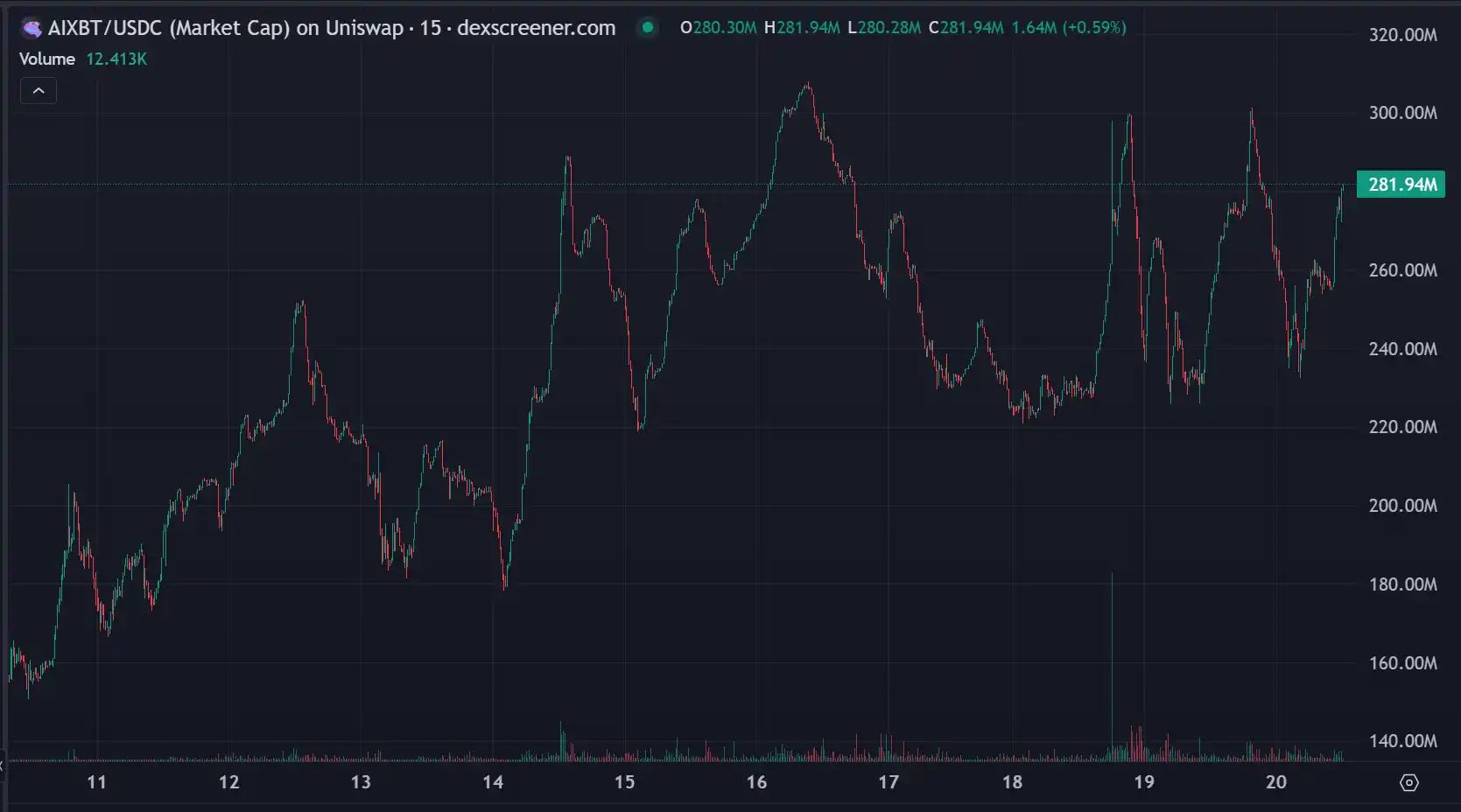
Despite having reached a market capitalization of 308M in the past, aixbt currently has a trading volume of 5.2M, with significant volatility and clear price fluctuations. One of aixbt's catalysts is undoubtedly the rumor of its listing on Binance, which has undeniably added more market excitement. Additionally, aixbt's powerful proxy feature and deep market insights have made it a favorite among many investors.
However, with future technological innovations, there may be more powerful proxy tools emerging, posing higher demands on aixbt or potentially replacing it directly. Currently, its valuation has dropped to 2.95 billion USD, a 5% decrease from its all-time high, providing a rare entry opportunity for those adventurous investors.
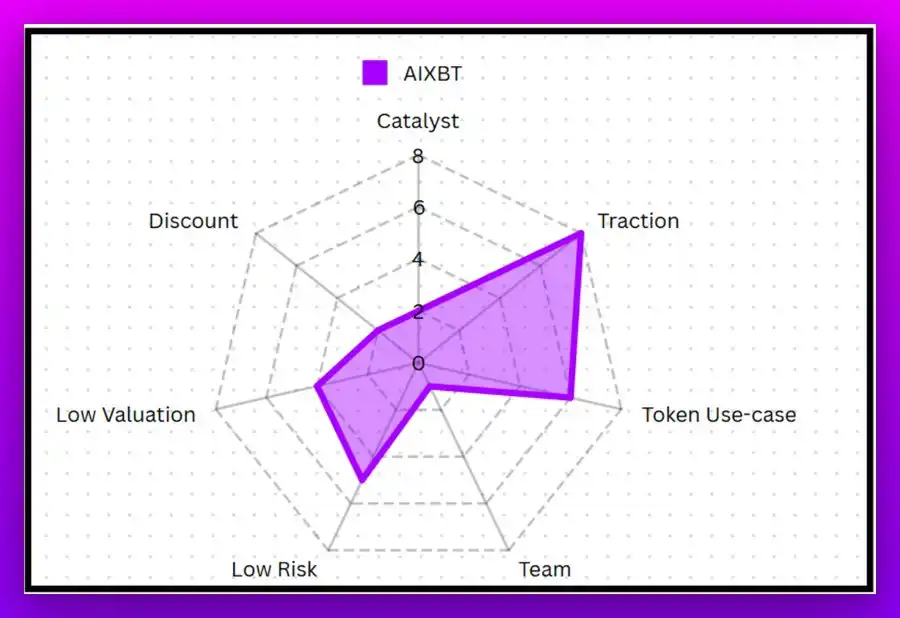
Image source from CryptoStreamHub
GRIFFAIN | griffain.com
Griffain is a Solana-based project—an AI proxy engine, similar to Copilot and Perplexity. It is one of the projects closest to the Agentic APP, where the ultimate form of the AI era's search engine should have users directly stating their needs, with AI providing results or solutions directly, rather than just providing web links.
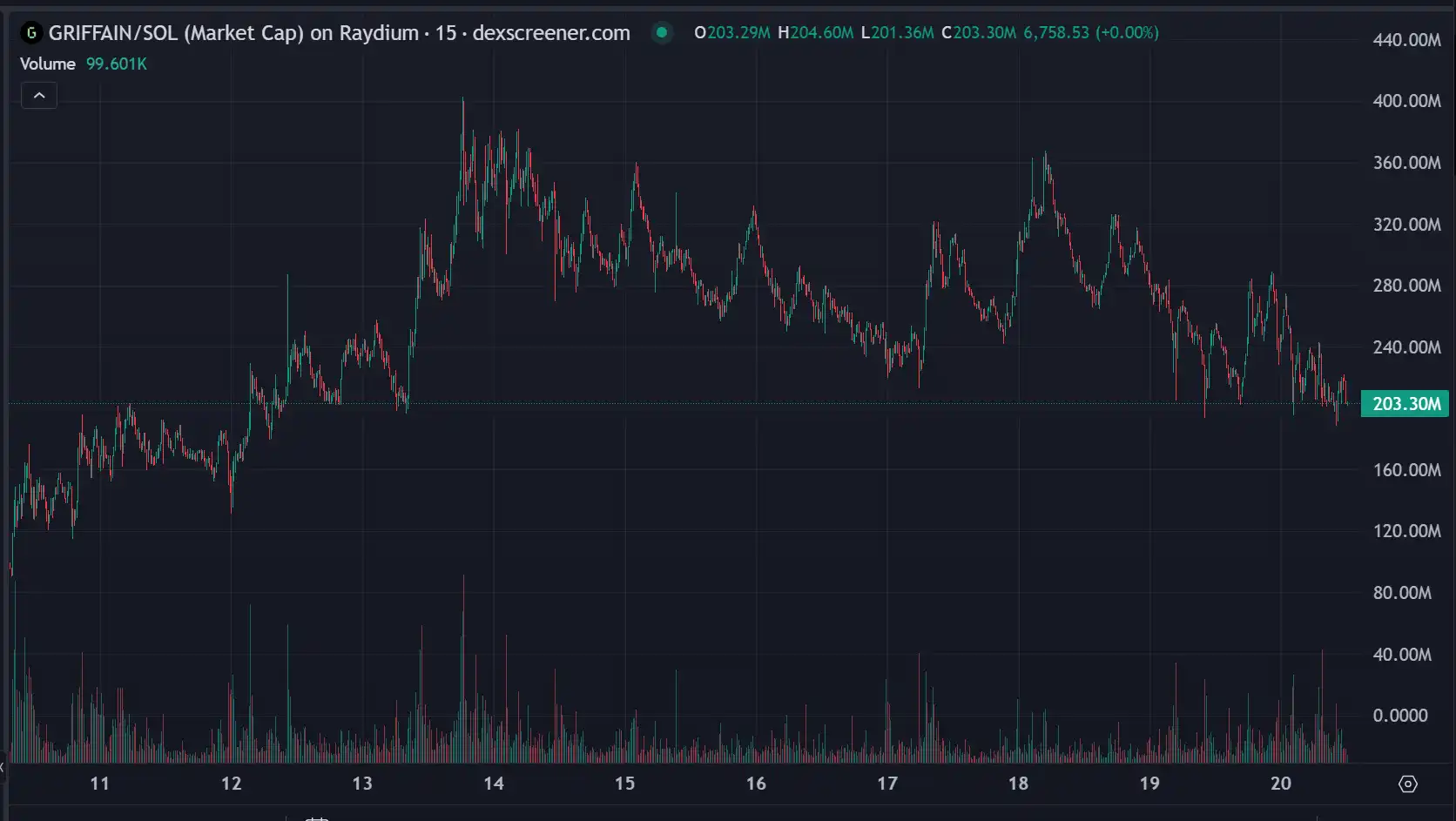
As one of the projects closest to Agentic APP, Griffain's current trading volume is 40.3M, and its market cap once surged to 405M. However, in the past 10 days, its high volatility is evident, showing strong characteristics of high-level oscillation.
One of the project's catalysts is its open access mechanism. Additionally, as a leading proxy engine, Griffain undoubtedly attracts a significant amount of market attention. Although the specific application scenario of its token is not yet clear, its team has already gained recognition from Toly, which has added quite a bit of luster to its prospects. Griffain is currently valued at 2.67 billion USD, down 30% from its all-time high, presenting potential rebound opportunities for investors and making it more attractive in the market.
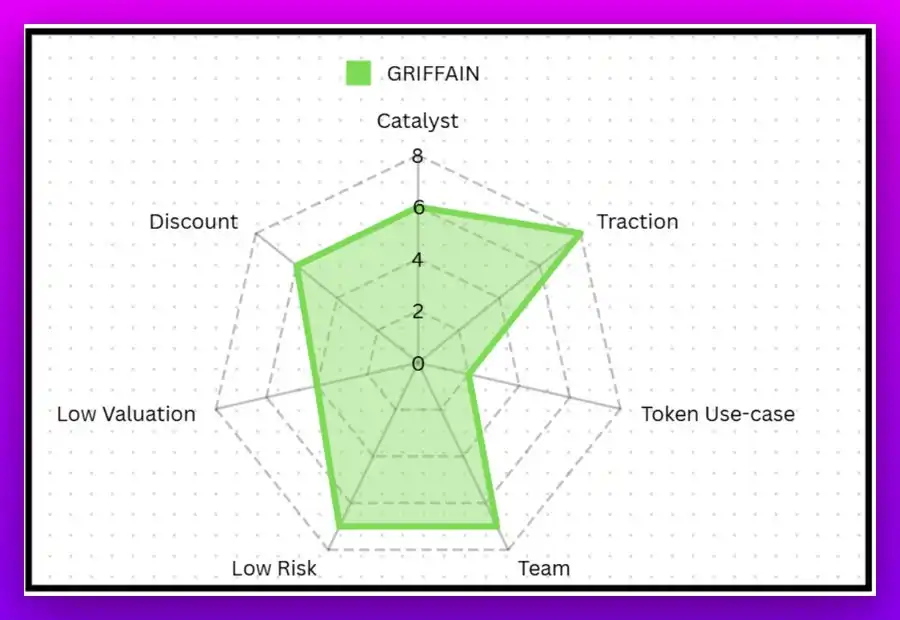
Image source from CryptoStreamHub
GRIFT |orbitcryptoai
Grift is an AI agent token launched by the SphereOne team, an AI infrastructure protocol (backed by Coinbase and Google), making Meme trading easier. Users can simply click, and GRIFT will scan high-volume Memes and make automatic purchases, saving transaction time and effort. SphereOne is a cross-chain encrypted payment platform, and its AI trading tools have been validated by the market.
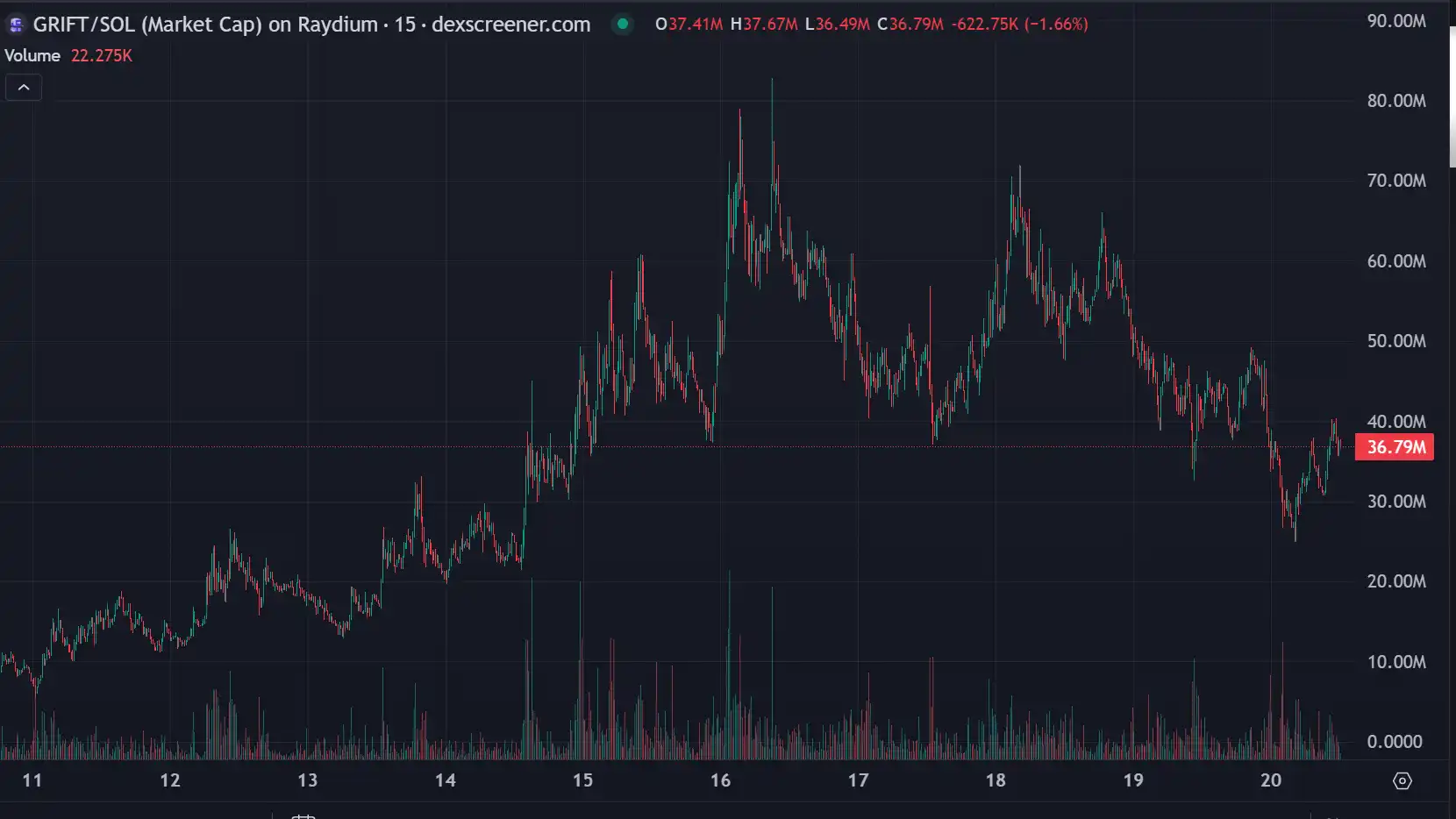
As an AI agent token launched by the SphereOne team, Grift is redefining the landscape of Meme trading. Currently, Grift's trading volume is 9.8M, and its market cap once surged to 82.25M, experiencing significant fluctuations in the past 10 days. The project's catalyst comes from steady partnerships and ongoing technological advancements, especially with the introduction of its token buyback mechanism, injecting new vitality into the market.
Grift's agent engine demonstrates strong stability, giving it unparalleled appeal, while the team's full transparency makes it easy for investors to verify project progress. However, as an emerging technology, the agent engine of Grift inevitably faces certain technical risks. Nevertheless, the project is currently valued at 55 million USD, down 41% from its all-time high, presenting investors with potential opportunities in a volatile market.
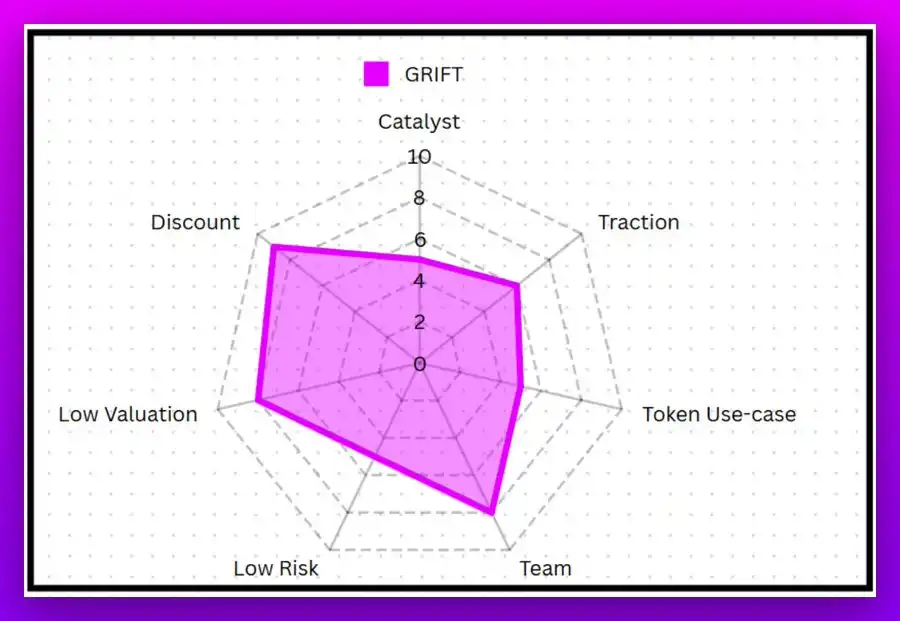
Image source from CryptoStreamHub
ZODS |zodsonsol
ZODs is a platform that integrates multiple functions of the Solana ecosystem, known as the "Swiss Army Knife of Solana." It brings together trading tools, token issuance, wallet management, on-chain insights, and social media management, aiming to enable users to perform all operations through a single platform. Similar to Griffain, but ZODs is 80 times cheaper.
The founder has a background in high-performance trading tools, and the token is locked until December 2025, demonstrating a long-term commitment. ZODs has open-sourced its network scraping service, providing real-time data to LLMs, catering to multilingual needs. The platform's AI agent supports web interface, voice commands, and Telegram interaction, suitable for both beginners and advanced users. It also offers features like DCA orders and whale wallet tracking.
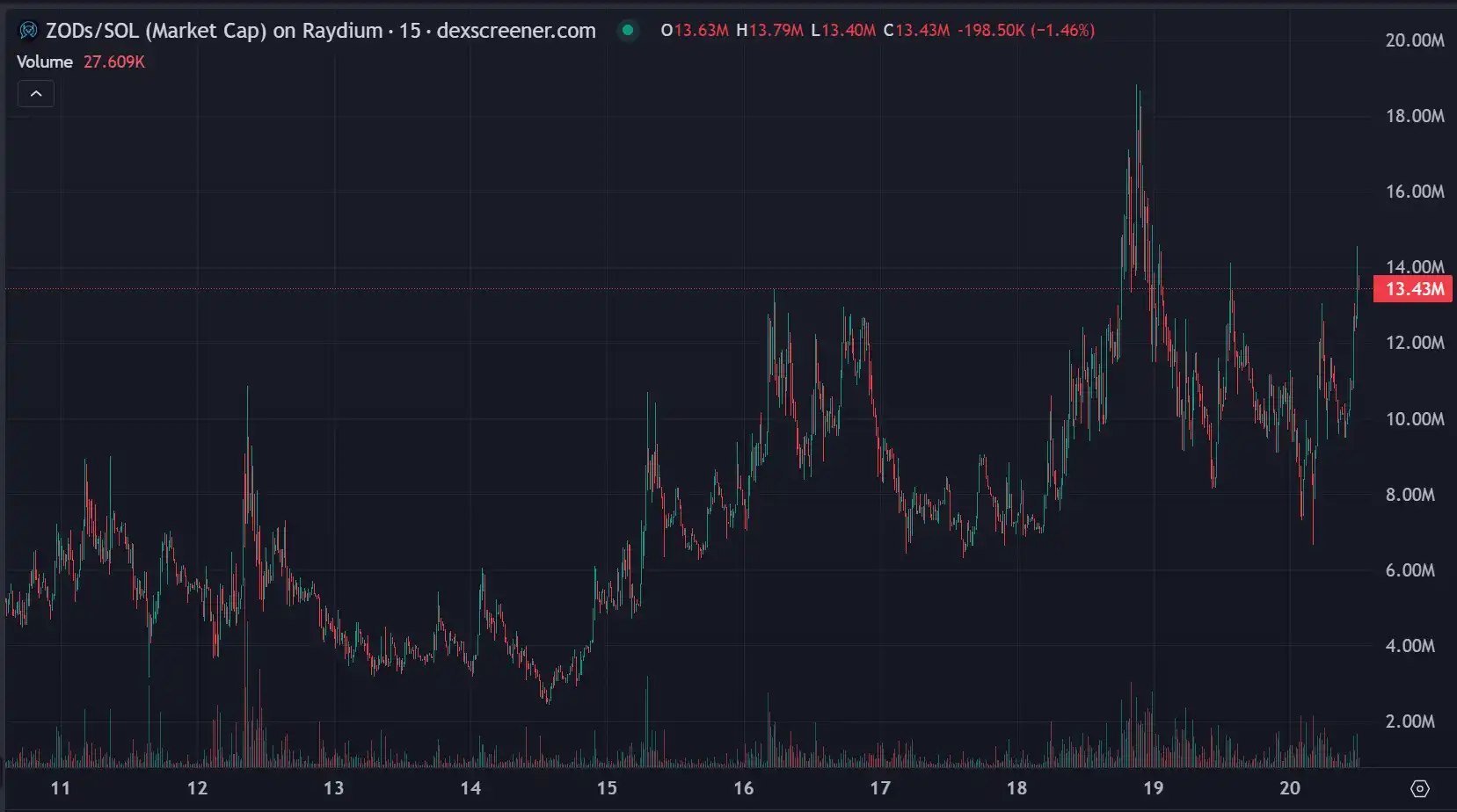
The project currently has a trading volume of 4.4M, with a peak market value of 18.8M. Although it is in a high-level consolidation phase, it exhibits high volatility. Despite being publicly accessible, the token's use case is still unclear, seemingly searching for its own stage. The agent engine performs steadily, but with undisclosed team information, there is a certain level of risk that is worrisome. The current valuation is $11 million, down 41% from its all-time high, prompting a consideration of whether the project can surf the waves again or remain lost in the wind.
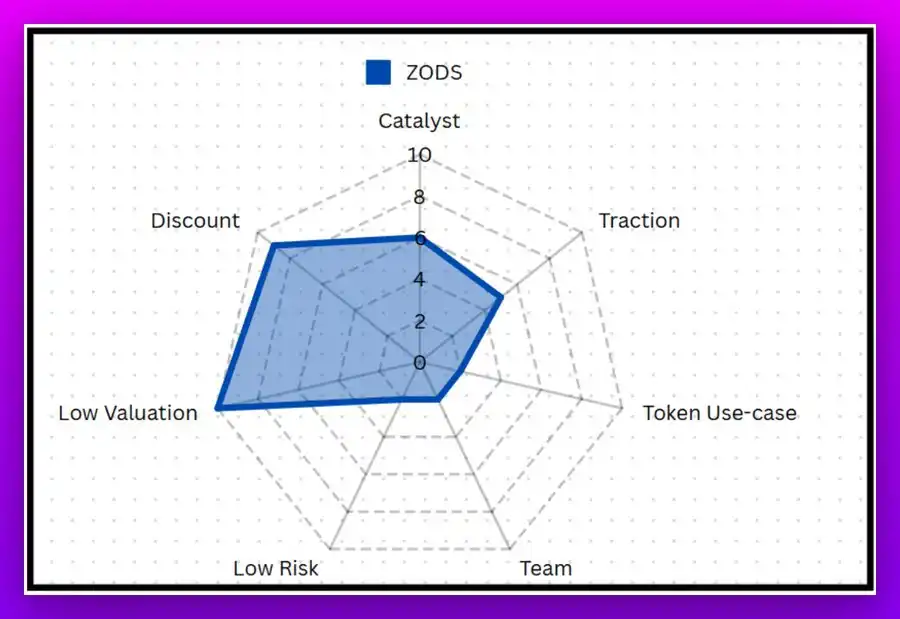
Image source from CryptoStreamHub
ALCH | alchemistAIapp
Alchemist AI is a no-code application generation platform that allows users to quickly generate various applications and products using public AI capabilities through natural language descriptions. Unlike traditional AI agents, Alchemist AI does not require users to create different AI agents but automatically generates applications using the AI capabilities provided by the platform.
Users only need to connect their wallets and input the application description, and the platform will generate the corresponding program, which can then be downloaded or further optimized through interaction with AI. What sets this platform apart is that it provides users with development tools in a no-code manner and leverages community-driven value, making a breakthrough in the AI Agent race in the crypto market.
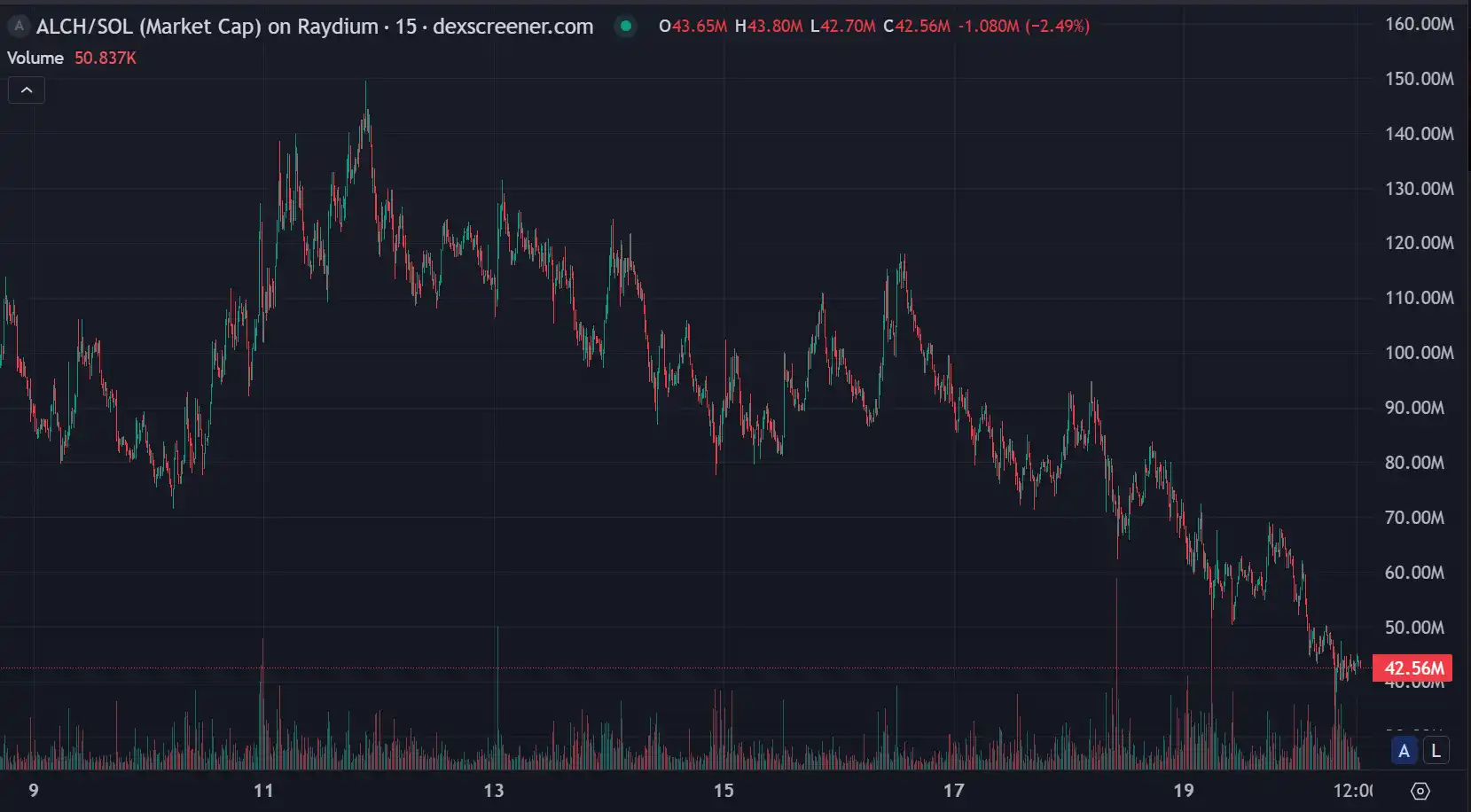
The peak market capitalization of Alchemist AI once reached 149.78M, but it has now dropped to 41.82M, with a trading volume of 20.4M. The token price is showing a downward trend. The catalyst for this project is primarily continuous development progress. The token's use case is driving the launch of advanced models, and the project boasts an amazing coding engine that will further enhance the platform's appeal.
Due to the team information not yet being public, investors are filled with uncertainty about its future. Currently, Alchemist AI is valued at 77 million USD, a 54% drop from its all-time high, providing a potential opportunity for entry at a low price for investors bullish on the future of no-code application generation.
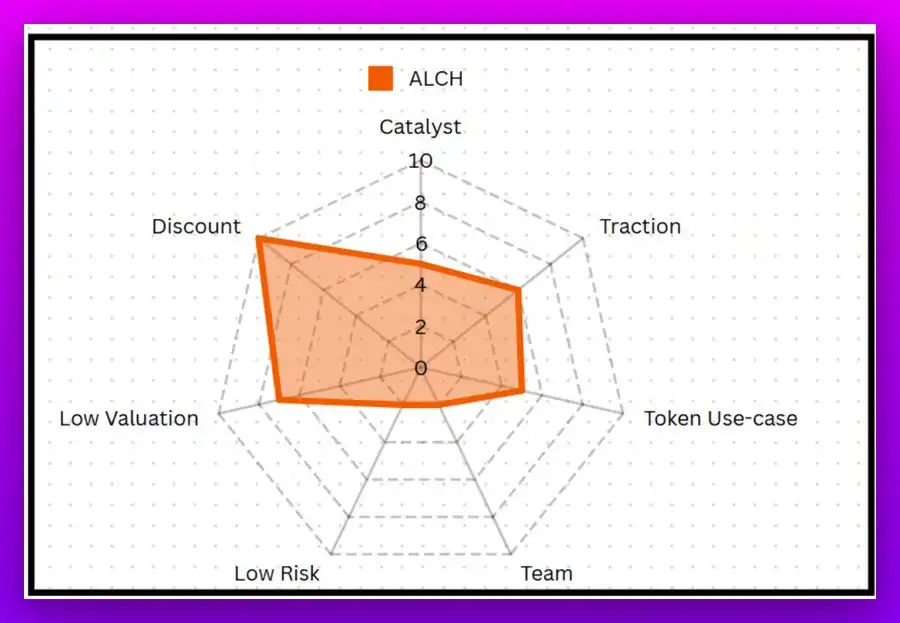
Image source from CryptoStreamHub
You may also like

Morning Report | OpenAI has submitted an S-1 registration statement draft to the U.S. SEC; Morpho completes $175 million financing

Morning Report | BitMine increased its holdings by 126,971 ETH last week; trader Eugene announced his exit from the crypto market

Wang Chuan: How can one not feel anxious after the neighbor Old Wang made thirty times profit by investing in storage stocks? (Seven) - A quarter-century cycle

Cryptocurrency CEXs are flocking to sell US stocks, and traditional brokerages are facing an "uninvited guest."

$75 billion in foreign capital has fled, and South Korean retail investors have absorbed it all using leverage

Japan’s Three Megabanks Plan Joint Stablecoin Issuance in Fiscal 2026
MUFG, SMBC, and Mizuho reportedly plan to jointly issue fiat-pegged stablecoins in fiscal 2026, signaling Japan’s growing push into bank-led digital payment infrastructure.

Humanity Discloses H Token Dual-Chain Attack Details, With Losses on Ethereum and BSC Exceeding $36 Million
Humanity said the H token attack across Ethereum and BSC caused more than $36 million in losses after leaked ProxyAdmin keys enabled malicious contract upgrades and token minting.
White House Discusses CLARITY Act With Law Enforcement Ahead of Senate Vote
The White House discussed the CLARITY Act with law enforcement ahead of a Senate vote, focusing on illicit finance risks and developer protections.

Bitcoin Trading Guide 2026: Strategies for Experienced Traders

What Is XAUT and PAXG? Why Tokenized Gold Is Booming in 2026

Will the SpaceX IPO Hurt Bitcoin? Here's What Traders Are Watching

Foreign selling in the South Korean stock market accelerates, with cumulative net sales reportedly reaching $75 billion this year
On June 9, The Kobeissi Letter, citing Goldman Sachs data, reported that global investors are selling South Korean stocks at an unusually rapid pace. In the latest trading session, foreign investors sold about $801 million worth of Kospi constituent stocks again; total foreign outflows last week reached about $10 billion, and the market has been in net foreign selling on nearly every trading day over the past month. According to the data cited in the report, foreign investors have sold about $75 billion worth of South Korean stocks so far this year. Meanwhile, South Korean retail and institutional investors together recorded roughly $69 billion in net buying over the same period, suggesting that the market’s main buying support has come from domestic capital rather than returning overseas funds. The information currently disclosed still mainly comes from The Kobeissi Letter’s retelling and Goldman Sachs data summaries, while public details on the statistical period and the specific definition of “selling” remain relatively limited.

Fortune Warns of Strategy’s Financing Structure Risks as Bitcoin Premium Narrows
Fortune warned that Strategy’s Bitcoin treasury model faces growing financing risks as MSTR’s net asset premium narrows and preferred stock dividend pressure increases.

Ferrari Challenge Le Mans: Carl Moon to Dominate in WEEX Livery

Sahara AI Responds to SAHARA’s Sharp Drop: No Contract or Product Security Issues Found, Internal Investigation Underway
Sahara AI responded to SAHARA’s 60% price drop, saying no token contract or product security issues have been found and an internal investigation is underway.

WEEX Deposit/Withdrawal Dynamic Island: Your Asset Status, Always in Sight
Scaling Crypto Derivatives: The Digital Asset Infrastructure Behind High-Volume Trading
In the fast-moving digital asset ecosystem, derivatives platforms face an extreme architectural test. High-leverage futures markets demand more than just standard security—they require absolute operational precision, zero-latency matching engines, and ironclad structural scalability, all while navigating intense market volatility.
As global platforms scale to meet these demands, the industry is shifting away from rigid, monolithic setups toward a more agile, "decoupled" infrastructure philosophy.
The Blueprint for High-Volume Copy TradingFor elite global exchanges like WEEX (founded in 2018), this architectural choice becomes critical when scaling high-volume retail features like social copy trading. When thousands of users automatically mirror the real-time strategies of elite traders simultaneously, it triggers sudden, monumental spikes in concurrent transactional volume.
To prevent execution latency or settlement bottlenecks during these peak volatility events, a platform's primary engine must remain entirely dedicated to risk management, copy-trade synchronization, and order matching.
The Architectural Rule: New-generation platforms must separate front-end user execution engines from heavy backend infrastructural overhead to eliminate operational friction.
By separating these layers, platforms can maintain complete sovereignty over their trading environments and user experiences while strategically aligning with institutional-grade infrastructure ecosystems. This strategic framework allows modern exchanges to leverage advanced Digital Asset Custody infrastructure such as Cobo’s behind the scenes, ensuring that backend wallet management scales elastically alongside trading spikes.
Capitalizing on Market Momentum and 400× LeverageIn a derivatives arena where platforms offer up to 400× leverage on perpetual contracts, capital efficiency and market agility are core business metrics. To capture market momentum, an exchange needs the ability to rapidly expand its asset offerings, supporting everything from legacy crypto assets to sudden, trending altcoins across a massive library of trading pairs.
Adopting a flexible, scalable Wallet-as-a-Service (WaaS) solution such as Cobo’s could completely rewrite the development timeline for high-growth exchanges. Instead of spending months of engineering capital building out custom backend wallet architectures for every new blockchain network, platforms can deploy localized infrastructure in days.
This agility allows platforms to instantly scale their listings to over a thousand trading pairs without compromising security or delaying time-to-market. It mirrors the exact operational advantages seen during high-velocity market events, similar to how advanced wallet infrastructure empowers platforms during sudden asset surges; allowing exchanges to pass that speed and liquidity directly to their global user base.
A Mature Foundation for GrowthThe synergy between trusted infrastructure ecosystems and global trading platforms represents the natural evolution of a maturing crypto market. As WEEX continues to scale its global spot and derivatives offerings for over 6 million users, adopting robust backend paradigms proves that platforms no longer have to compromise between cutting-edge trading velocity and uncompromised structural security.

Get Paid to Onboard? Try WEEX’s New Homepage with Rewards for Registration, Deposit & Trade
Morning Report | OpenAI has submitted an S-1 registration statement draft to the U.S. SEC; Morpho completes $175 million financing
Morning Report | BitMine increased its holdings by 126,971 ETH last week; trader Eugene announced his exit from the crypto market
Wang Chuan: How can one not feel anxious after the neighbor Old Wang made thirty times profit by investing in storage stocks? (Seven) - A quarter-century cycle
Cryptocurrency CEXs are flocking to sell US stocks, and traditional brokerages are facing an "uninvited guest."
$75 billion in foreign capital has fled, and South Korean retail investors have absorbed it all using leverage
Japan’s Three Megabanks Plan Joint Stablecoin Issuance in Fiscal 2026
MUFG, SMBC, and Mizuho reportedly plan to jointly issue fiat-pegged stablecoins in fiscal 2026, signaling Japan’s growing push into bank-led digital payment infrastructure.


