
focEliza Revealed: The TEE Eliza Verifiable Log Plugin


Original Author: CP, Artela Founder
0) TL;DR Version
The first step in achieving full on-chain Eliza: Don't trust, verify! Run Eliza in a TEE, freeing it from human manipulation to execute based on Eliza's own code.
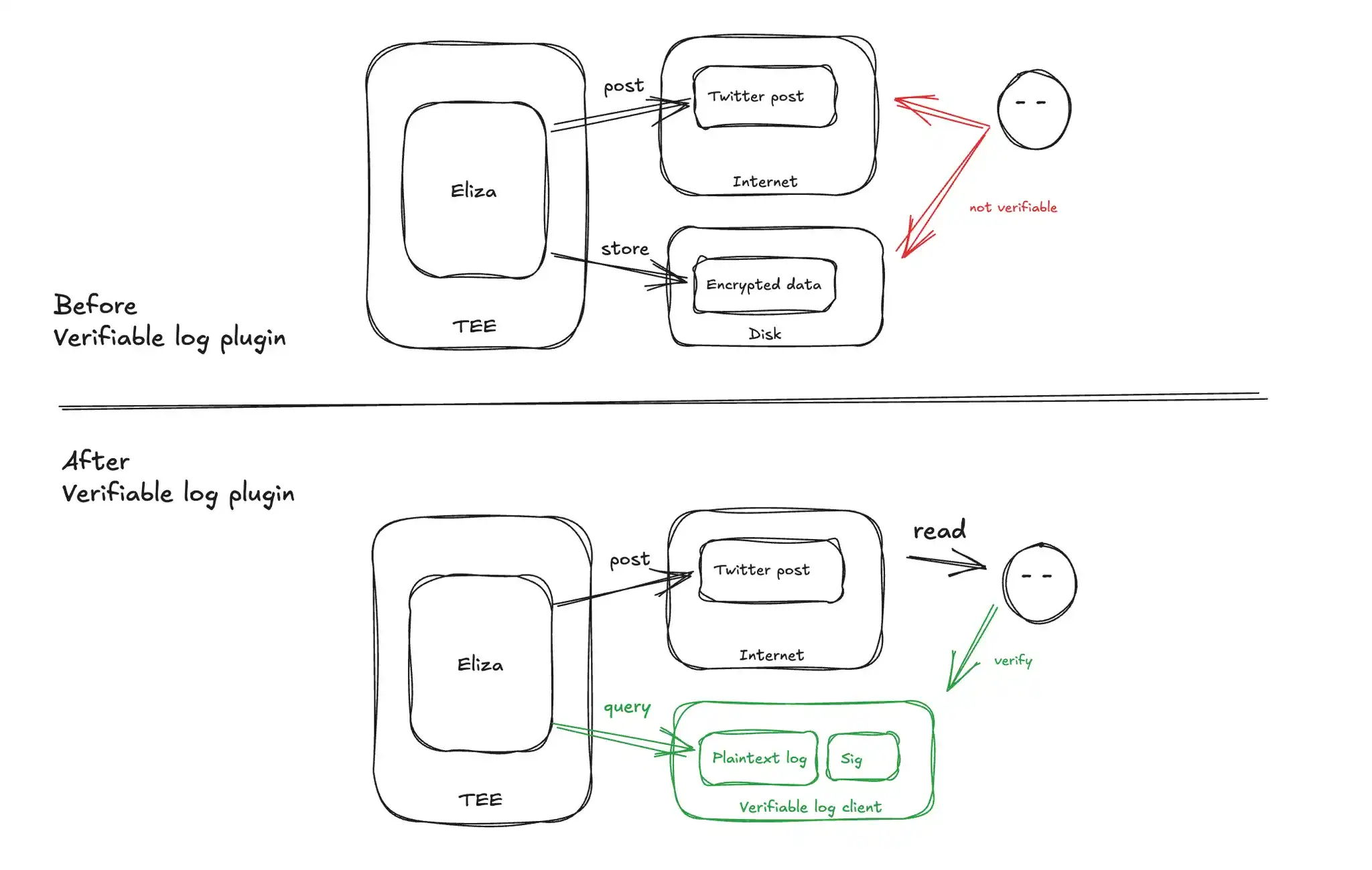
So, how does the outside world know what Eliza specifically did? Further development is needed: the outside world can read Eliza's execution log, and these logs can be verified to come from Eliza within the TEE. Eliza must sign these logs using a key pair derived from the TEE, allowing the logs to be verifiable as originating from Eliza inside the TEE.
focEliza's plugin plugin-tee-verifiable-log achieves this: it derives a key pair from the TEE specifically for signing logs. Logs generated using this key pair (including received and responded AI messages, as well as executed operations) are signed to create verifiable logs and stored in a database. It also provides an RPC interface, allowing external entities to:
· Obtain the AI agent's verifiable log public key through remote attestation.
· Query these verifiable logs, and verify the signatures using the public key to confirm that the AI agent executed the corresponding operations.
Verifiability is the cornerstone of achieving a fully on-chain AI agent, making magic a reality!
1) Starting From One Question!
A developer has deployed an Eliza AI agent on their server and launched a webpage for users to interact with.
Now, how do you distinguish if the entity you are interacting with is indeed responding from the AI agent (referring to Eliza + LLMs) and not artificially from the developer behind the scenes?
2) Is This Question Important?
This question is sometimes important and sometimes not.
· Sometimes not important: For example, a chatbot helping with article writing. As long as you get the desired content, it might not matter whether the response comes from an LLM or a human.
· Sometimes Somewhat Important: For example, when a trading bot manages your transactions. You need to transfer funds to a wallet controlled by an AI agent, and at this point, you will be concerned whether the decision was made by the running program rules of the LLM or by a human operator who may have malicious intent.
· Sometimes Very Important: When fairness is involved, this issue becomes extremely critical. For instance, an AI agent managing a community and distributing rewards to contributors. As the community grows and the value of rewards increases, the risk of human corruption or manipulation leading to unfair outcomes significantly escalates.
3) Eliza can now prove through verifiable logs what operations it executed!
Eliza running in a TEE operates independently of human control and performs tasks according to its own code.
However, to let external parties know exactly what Eliza accomplished, further functionality is required: external parties need access to Eliza's operation logs, and these logs must be verifiable to indeed originate from Eliza within the TEE.
The plugin-tee-verifiable-log achieves these functionalities and accomplishes the following tasks:
· Key Pair Derivation: Derives a key pair within the TEE dedicated to signing logs.
· Remote Attestation: Embeds the public key in a remote attestation report, allowing external parties to retrieve and verify that it indeed comes from Eliza within the TEE.
· Log Signing: Signs the logs generated during Eliza's operation (including messages sent and received, as well as actions taken) using the key and stores them in a database.
· Verifiability: External parties can use the public key from remote attestation to verify these logs, ensuring that certain operations were indeed performed by TEE Eliza.
· Queryability: External parties can subscribe to the latest verifiable logs or query specific logs based on message content.
What are the implications of the verification results?
· Passed: The operation was indeed carried out by Eliza.
· Failed: The operation may not have been carried out by Eliza. For example, logs could have been intercepted (e.g., deleted) during transmission to the client, preventing the external party from confirming whether Eliza performed a specific operation.
4) Enable the plugin-tee-verifiable-log for your Eliza!
focEliza is a set of plugins designed for a fully on-chain AI agent based on Eliza. It is fully compatible with Eliza, which means that any AI agent running on Eliza can achieve full on-chain functionality through the integration of focEliza!
If you are interested in a verifiable, fully on-chain autonomous AI agent, feel free to give it a try!
5) Closing
We are thrilled to build a fully on-chain autonomous AI agent based on Eliza and TEE. This is the first TEE plugin released by focEliza, and we have submitted a PR to the @ai16zdao and @shawmakesmagic teams. Looking forward to having more developers join us!
Feel free to check out our code.
6) focEliza's Next Feature: On-chain State! Achieving Autonomous Operation!
The Eliza running in TEE holds private keys and sensitive data. However, it relies on a physical machine that supports TEE to operate. If the administrator shuts down the machine, the "life" of the AI agent may be permanently terminated, and the managed assets and data may be lost forever.
To address this issue, we need to encrypt the key "life" data of the AI agent in the TEE, such as role definitions, short-term/long-term memory, and key storage. Then, upload this data to the blockchain or a DA network.
If the TEE hosting the AI agent is shut down, another TEE machine should be able to download the encrypted data, decrypt it, and restore the "life" of the AI agent to seamlessly continue its operation.
You may also like

SpaceX vs Tesla vs xAI: Which Elon Musk Trade Has the Biggest Upside in 2026?

OpenAI Reveals It Has Confidentially Submitted an S-1 to the SEC, Keeping the Door Open for a Future IPO
On June 9, according to an OpenAI announcement, the company recently confidentially submitted a draft S-1 registration statement to the U.S. Securities and Exchange Commission (SEC), beginning the preliminary compliance process for a potential initial public offering. OpenAI said it chose to disclose this proactively because it expected the news might leak; however, the company has not yet set a specific listing timeline, and related arrangements may still take some time.

Latest research from 13 top universities including Cornell University: The current state, challenges, and misconceptions of the fusion of Crypto and AI
Deconstructing Anthropic: The Best AI Company, Possibly Also a Type of Organizational Invention
Apollo and Blackstone Reportedly Back $35 Billion Anthropic Chip Financing as Deal Details Remain Unclear
On June 9, according to currently available news alerts, Apollo and Blackstone Group participated in a $35 billion financing for an Anthropic “chip project.” Based on the original wording of the report, the funding has already been raised, but public information remains limited. The financing structure, use of proceeds, project entity, and whether Apollo and Blackstone participated through equity, debt, or project financing have not yet been disclosed.

Humanity Protocol Security Incident Escalates: More Than $31 Million Stolen From Related Addresses as Attacker Continues Selling H for ETH
On June 9, according to monitoring by Onchain Lens, more than $31 million has been stolen from addresses linked to Humanity Protocol, and the attack is still ongoing, with the hacker continuously swapping H tokens for ETH. Project founder Terence Kwok later confirmed the security incident on X, saying the issue involved a private key leak.

Bloomberg: As Bitcoin Weakens, Stablecoins and RWA Continue to Drive Expansion in Crypto Businesses
In June, Bloomberg reported that despite Bitcoin falling below $60,000 last week, wiping out about $235 billion in market value within seven days, and dropping close to 50% from last year’s peak, some core businesses in the crypto industry are still expanding, mainly in stablecoins, real-world asset tokenization (RWA), payments, and infrastructure. The report also noted that overall altcoin activity has contracted significantly: altcoin market capitalization has fallen from a peak of about $431 billion in November 2021 to around $170 billion, and among the tens of millions of tokens issued in recent years, fewer than 1,700 still maintain meaningful trading activity.

Galaxy Deep Research Report: How Hyperliquid's HIP-4 Upgrade Changes the Landscape of Prediction Markets?
Binance Research: RWA Market Expected to Expand Nearly 6x from Early 2025, with Public Equities and Onchain Payments Heating Up Together
In June, Binance Research said in its monthly market report that the real-world asset (RWA) market is expected to grow by about 589% from the beginning of 2025. Bond- and money market fund-related RWA expanded by about $6.5 billion, up 83% year over year, while publicly traded equity RWAs grew by about 422%. The report also noted that monthly crypto debit card transaction volume exceeded $747 million in May, up 48.6% year to date.

Japan to Assess a Framework for Yen Stablecoins and Crypto ETFs as Asia’s Compliant Payments Narrative Heats Up
Recently, according to the original report, Japan is considering the launch of yen stablecoins and cryptocurrency ETFs. Public information remains limited at this stage, and there is still no complete policy text, regulatory draft, or clear implementation timeline, so this is better characterized as a “policy discussion” rather than formal implementation. The original wording also noted that advancing stablecoin regulation in Asia is driving XRP usage and supporting growth in the XRPL ecosystem. However, based on currently available public information, there is not enough evidence to directly establish a clear causal relationship between this round of discussion in Japan and XRP or XRPL.

ZachXBT: Humanity private key leak and abnormal surge in H token should be viewed separately
On June 9, according to related disclosures, on-chain investigator ZachXBT posted an update on Humanity’s roughly $31 million security incident, saying that after further analyzing fund flows, he currently tends to believe the project team was not involved in an “inside job” or a self-staged attack. According to him, the official explanation about the private key leak was broadly accurate, but before the token unlock, the price of H had been artificially pushed higher, and the hacker later took advantage of that market environment; therefore, the private key leak and the earlier abnormal price pumping should be regarded as two separate and independent events. This reframing has shifted the market’s understanding of the nature of the incident. Earlier discussion around Humanity had focused on whether the team directly participated in the attack or used the security incident to cover up internal operations. ZachXBT’s latest remarks shift the focus from “whether it was self-theft” to “whether there were pre-unlock market structure issues.” He also questioned whether the team may have.

Morning Report | OpenAI has submitted an S-1 registration statement draft to the U.S. SEC; Morpho completes $175 million financing

Morning Report | BitMine increased its holdings by 126,971 ETH last week; trader Eugene announced his exit from the crypto market

Wang Chuan: How can one not feel anxious after the neighbor Old Wang made thirty times profit by investing in storage stocks? (Seven) - A quarter-century cycle
Cryptocurrency CEXs are flocking to sell US stocks, and traditional brokerages are facing an "uninvited guest."
$75 billion in foreign capital has fled, and South Korean retail investors have absorbed it all using leverage

Japan’s Three Megabanks Plan Joint Stablecoin Issuance in Fiscal 2026
MUFG, SMBC, and Mizuho reportedly plan to jointly issue fiat-pegged stablecoins in fiscal 2026, signaling Japan’s growing push into bank-led digital payment infrastructure.

Humanity Discloses H Token Dual-Chain Attack Details, With Losses on Ethereum and BSC Exceeding $36 Million
Humanity said the H token attack across Ethereum and BSC caused more than $36 million in losses after leaked ProxyAdmin keys enabled malicious contract upgrades and token minting.
SpaceX vs Tesla vs xAI: Which Elon Musk Trade Has the Biggest Upside in 2026?
OpenAI Reveals It Has Confidentially Submitted an S-1 to the SEC, Keeping the Door Open for a Future IPO
On June 9, according to an OpenAI announcement, the company recently confidentially submitted a draft S-1 registration statement to the U.S. Securities and Exchange Commission (SEC), beginning the preliminary compliance process for a potential initial public offering. OpenAI said it chose to disclose this proactively because it expected the news might leak; however, the company has not yet set a specific listing timeline, and related arrangements may still take some time.
Latest research from 13 top universities including Cornell University: The current state, challenges, and misconceptions of the fusion of Crypto and AI
Deconstructing Anthropic: The Best AI Company, Possibly Also a Type of Organizational Invention
Apollo and Blackstone Reportedly Back $35 Billion Anthropic Chip Financing as Deal Details Remain Unclear
On June 9, according to currently available news alerts, Apollo and Blackstone Group participated in a $35 billion financing for an Anthropic “chip project.” Based on the original wording of the report, the funding has already been raised, but public information remains limited. The financing structure, use of proceeds, project entity, and whether Apollo and Blackstone participated through equity, debt, or project financing have not yet been disclosed.
Humanity Protocol Security Incident Escalates: More Than $31 Million Stolen From Related Addresses as Attacker Continues Selling H for ETH
On June 9, according to monitoring by Onchain Lens, more than $31 million has been stolen from addresses linked to Humanity Protocol, and the attack is still ongoing, with the hacker continuously swapping H tokens for ETH. Project founder Terence Kwok later confirmed the security incident on X, saying the issue involved a private key leak.


