
From Stablecoins to Consumer Finance, ENA is Gaining New Valuation Logic

 Prefer us on Google


TL;DR
· The core advantage of Ethena Pay is not just card issuance, but the ability to directly convert user funds into USDe while gaining access to payment gateways and underlying stablecoin yields.
· This allows Ethena to reinvest more revenue into cashback, fees, and user growth, making Pay a new consumer distribution channel for USDe.
· With the approval of the ENA fee switch, the growth of USDe is beginning to establish a more direct connection with ENA buybacks, clarifying the value capture path for ENA. However, this business closed loop is still in its early stages.
· Ethena Pay currently has limited scale, and what truly needs validation is whether the consumer business can scale and whether USDe can reach the $7.5 billion threshold to trigger buybacks.
In the past year, Crypto Neobanks have gradually become one of the most important consumer applications for stablecoins.
Stablecoins have addressed some issues related to global dollar accounts, cross-border transfers, and on-chain savings, while the proliferation of crypto debit cards has further integrated on-chain assets into everyday consumption scenarios. Data from Blockworks shows that in the first week of September, the weekly spending on crypto debit cards tracked reached a record $283 million, a year-on-year increase of over 200%.
However, as more projects begin to launch "stablecoin accounts + debit cards," the focus of industry competition is also shifting.
Issuing a card is no longer a challenge in itself. What truly determines whether a Crypto Neobank can succeed is its ability to acquire users at a sufficiently low cost and continuously generate revenue from the funds that users keep over the long term.
This is precisely where Ethena Pay deserves attention.
Ethena Pay's Advantage is More Than Just a Debit Card
The revenue structure of traditional Crypto Neobanks is usually not complex.
Users deposit USDC or USDT into their accounts and spend through debit cards, with the platform earning interchange fees from payment transactions. To attract users, platforms often need to allocate a significant portion of these fees for cashback, rewards, and subsidies, and then further increase per-user revenue through trading, lending, subscriptions, and other services.
The biggest problem with this model is that the most important part of the economic value in user accounts does not belong to the Neobank itself.
If users hold USDC, the interest generated from the underlying reserve assets is primarily earned by Circle; if using USDT, the related earnings are mainly captured by Tether. For financial applications built on stablecoins, although users keep their funds within their products, a significant portion of the earnings generated by user funds is still taken by upstream stablecoin issuers.
Ethena Pay starts from a different point. Funds entering Ethena Pay are converted into USDe, so from the moment users deposit, these funds enter Ethena's own stablecoin system and begin contributing to underlying asset income.
This means that Ethena not only controls payment and consumer entry but also possesses the economic yields generated by the stablecoin itself. This may seem like just a difference in revenue structure, but it holds significant meaning for financial businesses.
Data cited by Blockworks indicates that net interest income accounts for about 34% of Robinhood's revenue in 2025, while interest income accounts for about 22% of Revolut's revenue. For financial platforms, what is truly valuable is not just the money users "spend," but also the funds that users keep in their accounts over the long term, which is an important source of revenue.
Ethena's advantage lies in its ability to retain this portion of revenue instead of giving it entirely to third-party stablecoin issuers or partner banks.
After deducting the earnings paid to users and operational costs, the remaining income can be reinvested into products to enhance cashback, reduce fees, subsidize user growth, or develop more financial services.
Therefore, the competitiveness of Ethena Pay is not just about "whether it can provide a good card," but rather that it may possess a unit economic model that is better than that of ordinary Crypto Neobanks.
From Payment Products to Consumer Distribution Channels for USDe
Looking further, Ethena Pay's value to Ethena may not just be the addition of a new business. Its more important role is to become a new distribution channel for USDe.
In the past, the demand for USDe primarily came from DeFi, trading, and yield strategies. Users used USDe mainly due to on-chain yields and capital efficiency. Ethena Pay aims to bring in another type of funding: everyday savings, transfers, and consumer account balances.
If consumers begin to hold funds through Ethena Pay, these funds will naturally convert into the supply of USDe. As the scale of USDe expands, Ethena can gain more underlying income; higher income can support better cashback, fees, and user rewards, thereby helping Ethena Pay continue to scale.
In this way, a mutually reinforcing growth cycle may form between Pay and USDe.
This is also where Ethena's business model is more interesting compared to ordinary Crypto Neobanks. For many payment platforms, payment operations and stablecoin issuance belong to two different profit pools: applications are responsible for acquiring users, while stablecoin issuers are responsible for earning reserve yields.
Ethena hopes to integrate these two layers of economic value into the same system. If this model can be successfully implemented, Ethena Pay will no longer just be an application on top of USDe, but will instead become an important channel for driving USDe's expansion.
However, this is still more of an attractive business model rather than a growth flywheel that has been validated by the market.
As of Blockworks' article on September 15, Ethena Pay's weekly debit card spending had just reached a new high of about $250,000, with 456 funded accounts holding a total of about $4.3 million in balance, and the product is still in an invite-only phase. In contrast, EtherFi's weekly debit card spending has already reached about $30 million.
This indicates that there is still a two-order-of-magnitude scale gap between the two.
Therefore, what is most worth focusing on regarding Ethena Pay at this stage is not the growth data, but whether it can truly convert its theoretical economic advantages into user growth, lower customer acquisition costs, and higher retention. Consumer finance has never been a market that can win solely based on backend yield rates. Product experience, payment networks, regional coverage, compliance capabilities, and user trust will also determine the final outcome.
The Change in ENA is That Revenue Finally Begins to Relate to the Token
If Ethena Pay changes the source of USDe's growth, then the recently approved fee switch begins to change the relationship between ENA and the entire Ethena business system.
One of the biggest controversies in the market regarding ENA was that while Ethena could generate protocol revenue, there was not enough direct connection between this revenue and ENA holders.
The new fee switch is attempting to address this issue. According to the governance proposal, ENA buybacks will not be initiated immediately but will be linked to the supply scale of USDe. The first trigger threshold is $7.5 billion.
When the supply of USDe reaches this level, the protocol will start to extract revenue for ENA buybacks at a certain ratio; as USDe further grows to $10 billion, $15 billion, and $20 billion, the corresponding revenue extraction ratio will continue to increase. Among them, the $7.5 billion threshold corresponds to a 5% take rate.
This makes ENA's value logic more interpretable for the first time. In the past, USDe growth first meant growth in Ethena protocol revenue, but this revenue did not necessarily directly benefit ENA. In the future, if USDe reaches the trigger threshold of the fee switch, a more direct economic connection will be established between protocol growth and ENA. The emergence of Ethena Pay adds another layer of consumer growth source to this logic.
If Pay can acquire users and retain more funds, the supply of USDe may expand accordingly; if the scale of USDe continues to grow and crosses the $7.5 billion threshold, a portion of the protocol revenue will further enter the ENA buyback mechanism.
As of Blockworks' article on September 15, the supply of USDe was approximately $4.6 billion, having recorded net inflows for six consecutive weeks and just expanded to TRON. This means that although the fee switch has been approved, ENA's programmatic buybacks have not yet truly started.
This is why, at this stage, discussing ENA is more accurately described as "the value capture has not yet been completed," but rather that it has begun to possess a clearer value capture path.
-- Price
The Story of Ethena is Transitioning from Stablecoins to Financial Platforms
In the past, the market's understanding of Ethena typically revolved around two core questions. One is whether USDe can continue to expand in scale, and the other is whether its underlying revenue model can remain stable in different market environments.
Now, Ethena is adding a third layer of logic to this story: consumer finance distribution. If Ethena Pay can ultimately scale, Ethena will no longer rely solely on traders and DeFi users using USDe, but will have the opportunity to acquire more long-term and stable consumer account balances.
At the same time, the fee switch is beginning to connect protocol growth with ENA's value capture. Therefore, the true reason for the market to reassess Ethena Pay is not merely that it has launched another crypto debit card.
More importantly, Ethena is attempting to integrate consumer entry, stablecoin scale, protocol revenue, and token value into the same business model. The consumer business is responsible for acquiring funds, USDe is responsible for holding these funds and generating income, while ENA is beginning to have a clearer value capture mechanism. This logic is much more complete than the past narrative centered solely around "high-yield stablecoins."
However, it still has two prerequisites that must be validated.
Ethena Pay first needs to prove that it can grow from a small-scale invite-only product into a truly competitive consumer finance platform; USDe also needs to continue to expand in scale and truly cross the $7.5 billion threshold for the ENA buyback mechanism to transition from governance documents to actual operation.
Therefore, rather than saying ENA has completed its revaluation, it is more accurate to say that Ethena is building a new valuation framework.
The business closed loop has begun to emerge, but whether this flywheel can truly start turning will depend on Ethena Pay's user growth, the supply expansion of USDe, and when the ENA fee switch ultimately enters the execution phase.
This content is provided for general informational purposes only and doesn't constitute financial, investment, legal, or tax advice. Any events, rewards, online promotions, or related information mentioned herein should not be considered a recommendation, solicitation, or invitation to purchase, sell, trade, or otherwise deal in any crypto assets. Crypto assets are highly volatile and may result in loss. The availability of WEEX services, products, and related events may vary by region. You are responsible for ensuring that your participation is in accordance with applicable local laws and regulations.
You may also like

How to Rewrite Internet Rules When Everyone Has an Indefatigable Agent

The End of the Blank Prompt: Why Trading AI Needs a Playbook

Cardano proposal slashes fees by 55%, but it comes with a cost for small pools

The Evolution of AI: The Boundaries and Truth of Recursive Self-Improvement (RSI)
The Quantum Issue: You Never Really Know The Future

Security and fees hold back deeper crypto use among wealthy investors: Nexo report

Bitcoin Developers Concerned About Mining Subsidy

VVV Hits All-Time High: Founder’s Perspective on Models, Privacy, and Crypto

XRPL fixes critical pre-mainnet flaw, but client apps remain at risk

Glassnode Indicates Shift Towards Altcoin Season

Crypto: Kalshi accused of inflating its volumes with thousands of identical orders

HODLing ETH: Should You Choose Staking for Yield or Collateralized Lending?

SEC Clarity Meets Fed Rate Hike: How WEEX TradFi Lucky Eggs S2 Taps Into Cross-Market Opportunities

How Significant Are Changes in Overseas AI Investment?
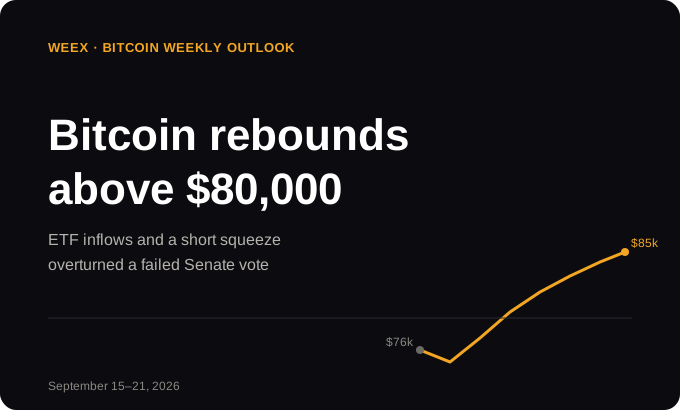
WEEX Bitcoin Weekly Outlook: Why Did Bitcoin Rebound Above $80,000 After the CLARITY Act Vote?
Bitcoin rebounded above $80,000 as SEC and CFTC action, renewed ETF inflows, and a short squeeze outweighed the failed CLARITY Act vote.

$8 Makes a Comeback, This Time X Money Rewrites the Logic of NFT Issuance
AMD Jumps Nearly 10%, Market Cap Tops $1 Trillion| WEEX TradFi Daily Brief (September 22, 2026)
Global markets on September 22 focus on a repair in AI-compute pricing. On September 21 the three major equity indexes closed higher. AMD rose nearly 10% and its market cap crossed $1 trillion for the first time, while Intel and Arm also surged. Brent crude fell about 3.4% to $100.34 and the 10-year Treasury yield eased to about 4.96%, lowering discount-rate pressure on long-duration tech. Bitcoin briefly broke above $87,000 and total crypto market cap returned above $3 trillion. Investors next watch consumer and housing earnings plus PMI flash prints.
Balancer Community Proposes Fork and Rebirth

The Answer to Dreamforce 2026: AI Agent, Has It Finally Turned from Demo to Revenue?
Ethereum: BitMine Approaches 5% of Total ETH Supply
Bitcoin's $84K rally isn't saving miners as difficulty signals already flash caution
ZEC's Largest Mining Company Moves to US Stock Market After Mining 70,000 ZEC in Six Months

Validators Vote on Batch V1.1 After Security Overhaul

Aptos Validators Decrease by 40% in Two Years, Concentration of Validator Nodes Shifts to Europe and America

SEC Takes Action: Who Can Handle "Compliant ICOs"?

TRON Weekly Industry Report: Regulatory and Interest Rate Pressures Fail to Dampen BTC Bullish Sentiment, Detailed Analysis of PayFi High-Performance Payment Infrastructure Axon Finance

When AI Agents Accelerate into Intranets: The Main Battlefield of Cybersecurity Has Changed
How to Earn Crypto Futures Trading Rewards on WEEX: Daily Lucky Eggs S2

ZetaChain, Linera, Switchboard Cease Operations
WEEX Futures Trading Rewards in Sep 2026: Win Up to 10,000 USDT
How to Rewrite Internet Rules When Everyone Has an Indefatigable Agent
The End of the Blank Prompt: Why Trading AI Needs a Playbook
Cardano proposal slashes fees by 55%, but it comes with a cost for small pools
The Evolution of AI: The Boundaries and Truth of Recursive Self-Improvement (RSI)
The Quantum Issue: You Never Really Know The Future
Security and fees hold back deeper crypto use among wealthy investors: Nexo report


