
[Full Text] "The Core of Blockchain Policy: Supporting Corporate Adoption and Protecting Investors"

 Prefer us on Google


Kim Yong-il, Vice President of Avalabs, emphasized that supporting corporate blockchain adoption while protecting users and investors should be at the center of policy.
At the seminar titled 'U.S. Cryptocurrency Fundraising Policies and Legislative Challenges for Digital Assets in Korea' held at the National Assembly Hall in Yeouido, Yeongdeungpo-gu, Kim stated, "There is a broad direction to support companies in adopting blockchain quickly and at low cost, but I believe that at the center of all policy directions is the protection of users and investors."
Specifically, he cited the policies related to token securities from the U.S. Securities and Exchange Commission (SEC) as an example. Kim said, "The core is to guarantee all rights just like when general investors buy stocks." He further explained, "While commercializing token stocks, we should ensure that rights such as voting rights, dividends, and participation in shareholder meetings, which existing stocks have, are equally guaranteed."
He also mentioned, "There are cases emerging not only about fundraising but also about how to use the raised funds utilizing blockchain," and added, "I view the current emerging policy direction positively from the perspective of protecting investors and the market."
Below is the full discussion by Vice President Kim.
Thank you very much for inviting us to this wonderful event today. To briefly introduce myself, I oversee global business development at Avalanche, a global blockchain mainnet. Previously, I worked for about 13 to 14 years in financial support for domestic small and medium-sized enterprises at domestic financial institutions, and I have been with Avalabs for about four years.
Initially, I was responsible for Korea, then Asia, and now I am in charge of the entire world from our Korean team. In that sense, I feel that our country's position is very high compared to other countries and shows a lot of development, and I hope to share my views from that perspective today.
Our business purpose is to support large corporations and financial institutions in conducting business activities, both for profit and non-profit, across various countries and industries using blockchain technology.
In Korea, recent notable examples include Hyundai Motor Group's overseas remittance and POSCO International's sales receivable tokenization. Following the announcement of the token securities policy direction on September 4, Hanwha Investment & Securities is also utilizing Avalanche technology in its own infrastructure. Hyundai Motor Group, POSCO International, and Hanwha are all leveraging our technology to develop various businesses.
While these initiatives seem to have many positive aspects, there are commonalities as well. In particular, Hyundai Motor, being a global conglomerate, utilized stablecoins for fund transfers between subsidiaries but did not use domestic entities. They moved funds using stablecoins between their U.S. and Mexican subsidiaries.
Typically, interbank transfers across countries can take as little as 5 to 6 hours or as long as 7 to 10 days, and sometimes up to 20 days, but in this test, the entire process of moving actual funds between banks was completed in under 7 minutes. While we are discussing fundraising today, we are also working on how to use the funds raised through blockchain.
Last week, Avalanche hosted a major conference with financial institutions in New York. Quite coincidentally, the dates were Wednesday and Thursday. On Wednesday, the CLARITY Act was voted down, and the next day, Thursday, the SEC made an announcement regarding token stocks, resulting in very different reactions within just a day or two. Overall, it seems that the main interest among users and institutions right now is the connection point between stocks and tokens.
Unfortunately, the CLARITY Act was voted down, but a very clear picture was presented regarding how token stocks can be commercialized using blockchain. I believe that the most important aspect here is that while looking at the CLARITY Act and various exemption regulations for token securities, there are fundamentally two key points at the center.
These are also the topics that both of you presented well today. The first is the broad direction of supporting companies to adopt blockchain quickly and at low cost. However, there is a relatively less mentioned aspect, which is that at the center of all these policy directions, the protection of users and investors is very important.
For instance, I believe that the most critical part of the SEC's direction on token stocks announced last week is this. The characteristics of assets like stocks include voting rights, dividends, and participation in shareholder meetings, but the token stocks traded on Robinhood, a well-known example, do not provide such rights. Therefore, I think the SEC's most important core message was to commercialize token stocks while guaranteeing all rights for general investors just as they would when purchasing stocks.
Thus, I believe that the current emerging directions are ultimately being pursued from the standpoint of protecting investors and the market, and I see this more positively than expected.
-- Price
This content is provided for general informational purposes only and doesn't constitute financial, investment, legal, or tax advice. Any events, rewards, online promotions, or related information mentioned herein should not be considered a recommendation, solicitation, or invitation to purchase, sell, trade, or otherwise deal in any crypto assets. Crypto assets are highly volatile and may result in loss. The availability of WEEX services, products, and related events may vary by region. You are responsible for ensuring that your participation is in accordance with applicable local laws and regulations.
You may also like

Bitcoin, Sports, and Politics: Predictive Markets Target $10 Trillion

Exclusive Interview with CK Zheng of ZX Squared Capital: How a Wall Street Risk Control Expert Accurately Grasped Market Trends and Outperformed Bitcoin Returns by Double

The End of the Blank Prompt: Why Trading AI Needs a Playbook
Bankless Ventures Partner Claims ZEC Will Attract Bitcoin Funds in 2026

US Bond Market 'Meltdown'... Why Are Interest Rates Soaring?

Sam Price: The Impact of Cryptocurrency Legislation on Market Dynamics

The Quantum Issue: You Never Really Know The Future

Crypto Kidnapping: 6 Suspects Charged in Case Involving a Few Hundred Euros in Val-d’Oise

Security and fees hold back deeper crypto use among wealthy investors: Nexo report
Why leaving your crypto on an exchange is not the same as having it in your own wallet?

Binance Under Scrutiny Again for Iran-Related Trading
Altcoin demand meets $18B threat as flows move into RWA perps as just 19% of traders keep alts
90% of U.S. Treasury Yield Increase Concentrated Around Employment Data and Fed Speeches
Can Kraken's Parent Company Open the Door for Hyperliquid to Enter the U.S. Market?
Gold Price Today in Thailand: XAU/USD Holds Near $4,347 as Key Support Level Tested

Scam AI Bot: 274 ETH Lost in Smart Contract Trap

Why Do You Always Make Small Profits and Then Lose Everything? Taleb Explained It with 'Asymmetric Leverage' Twenty Years Ago
AI has become a tool for a new generation of fraudsters: how deepfakes are stealing millions of dollars - research

Can SOXL Reach $160 as AI and Semiconductor Stocks Rally?
Can PEPE Reach $0.000006 as Meme Coin Momentum Returns?
Meta's Muse: A Slightly Smarter Version of 'AI Ordering Coffee'
Over 70% of South Korean Crypto Investors Oppose Crypto Tax: What Are Their Concerns?

Howard Marks: U.S. Fiscal Discipline Out of Control, Buying Bonds to Suppress Yields is Just 'Putting Ice Packs on a Feverish Patient'
Bitget Conversations with Trader Shiguang: Seeking the Discrepancy Between Price and Value

AI and Crypto: Why BlackRock Sees a Major Convergence

Nomura Warns of 'Double Whammy' Risk: The Next Market Storm May Start with Interest Rate Volatility
What is Travix? An on-chain omnibroker combining AI trading and blockchain verification
VVV Hits All-Time High: Founder’s Perspective on Models, Privacy, and Crypto
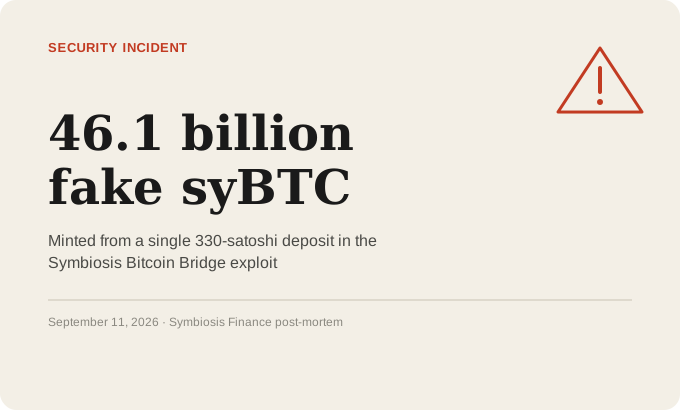
How Did a Hacker Create 46 Billion Fake Bitcoin in the Symbiosis Exploit? Decodes Bitcoin Hacker With WEEX Now
How two Symbiosis bridge bugs let a hacker mint 46.1 billion unbacked syBTC, drain Bitcoin pools and expose critical bridge risks.
This Cycle May Not Be Led by Bitcoin?
Bitcoin, Sports, and Politics: Predictive Markets Target $10 Trillion
Exclusive Interview with CK Zheng of ZX Squared Capital: How a Wall Street Risk Control Expert Accurately Grasped Market Trends and Outperformed Bitcoin Returns by Double
The End of the Blank Prompt: Why Trading AI Needs a Playbook
Bankless Ventures Partner Claims ZEC Will Attract Bitcoin Funds in 2026
US Bond Market 'Meltdown'... Why Are Interest Rates Soaring?
Sam Price: The Impact of Cryptocurrency Legislation on Market Dynamics


