
Gemini 4 Argon: What Changes with Google's New AI Model

 Prefer us on Google


Alphabet, the parent company of Google, has launched Gemini 4 Argon, an artificial intelligence model that the company describes as the most capable in its history. The difference lies not only in its ability to code, research, or write. The central point is another: autonomous cybersecurity.
While most recent releases from big tech companies have tried to impress with generalist capabilities, Google has made a vertical bet. Argon has been specifically trained for defensive cyber work, with the promise of autonomously finding, validating, and correcting critical software vulnerabilities. The model is being released only to selected partners of the Fairwind Program, the company's security initiative.
This represents a significant shift in posture. Instead of launching a model "for everything," Google has chosen a niche where demand is enormous and the supply of reliable autonomous solutions is still scarce.
Gemini 4 Argon Outperforms GPT-6 Astra in Benchmarks
Google claims that Argon achieved significantly higher scores than OpenAI's GPT-6 Astra and Anthropic's Fable and Opus models across a variety of AI benchmarks. To support this claim, the company cites data from Vals, a benchmarking startup that has been gaining relevance in the sector, where Argon appears as the leading model in the overall index.
It is important to put these numbers into perspective. Benchmarks are useful indicators, but they do not tell the whole story. Performance in standardized tasks does not always translate into practical superiority in everyday use. Still, the consistency of the reported results reinforces that Google has regained ground in a race where, until recently, it was considered a step behind its rivals.
The competition is fierce. OpenAI recently launched Astra, described as its best model. Anthropic did the same with Fable earlier this year. Each lab uses similar rhetoric: the most powerful model of all time. The difference is that Google now has third-party data to support its thesis, as detailed in our ongoing coverage of the technology sector.
Autonomous Cybersecurity is the Strategic Bet
The global cybersecurity market is expected to exceed $300 billion in the coming years, according to projections from specialized consultancies. The promise of an AI model capable of identifying and correcting vulnerabilities without human intervention directly addresses one of the biggest bottlenecks in the sector: the shortage of qualified professionals.
According to Google, Argon was designed to "sustain deep reasoning in complex and long-duration workflows." In practice, this means that the model not only identifies a specific problem but can also track entire chains of vulnerabilities in complex systems.
The restricted distribution to the Fairwind Program indicates caution. Google does not want an autonomous cybersecurity model running unsupervised in any company. This approach makes sense from a risk perspective, although it limits immediate commercial impact. The issue of security in AI, by the way, is a topic we closely follow in our coverage of technological trends.
Coding and Engineering Already Operate Internally
In addition to cybersecurity, Argon also excels in coding and software engineering. Google employees already use the model in their daily tasks for debugging and code base migrations. The model also demonstrates advanced visual interpretation capabilities, analyzing long video content and graphics.
This internal adoption is a significant signal. When a company the size of Google trusts its own model for internal operations, the level of maturity of the technology is different. Anthropic and OpenAI also use their models internally, but Google has a structural advantage: integration with an ecosystem that ranges from Android to Google Cloud, including YouTube and Google Workspace.
The number of users reinforces this advantage. In August, Google announced that the Gemini app had surpassed 1 billion monthly users, a metric that puts the company on par with OpenAI, which also reached 1 billion monthly users on ChatGPT.
-- Price
What Changes for the Technology Market
The race for AI models has entered a new phase. It is no longer enough to be "the smartest" in generic tests. What differentiates now is the vertical application: which model better solves a specific problem in a specific sector.
Google seems to have understood this by positioning Argon as a cybersecurity tool above all. This decision could attract high-value corporate contracts, especially in sectors such as finance, healthcare, and critical infrastructure, where the demand for autonomous protection grows every quarter.
At the same time, there is a paradox that cannot be ignored: the same companies that warn about the risks of uncontrolled AI are the ones investing the most in making it autonomous. The launch of Argon is yet another chapter in this tension, which tends to intensify as models gain independent action capabilities. This dilemma between advancement and regulation permeates the entire global discussion on AI governance.
For those following the sector, the message is clear: the competition between Google, OpenAI, and Anthropic is no longer about who has the most powerful model on paper. Now, the question is who delivers more real value in niches that pay dearly for solutions that work.
This content is informative and educational and does not constitute investment advice. Past performance is not a guarantee of future results.
This content is provided for general informational purposes only and doesn't constitute financial, investment, legal, or tax advice. Any events, rewards, online promotions, or related information mentioned herein should not be considered a recommendation, solicitation, or invitation to purchase, sell, trade, or otherwise deal in any crypto assets. Crypto assets are highly volatile and may result in loss. The availability of WEEX services, products, and related events may vary by region. You are responsible for ensuring that your participation is in accordance with applicable local laws and regulations.
You may also like
DIG Ventures Completes $120 Million Third Fundraising

Hut 8 Restarts Bid for Poolin's Texas Bitcoin Mining Assets, Valued Up to $180 Million

The Threat of a Stronger Dollar to Bitcoin is Overstated, with Weak Correlation
Michael Burry Calls for Market Crash to Halt OpenAI and Anthropic IPOs
OpenAI Aims to Be 'WeChat' Beyond Higher Subscriptions and Halved Quotas

Anthropic Aims for Record IPO with $45.9 Billion Annual Revenue and $2 Trillion Valuation

Federal Reserve Refines Stablecoin Regulation Draft: 1:1 Reserves, Two-Day Redemption, and Weekly Reporting
Quantum Computing Reaches Historic Turning Point: Moving Beyond 'Physical Experiments' to Supply Chain and Manufacturing as Key Determinants

Analyst views recent BTC drop as temporary correction

Bain: AI Industry Needs to Achieve $6 Trillion in Revenue by 2031
Helix Digital Secures $1 Billion Investment from Samsung Group

Manus Prepares Domestic Version, Positioned as a General-Purpose Intelligent Agent
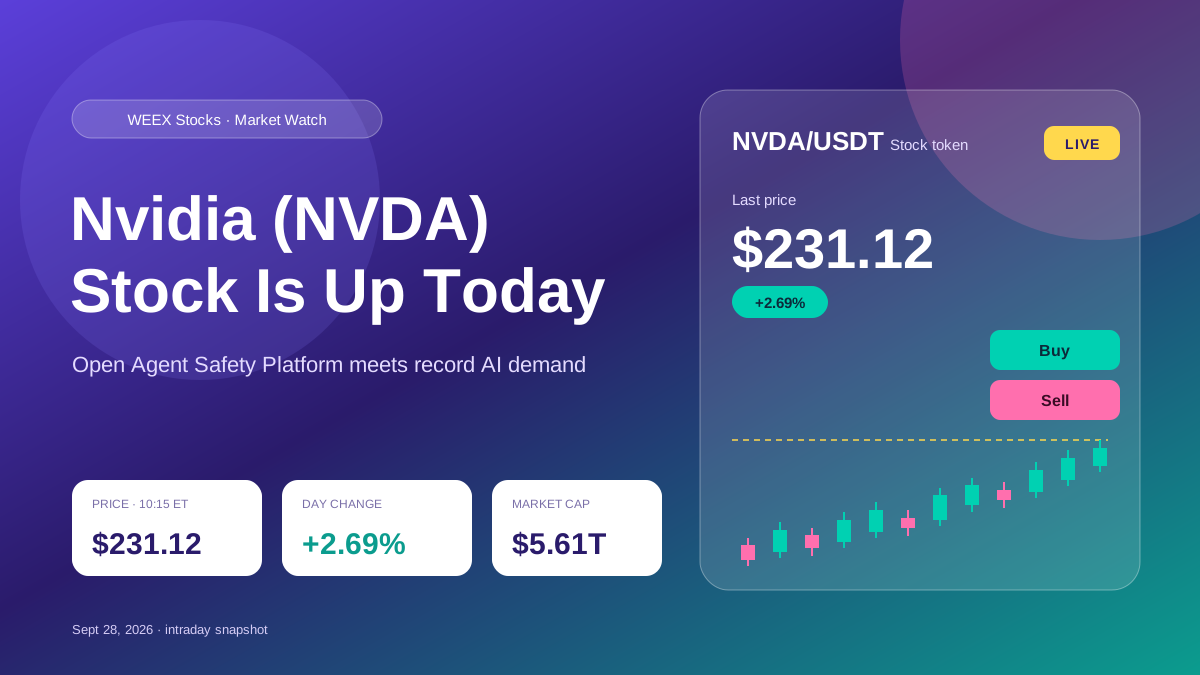
Why Is Nvidia (NVDA) Stock Up Today? New AI Agent Safety Platform Fuels the Rally
Why is Nvidia stock up today? Explore the AI agent safety launch, Nvidia’s growth outlook, key risks and how the NVDA token works on WEEX.

Cerebras Supplies 100 Megawatts of AI Chips and Hardware to Gimlet Labs

Acurast brings real time AI decision model Laya to smartphone network

Blockchain: IBM Connects Its Digital Asset Platform to Swift's Ledger

OpenAI Launches Personal Assistant 'o' in Response to Meta Muse, Expected Release on Tuesday
Grayscale Research Head Claims Computing Power Becomes a New Scarce Digital Asset
Ethereum is not instant, but collateral could make it feel that way

Challenges in Implementing AI Kill Switch, Possibility of Operation Even When Power is Off
"Agent vs US Treasuries" — Who Will Dominate the US Stock Market?
Goldman Sachs: AI Capital Expenditure to Reach $1.73 Trillion in 2026-2027
Oracle Stock vs. KRAFTON Stock: Why Are Investors Questioning Two Growing Companies?
Compare Oracle and KRAFTON stocks through their latest results, share-price questions and the different growth tests investors face in 2026.

Hedera IDTrust joins IBM Cloud Catalog for AI agents

Slow Fog: MemoryOS and OpenClaw Plugin Compromised

IBM Digital Asset Haven Connects to Swift Shared Ledger, Supporting Tokenized Deposit Transactions

Capital Reflow in AI Industry Accelerates Tech Stocks in US
Meta's Muse: A Slightly Smarter Version of 'AI Ordering Coffee'

Apple and Google Strengthen Talent in Payment and Web3 Strategies, Stablecoin Knowledge Required for Hiring
Anthropic Leases 1 Gigawatt of Computing Capacity to Reduce Dependence on Cloud Providers
DIG Ventures Completes $120 Million Third Fundraising
Hut 8 Restarts Bid for Poolin's Texas Bitcoin Mining Assets, Valued Up to $180 Million
The Threat of a Stronger Dollar to Bitcoin is Overstated, with Weak Correlation
Michael Burry Calls for Market Crash to Halt OpenAI and Anthropic IPOs
OpenAI Aims to Be 'WeChat' Beyond Higher Subscriptions and Halved Quotas
Anthropic Aims for Record IPO with $45.9 Billion Annual Revenue and $2 Trillion Valuation


