
Genius.fun launches BNB Chain platform for corporate ownership

 Prefer us on Google


Genius Foundation has launched Genius.fun on BNB Chain, giving crypto communities a platform to create tokens, build treasuries with tokenized public-company shares, and coordinate shareholder campaigns.
- Genius.fun lets communities pair newly created tokens with tokenized stocks and several crypto assets.
- The platform presents board campaigns and hostile takeovers as possible uses of accumulated equity.
- Creators can receive up to 1.25% of trading fees, while 0.25% funds token buybacks.
- Tokens graduate to PancakeSwap after reaching a threshold of 15 BNB.
In a Sep. 17 press release shared with crypto.news, Genius Foundation said that the new launchpad connects community-created tokens with tokenized public equities, allowing participants to pool capital around a company and accumulate exposure to its shares.
The platform presents the model as a way for online groups to move beyond meme-based trading and organize around corporate ownership. According to the Foundation, communities could use an accumulated position to support shareholder proposals, seek board representation, run an activist campaign or pursue an acquisition.
Such actions would require more than holding a community token. The Foundation said eligible tokenized positions may be redeemed for the underlying equity, but the rights available to users would depend on the structure of each paired product and its issuer.
Genius.fun links token launches with tokenized shares
Rather than offering only a standard meme-token launch, Genius.fun allows creators to choose a trading pair that may include BNB, USDT, USDC, or tokenized assets from Ondo, bStocks, xStocks and 4Stocks. More markets are expected through a product called gPerps, according to the announcement.
Trading activity is intended to help a community build a treasury that can acquire additional assets. Genius Foundation said the approach could turn online attention into a pool of capital tied to real-world companies, although it did not disclose how treasury decisions, voting power, or asset custody would be managed for each community.
Creators may collect up to 1.25% of trading fees generated by their tokens. Another 0.25% is directed toward token buybacks and supply locking, according to the platform's stated fee model.
From the token's trading page, users can monitor its progress from launch through graduation. A token becomes eligible to move to PancakeSwap once it reaches 15 BNB, with the decentralized exchange serving as Genius.fun's graduation partner.
The model differs from simply buying a token that tracks a company's share price. An economic interest tied to a stock does not always give its holder voting rights, access to dividends, or recognition on the company's official shareholder register. The exact legal claim depends on how the token is issued and whether it is backed by the underlying security.
Coinbase CEO Brian Armstrong recently addressed the same distinction when he called for full backing of tokenized equities with real securities. Coinbase's offshore structure holds underlying shares through a special-purpose company and a regulated U.S. broker, while verified holders can request redemption. Its products remain unavailable to U.S. persons and are not registered under the U.S. Securities Act.
Community ownership could support activist campaigns
Genius.fun frames community tokens as capital-formation tools that can organize people around a selected public company. After launching a market, participants could grow its treasury and use the accumulated share position to seek influence.
At a large enough scale, the Foundation said a community could request a board seat, coordinate an activist campaign or attempt a hostile takeover. Investment banks, private-equity firms, hedge funds and specialist activist investors have traditionally led such transactions.
A hostile takeover generally involves an effort to gain control of a company without approval from its existing board. Genius.fun has not announced a specific company targeted by its users, nor has the Foundation said that any community has accumulated enough shares to begin such a process.
The launch announcement instead describes hostile takeovers as a possible future use. Any campaign involving a listed U.S. company would still face securities laws, ownership disclosure rules, corporate governance procedures and limits contained in the company's governing documents.
Armaan Kalsi, CEO of Shuttle Labs, described the launch as a new form of crypto-based corporate coordination.
"We're excited to see what happens when crypto native communities launch capital formation vehicles with 2 clicks and, for example, potentially do things like vie for board seats," Kalsi said.
He added that a capital-formation tool able to influence companies in the physical economy was "inherently exciting."
U.S. rules make ownership rights central
For American investors, the difference between a fully backed share token and a synthetic product is especially important because price exposure alone does not establish corporate ownership.
On Sep. 17, the U.S. Securities and Exchange Commission granted five-year relief for eligible tokenized securities venues. The conditional framework permits approved platforms to trade tokenized National Market System stocks through permissioned automated market makers and liquidity pools.
Under the SEC order, an eligible tokenized share must carry the same rights and privileges as the conventional share it represents. Synthetic products that merely track a stock through a derivative do not qualify for the relief, according to the regulator.
Venues must also notify an issuer before listing a tokenized version of its stock and cannot proceed if the company objects. Smart contracts must be public and auditable, while trading in the token must stop when the primary exchange halts the underlying security.
The SEC's conditions matter to the corporate-action model proposed by Genius.fun. A community seeking voting influence would need ownership rights connected to the underlying shares, not only a token whose price follows the stock. Genius Foundation did not state whether the platform would seek access to the SEC exemption or make its services available to U.S. users.
American ownership rules can also require public filings once an investor or coordinated group crosses certain thresholds. Whether members of a decentralized community would be treated as a group would depend on their agreements, conduct, and the facts of a particular campaign; the launch announcement did not provide a legal structure for such cases.
-- Price
Tokenized stocks are adding on-chain uses
Alongside ownership experiments, crypto platforms are building other services around tokenized equities. Kraken recently introduced xStocks vaults for SPYx, QQQx and NVDAx, which track the SPDR S&P 500 ETF, Invesco QQQ ETF and Nvidia shares.
Kraken allocates deposited tokens to on-chain lending markets through an embedded, noncustodial wallet. The initial displayed annual percentage yields were about 2% for SPYx and QQQx and 1.8% for NVDAx, with a 25% performance fee already deducted from the quoted rates.
Genius.fun is taking a different route by combining token creation, trading fees and community treasuries with a proposed path toward shareholder action. Genius Foundation said users can begin by creating a token, selecting a trading pair and building a treasury around the company they want to influence.
The Cayman-based Foundation describes its work as infrastructure for permissionless markets, collective ownership and decentralized economic coordination. Genius.fun is live on BNB Chain, while token graduation takes place through PancakeSwap after the platform's 15 BNB threshold is met.
This content is provided for general informational purposes only and doesn't constitute financial, investment, legal, or tax advice. Any events, rewards, online promotions, or related information mentioned herein should not be considered a recommendation, solicitation, or invitation to purchase, sell, trade, or otherwise deal in any crypto assets. Crypto assets are highly volatile and may result in loss. The availability of WEEX services, products, and related events may vary by region. You are responsible for ensuring that your participation is in accordance with applicable local laws and regulations.
You may also like

XRPL to Implement Major Upgrade on October 5: Adding Permission Delegation Feature
67% of the wealthy own digital assets, but the crypto adoption gap remains huge

How to Rewrite Internet Rules When Everyone Has an Indefatigable Agent

The End of the Blank Prompt: Why Trading AI Needs a Playbook
Cardano proposal slashes fees by 55%, but it comes with a cost for small pools

The Evolution of AI: The Boundaries and Truth of Recursive Self-Improvement (RSI)
The Quantum Issue: You Never Really Know The Future

Security and fees hold back deeper crypto use among wealthy investors: Nexo report
Bitcoin Developers Concerned About Mining Subsidy

VVV Hits All-Time High: Founder’s Perspective on Models, Privacy, and Crypto

XRPL fixes critical pre-mainnet flaw, but client apps remain at risk

Glassnode Indicates Shift Towards Altcoin Season
Crypto: Kalshi accused of inflating its volumes with thousands of identical orders

HODLing ETH: Should You Choose Staking for Yield or Collateralized Lending?

SEC Clarity Meets Fed Rate Hike: How WEEX TradFi Lucky Eggs S2 Taps Into Cross-Market Opportunities

How Significant Are Changes in Overseas AI Investment?
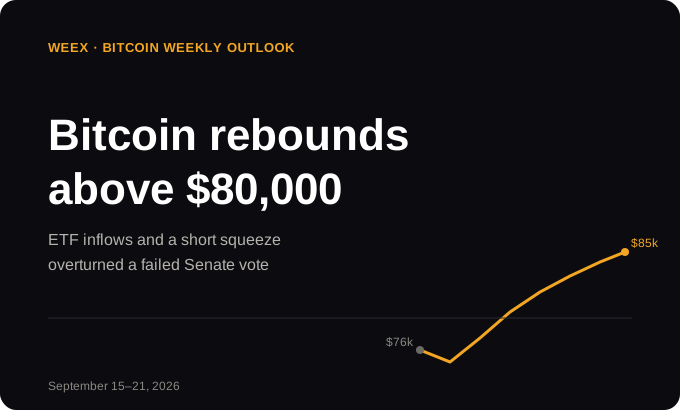
WEEX Bitcoin Weekly Outlook: Why Did Bitcoin Rebound Above $80,000 After the CLARITY Act Vote?
Bitcoin rebounded above $80,000 as SEC and CFTC action, renewed ETF inflows, and a short squeeze outweighed the failed CLARITY Act vote.
$8 Makes a Comeback, This Time X Money Rewrites the Logic of NFT Issuance
AMD Jumps Nearly 10%, Market Cap Tops $1 Trillion| WEEX TradFi Daily Brief (September 22, 2026)
Global markets on September 22 focus on a repair in AI-compute pricing. On September 21 the three major equity indexes closed higher. AMD rose nearly 10% and its market cap crossed $1 trillion for the first time, while Intel and Arm also surged. Brent crude fell about 3.4% to $100.34 and the 10-year Treasury yield eased to about 4.96%, lowering discount-rate pressure on long-duration tech. Bitcoin briefly broke above $87,000 and total crypto market cap returned above $3 trillion. Investors next watch consumer and housing earnings plus PMI flash prints.
Balancer Community Proposes Fork and Rebirth

The Answer to Dreamforce 2026: AI Agent, Has It Finally Turned from Demo to Revenue?
Ethereum: BitMine Approaches 5% of Total ETH Supply
Bitcoin's $84K rally isn't saving miners as difficulty signals already flash caution
ZEC's Largest Mining Company Moves to US Stock Market After Mining 70,000 ZEC in Six Months

Validators Vote on Batch V1.1 After Security Overhaul

Aptos Validators Decrease by 40% in Two Years, Concentration of Validator Nodes Shifts to Europe and America

SEC Takes Action: Who Can Handle "Compliant ICOs"?

TRON Weekly Industry Report: Regulatory and Interest Rate Pressures Fail to Dampen BTC Bullish Sentiment, Detailed Analysis of PayFi High-Performance Payment Infrastructure Axon Finance

When AI Agents Accelerate into Intranets: The Main Battlefield of Cybersecurity Has Changed
How to Earn Crypto Futures Trading Rewards on WEEX: Daily Lucky Eggs S2
XRPL to Implement Major Upgrade on October 5: Adding Permission Delegation Feature
67% of the wealthy own digital assets, but the crypto adoption gap remains huge
How to Rewrite Internet Rules When Everyone Has an Indefatigable Agent
The End of the Blank Prompt: Why Trading AI Needs a Playbook
Cardano proposal slashes fees by 55%, but it comes with a cost for small pools
The Evolution of AI: The Boundaries and Truth of Recursive Self-Improvement (RSI)


