
Harmony Cites AI Threats in Proposed Blockchain Shutdown

 Prefer us on Google


Harmony, once a prominent competitor to Ethereum, has proposed shutting down its blockchain on Sunday, saying threats from AI agents and state actors had become too great.
The announcement comes as the cryptocurrency industry attempts to defend against increasingly sophisticated cyberattacks enabled by frontier AI models, including Anthropic's Claude Mythos and OpenAI's GPT-6 Astra.
"The threats posed by state actors and AI agents are too great," the Harmony Team wrote on X. "Since our mainnet launch in 2019, our community has been resilient through attacks and changes---but it is time to fully sunset the Harmony network."
To mitigate the threat, Harmony is proposing to move Harmony's ONE token to Ethereum and use newly issued tokens to fund the ecosystem's new "The Remix Economy for AI Video" initiative. Validators, who verify network transactions, could take governance roles or join the AI-video business.
Launched in 2019, Harmony is a layer-1 blockchain that uses proof-of-stake, where validators commit tokens to help secure the network, and sharding, which divides transactions into smaller groups that work in parallel. The design aims to address the "blockchain trilemma" by increasing capacity without compromising security or concentrating control.
Moving ONE to Ethereum
According to Harmony, the migration would record ONE balances at the network's final block---a process called a snapshot---to determine each holder's allocation of replacement tokens on Ethereum. It would cover wallets, staked tokens, validator rewards, smart contracts, and centralized exchanges.
Replacement tokens would be airdropped to the same wallet addresses on Ethereum, with delegated stakes and unclaimed rewards going to individual governor vaults. Exchange listings would also move to the new token.
Although the proposal says holders would not need to submit a claim, users with assets in smart contracts face a separate deadline.
"Multisig safes, liquidity pools, and onchain apps cannot be migrated; users are urged to exit all smart contracts before September 10, 2026," the Harmony Team wrote.
Harmony also proposes paying eligible validators and their delegators from a $1.372 million pool in four quarterly installments, provided validators retain their stakes, sign an agreement, and serve as governors.
"The ONE token's total supply and emission rate will remain unchanged. Tokens issued through emissions will now be allocated to our new mission, "The Remix Economy for AI Video", subject to governor feedback," the team wrote.
AI and Crypto Attacks
The migration proposal is the latest in examples of attacks leading to increased scrutiny of blockchain networks.
In August, Harmony confirmed an exploit after an attacker created roughly 4 billion unauthorized ONE tokens. The team released a patch and said it was considering a rollback, which would reverse transactions by restoring an earlier version of the blockchain.
The X post on Sunday underscores how AI is playing a larger role in crypto security, with companies reporting suspected AI-assisted attacks and developers using the technology to find and fix vulnerabilities.
In July, Coldcard maker Coinkite said it suspected an attacker used AI to find a flaw that made wallet keys easier to guess---a vulnerability its own AI review missed. The company overhauled its security in August after thefts exceeded $100 million.
Following the Coldcard attack, developers formed the Bitcoin Red Team to find vulnerabilities before attackers could exploit them. The group combines AI models, including Moonshot AI's Kimi K3, with human review to examine wallets, payment applications, and other Bitcoin software, then privately alerts developers to flaws.
The team grew to about 20 to 25 volunteers, according to pseudonymous member and developer Calle. He said it had found no issues in Bitcoin's underlying protocol.
"The reason why the Bitcoin Red Team exists right now is because we need to get ahead of the attackers as fast as possible," Calle toldDecrypt.
-- Price
This content is provided for general informational purposes only and doesn't constitute financial, investment, legal, or tax advice. Any events, rewards, online promotions, or related information mentioned herein should not be considered a recommendation, solicitation, or invitation to purchase, sell, trade, or otherwise deal in any crypto assets. Crypto assets are highly volatile and may result in loss. The availability of WEEX services, products, and related events may vary by region. You are responsible for ensuring that your participation is in accordance with applicable local laws and regulations.
You may also like

NVIDIA Scandal Shakes the Internet! How Should Cryptocurrency Be Divided After a Divorce with a Tech Tycoon?

Bundesbank President Says Economic Recovery Faster Than Expected, Structural Reforms Needed

Immutable Chain's Transition to OP Stack: What Changes for Users
Ledger CEO faces backlash after saying everybody will be hacked at some point

WEEX 11.11 Shopping Fest: Buy BTC and Unlock Up to 888 USDT in Rewards

NEAR AI Discloses SGLang Security Incident and Revokes Exposed API Keys

The Art of Trading: How They Profit from Arbitraging USDE Stocks

VARA Is Not a Panacea: Dubai's Crypto Payments Still Depend on the Central Bank

a16z Frontier Partner: Agents Should Rebuild Uber-like Transaction Networks

Poland's Parliament Votes 240-202 To Let Officials Freeze Crypto Before Court Review

WEEX P2P now supports ILS, BHD, OMR & QAR —Merchant Recruitment Now Open

Cryptocurrency Security Checklist: Four Lessons from Phemex Safety Hub Vol. 05–08
Ondo Claims $4B in Tokenized Assets as RWA Market Gains Institutional Depth

DTCC Launches Tokenization Service: What Can Investors Actually Do?

The catch in recovering a hacked crypto wallet: the thief may still have a key

Bitcoin Remains Strong: Why $76,000 is the Level That Matters Now
Peter Schiff Criticizes Strategy's Bitcoin Purchases
iPhone Attack Kit 'DarkSword' Suspected of Being Misused for Cryptocurrency Theft, Bitquery Identifies Approximately $4.06 Million in Stolen Funds

Financial and Political Crisis in Paraguay: How the Ueno Bank Explosion Triggered the President's Resignation
OpenAI Releases National Community Covenant and Computing Park Policy Blueprint

GitBook Security Incident Review, Attack Targeting Trade.xyz

Post-Quantum Era Consensus Layer Divergence: Ethereum Maintains Decentralization, Monad Prioritizes Speed

The Ghost Behind the Screen: Unveiling the Secret World of North Korean Hackers Lazarus
Bitcoin Miners Turn to AI: Escaping the Crypto Cycle, but Entering New Turbulence
Decoding Variational: How a No-Order-Book Exchange Became the Dragon Behind Hyperliquid?
Creators Speak | The Biggest Risk in the Crypto Industry is Thinking It's Safe
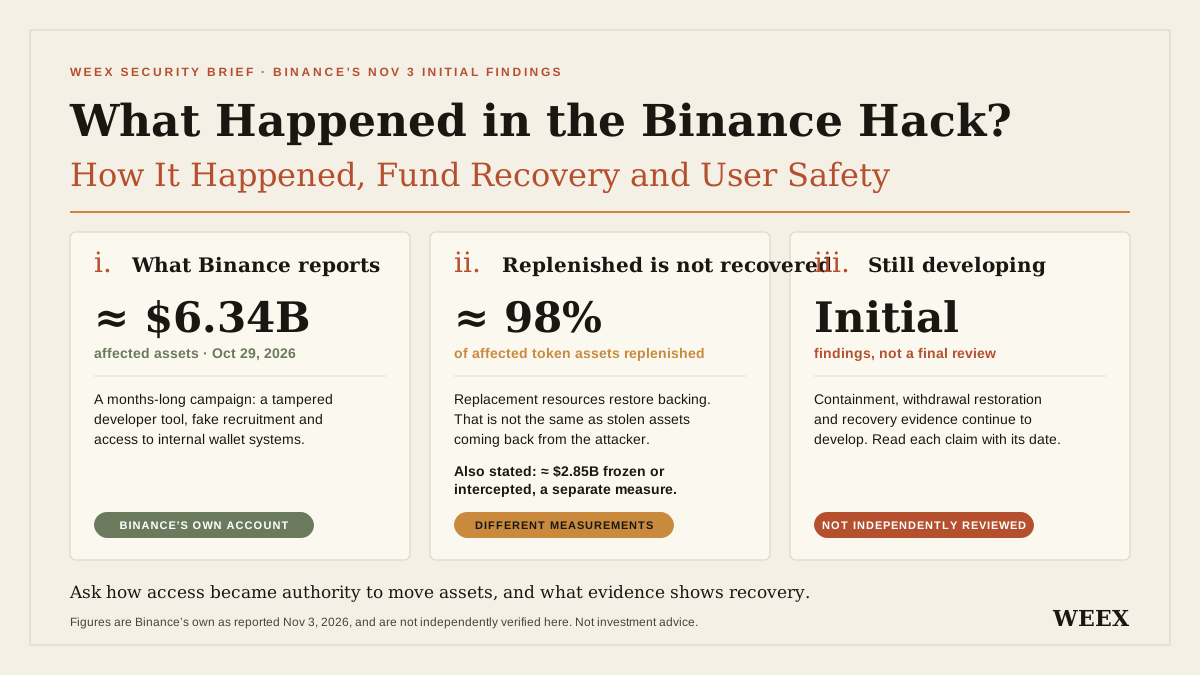
What Happened in the Binance Hack? How It Happened, Fund Recovery and User Safety
What happened in the Binance hack? Review the attack timeline, latest fund replenishment, recovery limits and practical steps to protect your account.

Who really controls a crypto project? Inside the SEC’s new guidance

Reflections After the Binance Heist: Who Should We Trust with Our Crypto Assets?
Solana study finds wider spreads outside aggregators at five of six sampled pools
NVIDIA Scandal Shakes the Internet! How Should Cryptocurrency Be Divided After a Divorce with a Tech Tycoon?
Bundesbank President Says Economic Recovery Faster Than Expected, Structural Reforms Needed
Immutable Chain's Transition to OP Stack: What Changes for Users
Ledger CEO faces backlash after saying everybody will be hacked at some point
WEEX 11.11 Shopping Fest: Buy BTC and Unlock Up to 888 USDT in Rewards
NEAR AI Discloses SGLang Security Incident and Revokes Exposed API Keys
Latest articles


Latest coin listings on WEEX


