
NVIDIA Scandal Shakes the Internet! How Should Cryptocurrency Be Divided After a Divorce with a Tech Tycoon?

 Prefer us on Google


Analysis of key judicial points in cryptocurrency divorce division.
Written by: Xiao Sa Lawyer Team
Recently, NVIDIA founder and CEO Jensen Huang has attracted global media attention due to an extramarital affair scandal. According to reports, Huang did not sign a prenuptial agreement with his wife, and if they proceed with a divorce, the large amount of NVIDIA shares he holds and potential other digital assets will face complex division issues.
Although this is a case under U.S. law, the Sa Jie team believes that this hot topic reflects an increasingly common pain point in judicial practice: in the digital age, the proportion of cryptocurrencies (such as BTC, ETH, USDT, etc.) in marital joint property is rising, and the anonymity and decentralization of these assets pose unprecedented challenges for property identification, division, and enforcement after divorce.
According to estimates by Triple-A based on Chainalysis data, approximately 78 million people in China hold cryptocurrencies, with holders highly concentrated in the marriageable age group. As disputes involving cryptocurrencies in divorce cases increase, how can one party protect their property rights through legal means if the other party conceals or refuses to disclose cryptocurrency? This article will analyze the classification, identification paths, and enforcement dilemmas and countermeasures of cryptocurrencies in divorce litigation from the perspective of mainland judicial practice.
I. Legal Classification: Are Cryptocurrencies Joint Property of the Couple?
1. China's regulatory policies do not negate property attributes
Many parties and even some grassroots judges have a misunderstanding that since the state prohibits virtual currency trading and speculation, cryptocurrencies are "illegal property" and are not protected by law, thus cannot be divided in a divorce. This view confuses administrative regulatory assessments with civil rights ownership.
China's regulatory policies on virtual currencies are indeed strict, and the People's Bank of China and other departments have issued notices clearly prohibiting virtual currency-related business activities. However, "prohibiting business" does not equal "prohibiting ownership." Simply holding cryptocurrencies is not explicitly prohibited by law. More importantly, Article 127 of the Civil Code of the People's Republic of China states: "Where the law provides for the protection of data and network virtual property, it shall be implemented in accordance with its provisions." This clause establishes the status of network virtual property as a civil rights object.
In the field of marriage and family, Article 1062 of the Civil Code of the People's Republic of China clearly stipulates that the income from production, operation, and investment obtained by the couple during the existence of the marriage relationship, as well as other property that should be jointly owned, constitutes joint property of the couple. Cryptocurrencies, as digital assets with exchange value and disposability, are essentially investment property. As long as they are acquired during the existence of the marriage, regardless of their special form, they should generally be recognized as joint property of the couple.
2. Affirmative attitude in judicial practice
Mainland courts have gradually formed a consensus in judicial practice: cryptocurrencies possess divisible property attributes. For example, in case (2020) Yue 0305 Minchu 28569, the parties agreed on the ownership of virtual currencies in their divorce agreement, and the court directly supported the performance of the agreement; in case (2021) Jing 0102 Minchu 35486, the parties agreed to split 2.4 million yuan worth of digital currency in half, which the court recognized and ordered one party to fulfill their payment obligation. These cases indicate that the court does not refuse to handle property division requests involving cryptocurrencies on the grounds of "regulatory prohibitions," but rather includes them in the framework for handling joint property of the couple.
It is important to note that the Supreme People's Court has previously issued opinions on related issues, pointing out that for virtual currencies that have not yet exited, due to the inability to value and the prohibition of circulation, it is not advisable to directly divide the virtual currency itself, and after exiting as stipulated, the other party may request a division of the corresponding compensation obtained after the exit. However, this does not mean a complete deprivation of the right to divide, but rather conditional, emphasizing the practicality of the division method—focusing on monetary compensation rather than physical delivery.
II. Property Identification: How to Solve the "Concealment Difficulty" and "Burden of Proof Difficulty"
The biggest feature of cryptocurrencies is private key control and address anonymity. Once the holder refuses to cooperate, the non-holder often faces the dilemma of "invisible and intangible." To address this, we need to establish a set of procedural tools from preliminary evidence to responsibility transfer.
1. Establish a chain of evidence for "reasonable suspicion"
According to Article 67 of the Civil Procedure Law of the People's Republic of China, parties have the responsibility to provide evidence for their claims. When the non-holder cannot directly access the other party's wallet, they must form "reasonable suspicion" through peripheral clues, thereby triggering the court's investigation intervention or the transfer of the burden of proof.
In practice, the following evidence is crucial:
2. Utilize the property declaration system to raise concealment costs
The revised Article 67, Paragraph 2 of the Women's Rights Protection Law of the People's Republic of China clearly states: "During the divorce litigation period, both parties have the obligation to declare all joint property to the People's Court." This provision fills the gap in the property declaration system during the trial phase.
The court can order the holder to declare in writing the quantity of cryptocurrencies held, wallet addresses, purchase time, and source of funds. If the holder refuses to declare or falsely declares, according to Article 1092 of the Civil Code of the People's Republic of China, if one party conceals, transfers, sells, damages, or squanders joint property, that party may receive a reduced share or no share during the division of joint property in divorce.
This means that even if the court cannot forcibly transfer cryptocurrencies, it can achieve punitive correction of concealment behavior through skewed distribution of other visible properties such as real estate and deposits. For example, if one party conceals cryptocurrencies worth 6 million yuan, although the court cannot directly execute that currency, it can rule that the spouse receives a larger share when dividing an 8 million yuan property and 2 million yuan in deposits, thus achieving fairness in outcome.
3. Safe verification paths for control rights
It is particularly important to emphasize that verifying control rights does not equal handing over private keys. Once the private key is leaked, the assets are immediately out of control and cannot be recovered. Therefore, lawyers and courts are strictly prohibited from requesting private keys or mnemonic phrases. According to the Sa Jie team's practical operations, low-cost verification methods that have a high probability of court recognition include:
III. How to Implement After the Judgment? A New Breakthrough from the Shanghai High Court
For a long time, execution judges have been cautious or even evasive about executing virtual currencies due to a lack of normative basis. Recently, the Shanghai High People's Court issued the "Guidelines for Regulating the Execution of Network Virtual Property (Trial)," which is an important local judicial development.
The guidelines clarify the following key points: (1) Virtual currencies fall within the scope of executable property. (2) The applicant for execution can provide property clues, and the court should respond with investigation results within 7 days (3 days for emergencies). The court can conduct inquiries, searches, and summons as needed. If necessary, the virtual currencies in the executed person's wallet can be transferred to a cold wallet established by the court for storage.
Additionally, the "Guidelines for Regulating the Execution of Network Virtual Property (Trial)" also clarify that, under certain conditions, value disposal can be carried out through compliant channels. Although these guidelines only apply to the Shanghai region and do not have nationwide legal effect, they send a positive signal: judicial authorities are exploring the establishment of standardized processes for executing virtual currencies. Furthermore, there have been successful precedents in criminal execution practices. In a case of illegal public deposit absorption in Shanghai, the court adopted a method of "domestic entrustment, overseas disposal, closed-loop return" for the involved FIL currency, using a licensed platform in Hong Kong for value disposal, with funds returning to the court's case account. This provides a reference for civil execution, indicating that when compliant disposal channels are available, the value disposal of virtual currencies is not an insurmountable technical obstacle.
-- Price
Final Thoughts
The division and execution of cryptocurrencies in divorce cases is a game of law, technology, and psychology. For the non-holder, the key is to act early, secure evidence, and effectively use the property declaration system to apply pressure; for the holder, attempting to evade division by concealing cryptocurrencies not only faces legal consequences of "receiving less or no share" but may also be subject to judicial sanctions for false declarations.
The Sa Jie team recommends that parties facing such complex family disputes hire professional lawyers with blockchain knowledge backgrounds to develop detailed litigation strategies. From evidence preservation before filing a lawsuit, to the offensive and defensive responsibilities during the trial, to property control during the execution phase, every step requires professional intervention. As judicial rules continue to improve, cryptocurrencies are no longer outside the law, and their property attributes and enforceability in the field of marriage and family are gradually being confirmed and strengthened.
This content is provided for general informational purposes only and doesn't constitute financial, investment, legal, or tax advice. Any events, rewards, online promotions, or related information mentioned herein should not be considered a recommendation, solicitation, or invitation to purchase, sell, trade, or otherwise deal in any crypto assets. Crypto assets are highly volatile and may result in loss. The availability of WEEX services, products, and related events may vary by region. You are responsible for ensuring that your participation is in accordance with applicable local laws and regulations.
You may also like

Bundesbank President Says Economic Recovery Faster Than Expected, Structural Reforms Needed

Immutable Chain's Transition to OP Stack: What Changes for Users

Ledger CEO faces backlash after saying everybody will be hacked at some point

WEEX 11.11 Shopping Fest: Buy BTC and Unlock Up to 888 USDT in Rewards

NEAR AI Discloses SGLang Security Incident and Revokes Exposed API Keys

The Art of Trading: How They Profit from Arbitraging USDE Stocks

VARA Is Not a Panacea: Dubai's Crypto Payments Still Depend on the Central Bank

a16z Frontier Partner: Agents Should Rebuild Uber-like Transaction Networks

Poland's Parliament Votes 240-202 To Let Officials Freeze Crypto Before Court Review

WEEX P2P now supports ILS, BHD, OMR & QAR —Merchant Recruitment Now Open

Cryptocurrency Security Checklist: Four Lessons from Phemex Safety Hub Vol. 05–08

Ondo Claims $4B in Tokenized Assets as RWA Market Gains Institutional Depth

DTCC Launches Tokenization Service: What Can Investors Actually Do?

The catch in recovering a hacked crypto wallet: the thief may still have a key

Bitcoin Remains Strong: Why $76,000 is the Level That Matters Now
Peter Schiff Criticizes Strategy's Bitcoin Purchases

iPhone Attack Kit 'DarkSword' Suspected of Being Misused for Cryptocurrency Theft, Bitquery Identifies Approximately $4.06 Million in Stolen Funds

Financial and Political Crisis in Paraguay: How the Ueno Bank Explosion Triggered the President's Resignation

OpenAI Releases National Community Covenant and Computing Park Policy Blueprint

GitBook Security Incident Review, Attack Targeting Trade.xyz

Post-Quantum Era Consensus Layer Divergence: Ethereum Maintains Decentralization, Monad Prioritizes Speed

The Ghost Behind the Screen: Unveiling the Secret World of North Korean Hackers Lazarus

Bitcoin Miners Turn to AI: Escaping the Crypto Cycle, but Entering New Turbulence
Decoding Variational: How a No-Order-Book Exchange Became the Dragon Behind Hyperliquid?

Creators Speak | The Biggest Risk in the Crypto Industry is Thinking It's Safe
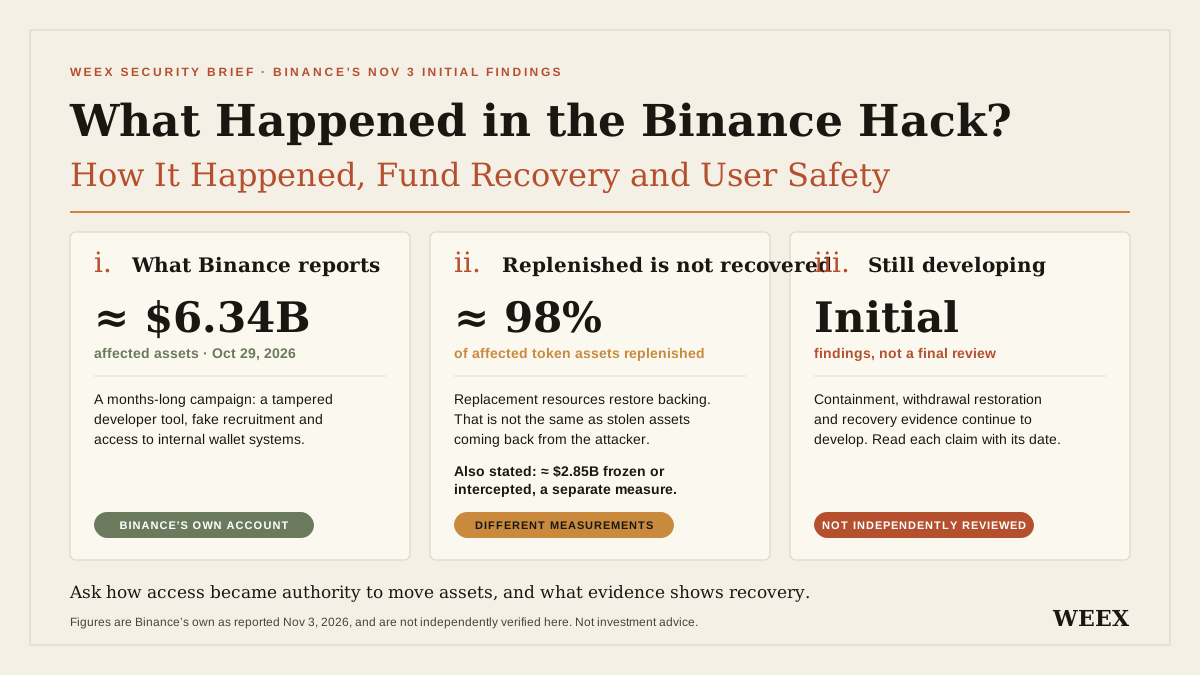
What Happened in the Binance Hack? How It Happened, Fund Recovery and User Safety
What happened in the Binance hack? Review the attack timeline, latest fund replenishment, recovery limits and practical steps to protect your account.

Who really controls a crypto project? Inside the SEC’s new guidance

Reflections After the Binance Heist: Who Should We Trust with Our Crypto Assets?
Solana study finds wider spreads outside aggregators at five of six sampled pools

Is it theft or fraud when the coins in the wallet remain but are changed to multi-signature by someone else?
Bundesbank President Says Economic Recovery Faster Than Expected, Structural Reforms Needed
Immutable Chain's Transition to OP Stack: What Changes for Users
Ledger CEO faces backlash after saying everybody will be hacked at some point
WEEX 11.11 Shopping Fest: Buy BTC and Unlock Up to 888 USDT in Rewards
NEAR AI Discloses SGLang Security Incident and Revokes Exposed API Keys
The Art of Trading: How They Profit from Arbitraging USDE Stocks
Latest articles


Latest coin listings on WEEX


