
Harmony Plans to Shut Down Mainnet and Migrate ONE to Ethereum, Shifting Focus to AI Video Remix Business

 Prefer us on Google


On September 6, Harmony announced two proposals to fully shut down its mainnet launched in 2019, migrate its native token ONE to Ethereum, and shift towards an AI video "remix economy" business. The team stated that threats from nation-state attackers and AI agents are the reasons for proposing the network closure plan.
The migration plan proposes to take a snapshot of user wallets, staking delegations, validator rewards, smart contracts, and tokens on centralized exchanges at the last block of the network. New ONE tokens will be airdropped to the same wallet addresses on Ethereum, and holders will not need to actively claim them; delegated staking and unclaimed rewards will be airdropped to their respective governance vaults. The total supply of ONE and its issuance rate will remain unchanged, with newly issued tokens intended for the new business and feedback from governors being considered. Multi-signature wallets, liquidity pools, and on-chain applications cannot be migrated, and the team urges users to exit all smart contracts by September 10, 2026, and plans to publicly release token contracts, snapshot calculations, and airdrop scripts for auditing.
Validators can stop running nodes starting from 10:00 PM Beijing time on September 10. The team plans to compensate for the difference in issuance rewards between node shutdown and the final block of the network, establishing a one-time compensation pool of $1.372 million to be paid out in four quarters to validators and their delegators who stop operations on time, sign agreements, retain staking, and serve as governors for the new project.
The new business will provide prompts and materials for users to create secondary content, with AI agents expanding video stories and recruiting operators responsible for video generation, distribution, and content review. Harmony plans to subsidize GPU hardware in the first year and promote video generation demand, with operators required to stake tokens and earn rewards based on service online time. The team aims to help operators generate up to $1 million in total revenue in the first year, provided they meet staking and online rate requirements; promoters can initially earn a 30% ongoing commission from each $10 monthly subscription they recommend. Both proposals are non-binding and may still be adjusted.
AI video business proposal: https://x.com/harmonyprotocol/status/2096604013940838667
-- Price
This content is provided for general informational purposes only and doesn't constitute financial, investment, legal, or tax advice. Any events, rewards, online promotions, or related information mentioned herein should not be considered a recommendation, solicitation, or invitation to purchase, sell, trade, or otherwise deal in any crypto assets. Crypto assets are highly volatile and may result in loss. The availability of WEEX services, products, and related events may vary by region. You are responsible for ensuring that your participation is in accordance with applicable local laws and regulations.
You may also like
AI Agents Do More Than Just Place Orders: The Next Entrepreneurial Opportunity Lies in Matching and Trust

NVIDIA Scandal Shakes the Internet! How Should Cryptocurrency Be Divided After a Divorce with a Tech Tycoon?

Bundesbank President Says Economic Recovery Faster Than Expected, Structural Reforms Needed

Immutable Chain's Transition to OP Stack: What Changes for Users
Ledger CEO faces backlash after saying everybody will be hacked at some point

WEEX 11.11 Shopping Fest: Buy BTC and Unlock Up to 888 USDT in Rewards

NEAR AI Discloses SGLang Security Incident and Revokes Exposed API Keys

The Art of Trading: How They Profit from Arbitraging USDE Stocks

VARA Is Not a Panacea: Dubai's Crypto Payments Still Depend on the Central Bank

a16z Frontier Partner: Agents Should Rebuild Uber-like Transaction Networks

Poland's Parliament Votes 240-202 To Let Officials Freeze Crypto Before Court Review
WEEX P2P now supports ILS, BHD, OMR & QAR —Merchant Recruitment Now Open

Cryptocurrency Security Checklist: Four Lessons from Phemex Safety Hub Vol. 05–08
Ondo Claims $4B in Tokenized Assets as RWA Market Gains Institutional Depth

DTCC Launches Tokenization Service: What Can Investors Actually Do?

The catch in recovering a hacked crypto wallet: the thief may still have a key

Bitcoin Remains Strong: Why $76,000 is the Level That Matters Now
Peter Schiff Criticizes Strategy's Bitcoin Purchases

iPhone Attack Kit 'DarkSword' Suspected of Being Misused for Cryptocurrency Theft, Bitquery Identifies Approximately $4.06 Million in Stolen Funds

Financial and Political Crisis in Paraguay: How the Ueno Bank Explosion Triggered the President's Resignation
OpenAI Releases National Community Covenant and Computing Park Policy Blueprint

GitBook Security Incident Review, Attack Targeting Trade.xyz

Post-Quantum Era Consensus Layer Divergence: Ethereum Maintains Decentralization, Monad Prioritizes Speed

The Ghost Behind the Screen: Unveiling the Secret World of North Korean Hackers Lazarus

Bitcoin Miners Turn to AI: Escaping the Crypto Cycle, but Entering New Turbulence
Decoding Variational: How a No-Order-Book Exchange Became the Dragon Behind Hyperliquid?
Creators Speak | The Biggest Risk in the Crypto Industry is Thinking It's Safe
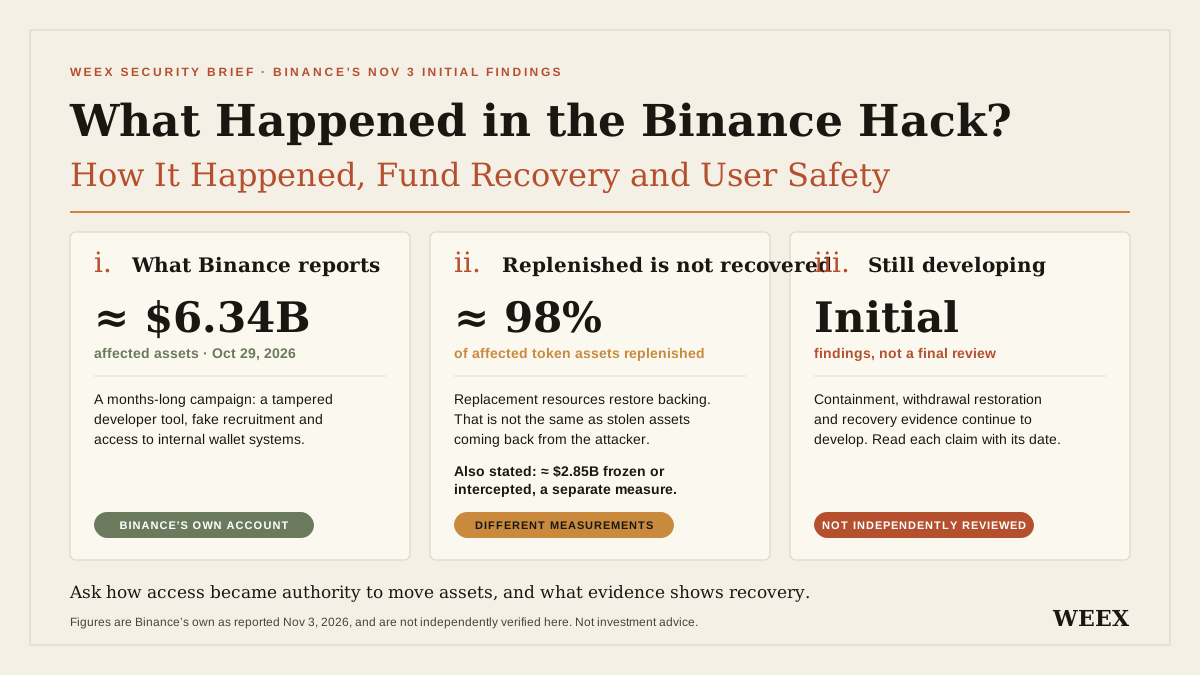
What Happened in the Binance Hack? How It Happened, Fund Recovery and User Safety
What happened in the Binance hack? Review the attack timeline, latest fund replenishment, recovery limits and practical steps to protect your account.

Who really controls a crypto project? Inside the SEC’s new guidance

Reflections After the Binance Heist: Who Should We Trust with Our Crypto Assets?
AI Agents Do More Than Just Place Orders: The Next Entrepreneurial Opportunity Lies in Matching and Trust
NVIDIA Scandal Shakes the Internet! How Should Cryptocurrency Be Divided After a Divorce with a Tech Tycoon?
Bundesbank President Says Economic Recovery Faster Than Expected, Structural Reforms Needed
Immutable Chain's Transition to OP Stack: What Changes for Users
Ledger CEO faces backlash after saying everybody will be hacked at some point
WEEX 11.11 Shopping Fest: Buy BTC and Unlock Up to 888 USDT in Rewards
Latest articles




Latest coin listings on WEEX


