
HYPE Faces Over 20% Daily Pullback, North Korean Hackers Targeting Hyperliquid?


Original Title: "HYPE Sees Over 20% Daily Pullback, Is North Korea Hacker Eyeing Hyperliquid?"
Original Author: Azuma, Odaily Planet Daily
The popular project Hyperliquid (HYPE) experienced its largest pullback since launching today.
Bitget data shows that as of around 14:00 Beijing time, HYPE was trading at 26.21 USDT, marking a sharp 20.5% intraday decline.
Is North Korea Hacker Eyeing Hyperliquid?
Looking at the market news, the biggest event in the Hyperliquid community discussion today was a warning from well-known security researcher Tay (@tayvano_) — multiple flagged North Korean hacker addresses have recently been transacting on Hyperliquid, resulting in a total loss of over $700,000.
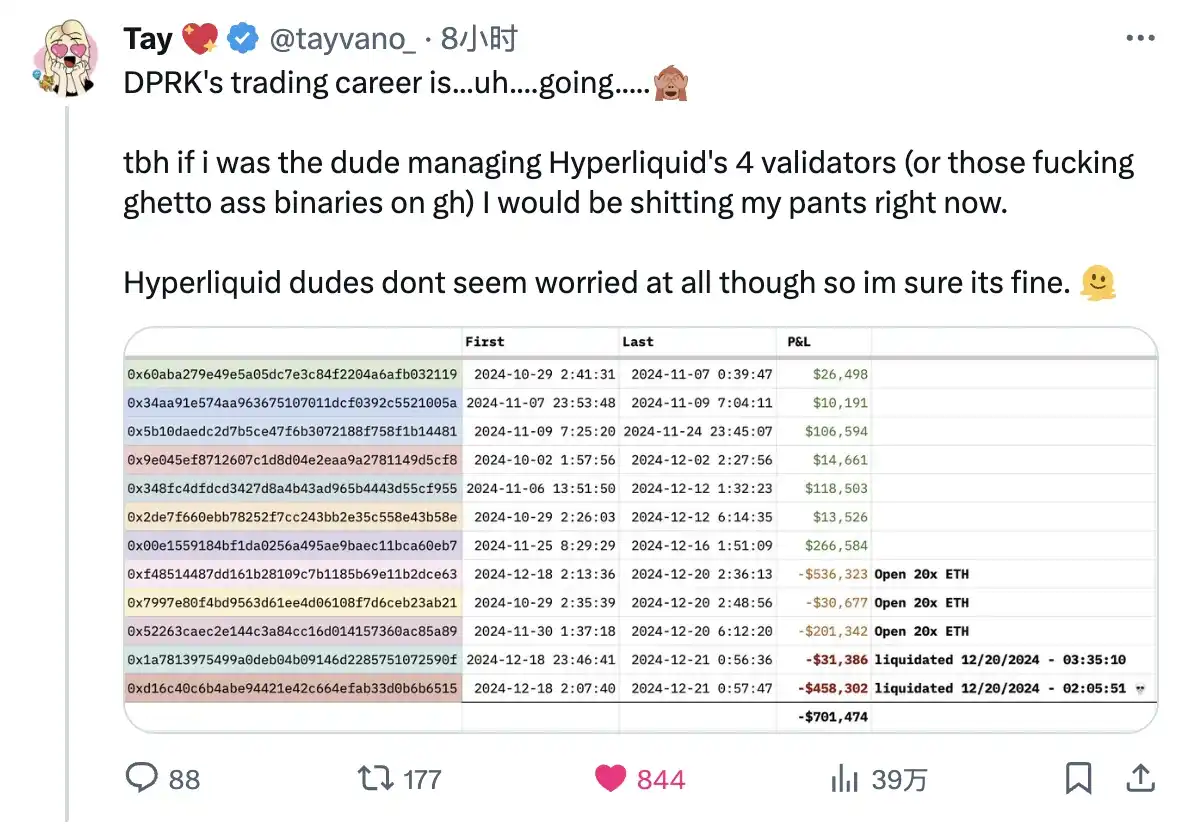
While as of the time of writing, there have been no signs of any attack on Hyperliquid, but as Tay stated, "If I were one of the 4 validators managing Hyperliquid, I might be peeing my pants right now"... signs of activity from the strongest hacker forces in the cryptocurrency world, could mean that North Korean hackers have identified Hyperliquid as a potential target and are testing the system's stability through transactions.
After Tay's post, it immediately sparked heated discussions within the community, especially the issue of the "4 validators" mentioned by Tay, which some community members even see as the weakest link in the current Hyperliquid system security.
Potential Threat: $2.3 Billion Depending Solely on 3/4 Multisig
Abstract developer cygaar explained that the Hyperliquid bridging contract currently deployed on Arbitrum holds a total of $2.3 billion in USDC, with most functions in this bridging contract requiring 2/3 validator signatures to execute (as there are only 4 validators, this effectively requires 3 signatures).
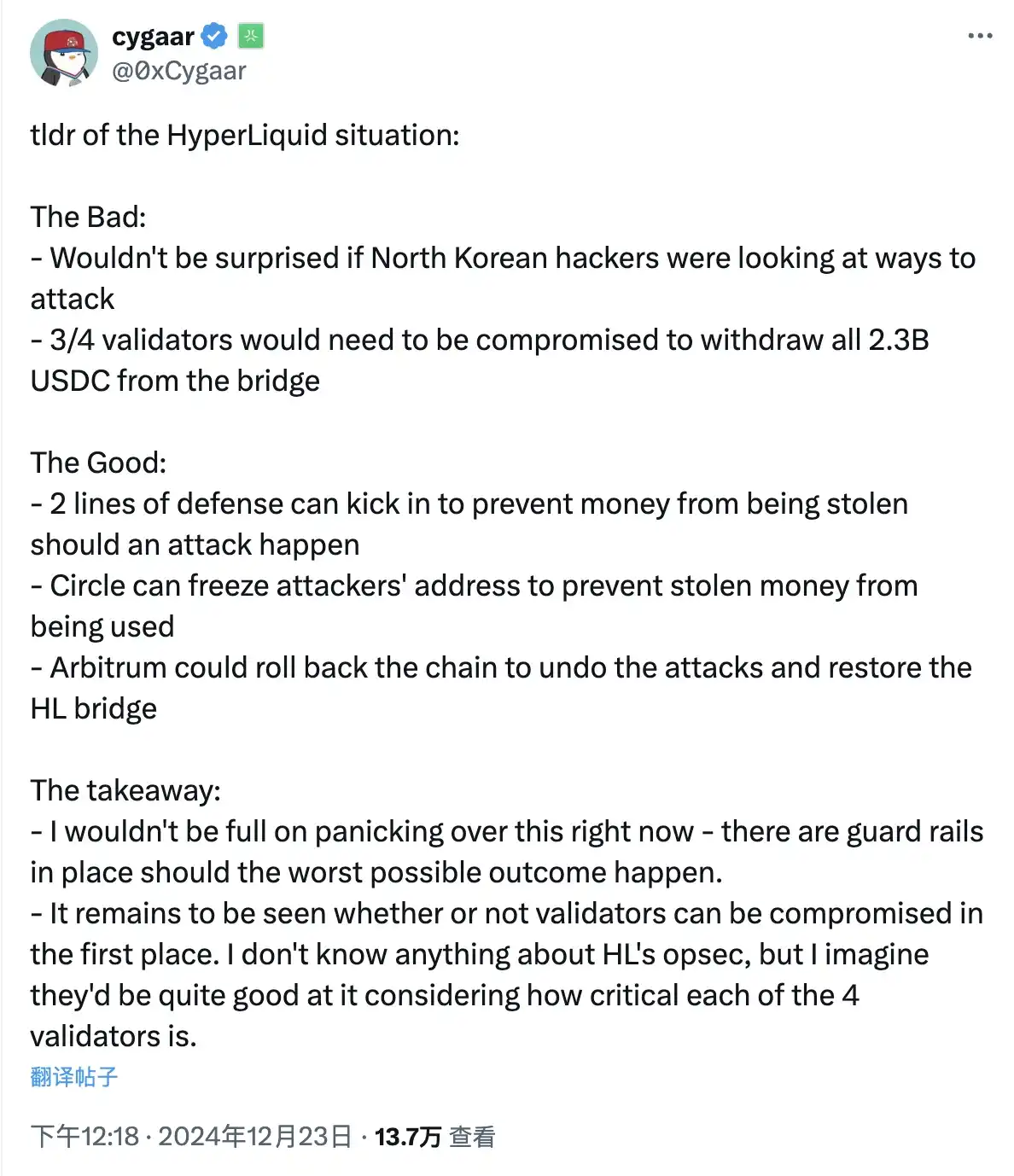
Assuming that a majority (3/4) of validators are compromised, the breached validators can submit a request to withdraw all USDC from the bridge contract and send them to a malicious address. Since the attacker has control of the vast majority of validators, they will be able to smoothly pass the request and ultimately finalize the withdrawal, meaning that $2.3 billion USDC will be transferred to the attacker.
Currently, there are two lines of defense that can intervene to prevent these USDC from being permanently lost.
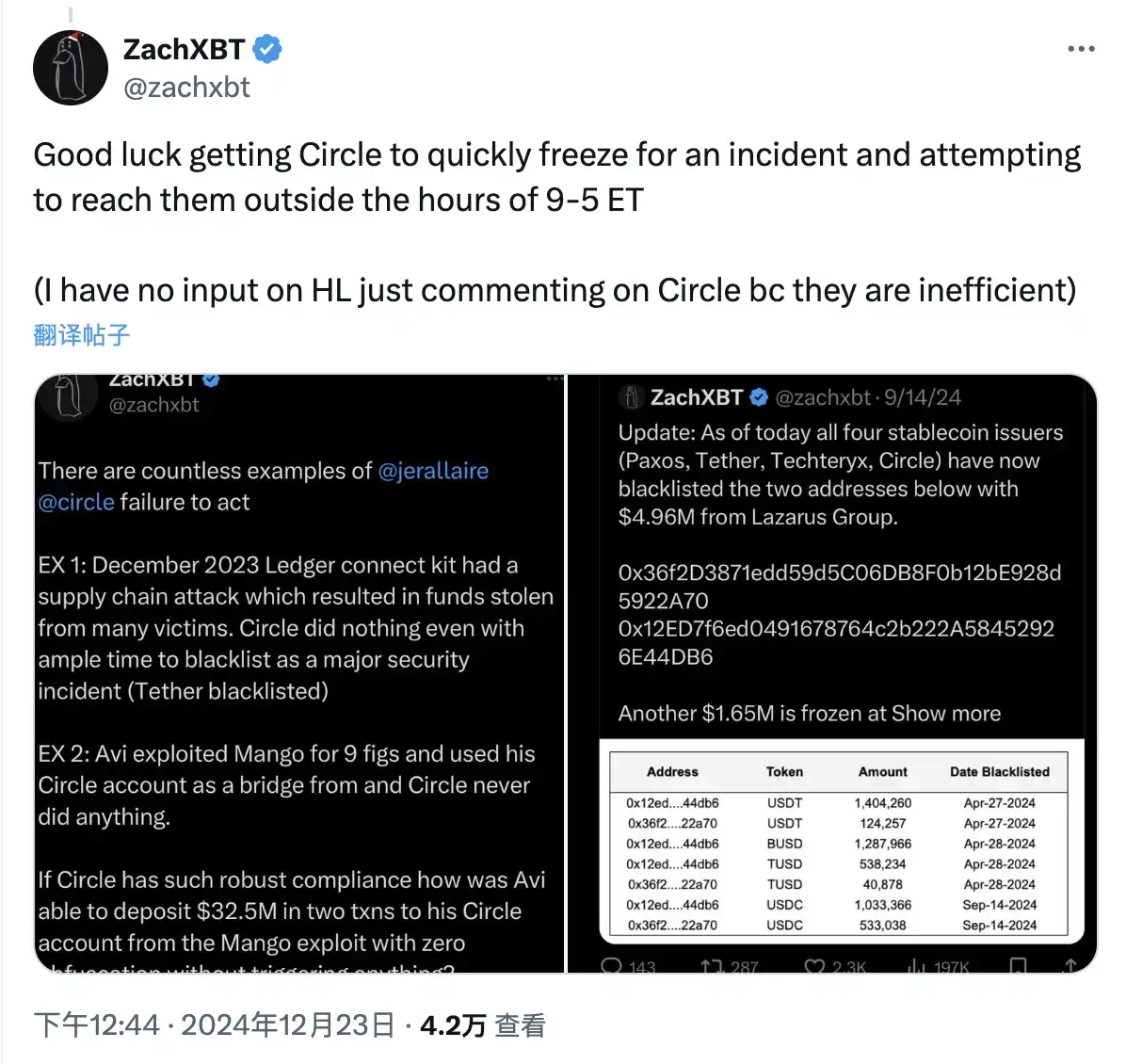
The first line of defense is at the USDC contract level. Circle's blacklist mechanism can entirely prevent specific addresses from transferring USDC. If they act fast enough, they can stop the attacker from transferring the stolen USDC, effectively freezing the funds and reimbursing the Hyperliquid bridge contract.
Regarding this defense line, security guru ZachXBT commented that Circle is very inefficient, and one should not expect them to take any remedial action. However, ZachXBT also clarified that this comment is only directed at Circle and does not involve an opinion on Hyperliquid.
The second line of defense is at the Arbitrum network level. Currently, the Arbitrum L1/L2 bridge contract on Ethereum is protected by a 9/12 multi-signature contract (security council). Suppose the attacker somehow controls this $2.3 billion USDC and immediately swaps it for other tokens to circumvent Circle's blacklist mechanism. In theory, Arbitrum's security council can also change the chain's state, roll back, and prevent the initial attack transaction from occurring. In an "emergency," the council can vote to decide whether to undertake this intervention.
cygaar added that the final line of defense is evidently highly controversial and should only be used in the most dire circumstances.
「Intentional FUD」 or 「Well-intended Warning」? Community Reaction Divided
In response to Tay's warning post, the community reaction has shown a stark dichotomy.
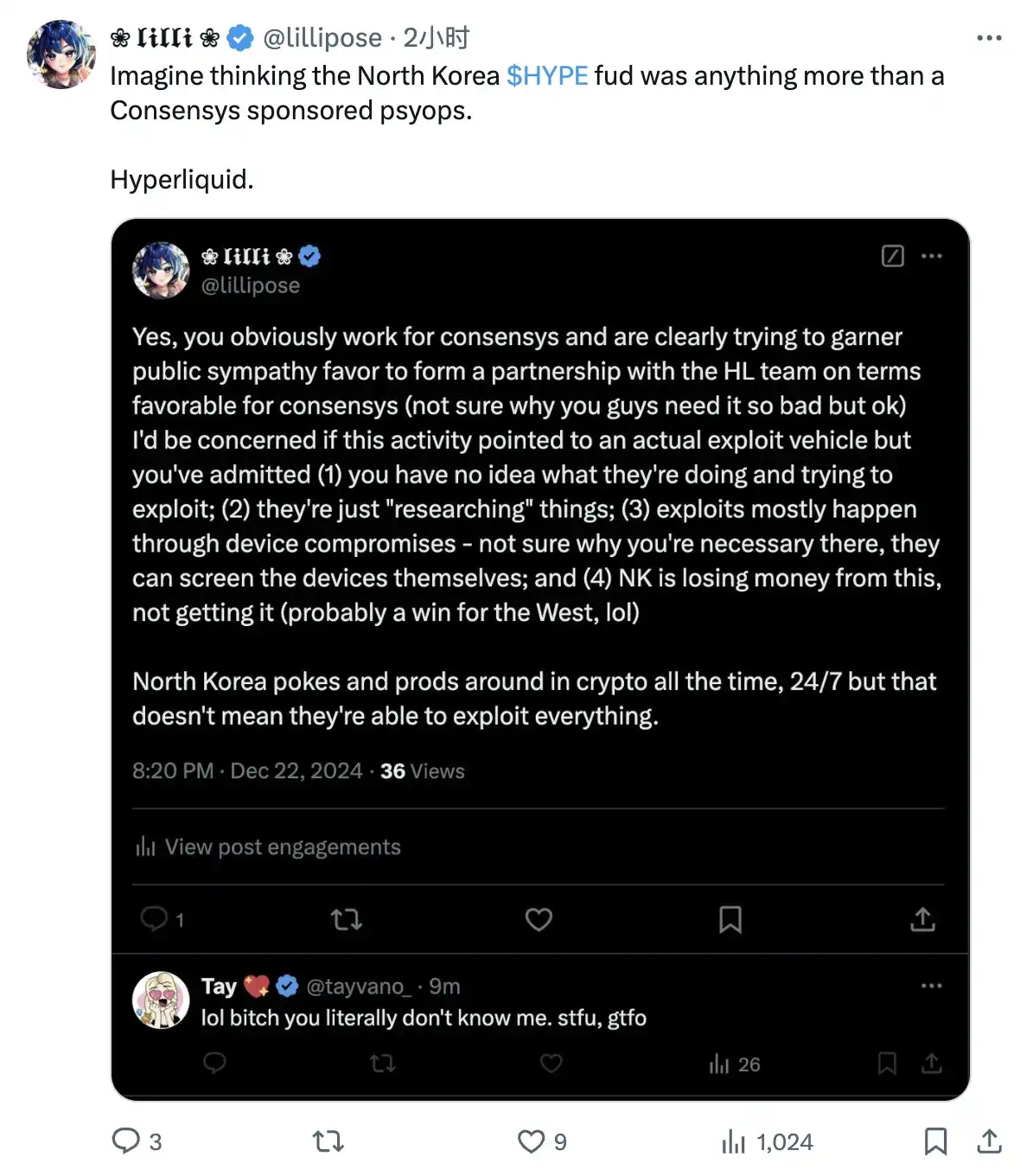
On one hand, some community members believe that Tay's warning is exaggerated, especially after the decline in HYPE, with many in the community considering Tay to be merely spreading "intentional FUD".
· Some community members pointed out that North Korean hackers target every protocol with a high TVL, not just Hyperliquid. Discovering the hacker's traces does not necessarily mean the protocol has been compromised;
· Some community members also mentioned that Tay himself actually works for Consensys, raising suspicions of a conflict of interest in his so-called "warning." In reality, it may just be to ensure that Consensys can secure the most advantageous cooperation with the Hyperliquid team.
On the other hand, some well-known figures have chosen to support Tay's security work.
· Renowned white-hat hacker samczsun stated that despite Tay's years of pro bono service to the cryptocurrency industry, he faced intense criticism due to this post simply because HYPE's price experienced a significant drop after the warning was issued... it's sad to see such news.
· Wintermute's founder and CEO, Evgeny Gaevoy, also mentioned that Tay's communication style may be somewhat aggressive (after this tweet was posted, Tay engaged in heated arguments with some of the users accusing him), but you cannot overlook information like this.

Overall, for Hyperliquid, which has been sailing smoothly since its launch, today's discussion can be considered a somewhat significant incident in the project's operation. It's called significant because Hyperliquid was not actually attacked; however, certain vulnerable aspects of the Hyperliquid system were exposed, and there was a certain degree of community division in this event... but as a leader aspiring to revolutionize industry norms, this incident is more of a litmus test than a hardship. How Hyperliquid will address the 3/4 multisig issue and calm UFD will also be a great opportunity for the market to reevaluate the project's quality and efficiency.
You may also like

Latest research from 13 top universities including Cornell University: The current state, challenges, and misconceptions of the fusion of Crypto and AI
Deconstructing Anthropic: The Best AI Company, Possibly Also a Type of Organizational Invention

Humanity Protocol Security Incident Escalates: More Than $31 Million Stolen From Related Addresses as Attacker Continues Selling H for ETH
On June 9, according to monitoring by Onchain Lens, more than $31 million has been stolen from addresses linked to Humanity Protocol, and the attack is still ongoing, with the hacker continuously swapping H tokens for ETH. Project founder Terence Kwok later confirmed the security incident on X, saying the issue involved a private key leak.

Bloomberg: As Bitcoin Weakens, Stablecoins and RWA Continue to Drive Expansion in Crypto Businesses
In June, Bloomberg reported that despite Bitcoin falling below $60,000 last week, wiping out about $235 billion in market value within seven days, and dropping close to 50% from last year’s peak, some core businesses in the crypto industry are still expanding, mainly in stablecoins, real-world asset tokenization (RWA), payments, and infrastructure. The report also noted that overall altcoin activity has contracted significantly: altcoin market capitalization has fallen from a peak of about $431 billion in November 2021 to around $170 billion, and among the tens of millions of tokens issued in recent years, fewer than 1,700 still maintain meaningful trading activity.

Galaxy Deep Research Report: How Hyperliquid's HIP-4 Upgrade Changes the Landscape of Prediction Markets?
Binance Research: RWA Market Expected to Expand Nearly 6x from Early 2025, with Public Equities and Onchain Payments Heating Up Together
In June, Binance Research said in its monthly market report that the real-world asset (RWA) market is expected to grow by about 589% from the beginning of 2025. Bond- and money market fund-related RWA expanded by about $6.5 billion, up 83% year over year, while publicly traded equity RWAs grew by about 422%. The report also noted that monthly crypto debit card transaction volume exceeded $747 million in May, up 48.6% year to date.

Japan to Assess a Framework for Yen Stablecoins and Crypto ETFs as Asia’s Compliant Payments Narrative Heats Up
Recently, according to the original report, Japan is considering the launch of yen stablecoins and cryptocurrency ETFs. Public information remains limited at this stage, and there is still no complete policy text, regulatory draft, or clear implementation timeline, so this is better characterized as a “policy discussion” rather than formal implementation. The original wording also noted that advancing stablecoin regulation in Asia is driving XRP usage and supporting growth in the XRPL ecosystem. However, based on currently available public information, there is not enough evidence to directly establish a clear causal relationship between this round of discussion in Japan and XRP or XRPL.

ZachXBT: Humanity private key leak and abnormal surge in H token should be viewed separately
On June 9, according to related disclosures, on-chain investigator ZachXBT posted an update on Humanity’s roughly $31 million security incident, saying that after further analyzing fund flows, he currently tends to believe the project team was not involved in an “inside job” or a self-staged attack. According to him, the official explanation about the private key leak was broadly accurate, but before the token unlock, the price of H had been artificially pushed higher, and the hacker later took advantage of that market environment; therefore, the private key leak and the earlier abnormal price pumping should be regarded as two separate and independent events. This reframing has shifted the market’s understanding of the nature of the incident. Earlier discussion around Humanity had focused on whether the team directly participated in the attack or used the security incident to cover up internal operations. ZachXBT’s latest remarks shift the focus from “whether it was self-theft” to “whether there were pre-unlock market structure issues.” He also questioned whether the team may have.

Morning Report | OpenAI has submitted an S-1 registration statement draft to the U.S. SEC; Morpho completes $175 million financing

Morning Report | BitMine increased its holdings by 126,971 ETH last week; trader Eugene announced his exit from the crypto market

Wang Chuan: How can one not feel anxious after the neighbor Old Wang made thirty times profit by investing in storage stocks? (Seven) - A quarter-century cycle

Cryptocurrency CEXs are flocking to sell US stocks, and traditional brokerages are facing an "uninvited guest."
$75 billion in foreign capital has fled, and South Korean retail investors have absorbed it all using leverage

Japan’s Three Megabanks Plan Joint Stablecoin Issuance in Fiscal 2026
MUFG, SMBC, and Mizuho reportedly plan to jointly issue fiat-pegged stablecoins in fiscal 2026, signaling Japan’s growing push into bank-led digital payment infrastructure.

Humanity Discloses H Token Dual-Chain Attack Details, With Losses on Ethereum and BSC Exceeding $36 Million
Humanity said the H token attack across Ethereum and BSC caused more than $36 million in losses after leaked ProxyAdmin keys enabled malicious contract upgrades and token minting.
White House Discusses CLARITY Act With Law Enforcement Ahead of Senate Vote
The White House discussed the CLARITY Act with law enforcement ahead of a Senate vote, focusing on illicit finance risks and developer protections.

Bitcoin Trading Guide 2026: Strategies for Experienced Traders

What Is XAUT and PAXG? Why Tokenized Gold Is Booming in 2026
Latest research from 13 top universities including Cornell University: The current state, challenges, and misconceptions of the fusion of Crypto and AI
Deconstructing Anthropic: The Best AI Company, Possibly Also a Type of Organizational Invention
Humanity Protocol Security Incident Escalates: More Than $31 Million Stolen From Related Addresses as Attacker Continues Selling H for ETH
On June 9, according to monitoring by Onchain Lens, more than $31 million has been stolen from addresses linked to Humanity Protocol, and the attack is still ongoing, with the hacker continuously swapping H tokens for ETH. Project founder Terence Kwok later confirmed the security incident on X, saying the issue involved a private key leak.
Bloomberg: As Bitcoin Weakens, Stablecoins and RWA Continue to Drive Expansion in Crypto Businesses
In June, Bloomberg reported that despite Bitcoin falling below $60,000 last week, wiping out about $235 billion in market value within seven days, and dropping close to 50% from last year’s peak, some core businesses in the crypto industry are still expanding, mainly in stablecoins, real-world asset tokenization (RWA), payments, and infrastructure. The report also noted that overall altcoin activity has contracted significantly: altcoin market capitalization has fallen from a peak of about $431 billion in November 2021 to around $170 billion, and among the tens of millions of tokens issued in recent years, fewer than 1,700 still maintain meaningful trading activity.
Galaxy Deep Research Report: How Hyperliquid's HIP-4 Upgrade Changes the Landscape of Prediction Markets?
Binance Research: RWA Market Expected to Expand Nearly 6x from Early 2025, with Public Equities and Onchain Payments Heating Up Together
In June, Binance Research said in its monthly market report that the real-world asset (RWA) market is expected to grow by about 589% from the beginning of 2025. Bond- and money market fund-related RWA expanded by about $6.5 billion, up 83% year over year, while publicly traded equity RWAs grew by about 422%. The report also noted that monthly crypto debit card transaction volume exceeded $747 million in May, up 48.6% year to date.


