
Insight WEEX: CLARITY Act Explained as Bitcoin Tests the $75K Level

 Prefer us on Google
- CLARITY Act Senate Vote: The CLARITY Act failed to advance after a 49–50 procedural vote fell short of the 60-vote threshold, keeping crypto regulation in focus.
- Bitcoin Price Below $75K: Bitcoin briefly dropped below $75,000 following the vote as traders repriced expectations for near-term regulatory clarity.
- BTC, ETH & SOL Outlook: With ETH and SOL also under pressure, markets are now watching BTC support, liquidity, funding rates, and the next steps for the CLARITY Act.
Why Did the CLARITY Act Fail to Advance in the Senate?
- The Threshold: Reaching cloture required 60 votes. The final 49-50 outcome fell 11 votes short, primarily reflecting partisan splits over official ethics frameworks, stablecoin yield provisions, and jurisdictional boundaries between the SEC and CFTC.
- Procedural Status: The bill was not "killed" permanently in a constitutional sense. Senator Thom Tillis shifted his vote to "No" late in the proceedings, preserving the procedural right for proponents to introduce a motion to reconsider in future sessions.
- Pre-Vote Market Positioning: Prediction-market odds had already begun pricing in a lower probability of passage before the vote. Probabilities for the bill becoming law within the calendar year fell from 34% down to 17% prior to the vote. (Source: Yahoo Finance / Polymarket data, Sept 15, 2026)
Why Did Bitcoin Fall Below $75K After the CLARITY Act Vote?
| Market Segment | Post-Vote Status |
| Macro liquidity conditions | Stable / insulated |
| Traditional equity markets | Neutral / uncorrelated |
| Crypto asset valuation | Policy discount applied |
What Happens Next for the CLARITY Act?
| Catalyst | Channel |
| 1. Legislative revision | Secondary attachments to must-pass bills |
| 2. Executive agency action | Informal rulemaking via SEC / CFTC |
How Could the CLARITY Act Setback Affect BTC, ETH, and SOL?
| Asset | Structure | Market Behavior |
| Bitcoin (BTC) — Macro liquidity anchor | Primary gauge for market-wide risk-aversion | Having tested liquidations below $75,000, traders may watch BTC spot volume, order-book depth, and the $75K area for signs of stabilization. |
| Ethereum (ETH) — Financial infrastructure proxy | Direct exposure to DeFi frameworks and tokenized asset integration | Because institutional DeFi is heavily dependent on regulatory clarity around staking and asset classification, ETH may remain sensitive to developments involving staking, DeFi, and digital-asset classification. |
| Solana (SOL) — High-beta velocity | Primary vehicle for retail velocity and momentum trading during market rotations | During policy-induced drawdowns, capital has historically flowed out of high-beta assets first; once BTC establishes a range. As a higher-beta large-cap asset, SOL may experience larger price swings when crypto risk appetite shifts. |
What Should Crypto Traders Watch After the CLARITY Act Vote?
- Order Book Depth vs. Slippage: Venues offering deep, unified order books across both spot and perpetual futures markets—such as WEEX, can help traders track capital flows while managing execution slippage during high-volatility spikes.
- Derivative Metrics Tracking: Monitoring shifts in Open Interest (OI) alongside funding rate compressions can help distinguish whether a downside expansion is driven by genuine spot selling or aggressive short-side leverage saturation.
- Cross-Market Hedging: In volatile macro environments, relying solely on directional spot accumulation carries its own risks. Perpetual contracts are one tool some traders use to hedge spot inventory near key structural resistance levels, though hedging strategies carry their own costs and risks.
FAQ: CLARITY Act and Bitcoin
This content is provided for general informational purposes only and doesn't constitute financial, investment, legal, or tax advice. Any events, rewards, online promotions, or related information mentioned herein should not be considered a recommendation, solicitation, or invitation to purchase, sell, trade, or otherwise deal in any crypto assets. Crypto assets are highly volatile and may result in loss. The availability of WEEX services, products, and related events may vary by region. You are responsible for ensuring that your participation is in accordance with applicable local laws and regulations.
You may also like

LTC Airdrop 2026: How to Claim 50,000 USDT Rewards on WEEX

Dom Kwok Expects a Sudden Surge in Crypto Prices

Exclusive Interview with Frontier Technology Investor Zheng Di: SEC's 'Innovation Exemption' Opens the Door to a Compliant Bull Market, Which Assets Are Potential Stocks?

XRPL to Implement Major Upgrade on October 5: Adding Permission Delegation Feature

67% of the wealthy own digital assets, but the crypto adoption gap remains huge
How to Rewrite Internet Rules When Everyone Has an Indefatigable Agent

The End of the Blank Prompt: Why Trading AI Needs a Playbook

Cardano proposal slashes fees by 55%, but it comes with a cost for small pools

The Evolution of AI: The Boundaries and Truth of Recursive Self-Improvement (RSI)
The Quantum Issue: You Never Really Know The Future

Security and fees hold back deeper crypto use among wealthy investors: Nexo report

Bitcoin Developers Concerned About Mining Subsidy

VVV Hits All-Time High: Founder’s Perspective on Models, Privacy, and Crypto

XRPL fixes critical pre-mainnet flaw, but client apps remain at risk

Glassnode Indicates Shift Towards Altcoin Season

Crypto: Kalshi accused of inflating its volumes with thousands of identical orders

HODLing ETH: Should You Choose Staking for Yield or Collateralized Lending?

SEC Clarity Meets Fed Rate Hike: How WEEX TradFi Lucky Eggs S2 Taps Into Cross-Market Opportunities

How Significant Are Changes in Overseas AI Investment?
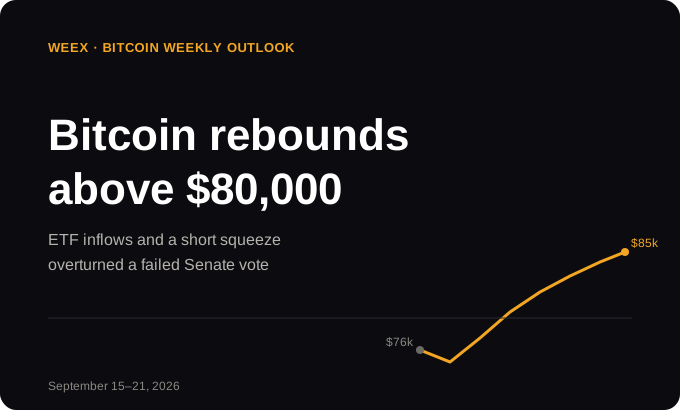
WEEX Bitcoin Weekly Outlook: Why Did Bitcoin Rebound Above $80,000 After the CLARITY Act Vote?
Bitcoin rebounded above $80,000 as SEC and CFTC action, renewed ETF inflows, and a short squeeze outweighed the failed CLARITY Act vote.

$8 Makes a Comeback, This Time X Money Rewrites the Logic of NFT Issuance
AMD Jumps Nearly 10%, Market Cap Tops $1 Trillion| WEEX TradFi Daily Brief (September 22, 2026)
Global markets on September 22 focus on a repair in AI-compute pricing. On September 21 the three major equity indexes closed higher. AMD rose nearly 10% and its market cap crossed $1 trillion for the first time, while Intel and Arm also surged. Brent crude fell about 3.4% to $100.34 and the 10-year Treasury yield eased to about 4.96%, lowering discount-rate pressure on long-duration tech. Bitcoin briefly broke above $87,000 and total crypto market cap returned above $3 trillion. Investors next watch consumer and housing earnings plus PMI flash prints.
Balancer Community Proposes Fork and Rebirth

The Answer to Dreamforce 2026: AI Agent, Has It Finally Turned from Demo to Revenue?
Ethereum: BitMine Approaches 5% of Total ETH Supply
Bitcoin's $84K rally isn't saving miners as difficulty signals already flash caution
ZEC's Largest Mining Company Moves to US Stock Market After Mining 70,000 ZEC in Six Months

Validators Vote on Batch V1.1 After Security Overhaul

Aptos Validators Decrease by 40% in Two Years, Concentration of Validator Nodes Shifts to Europe and America

SEC Takes Action: Who Can Handle "Compliant ICOs"?
LTC Airdrop 2026: How to Claim 50,000 USDT Rewards on WEEX
Dom Kwok Expects a Sudden Surge in Crypto Prices
Exclusive Interview with Frontier Technology Investor Zheng Di: SEC's 'Innovation Exemption' Opens the Door to a Compliant Bull Market, Which Assets Are Potential Stocks?
XRPL to Implement Major Upgrade on October 5: Adding Permission Delegation Feature
67% of the wealthy own digital assets, but the crypto adoption gap remains huge
How to Rewrite Internet Rules When Everyone Has an Indefatigable Agent





