
Larry is Farcaster's silver shovel?




Recently, innovations in asset issuance methods on Base have continued to emerge: "Can you really play Base Clanker?", many new products have emerged in the community, and Larry is one of the most distinctive ones.
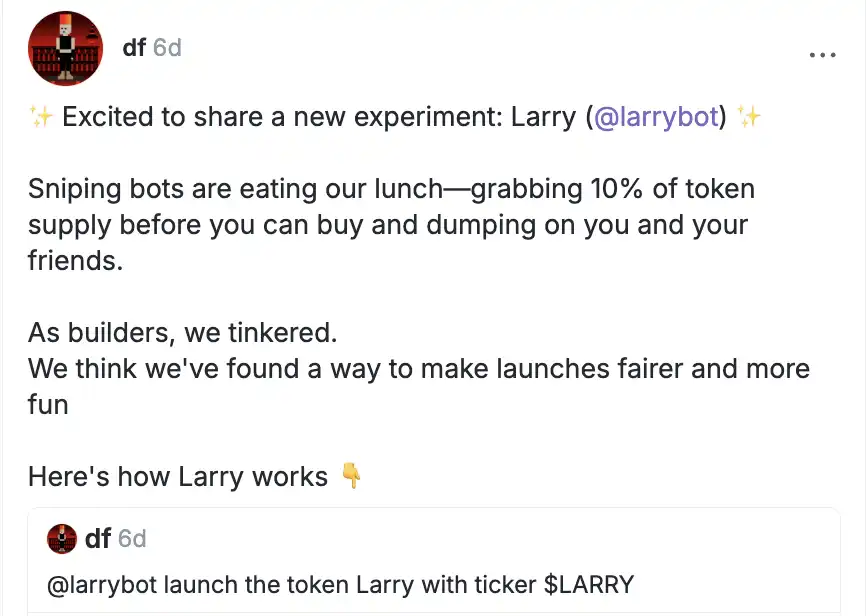
At 12 noon on December 5, David Fulong (@df), senior developer of Farcaster and founder of Frame protocol, published a cast, announcing the birth of Larry.
Team background: Larry vs Clanker
Clanker was founded by @_proxystudio and @JackDishman, and Larry was founded by @davidvfurlong and @stephancill.
Farcaster veteran player @0xLuo popular science: Clanker's founding team is a new developer of Farcaster, Larry's founding team is Farcaster OG, @davidvfurlong's resume is particularly impressive: his company has received investment from A16Z (note that A16Z did not invest in Larry), and he himself is also the proposer of the Frame protocol - Frame is a major innovation of Farcaster, and it is also the key to the Farcaster team's ability to get $150 million "on the surface".
In contrast, Larry's team is more politically successful; but Farcaster's OG status is a negative buff for the publisher, after all, it is well known that Farcaster is a mosque...
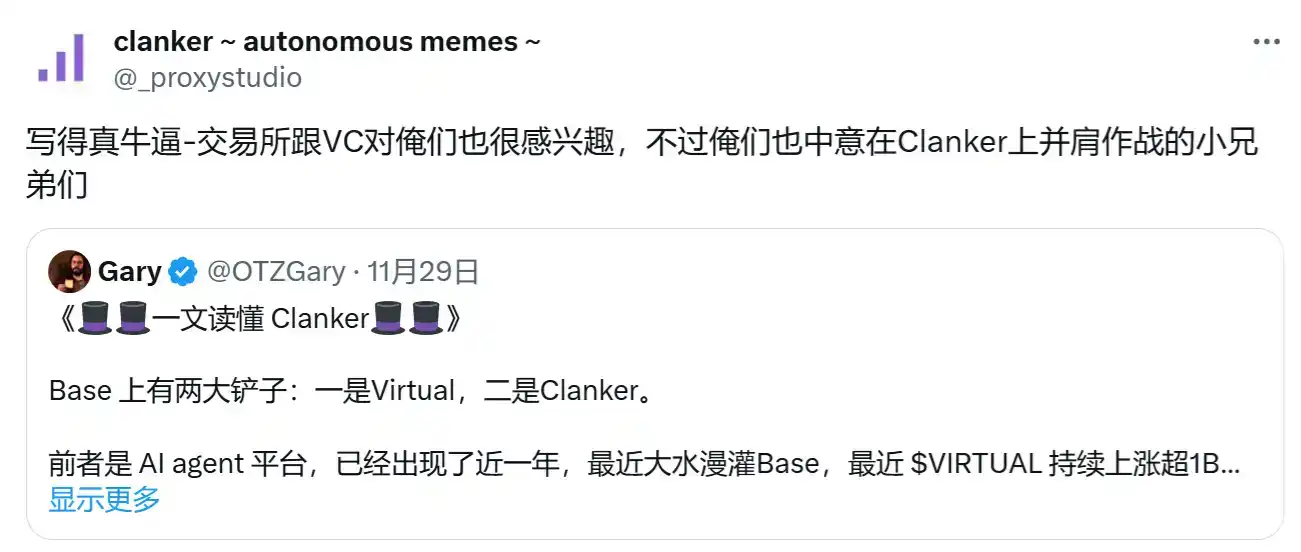
From an operational perspective, Clanker does understand memes better. Its founder @proxystudio.eth often contributes various "god comments" to Farcaster, and Clanker's official account (@_proxystudio ) is also very funny:
On the other hand, Larry, maybe because it was just launched less than a week ago, the entire team's energy was completely focused on product development and mechanism design, and there was almost no support for ecological projects and operation of official brands and communities - this is an important reason why its leading token $LARRY (currently around 3M, up to 7M) lags far behind Clanker's leading token $CLANKER (currently around 50M, up to 150M) in market value.
Asset Issuance Mechanism: Larry vs Clanker
In a nutshell, Larry and Clanker are both AI Agents that issue tokens as soon as they post. Larry’s asset issuance method imitates Pumpfun’s internal and external pool mechanism, while Clanker’s asset issuance method is fair launch - the former’s shortcoming is that the threshold restricts retail investors from participating in the early stage, while the latter’s shortcoming is that it is difficult to overcome robot sniping.
Asset issuance mechanism: Clanker
Specifically, by tagging Clanker on Farcaster and stating the token name, ticker, and header image, Clanker can add a Uniswap pool with a starting market value of approximately $30,000 on Base for free (the threshold is that the Farcaster account Neynar score must be high enough, which means it is difficult for newcomers to issue tokens). All deployed tokens can be viewed on the official website.
Unlike PumpFun, which charges 1% transaction fee + 2 Sols on Raydium fee during the bonding curve, Clanker does not have a bonding curve, but charges 1% handling fee from Uni v3 as income: 40% to the issuer and 60% to the Clanker team - this split ratio may change, see official documentation for details.
Asset issuance mechanism: Larry
Like Clanker, Larry also issues tokens by posting with a threshold limit.
After receiving the message, Larry AI Agent will initiate an internal market on its official website Larry.club : The latest rule is that the upper limit of the internal market fundraising time is changed to 69 minutes, each person can put in a maximum of 0.25E, and all people can put in a total of 3E. After it is full, it will wait for a while before adding a pool to open on V3. (Previously it was 15 minutes and over-subscription was allowed)
The specific details are that a launch button will appear on the page, and then an internal user is required to confirm and pay the gas fee (Note: the dev sold displayed on GMGN is actually the user who clicked the launch button, not the real developer...)
A very criticized point in the whole mechanism is that the neynar score needs to be higher than 0.8 to fill the internal plate, and ordinary retail investors can't get in at all. They can only watch Farcaster OGs fill the internal plate and then take their chips on the external plate - in fact, they can understand the intentions of the mechanism designers: after all, this is an era where whoever has the bottom chips is the dealer, and the team hopes that the "dealers" will cherish their feathers and not smash them as soon as the market opens - but the reality is: many plates on Larry are drilled into the ground in 10 seconds, because people on the internal plate know how bad the experience of people on the external plate is. If the angle is not tricky enough, no one will come to take it, thus forming a stampede on the internal plate...
Currently The voice of FUD Larry tokens is dominant. Apart from the leading $LARRY, no other token can survive the second wave of drilling, let alone take off like $ANON $CLANKER $LUM on Clanker... (For the launch of various tokens on Larry in the past few days, see this tweet)
But it’s still early days, the mechanism design may change at any time, and the team is also constantly thinking about how to best couple the internal mechanism with the real-name PVP Socialfi game - let us continue to observe. (For a more detailed comparison between Clanker and Larry, see this tweet.)
Larry’s development history: from drilling into the ground to V-reversal
BUG storm: explosive pull and then drilling into the ground
Open the candlestick chart of $LARRY, you will find that it pulled up on the first day, and then continued to drill into the ground for the next two days.

(Note again: the dev sold shown on GMGN is actually the user who clicked the launch button, not the real developer)
Why? The most important reason is that Larry's software crashed at the beginning. On the one hand, it could not issue coins. On the other hand, it was caught in a public opinion storm that the software had a bug and introduced internal insider trading: An anonymous person claimed that two participants used 0.6 ETH and 1.05 ETH at the bottom to sell when the market was rising, and each earned 90k and 12k...
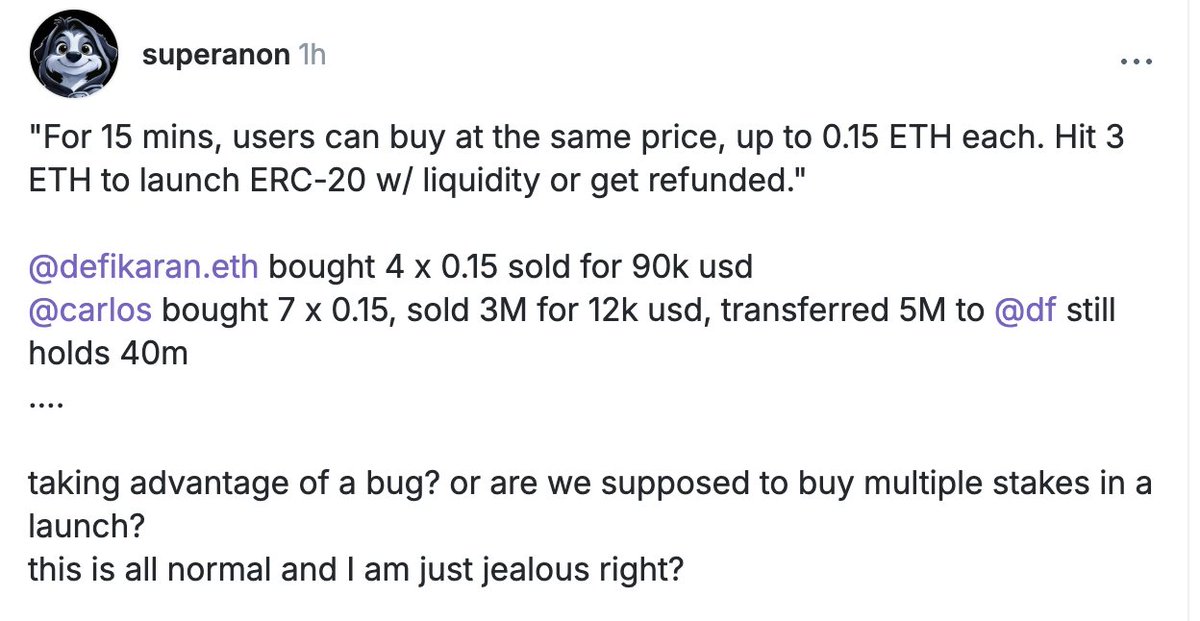
The founder @davidvfurlong admitted the software bug and apologized, and then fixed the vulnerability. He also kept fixing bugs for the next two days, which was quite embarrassing: the coin price plummeted all the way, from a high of 7M to less than 1M...
Continuous construction: drilling is rising again
BUG After repairs and mechanism optimization, the K-line of Drilling has risen again, and is currently fluctuating between 2M and 4M.
Two days ago, the founder @davidvfurlong did another big thing: he released a Farcaster AI template as an open source for later developers to quickly deploy AI Agents on Farcaster, which led to a series of AI Agents interacting with Larry, including the dqau (the corresponding token is @freysa_ai "man-machine game" story that went viral on Twitter) reproduced on Farcaster.
Where is Larry's future?
The editor observed the community and found that the evaluation of Larry by community members can be summarized in eight words: "Sorry for his misfortune, angry at his lack of competition."
"Sorry for his misfortune" means that Larry's release did not cater to the right time: on the day of Larry's release, Clanker was making a fortune and was in the limelight; in addition, the liquidity of the Farcaster ecosystem was far from sufficient for people to chase the second dragon; and who would have thought that the products of the two super developers would have a lot of bugs as soon as they went online - the leading token $LARRY and its ecological tokens were continuously suppressed, and many "precious angles" were wasted...
"Angry at his lack of competition" means that Larry's team is too pure, does not know how to make things, and more importantly, does not know how to make markets - this is actually a common problem of all Farcaster tokens.
This wave of memes is a key step in the process of Farcaster's de-halalization. People will gradually flock in: from the lone P players to the real dealers, who can only pull up the lever to bring about a flood of money - I hope this day will come soon.
You may also like

SpaceX vs Tesla vs xAI: Which Elon Musk Trade Has the Biggest Upside in 2026?

OpenAI Reveals It Has Confidentially Submitted an S-1 to the SEC, Keeping the Door Open for a Future IPO
On June 9, according to an OpenAI announcement, the company recently confidentially submitted a draft S-1 registration statement to the U.S. Securities and Exchange Commission (SEC), beginning the preliminary compliance process for a potential initial public offering. OpenAI said it chose to disclose this proactively because it expected the news might leak; however, the company has not yet set a specific listing timeline, and related arrangements may still take some time.

Latest research from 13 top universities including Cornell University: The current state, challenges, and misconceptions of the fusion of Crypto and AI
Deconstructing Anthropic: The Best AI Company, Possibly Also a Type of Organizational Invention
Apollo and Blackstone Reportedly Back $35 Billion Anthropic Chip Financing as Deal Details Remain Unclear
On June 9, according to currently available news alerts, Apollo and Blackstone Group participated in a $35 billion financing for an Anthropic “chip project.” Based on the original wording of the report, the funding has already been raised, but public information remains limited. The financing structure, use of proceeds, project entity, and whether Apollo and Blackstone participated through equity, debt, or project financing have not yet been disclosed.

Humanity Protocol Security Incident Escalates: More Than $31 Million Stolen From Related Addresses as Attacker Continues Selling H for ETH
On June 9, according to monitoring by Onchain Lens, more than $31 million has been stolen from addresses linked to Humanity Protocol, and the attack is still ongoing, with the hacker continuously swapping H tokens for ETH. Project founder Terence Kwok later confirmed the security incident on X, saying the issue involved a private key leak.

Bloomberg: As Bitcoin Weakens, Stablecoins and RWA Continue to Drive Expansion in Crypto Businesses
In June, Bloomberg reported that despite Bitcoin falling below $60,000 last week, wiping out about $235 billion in market value within seven days, and dropping close to 50% from last year’s peak, some core businesses in the crypto industry are still expanding, mainly in stablecoins, real-world asset tokenization (RWA), payments, and infrastructure. The report also noted that overall altcoin activity has contracted significantly: altcoin market capitalization has fallen from a peak of about $431 billion in November 2021 to around $170 billion, and among the tens of millions of tokens issued in recent years, fewer than 1,700 still maintain meaningful trading activity.

Galaxy Deep Research Report: How Hyperliquid's HIP-4 Upgrade Changes the Landscape of Prediction Markets?
Binance Research: RWA Market Expected to Expand Nearly 6x from Early 2025, with Public Equities and Onchain Payments Heating Up Together
In June, Binance Research said in its monthly market report that the real-world asset (RWA) market is expected to grow by about 589% from the beginning of 2025. Bond- and money market fund-related RWA expanded by about $6.5 billion, up 83% year over year, while publicly traded equity RWAs grew by about 422%. The report also noted that monthly crypto debit card transaction volume exceeded $747 million in May, up 48.6% year to date.

Japan to Assess a Framework for Yen Stablecoins and Crypto ETFs as Asia’s Compliant Payments Narrative Heats Up
Recently, according to the original report, Japan is considering the launch of yen stablecoins and cryptocurrency ETFs. Public information remains limited at this stage, and there is still no complete policy text, regulatory draft, or clear implementation timeline, so this is better characterized as a “policy discussion” rather than formal implementation. The original wording also noted that advancing stablecoin regulation in Asia is driving XRP usage and supporting growth in the XRPL ecosystem. However, based on currently available public information, there is not enough evidence to directly establish a clear causal relationship between this round of discussion in Japan and XRP or XRPL.

ZachXBT: Humanity private key leak and abnormal surge in H token should be viewed separately
On June 9, according to related disclosures, on-chain investigator ZachXBT posted an update on Humanity’s roughly $31 million security incident, saying that after further analyzing fund flows, he currently tends to believe the project team was not involved in an “inside job” or a self-staged attack. According to him, the official explanation about the private key leak was broadly accurate, but before the token unlock, the price of H had been artificially pushed higher, and the hacker later took advantage of that market environment; therefore, the private key leak and the earlier abnormal price pumping should be regarded as two separate and independent events. This reframing has shifted the market’s understanding of the nature of the incident. Earlier discussion around Humanity had focused on whether the team directly participated in the attack or used the security incident to cover up internal operations. ZachXBT’s latest remarks shift the focus from “whether it was self-theft” to “whether there were pre-unlock market structure issues.” He also questioned whether the team may have.

Morning Report | OpenAI has submitted an S-1 registration statement draft to the U.S. SEC; Morpho completes $175 million financing

Morning Report | BitMine increased its holdings by 126,971 ETH last week; trader Eugene announced his exit from the crypto market

Wang Chuan: How can one not feel anxious after the neighbor Old Wang made thirty times profit by investing in storage stocks? (Seven) - A quarter-century cycle
Cryptocurrency CEXs are flocking to sell US stocks, and traditional brokerages are facing an "uninvited guest."
$75 billion in foreign capital has fled, and South Korean retail investors have absorbed it all using leverage

Japan’s Three Megabanks Plan Joint Stablecoin Issuance in Fiscal 2026
MUFG, SMBC, and Mizuho reportedly plan to jointly issue fiat-pegged stablecoins in fiscal 2026, signaling Japan’s growing push into bank-led digital payment infrastructure.

Humanity Discloses H Token Dual-Chain Attack Details, With Losses on Ethereum and BSC Exceeding $36 Million
Humanity said the H token attack across Ethereum and BSC caused more than $36 million in losses after leaked ProxyAdmin keys enabled malicious contract upgrades and token minting.
SpaceX vs Tesla vs xAI: Which Elon Musk Trade Has the Biggest Upside in 2026?
OpenAI Reveals It Has Confidentially Submitted an S-1 to the SEC, Keeping the Door Open for a Future IPO
On June 9, according to an OpenAI announcement, the company recently confidentially submitted a draft S-1 registration statement to the U.S. Securities and Exchange Commission (SEC), beginning the preliminary compliance process for a potential initial public offering. OpenAI said it chose to disclose this proactively because it expected the news might leak; however, the company has not yet set a specific listing timeline, and related arrangements may still take some time.
Latest research from 13 top universities including Cornell University: The current state, challenges, and misconceptions of the fusion of Crypto and AI
Deconstructing Anthropic: The Best AI Company, Possibly Also a Type of Organizational Invention
Apollo and Blackstone Reportedly Back $35 Billion Anthropic Chip Financing as Deal Details Remain Unclear
On June 9, according to currently available news alerts, Apollo and Blackstone Group participated in a $35 billion financing for an Anthropic “chip project.” Based on the original wording of the report, the funding has already been raised, but public information remains limited. The financing structure, use of proceeds, project entity, and whether Apollo and Blackstone participated through equity, debt, or project financing have not yet been disclosed.
Humanity Protocol Security Incident Escalates: More Than $31 Million Stolen From Related Addresses as Attacker Continues Selling H for ETH
On June 9, according to monitoring by Onchain Lens, more than $31 million has been stolen from addresses linked to Humanity Protocol, and the attack is still ongoing, with the hacker continuously swapping H tokens for ETH. Project founder Terence Kwok later confirmed the security incident on X, saying the issue involved a private key leak.


