
Polymarket Announces In-House L2, Is Polygon's Ace Up?

 Prefer us on Google


Original Title: "The Economic Account Behind Polymarket's Exodus from Polygon"
Original Author: Azuma, Odaily Planet Daily
On December 22, a piece of news about the leading prediction market Polymarket sparked widespread market attention. Polymarket team member Mustafa confirmed in the Discord community that Polymarket plans to migrate from Polygon and launch an Ethereum Layer 2 network called POLY, which is the project's current top priority.
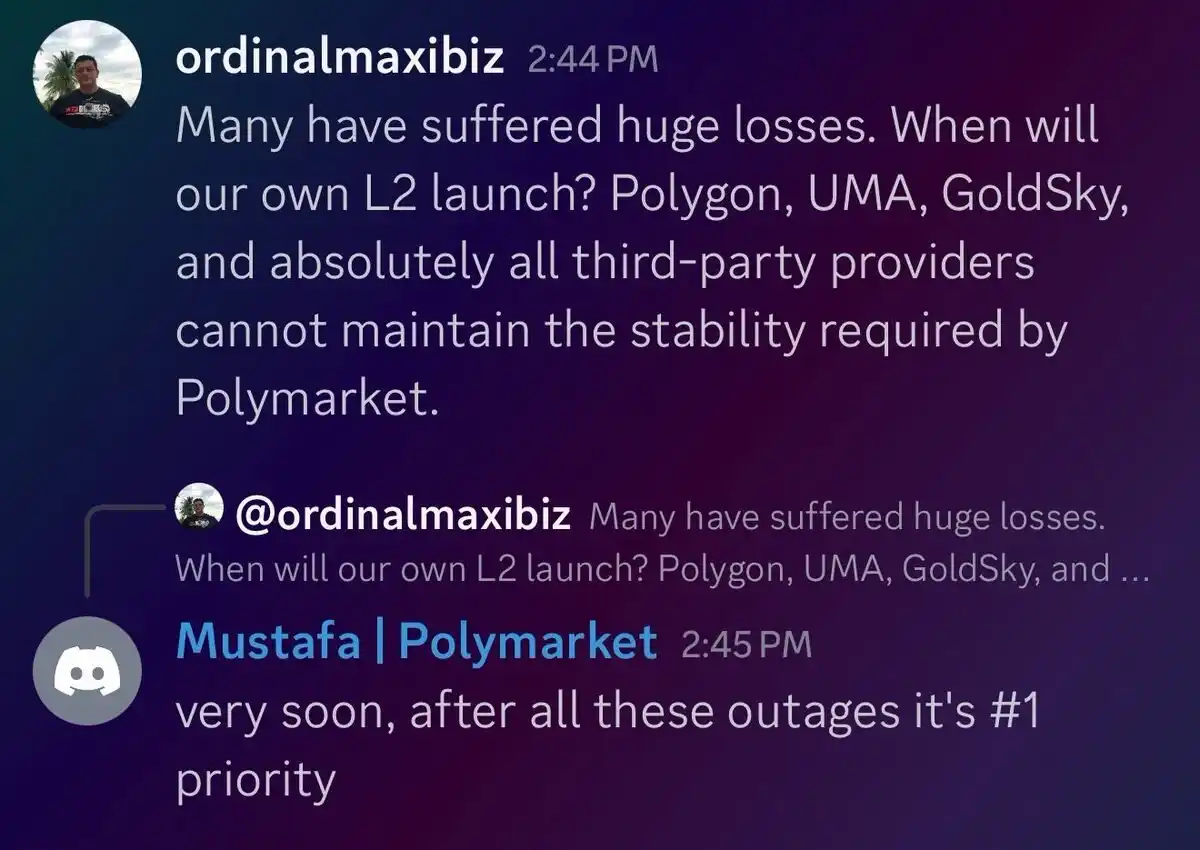
An Not-so-Surprising "Breakup"
Polymarket's decision to leave Polygon is not particularly surprising. One is a leading application layer representative, and the other is a fading old base layer. The mismatch between the market heat and expected value of the two has existed. As Polymarket gradually grows into a new giant, Polygon's unstable network performance (the most recent failure occurred on December 18) and relatively weak ecosystem have objectively restricted the former.
For Polymarket, building its own gateway means a win-win choice in both product and economic dimensions.
On the product side, in addition to seeking a more stable operating environment, building a Layer 2 network can help Polymarket customize the underlying features based on its platform needs, making it more flexible to adapt to future platform upgrades and iterations.
The more important significance lies in the economic aspect. Building its network means that Polymarket can consolidate the economic activities derived from its platform and peripheral services into its own system, preventing related value from spilling over to external networks, and gradually solidifying into its own systemic advantage.
Explicit and Implicit Economic Contributions
As an application layer, Polymarket's skyrocketing popularity once brought Polygon objective direct economic contributions. Data analyst dash's data history compiled by Dune shows:
· Polymarket has 419,309 active users this month and a total of 1,766,193 historical users;
· This month's total number of transactions is 19.63 million, with a total historical number of transactions of 115 million;
· This month's total transaction volume is $15.38 billion, with a total historical transaction volume of $14.3 billion.
As for how to evaluate Polymarket's contribution to the Polygon ecosystem, Odaily Star Daily found a coincidental ratio when compiling data on the two.
· First, in terms of TVL, Defillama data shows that the current total value locked across all Polymarket is approximately $326 million, representing about a quarter of Polygon's total locked value of $1.19 billion;
· Secondly, in terms of gas consumption, Coin Metrics previously reported that transactions related to Polymarket were estimated to have consumed 25% of Polygon's total gas last October;
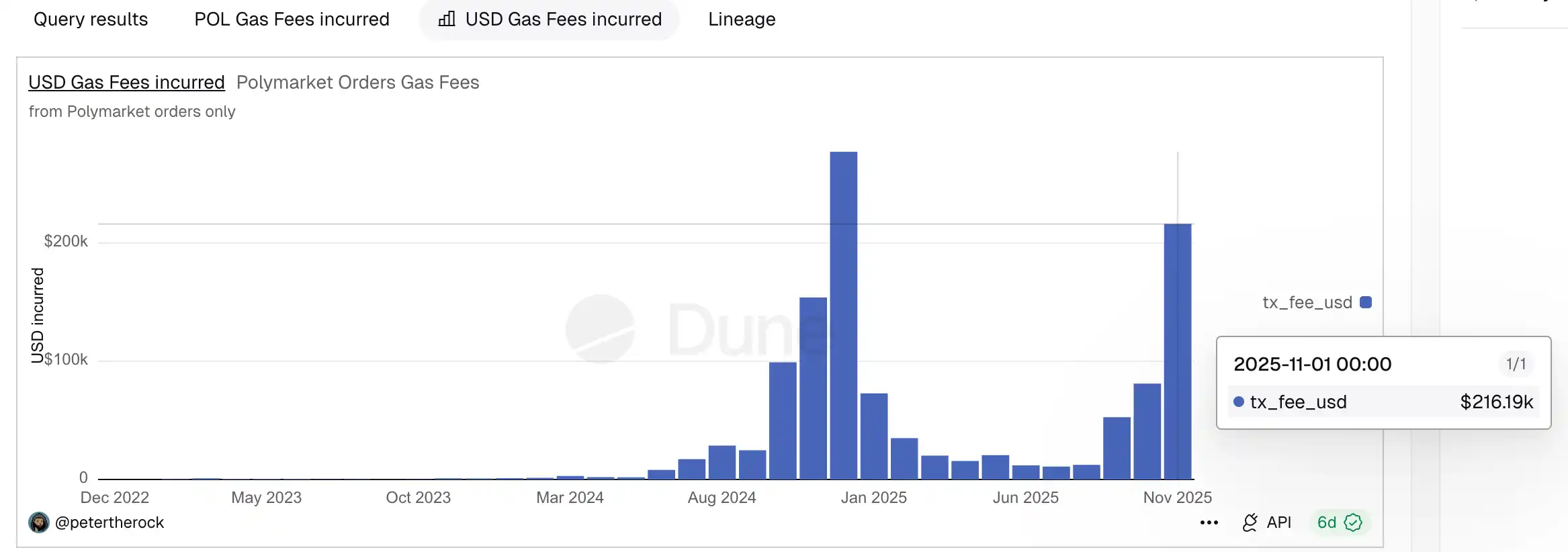
· Considering the potentially outdated nature of the data, we examined recent changes, data analyst petertherock's analysis on Dune showed that Polymarket-related transactions in November consumed approximately $216,000 in gas, while Token Terminal statistics indicated that the total gas consumption on the Polygon network that month was around $939,000, a proportion also close to a quarter (approximately 23%).
While there may be coincidences due to statistical methodologies and timeframes, similar results across dimensions can also serve as a reference for estimating Polymarket's significance to the Polygon economy.
In addition to quantifiable metrics such as active users, total value locked, trading volume, and gas contribution, Polymarket's economic significance to Polygon is also reflected in a series of more difficult-to-measure yet equally real implicit contributions.
First is the activation of stablecoin liquidity. All of Polymarket's transactions are settled in USDC, and its high-frequency, continuous trading activity objectively enhances the circulation demand and use cases of USDC on the Polygon network; second is the ancillary value of retained users. Aside from the prediction market itself, these users may also potentially switch to using other DeFi products in the Polygon ecosystem out of convenience, thereby enhancing the overall ecosystem value of the Polygon network. These contributions, although challenging to quantify with specific data, constitute the most highly valued and scarce "real demand" at the base layer of the network.
Why Now? The Answer Isn't Hard to Guess
In fact, simply from the perspective of user base, data performance, and market presence, Polymarket has fully demonstrated the confidence to stand alone. It is no longer a question of "whether to leave," but a question of "when to leave."
The reason for choosing to start the migration at this particular moment lies in the proximity of the Polymarket TGE. On the one hand, once Polymarket completes its token launch, its governance structure, incentive system, and economic model will relatively solidify, and the cost and complexity of subsequent underlying migrations will significantly increase; on the other hand, upgrading from a "single application" to a "full-stack system of application + underlying layer" itself implies a change in valuation logic, and building a Layer 2 undoubtedly opens up a higher ceiling for Polymarket in terms of narrative and capital.
Overall, Polymarket's departure to Polygon is essentially not just a simple underlying migration, but a microcosm of a structural change in the crypto industry. When top-level applications begin to have the ability to independently support users, traffic, and economic activity, if the underlying network cannot provide additional value, it will inevitably be "betrayed."
Nothing else, just for profit.
-- Price
This content is provided for general informational purposes only and doesn't constitute financial, investment, legal, or tax advice. Any events, rewards, online promotions, or related information mentioned herein should not be considered a recommendation, solicitation, or invitation to purchase, sell, trade, or otherwise deal in any crypto assets. Crypto assets are highly volatile and may result in loss. The availability of WEEX services, products, and related events may vary by region. You are responsible for ensuring that your participation is in accordance with applicable local laws and regulations.
You may also like

Institutional Investors Increase Digital Asset Allocation by 1.2%

Korean Won Interest Rate Swaps Decline Across All Maturities, 2- and 3-Year Rates Down 5.75bp

KITE Migrates to New Token Contract, Attacker's Address Excluded
"I received an airdrop, but will I have to pay taxes next year?"... How to calculate in advance with a coin calculator
TRON to Initiate TVM Compatibility Upgrade Proposal on August 25

Tom Lee Advocates Ethereum as AI Verification Layer Following BlackRock Bitcoin Report

Cryptocurrency Transactions: What Will Change for Investors in Russia
Milrem Fire, Investigation Linked to Russia Launched
Interstice Digital and FalconX Launch Cross-Chain Exchange Engine Connecting Canton and Other Public Chains
$16.16 Billion Tokenized U.S. Treasury Size Recorded

Crypto Hack: Harmony Erases 141,000 Blocks to Cancel 3 Trillion ONE Minted by a Hacker

SoftBank Invests $200 Million in Gravis Robotics, Valuation Reaches $1 Billion
Tom Lee: ETH/BTC Exchange Rate Breaks Long-term Downtrend, Tokenization and AI Drive Surge
BitMine Increases Holdings by 9,926 ETH, Total Holdings Reach 5.815 Million
Grayscale Predicts Price Increase for Ethereum and Solana

Coinsbuy Attack Funds Flow to HitBTC and BingX

Grayscale: ETH, SOL tokenomics changes may reduce supply and increase prices

Bit Digital Provides 74% of LsETH as Galaxy Collateral
GameSquare reports $26M in crypto assets, only $2.1M cash available

Ethereum Staking Ratio Rises to 34.7%, Staking Yield Drops to 2.6%
Machi Big Brother Sells BAYC NFT for 8.3 ETH to Supplement ETH Long Position
Uniswap Founder Abandons Creator Fees for Test Tokens, Shifts to Automatic Buyback and Burn Contract

Bitmine Immersion Technologies Limits Ethereum Purchases, Reaching 4.8% of Supply

Ethereum Wallet from Early Days Moves Balance After 11 Years, Realizing Over 6000x Gains
Bitmine ETH Holdings Reach 4.8%, Approaching 5% Target
Bitmain Continues Share Buyback of 19.1 Million Shares and ETH Purchases

Joseph Chalom Criticizes EIP-8363 for Impacting Ethereum's Performance Against Bitcoin
Ethereum Staking Reaches 41.7 Million ETH, Accounting for One-Third of Total Supply

USM Contract Attacked, Loss of Approximately 70.83 ETH
Ethereum upgrade proposal threatens SharpLink's yield, risks $125M treasury
Institutional Investors Increase Digital Asset Allocation by 1.2%
Korean Won Interest Rate Swaps Decline Across All Maturities, 2- and 3-Year Rates Down 5.75bp
KITE Migrates to New Token Contract, Attacker's Address Excluded
"I received an airdrop, but will I have to pay taxes next year?"... How to calculate in advance with a coin calculator
TRON to Initiate TVM Compatibility Upgrade Proposal on August 25
Tom Lee Advocates Ethereum as AI Verification Layer Following BlackRock Bitcoin Report

Contents
Latest articles


Latest coin listings on WEEX


