
SEC Implements 'Innovation Exemption' for On-Chain Trading of Listed Stocks, Valid for Up to 5 Years

 Prefer us on Google


[Mexico City = Shim Young-jae, Correspondent] The U.S. Securities and Exchange Commission (SEC) will implement an "Innovation Exemption" that allows tokenized U.S. listed stocks to be traded on public blockchains. Platforms that meet certain requirements can provide tokenized stock trading using automated market makers (AMM) and liquidity pools without registering as national securities exchanges.
This move comes shortly after the U.S. Senate failed to advance the CLARITY Act. The SEC plans to first establish a temporary regulatory framework that allows limited on-chain trading of tokenized stocks, which will then be connected to formal regulations and congressional legislation in the future.
According to Crypto in America and Wu Blockchain, the SEC announced on the 17th (local time) the "Innovation Exemption" that permits on-chain trading of tokenized U.S. stocks. The exemption takes effect immediately and is applicable for up to five years.
SEC Commissioner Paul Atkins stated in a press release, "Despite the relentless efforts of many earlier this week, Congress failed to advance the CLARITY Act."
He added, "The SEC is taking significant steps to transition the U.S. capital markets into the digital age within the authority granted by law," and "will promote on-chain trading of certain tokenized stocks through the Innovation Exemption."
The core of the new system is the Tokenized Securities Venue (TSV). TSVs that meet the requirements can provide tokenized stock trading without registering as national securities exchanges under U.S. securities law.
Trading can utilize public and permissionless blockchains. Transactions through automated market makers and liquidity pools are also permitted.
According to Wu Blockchain, this system is a pilot framework that tokenizes stocks included in the U.S. National Market System (NMS) for limited trading on designated tokenized securities exchanges. Separate regulatory guidelines and exemption systems will apply to some operators that provide liquidity to the market by investing their own capital.
Crypto in America reports that liquidity providers meeting certain requirements may also receive separate exemptions from dealer registration obligations.
The SEC does not approve individual tokenized securities exchanges one by one. If a business meets the necessary requirements and notifies the SEC, it can utilize the Innovation Exemption under specified conditions.
Only Tokens with Actual Shareholder Rights Allowed...Synthetic Stocks Excluded
The SEC has not allowed all forms of tokenized stocks.
The Innovation Exemption is limited to actual tokenized stocks that have the same rights as existing stocks. Token holders must have rights such as dividends and voting rights, just like existing shareholders.
In contrast, synthetic products that only track the price of specific stocks without rights to actual shares are excluded from the exemption.
According to Crypto in America, such synthetic stock products have expanded their market on digital asset (virtual asset) trading platforms outside the U.S. Traditional Wall Street financial firms have expressed significant opposition to this.
There are also differences in the approach to the blockchain itself and trading platforms. Tokenized securities exchanges can use public and permissionless blockchains, but access to actual trading platforms operates on a permissioned basis. Consequently, users and liquidity providers must meet the qualification requirements set by the tokenized securities exchanges to participate in trading.
Initially, the trading volume will also be limited. The SEC will impose a cap on the number of stocks that a single tokenized securities exchange can offer. There will also be limits on the volume of stocks that can be traded on the tokenized securities exchange from the total daily trading volume of individual stocks.
The specific number of stocks and trading volume limits are not provided in the original text.
Third Parties Can Tokenize Stocks...Trading Not Allowed if Issuer Refuses
This exemption allows third parties unrelated to the listed company to tokenize stocks. However, the final decision on whether to trade remains with the issuing company.
According to Crypto in America, tokenized securities exchanges must notify the listed company before trading stocks tokenized by third parties. The issuing company can raise objections within 30 days after receiving the notification.
If the listed company opposes, the tokenized stocks of that company cannot be traded on the tokenized securities exchange.
Chris Hayes, Executive Director of the Coalition for Tokenized Markets and Partner at Thorn Run Partners, positively evaluated this protective measure for issuers.
Hayes stated that the requirement allowing listed companies to reject unauthorized third-party tokenizations and grant investors the same rights as existing shareholders "will help curb synthetic tokenization and provide clearer understanding for investors about what they are purchasing."
Crypto in America notes that while the current market size for tokenized stocks is relatively small, this system could impact the competitive landscape between the existing securities market and the on-chain market.
Hayes further stated, "With the Innovation Exemption, decentralized finance (DeFi) trading platforms and liquidity pools can compete much more directly with existing exchanges and alternative trading systems," adding that "they can also operate under a more flexible regulatory framework."
He continued, "This could encourage more traditional financial market participants to shift their activities to the tokenized market and accelerate adoption."
SEC officials described this Innovation Exemption as a temporary bridge to a permanent regulatory framework. They have left open the possibility of developing the system through formal regulations and related congressional legislation in the future.
Comments 0
-- Price
This content is provided for general informational purposes only and doesn't constitute financial, investment, legal, or tax advice. Any events, rewards, online promotions, or related information mentioned herein should not be considered a recommendation, solicitation, or invitation to purchase, sell, trade, or otherwise deal in any crypto assets. Crypto assets are highly volatile and may result in loss. The availability of WEEX services, products, and related events may vary by region. You are responsible for ensuring that your participation is in accordance with applicable local laws and regulations.
You may also like

Bitcoin, Sports, and Politics: Predictive Markets Target $10 Trillion

Exclusive Interview with CK Zheng of ZX Squared Capital: How a Wall Street Risk Control Expert Accurately Grasped Market Trends and Outperformed Bitcoin Returns by Double

The End of the Blank Prompt: Why Trading AI Needs a Playbook
Bankless Ventures Partner Claims ZEC Will Attract Bitcoin Funds in 2026

US Bond Market 'Meltdown'... Why Are Interest Rates Soaring?

Sam Price: The Impact of Cryptocurrency Legislation on Market Dynamics

The Quantum Issue: You Never Really Know The Future

Crypto Kidnapping: 6 Suspects Charged in Case Involving a Few Hundred Euros in Val-d’Oise

Security and fees hold back deeper crypto use among wealthy investors: Nexo report
Why leaving your crypto on an exchange is not the same as having it in your own wallet?

Binance Under Scrutiny Again for Iran-Related Trading
Altcoin demand meets $18B threat as flows move into RWA perps as just 19% of traders keep alts
90% of U.S. Treasury Yield Increase Concentrated Around Employment Data and Fed Speeches
Can Kraken's Parent Company Open the Door for Hyperliquid to Enter the U.S. Market?
Gold Price Today in Thailand: XAU/USD Holds Near $4,347 as Key Support Level Tested

Scam AI Bot: 274 ETH Lost in Smart Contract Trap

Why Do You Always Make Small Profits and Then Lose Everything? Taleb Explained It with 'Asymmetric Leverage' Twenty Years Ago
AI has become a tool for a new generation of fraudsters: how deepfakes are stealing millions of dollars - research

Can SOXL Reach $160 as AI and Semiconductor Stocks Rally?
Can PEPE Reach $0.000006 as Meme Coin Momentum Returns?
Meta's Muse: A Slightly Smarter Version of 'AI Ordering Coffee'
Over 70% of South Korean Crypto Investors Oppose Crypto Tax: What Are Their Concerns?

Howard Marks: U.S. Fiscal Discipline Out of Control, Buying Bonds to Suppress Yields is Just 'Putting Ice Packs on a Feverish Patient'
Bitget Conversations with Trader Shiguang: Seeking the Discrepancy Between Price and Value

AI and Crypto: Why BlackRock Sees a Major Convergence
Nomura Warns of 'Double Whammy' Risk: The Next Market Storm May Start with Interest Rate Volatility
What is Travix? An on-chain omnibroker combining AI trading and blockchain verification
VVV Hits All-Time High: Founder’s Perspective on Models, Privacy, and Crypto
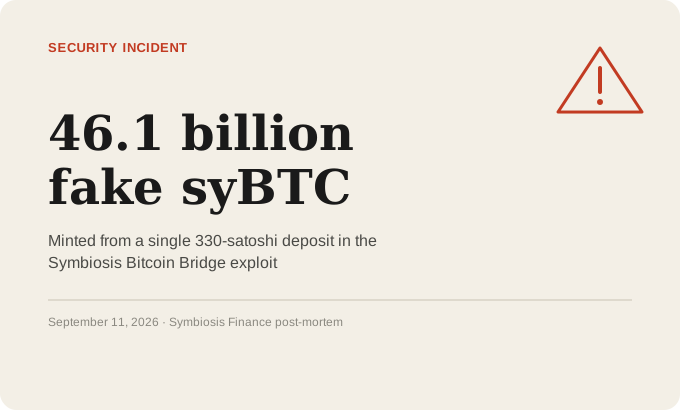
How Did a Hacker Create 46 Billion Fake Bitcoin in the Symbiosis Exploit? Decodes Bitcoin Hacker With WEEX Now
How two Symbiosis bridge bugs let a hacker mint 46.1 billion unbacked syBTC, drain Bitcoin pools and expose critical bridge risks.
This Cycle May Not Be Led by Bitcoin?
Bitcoin, Sports, and Politics: Predictive Markets Target $10 Trillion
Exclusive Interview with CK Zheng of ZX Squared Capital: How a Wall Street Risk Control Expert Accurately Grasped Market Trends and Outperformed Bitcoin Returns by Double
The End of the Blank Prompt: Why Trading AI Needs a Playbook
Bankless Ventures Partner Claims ZEC Will Attract Bitcoin Funds in 2026
US Bond Market 'Meltdown'... Why Are Interest Rates Soaring?
Sam Price: The Impact of Cryptocurrency Legislation on Market Dynamics


