
South Korea Faces Fourth Wave of Calls to Delay Crypto Tax

 Prefer us on Google


South Korea is facing a fourth wave of calls to delay the crypto tax. Photo: Forbes
Rising Opposition to Crypto Tax
The tug-of-war over crypto tax in South Korea is heating up again as the law is set to take effect in three months.
A petition requesting a two-year delay on the tax has just surpassed 50,000 signatures on the National Assembly's electronic system, qualifying it for consideration by the relevant committee. As of the morning of September 14, over 50,800 people have signed.
According to the current plan, starting from January 1, 2027, South Korea will impose a 20% tax on profits from the sale, transfer, or lending of crypto, plus an additional 2% local tax, bringing the effective tax rate to 22%.
Investors are exempt from tax on the first 2.5 million won of profit each year. Any amount exceeding this threshold will be classified as other income and will need to be declared starting in May 2028.
This is the fourth time South Korea has faced pressure to postpone this policy. The crypto tax was initially scheduled to take effect in 2022 but was postponed to 2023 and then again to 2025.
This time, opponents argue that the legal framework and tax collection system are not yet complete, and the domestic crypto market is weakening. Imposing the tax now could push investors to foreign exchanges and add further pressure on the domestic crypto industry.
This viewpoint is supported by the financial performance of major exchanges. In the first half of 2026, Dunamu, the company operating the Upbit exchange, saw its revenue drop by 49.1%, while operating profit plummeted by 79.7%. Bithumb also experienced a 48.7% drop in revenue, with operating profit decreasing by 83.4%, resulting in a net loss of 108.7 billion won.
In May, there was an even stronger petition calling for the complete abolition of the crypto tax, which reached 50,000 signatures in just eight days and was submitted to the National Assembly, but it did not progress further.
On August 10, a group of 11 lawmakers led by Jung Sung-kook presented a bill to amend the Income Tax Act, proposing to delay the crypto tax until January 1, 2030, effectively postponing it by another three years. The bill has been forwarded to the Planning and Finance Committee for review.
The lawmakers provided similar reasoning to the investment community. South Korea has only recently completed the initial steps of the digital asset regulatory framework through the Virtual Asset User Protection Act, while broader regulations on the market, investor protection, and tax collection systems are still being developed.
The controversy has intensified as the treatment of crypto and securities diverges further. South Korea has canceled plans to impose income tax on financial investments in stocks while still preparing to tax crypto separately. Investors are also not allowed to carry over crypto losses to subsequent years to offset profits, despite the market's high volatility.
The Land of the Morning Calm currently has about 13 million crypto asset investors, so any tax changes will impact a large segment of individual investors.
Government Sticks to 2027 Deadline
Despite pressure from investors and the National Assembly, the South Korean government has shown no signs of backing down, as reaffirmed at the end of July.
Lee Hyoung-il, the candidate for Deputy Prime Minister and Minister of Economy and Finance, stated on September 13 that the crypto tax will proceed as planned. The National Tax Service of South Korea will publish detailed guidelines before the end of this year.
Mr. Lee directly dismissed the argument that transferring assets to foreign exchanges or personal wallets could cause the tax authorities to lose track of transactions. Data from users of foreign exchanges can be collected through the mechanism of reporting foreign financial accounts and the Crypto Asset Reporting Framework (CARF), which allows countries to exchange tax-related data concerning crypto.
Transactions that have not been automatically recorded by the system can still be detected through investigations into the source of funds and information about tax evasion behavior. The government has stated it will expand infrastructure to address concealment of profits through transactions abroad or between individuals.
Mr. Lee also defended classifying crypto profits as other income, arguing that this approach allows for the application of a basic tax exemption and a uniform tax rate, while also reducing filing costs.
-- Price
This content is provided for general informational purposes only and doesn't constitute financial, investment, legal, or tax advice. Any events, rewards, online promotions, or related information mentioned herein should not be considered a recommendation, solicitation, or invitation to purchase, sell, trade, or otherwise deal in any crypto assets. Crypto assets are highly volatile and may result in loss. The availability of WEEX services, products, and related events may vary by region. You are responsible for ensuring that your participation is in accordance with applicable local laws and regulations.
You may also like

The End of the Blank Prompt: Why Trading AI Needs a Playbook

Cardano proposal slashes fees by 55%, but it comes with a cost for small pools

The Evolution of AI: The Boundaries and Truth of Recursive Self-Improvement (RSI)

The Quantum Issue: You Never Really Know The Future

Security and fees hold back deeper crypto use among wealthy investors: Nexo report

Bitcoin Developers Concerned About Mining Subsidy

VVV Hits All-Time High: Founder’s Perspective on Models, Privacy, and Crypto

XRPL fixes critical pre-mainnet flaw, but client apps remain at risk

Glassnode Indicates Shift Towards Altcoin Season
Crypto: Kalshi accused of inflating its volumes with thousands of identical orders

HODLing ETH: Should You Choose Staking for Yield or Collateralized Lending?

SEC Clarity Meets Fed Rate Hike: How WEEX TradFi Lucky Eggs S2 Taps Into Cross-Market Opportunities

How Significant Are Changes in Overseas AI Investment?
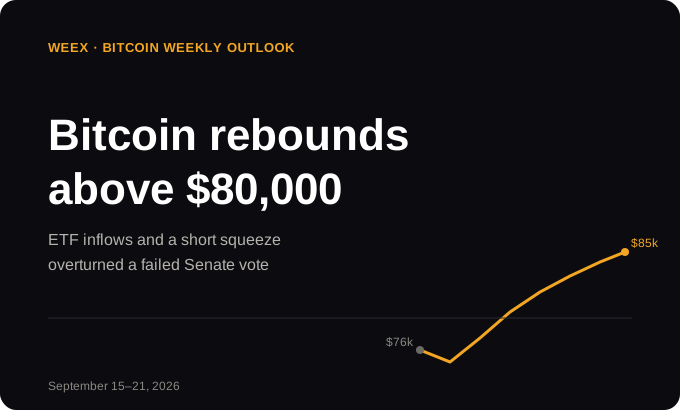
WEEX Bitcoin Weekly Outlook: Why Did Bitcoin Rebound Above $80,000 After the CLARITY Act Vote?
Bitcoin rebounded above $80,000 as SEC and CFTC action, renewed ETF inflows, and a short squeeze outweighed the failed CLARITY Act vote.

$8 Makes a Comeback, This Time X Money Rewrites the Logic of NFT Issuance
AMD Jumps Nearly 10%, Market Cap Tops $1 Trillion| WEEX TradFi Daily Brief (September 22, 2026)
Global markets on September 22 focus on a repair in AI-compute pricing. On September 21 the three major equity indexes closed higher. AMD rose nearly 10% and its market cap crossed $1 trillion for the first time, while Intel and Arm also surged. Brent crude fell about 3.4% to $100.34 and the 10-year Treasury yield eased to about 4.96%, lowering discount-rate pressure on long-duration tech. Bitcoin briefly broke above $87,000 and total crypto market cap returned above $3 trillion. Investors next watch consumer and housing earnings plus PMI flash prints.
Balancer Community Proposes Fork and Rebirth

The Answer to Dreamforce 2026: AI Agent, Has It Finally Turned from Demo to Revenue?
Ethereum: BitMine Approaches 5% of Total ETH Supply
Bitcoin's $84K rally isn't saving miners as difficulty signals already flash caution
ZEC's Largest Mining Company Moves to US Stock Market After Mining 70,000 ZEC in Six Months

Validators Vote on Batch V1.1 After Security Overhaul

Aptos Validators Decrease by 40% in Two Years, Concentration of Validator Nodes Shifts to Europe and America

SEC Takes Action: Who Can Handle "Compliant ICOs"?

TRON Weekly Industry Report: Regulatory and Interest Rate Pressures Fail to Dampen BTC Bullish Sentiment, Detailed Analysis of PayFi High-Performance Payment Infrastructure Axon Finance

When AI Agents Accelerate into Intranets: The Main Battlefield of Cybersecurity Has Changed
How to Earn Crypto Futures Trading Rewards on WEEX: Daily Lucky Eggs S2

ZetaChain, Linera, Switchboard Cease Operations
WEEX Futures Trading Rewards in Sep 2026: Win Up to 10,000 USDT

The Next Phase of Ethereum from the EF Protocol AMA
The End of the Blank Prompt: Why Trading AI Needs a Playbook
Cardano proposal slashes fees by 55%, but it comes with a cost for small pools
The Evolution of AI: The Boundaries and Truth of Recursive Self-Improvement (RSI)
The Quantum Issue: You Never Really Know The Future
Security and fees hold back deeper crypto use among wealthy investors: Nexo report
Bitcoin Developers Concerned About Mining Subsidy


