
Verizon CEO: Musk's Starlink entry into mobile communications may cost over $300 billion

 Prefer us on Google


American tech billionaire Elon Musk hopes that "Starlink" will become a mainstream mobile operator in the United States. Verizon CEO Dan Schulman stated that if Musk can indeed achieve this, it may take him 4 to 6 years and cost around $300 billion, equivalent to recreating Verizon.
"Ultimately, the network he builds may be almost identical to the one we have today," Schulman told Alyson Shontell, editor of Fortune magazine, in a recent funding interview. "There is no 'secret sauce' here, no 'magic wand,' and no structural cost advantages that will magically appear. He will eventually build a network, and by then—four, five, or six years from now—he will be the sixth entrant in that market."
On Wednesday, Musk further elaborated on this vision. At the DealBook Summit, he stated that SpaceX plans to produce "microcell base stations" for "Starlink Mobile" as early as next year—ground hardware facilities. Schulman pointed out that this hardware would transform SpaceX into another telecommunications operator.
Last month, Musk's SpaceX announced plans to turn its satellite internet service "Starlink" into "a major mobile operator in the United States." Following this news, U.S. telecom stocks plummeted, with the total market value of the three major U.S. telecom operators shrinking by $50 billion. Verizon's stock alone fell by 8.7%, marking its largest single-day drop since 2002.
In September 2025, SpaceX spent $17 billion to acquire wireless spectrum from telecommunications company Echostar. Previously, the Federal Communications Commission (FCC) had approved the relevant matters in May, laying the groundwork for SpaceX to launch its "Starlink Mobile" service. This service differs from traditional operators, allowing users to connect mobile devices directly to satellites without installing satellite dishes or routers.
In an announcement released in October, SpaceX also mentioned that the FCC had approved its launch of 15,000 new satellites for the "Starlink Mobile" service; additionally, SpaceX obtained an extra 14 megahertz (MHz) of paired spectrum licenses in the 800 MHz band from Grain Management.
According to SpaceX's latest financial report, "Starlink," which has 12 million paying users, remains the only profitable business segment under the company.
Intensifying Competition in the Telecommunications Sector
Schulman believes that the current market competition is very fierce, dominated by two large cable companies and three mobile network operators; he predicts that in three to four years, the entire industry will undergo a "complete transformation" in appearance and structure. The upcoming 6G era will pave the way for the widespread adoption of high-speed broadband across the country; at the same time, Verizon's network will build an artificial intelligence architecture to generate more application scenarios for various "agentic technologies." Regardless of whether SpaceX ultimately becomes a major player in the industry, the telecommunications sector must continue to evolve.
"I think the right approach is to believe in everything SpaceX promises—believe that they will execute and do it well," Schulman said. "Holding this mindset and preparing accordingly is never a bad thing; the real risk lies in being complacent about it."
Last month, JPMorgan analysts pointed out in a report to investors that if SpaceX cannot reach agreements with existing wireless operators, it will need to build its own ground network to compete directly with rivals. This would be an enormous undertaking, requiring funding that could exceed the substantial amounts the company has already invested in acquiring wireless communication spectrum.
Analysts noted that considering the time, infrastructure, and capital required to build a competitive ground network, the risks faced by existing U.S. wireless operators in the short term remain limited.
Schulman stated that he has not recently spoken with Musk, but he believes Musk has a range of follow-up actions available—such as SpaceX further investing in space data centers or seeking other opportunities with high investment return potential. Schulman added that, in his view, Musk's specific strategy remains unclear.
"Clearly, regardless of the scenarios or possibilities that arise, we are thinking and preparing to respond—this is what I tell the company team: let’s be ready at all times," he said. "No matter how the future unfolds, we must be prepared to proactively shape the market rather than react passively."
-- Price
This content is provided for general informational purposes only and doesn't constitute financial, investment, legal, or tax advice. Any events, rewards, online promotions, or related information mentioned herein should not be considered a recommendation, solicitation, or invitation to purchase, sell, trade, or otherwise deal in any crypto assets. Crypto assets are highly volatile and may result in loss. The availability of WEEX services, products, and related events may vary by region. You are responsible for ensuring that your participation is in accordance with applicable local laws and regulations.
You may also like

Musk Reveals Training Secret, Enabling Baristas and Stock Clerks to Participate in Data Center Construction
Stanford’s encryption breakthrough could unlock a new era for Bitcoin

Ripple CTO Sees Difficulty in Reflecting Private XRP Purchases on Market Price

US files lawsuit for $1.1 billion USDC stolen from Binance

Bonk Guy's Portfolio Drawdown Exceeds $24.5 Million, Denies Secret Asset Sales
Deutsche Bank's Italian Division Allegedly Concealed Losses for Years, Amounting to Up to €800 Million

Monero FCMP++ upgrade clears zkSecurity audit with no major issues

Trezor Warns 27,000 Shipping Orders Were Exposed in Partner Breach, Not Wallet Keys

ZachXBT flags Lazarus use of Kruw’s CoinJoin: Should coordinators be held accountable?

Canada's OSC Launches Niagara Operation to Combat Crypto Fraud

RoboSats App Vulnerability Discovered for Account Takeover
Microsoft found a way to turn a helpful AI into a sleeper agent

A metro ticket revealed how a man demanded bitcoin under bomb threats

Georgia Residents Sue OpenAI Over Secret $20 Billion Data Center Plan

Malicious Pull Requests Target Vizor and Zingo Wallets, Six Requests Remain Unmerged

The AI Power Surge Returns to Rationality: Where to Find Valuation Lows

Prediction: Micron Stock Will Be at This Price at the End of 2027

How to Use Tokenized Stocks on the Blockchain?
Bitcoin ETF Surpasses 2,200 Institutional Holders, Primarily Investment Advisors

First Circle Capital Announces Final Closing of $26 Million Fund to Invest in Fintech in Africa
A New Path for API3: Fixed Supply, On-Chain Curation, and Infrastructure for AI Agents

Nestlé Expands into Wearable Devices, Plans to Match Nutritional Products with Health Data

ECB Governing Council Member Kocher Warns Against Lagging in Inflation Response
Over 20% of Generation Z Own Cryptocurrency, Barriers to Adoption for the General Public Include 'Fragmentation of Financial Services' = SoFi Survey

Where Will SpaceX Stock Be in 5 Years?
Ray Dalio's Latest Interview: Why Great Technologies Are Often Not Great Investments?
Will On-Chain BTC Lending Become Mainstream? Data and Institutional Trends Point to Traditional Finance
Is BTC Different This Time?
Tonight, the last major inflation report before the Federal Reserve's December decision is released!
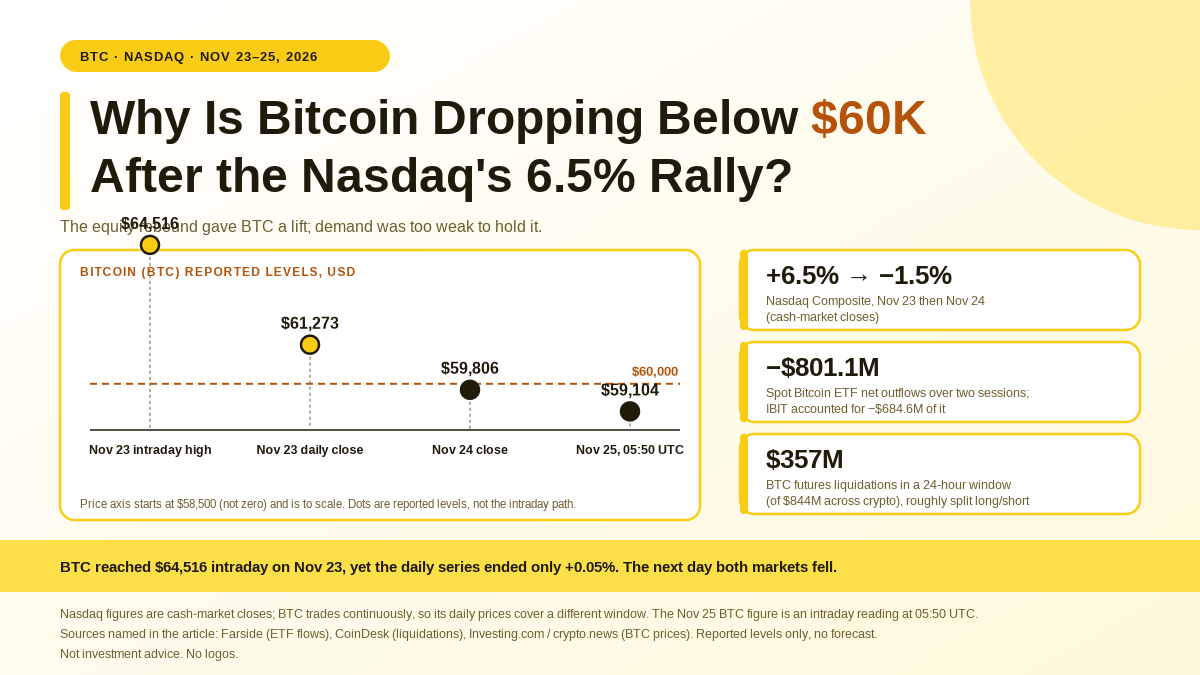
Why Is Bitcoin Dropping Below $60K After the Nasdaq’s 6.5% Rally?
Why is Bitcoin dropping below $60,000 after the Nasdaq rallied 6.5%? See what $801.1 million in ETF outflows, exchange flows, and liquidations reveal.
Musk Reveals Training Secret, Enabling Baristas and Stock Clerks to Participate in Data Center Construction
Stanford’s encryption breakthrough could unlock a new era for Bitcoin
Ripple CTO Sees Difficulty in Reflecting Private XRP Purchases on Market Price
US files lawsuit for $1.1 billion USDC stolen from Binance
Bonk Guy's Portfolio Drawdown Exceeds $24.5 Million, Denies Secret Asset Sales
Deutsche Bank's Italian Division Allegedly Concealed Losses for Years, Amounting to Up to €800 Million
Latest articles


Latest coin listings on WEEX


