
What Does Fidelity Verify on the Ondo Bridge? Ondo (ONDO) and Tokenized Stocks Explained

 Prefer us on Google


Cover image ALT: Ondo tokenized stock moving from Ethereum to HyperEVM through a verification checkpoint that includes Fidelity’s FCAT and other verifiers.
Fidelity’s role on the Ondo Bridge is to help verify cross-chain messages for supported Ondo Stocks transfers. Ondo says the Fidelity Center for Applied Technology, or FCAT, is now a required verifier alongside other verifiers. Its check helps determine whether a message can proceed to settlement on the destination chain. It does not establish who holds the underlying shares, whether a token holder can redeem, or whether the transfer has already reached the receiving wallet.
That distinction also matters for anyone following the Ondo (ONDO) crypto token. The announcement concerns how eligible tokenized stocks and ETFs move between networks. ONDO is a separate governance token, and the announcement does not establish that users must buy or spend ONDO to use those routes.
Key Takeaways
- FCAT participates in verifying cross-chain transfer messages. On covered routes, its verification is required alongside the applicable verifier quorum.
- Ondo identified 35 Ondo Stocks for transfers to HyperEVM and more than 450 across other supported networks. Check the specific token and direction before starting a transfer.
- A successful source transaction, a verified message, and a destination credit are three different milestones. A receipt for one does not prove the next has happened.
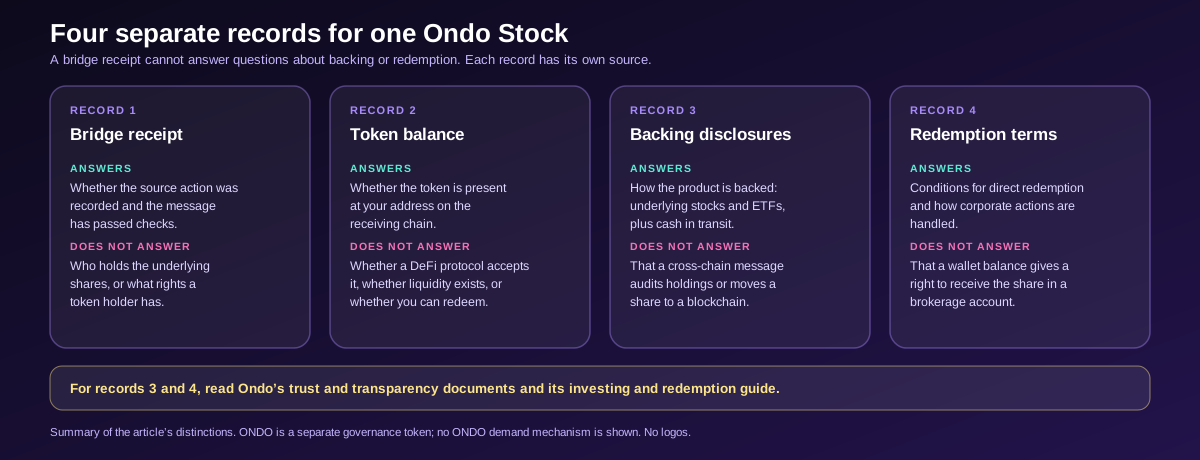
- A bridge receipt cannot establish who holds the underlying securities or what rights a token holder has. For those questions, use the issuer’s product and legal documents.
What Does Fidelity Actually Verify on the Ondo Bridge?
In its November 10 announcement, Ondo named FCAT as a required verifier for eligible Ondo Stocks transfers across Ethereum, HyperEVM, and additional supported networks. FCAT operates a Decentralized Verifier Network, or DVN. Its job in this context is to participate in checking the cross-chain message before the receiving network can act on it.
The word required describes how verification is configured. FCAT is not merely an optional observer whose check can be skipped once enough other verifiers respond. Its participation is needed alongside the applicable quorum. Conversely, one attestation from FCAT does not on its own complete the transfer. The other verification and destination execution requirements still apply.
This is also an expansion of an existing relationship. Ondo said its bridge first adopted FCAT’s DVN for tokenized assets in February 2026 and that the November announcement extends that verification arrangement to Ondo Stocks. The new information is the scope of the integration. It does not establish that Fidelity became the issuer, custodian, or redemption counterparty for those products.
How an Ondo Stock Moves From Ethereum to HyperEVM
Consider a holder moving an eligible Ondo Stock from Ethereum to HyperEVM. The Ondo Bridge launch documentation describes the bridge as an integration with LayerZero. For the holder, there are three technical milestones to track and a separate set of product questions that the bridge cannot answer.
| Stage | What the holder can check | What the evidence establishes |
|---|---|---|
| Source transaction | Source chain, asset contract, transaction hash, success status, and intended destination | The source-chain action was recorded. |
| Message verification | Message status and any verification details exposed by the bridge or explorer | Whether the message is still waiting for checks or has passed them. |
| Destination execution | Destination transaction, recipient address, token contract, and balance | Whether the receiving chain processed the transfer for the intended wallet. |
| Product rights | The product’s issuer, custody disclosures, applicable terms, and redemption rules | The legal and economic terms of holding the token. |
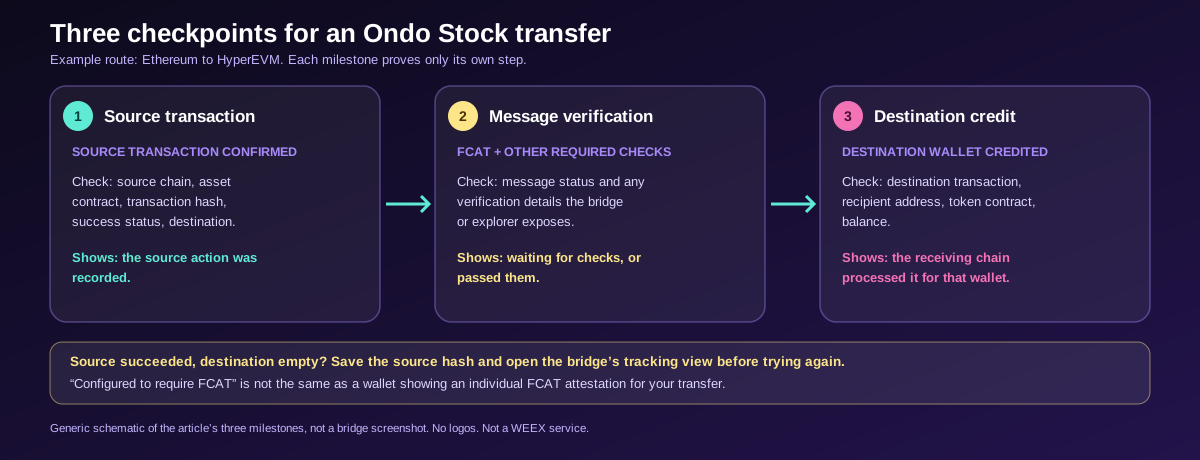
If the source transaction succeeded but the destination wallet is empty, save the source hash and open the bridge’s tracking view before trying again. A message still awaiting verification is a different problem from a verified message whose destination transaction has not executed. If execution succeeded, verify the wallet address and destination token contract in an explorer. The wallet interface may not display a token automatically even when the balance is visible onchain.
When a status view does not show individual verifier attestations, use the language the evidence supports. A route can be configured to require FCAT without the wallet interface showing proof of an individual FCAT attestation for that particular transfer.
Which Ondo Stocks Can You Bridge to HyperEVM?
Ondo reported that FCAT verifies transfers of 35 Ondo Stocks to HyperEVM and more than 450 Ondo Stocks across other supported networks. The figures describe different scopes. The larger number cannot be used as a HyperEVM asset count or as proof that every possible source and destination pair is available.
Start with the specific token in the Ondo app. Check the source chain, destination chain, token contract, and receiving address before authorizing the transfer. If you expect to move the asset back later, check the reverse route separately. A token appearing in an app’s general catalog does not establish that the same token can bridge in both directions on the route you need.
There is a second check after bridging: what can you do with the token on the receiving chain? A destination balance shows that the token is present. It does not establish that a particular DeFi protocol accepts it, that there is enough liquidity for a sale, or that you are eligible to redeem directly with the issuer.
-- Price
Who Holds the Underlying Stocks, and What Can Holders Redeem?
Ondo’s trust and transparency documentation describes how Ondo Stocks are backed by underlying stocks and ETFs, together with cash in transit. That arrangement is documented at the product level. A cross-chain message does not audit those holdings or cause the underlying share at a brokerage or custodian to move to a blockchain.
For a particular product, look up the issuer and the governing terms. These are the documents that explain how the underlying exposure is structured and what happens when there is a dividend, stock split, or other corporate action. Review Ondo’s investing and redemption guide separately for the conditions that apply to direct redemption. Holding a token in a wallet does not by itself establish a right to receive the underlying share into a brokerage account.
Does the Fidelity Integration Change Ondo (ONDO) Token Demand?
The announcement does not show a direct ONDO demand mechanism. To establish one, look for documentation that makes ONDO necessary for a fee, requires it as collateral, or directs revenue to a mechanism involving the token. Ondo’s verification announcement describes none of those changes.
More transfers could make Ondo’s products more useful. Whether that activity creates demand for ONDO is a separate economic question. The relevant evidence would be how fees are charged, who receives them, and what the governing contracts or policies require. Neither the verifier’s name nor a rise in the ONDO price answers those questions.
Ondo (ONDO) Futures and Spot on WEEX
The ONDO/USDT perpetual futures market provides contract exposure to the governance token’s price. Before placing an order, review the order type, position size, margin mode, leverage, funding, and liquidation price. The ONDO/USDT spot market is the separate market for buying or selling the token itself. Neither market gives holders ownership of an Ondo Stock or access to its redemption process.
WEEX Editorial View
FCAT’s participation changes who must verify a supported bridge message. The most useful test for a reader is still whether they can connect the source transaction to a completed destination transfer. Then, if their concern is what the token represents or how to exit the position, the next place to look is the product terms. Those are separate checks, and each answers a different risk question.
FAQ
Does Fidelity Custody the Stocks Behind Ondo Stocks?
The bridge announcement does not assign that role to Fidelity. It identifies FCAT as a required verifier for eligible cross-chain transfers. Check the applicable Ondo product disclosures for the parties involved in holding the underlying securities.
Can I Bridge Every Ondo Stock to HyperEVM?
Do not assume so. Ondo identified 35 Ondo Stocks for transfers to HyperEVM in the November announcement. Verify the live token, source chain, and destination in the bridge interface.
Does a Successful Source Transaction Mean My Ondo Stock Has Arrived?
No. Confirm the destination transaction and check the token balance at the intended address. Source confirmation only establishes what happened on the sending network.
Is Ondo (ONDO) the Same as an Ondo Stock?
No. ONDO is a governance token. An Ondo Stock is a tokenized product tied to a specific stock or ETF under separate terms.
This content is provided for general informational purposes only and doesn't constitute financial, investment, legal, or tax advice. Any events, rewards, online promotions, or related information mentioned herein should not be considered a recommendation, solicitation, or invitation to purchase, sell, trade, or otherwise deal in any crypto assets. Crypto assets are highly volatile and may result in loss. The availability of WEEX services, products, and related events may vary by region. You are responsible for ensuring that your participation is in accordance with applicable local laws and regulations.
You may also like

21X and LayerZero Report 10,000 Onchain Order Matches Per Second in Pilot
Ethereum software bug triggers emergency fixes across major layer-2 networks
AnubisChain TVL Rises to 14th in the World
LayerZero Integrates AnubisChain, OFT Standardized Protocol Token Launches

Reth Client State Root Calculation Error Affects EVM Chains, LayerZero Suspends Cross-Chain Operations

OlympusDAO completes OHM bridge migration to CCIP, adds Robinhood Chain

LayerZero and 21X Complete On-Chain Order Book Pilot

Circle Opens CCTP to Third-Party Tokens, Joining the Cross-Chain Standard Battle

October Sees 56 Attacks in Crypto Industry, Losses Reach $6.48 Billion, Up 745% Month-on-Month

Initia to Restart L1 and Rollups on Nov. 2 with No Transaction Rollback

Stellar launches cross-chain messaging with ethereum through VIA Labs

Centralized Exchange And DeFi Losses Dominate 2026 Crypto Hacks Despite Hardware Wallet Failures

Ritual Raises $30 Million to Launch Token: AI Game Changer or Retail Investor Trap?
The crypto market loses altitude, patience becomes a habit – Steady Lads
SpaceX Q3 Revenue Beats and Strengthens After Hours| WEEX TradFi Daily(October 21, 2026)
On October 20, equity indexes were mixed. The S&P 500 closed slightly higher, while the Nasdaq was roughly flat. SpaceX reported third-quarter revenue of $14.58 billion and net income of $4.4 billion, both well above forecasts, and rose about 3% after hours. Bitcoin traded near $83,000, while ZEC led majors with a more-than-10% gain in 24 hours. Memory, optical and crypto-finance names rose from the prior evening, and CoreWeave and SMCI bounced off lows. Tesla, Meta and other companies report on October 21.

WEEX Exclusive:SpaceX Q3 Revenue Beats and Strengthens After Hours| WEEX TradFi Daily(October 21, 2026)

Zero Mainnet and lzATLAS to Launch on November 30, 2026

US Economic Data and Crypto Updates for the Week of October 19-23
6.04 million bitcoins face quantum threat as Quantum Alliance is formed
LayerZero Launches Post-Quantum Signature Aggregation System Aerie, Aggregating Over 32,000 Signatures in 0.65 Seconds

Tether invests in stablecoin payments across 17 countries

Autheo THEO token plunges 92% after suspected bridge exploit

Crypto Hacks: $2.81 Billion Stolen in 2026, October Already at $116 Million

Billions of Dollars in Crypto Assets Exposed to Risk: Who Will Insure Them?

Citrini Research Reveals Crypto Holdings, DRV, LIT, and ETHFI Each Account for 10%
S&P 500 and Nasdaq Hit New Highs| WEEX TradFi Daily Brief (October 7, 2026)
Major equity indexes closed higher on October 6 ET. The S&P 500 and Nasdaq both set closing highs as long-end yields eased and oil stabilized, shifting capital from rate worries toward earnings. Constellation Energy led on a long-term power agreement to supply Google, while tokenized-securities platform Securitize jumped early after signing a tech partnership. Bitcoin held near $86,000, LayerZero led majors, and Anvil surged after an institutional purchase of governance tokens. Applied Digital reports after the close on October 7 ET, while markets also track policy-meeting minutes and TOKEN2049 industry headlines.
WEEX Exclusive:S&P 500 and Nasdaq Hit New Highs| WEEX TradFi Daily Brief (October 7, 2026)

Arbitrum Joins Paxos Stablecoin Alliance, USDG Launches on Arbitrum

LayerZero Unlock October 2026: Can ZRO Hold $2 Amid Whale Inflows?

AI Cluster Experiment on Ethereum: How IMD's Destruction Mechanism Works?
21X and LayerZero Report 10,000 Onchain Order Matches Per Second in Pilot
Ethereum software bug triggers emergency fixes across major layer-2 networks
AnubisChain TVL Rises to 14th in the World
LayerZero Integrates AnubisChain, OFT Standardized Protocol Token Launches
Reth Client State Root Calculation Error Affects EVM Chains, LayerZero Suspends Cross-Chain Operations
OlympusDAO completes OHM bridge migration to CCIP, adds Robinhood Chain
Latest articles


Latest coin listings on WEEX


