
Which assets might the Trump project WLFI buy next?

Original Article Title: "Which Assets Might the Trump Family's Project WLFI Acquire Next?"
Original Article Author: jk, Odaily Planet Daily
With the dominance of the American narrative and the Trump narrative since Trump's election and Bitcoin breaking the hundred thousand mark, the market's attention is now focused on World Liberty Financial (WLFI), which has strong ties to his family. Since its launch in September 2023, WLFI, with its unique narrative and large-scale capital operations, has quickly captured widespread market attention. Especially during December, WLFI made a significant purchase of nearly $45 million worth of crypto assets, triggering various speculations in the market. Investors and analysts are all trying to answer a key question: What tokens might WLFI continue to acquire in the future?
Background Information
World Liberty Financial (WLFI) was officially launched in September 2023, claiming to be a DeFi platform characterized by its reliance on and strong Trump-personal-attribute-colored values such as its relationship with the Trump family and the slogan "Be Defiant." On WLFI's official website, Trump is listed as the "Chief Crypto Advocate," and his sons Donald Trump Jr., Eric Trump, and Barron Trump hold positions as "Ambassadors."
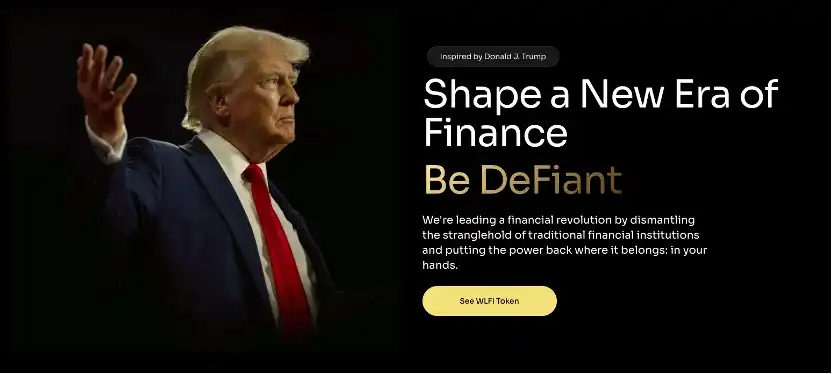
WLFI's website. Source: WLFI Official Website
It is important to note that on the official website, this project actually legally avoids any connection with the Trump family. The project claims to be “the only DeFi platform inspired by Trump,” and the positions of advocates and ambassadors cannot be considered genuine positions involved in management. Moreover, at the bottom of the website, there is a small disclaimer:
“Donald J. Trump, any family member, or any director, officer, or employee of Trump Organization, DT Marks DEFI LLC, or their respective affiliates are not officers, directors, founders, or employees of World Liberty Financial (WLFI) or its affiliates. Ownership, management, or operation of World Liberty Financial, Inc., its affiliates, or the World Liberty Financial platform does not belong to Trump, any family member, Trump Organization, DT Marks DEFI LLC, or their respective directors, officers, employees, affiliates, or principals.”
The use and sale of the $WLFI token and the World Liberty Financial platform are provided solely by World Liberty Financial or its affiliates. DT Marks DEFI, LLC and its affiliates (including Donald J. Trump) have received or may receive approximately 22.5 billion tokens from World Liberty Financial and are entitled to receive 75% of the net protocol revenue under a service agreement. The definition of this protocol revenue includes revenue from any source, net of agreed-upon reserves, expenses, and other amounts, the specific amount of which has yet to be determined.
World Liberty Financial and its $WLFI token are not political in nature and are also not part of any political campaign activity.
Overall, the project team is basically telling everyone outright: "We have extensive ties to the Trump family, but in reality, legally we have no connection whatsoever." It sounds quite irresponsible.
This is also why hardly anyone is buying into the WLFI token: currently, as displayed on the project's official website, the total supply of 20 billion tokens has only achieved a quarter of its sales target since its launch for such a long time, even in the backdrop of such a bullish market.
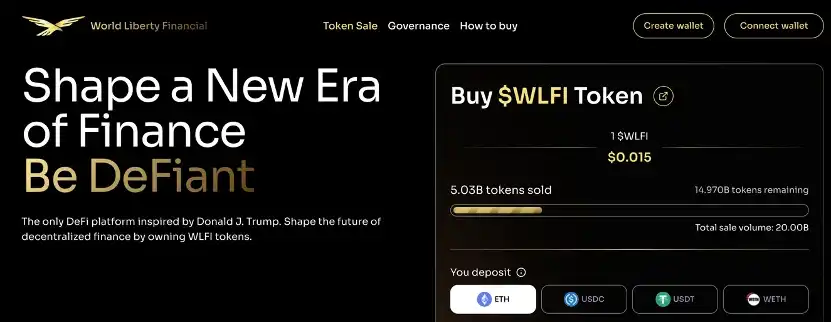
Token sales target only achieved 5 billion. Source: WLFI Official Website
However, this does not affect the fact that the assets purchased by this project have to some extent set a market trend; after all, "willing to invest with the Trump family" and "What assets has the Trump family invested in? Can I mirror their trades?" are two completely different things. In the latter case, the unparalleled appeal of Trump, who emerged as a crypto advocate winner, is undeniable.
Large-Scale Cryptocurrency Asset Purchase
Odaily previously reported that, according to Spot On Chain monitoring, since November 2023, WLFI has made large-scale purchases of various mainstream and emerging cryptocurrency assets through a single primary wallet address.
The assets purchased include:
· ETH: Total amount $30 million, purchased 8,105 ETH, with an average purchase price of $3,701 per ETH;
· cbBTC: Total amount $10 million, purchased 102.9 cbBTC, with an average purchase price of $97,181 per cbBTC; (to be later converted to WBTC)
· LINK: Total amount $2 million, purchased 78,387 LINK, with an average purchase price of $25.51 per LINK;
· AAVE: Total amount $1.91 million, purchased 5,886 AAVE, with an average purchase price of $324.4 per AAVE;
· ENA: Total amount $750,000, purchased 741,687 ENA, with an average purchase price of $1.011 per ENA;
· ONDO: Total amount $250,000, purchased 134,216 ONDO, with an average purchase price of $1.86 per ONDO
Odaily later reported that World Liberty Financial announced a partnership with Ethena Labs, and the two parties are seeking long-term cooperation, starting with Ethena's revenue token sUSDe.
It can be seen that even after experiencing several pullbacks after breaking through the six-digit mark and a major plunge due to the hawkish Fed interest rate cut news, as of December 19, the six tokens purchased by WLFI still maintained gains within their 30-day trends: Bitcoin and Ethereum had gains of 10% and 15%, Chainlink had 65.1%, Aave had 103.9%, Ethena had 89.4%, and Ondo had 85.1%. In other words, WLFI's purchase targets did indeed become the market's direction during the uptrend, allowing them to retain their 30-day gains during major pullbacks.
So, what could be the next tokens WLFI might purchase?
What Is WLFI's Potential Next Purchase Asset?
We have three dimensions to speculate:
Polychain's Investment Assets
It can be seen on the official website that Luke Pearson from Polychain has become one of WLFI's advisors. (Information about other advisors and team members can be found in this article: Who Are the Decision Makers Behind the Trump Project WLFI Which Made a Large Purchase of Cryptocurrency?) A significant portion of the purchased tokens is likely to come from Polychain's investment portfolio. According to Rootdata, we can see that not every project in Polychain's investment portfolio has a native token, and those that can be considered as senior DeFi projects are even fewer.
Coingecko Top 100 DeFi Assets by Market Cap
Moreover, the assets previously purchased by WLFI were all in the Coingecko Top 100 by market cap list, likely due to considerations of volatility and drawdowns. Furthermore, considering the collaboration between WLFI and Ethena, the token purchases most likely also carried considerations for future collaborations; leveraging the purchased tokens' popularity and influence to collaborate with larger DeFi projects in the market and then contribute back to WLFI as a DeFi protocol's brand value.
COWSwap Listed Assets (Minor Impact)
WLFI uses the decentralized exchange platform CowSwap, which is one of the popular DEXs currently available, with products including AMM, among others. On the CowSwap interface, assets that have been officially verified by CowSwap and do not require manual entry of contracts can be found. If the selected network is Ethereum, there are a total of 374 assets available, making it the widest range to choose from. CowSwap does not support many networks, other than Ethereum, only Gnosis, Base, Arbitrum One, and the Sepolia testnet. WLFI's other purchases are also likely to have taken place on CowSwap, so the likelihood of DeFi projects on Solana is relatively lower. Of course, this factor's influence is relatively minor, as WLFI can still purchase assets from Solana-supported platforms, manual purchases, or OTC purchases of other projects.
Considering these factors, what tokens could be identified?
Considering both Polychain's investment projects, CowSwap's listed assets, and Coingecko's Top 100 Market Cap:
· Maker (MKR), recently rebranded as SKY
· Uniswap (UNI)
· DYDX (currently ranked 113 by market cap, not far off)
Additionally, if we consider projects with high brand value that are not in Polychain's portfolio, we can also include the following four coins: Lido, Pendle, Eigen, and Curve. These projects also have some "American attributes," making collaboration equally possible. If we expand the market cap a bit further back, then coins like 1inch and Morpho also have a smaller chance.
Overall, WLFI's investment strategy demonstrates a certain level of strategic thinking and shows strong fund operation capabilities. In the future, WLFI's buying targets may continue to focus on the top 100 market cap quality DeFi assets, and this recent significant pullback may also provide the best buying opportunity. During Trump's term, WLFI's buying actions may offer important signals for investment decisions.
You may also like

Morning Report | OpenAI has submitted an S-1 registration statement draft to the U.S. SEC; Morpho completes $175 million financing

Morning Report | BitMine increased its holdings by 126,971 ETH last week; trader Eugene announced his exit from the crypto market

Wang Chuan: How can one not feel anxious after the neighbor Old Wang made thirty times profit by investing in storage stocks? (Seven) - A quarter-century cycle

Cryptocurrency CEXs are flocking to sell US stocks, and traditional brokerages are facing an "uninvited guest."

$75 billion in foreign capital has fled, and South Korean retail investors have absorbed it all using leverage

Japan’s Three Megabanks Plan Joint Stablecoin Issuance in Fiscal 2026
MUFG, SMBC, and Mizuho reportedly plan to jointly issue fiat-pegged stablecoins in fiscal 2026, signaling Japan’s growing push into bank-led digital payment infrastructure.

Humanity Discloses H Token Dual-Chain Attack Details, With Losses on Ethereum and BSC Exceeding $36 Million
Humanity said the H token attack across Ethereum and BSC caused more than $36 million in losses after leaked ProxyAdmin keys enabled malicious contract upgrades and token minting.
White House Discusses CLARITY Act With Law Enforcement Ahead of Senate Vote
The White House discussed the CLARITY Act with law enforcement ahead of a Senate vote, focusing on illicit finance risks and developer protections.

Bitcoin Trading Guide 2026: Strategies for Experienced Traders

What Is XAUT and PAXG? Why Tokenized Gold Is Booming in 2026

Will the SpaceX IPO Hurt Bitcoin? Here's What Traders Are Watching

Foreign selling in the South Korean stock market accelerates, with cumulative net sales reportedly reaching $75 billion this year
On June 9, The Kobeissi Letter, citing Goldman Sachs data, reported that global investors are selling South Korean stocks at an unusually rapid pace. In the latest trading session, foreign investors sold about $801 million worth of Kospi constituent stocks again; total foreign outflows last week reached about $10 billion, and the market has been in net foreign selling on nearly every trading day over the past month. According to the data cited in the report, foreign investors have sold about $75 billion worth of South Korean stocks so far this year. Meanwhile, South Korean retail and institutional investors together recorded roughly $69 billion in net buying over the same period, suggesting that the market’s main buying support has come from domestic capital rather than returning overseas funds. The information currently disclosed still mainly comes from The Kobeissi Letter’s retelling and Goldman Sachs data summaries, while public details on the statistical period and the specific definition of “selling” remain relatively limited.

Fortune Warns of Strategy’s Financing Structure Risks as Bitcoin Premium Narrows
Fortune warned that Strategy’s Bitcoin treasury model faces growing financing risks as MSTR’s net asset premium narrows and preferred stock dividend pressure increases.

Ferrari Challenge Le Mans: Carl Moon to Dominate in WEEX Livery

Sahara AI Responds to SAHARA’s Sharp Drop: No Contract or Product Security Issues Found, Internal Investigation Underway
Sahara AI responded to SAHARA’s 60% price drop, saying no token contract or product security issues have been found and an internal investigation is underway.

WEEX Deposit/Withdrawal Dynamic Island: Your Asset Status, Always in Sight
Scaling Crypto Derivatives: The Digital Asset Infrastructure Behind High-Volume Trading
In the fast-moving digital asset ecosystem, derivatives platforms face an extreme architectural test. High-leverage futures markets demand more than just standard security—they require absolute operational precision, zero-latency matching engines, and ironclad structural scalability, all while navigating intense market volatility.
As global platforms scale to meet these demands, the industry is shifting away from rigid, monolithic setups toward a more agile, "decoupled" infrastructure philosophy.
The Blueprint for High-Volume Copy TradingFor elite global exchanges like WEEX (founded in 2018), this architectural choice becomes critical when scaling high-volume retail features like social copy trading. When thousands of users automatically mirror the real-time strategies of elite traders simultaneously, it triggers sudden, monumental spikes in concurrent transactional volume.
To prevent execution latency or settlement bottlenecks during these peak volatility events, a platform's primary engine must remain entirely dedicated to risk management, copy-trade synchronization, and order matching.
The Architectural Rule: New-generation platforms must separate front-end user execution engines from heavy backend infrastructural overhead to eliminate operational friction.
By separating these layers, platforms can maintain complete sovereignty over their trading environments and user experiences while strategically aligning with institutional-grade infrastructure ecosystems. This strategic framework allows modern exchanges to leverage advanced Digital Asset Custody infrastructure such as Cobo’s behind the scenes, ensuring that backend wallet management scales elastically alongside trading spikes.
Capitalizing on Market Momentum and 400× LeverageIn a derivatives arena where platforms offer up to 400× leverage on perpetual contracts, capital efficiency and market agility are core business metrics. To capture market momentum, an exchange needs the ability to rapidly expand its asset offerings, supporting everything from legacy crypto assets to sudden, trending altcoins across a massive library of trading pairs.
Adopting a flexible, scalable Wallet-as-a-Service (WaaS) solution such as Cobo’s could completely rewrite the development timeline for high-growth exchanges. Instead of spending months of engineering capital building out custom backend wallet architectures for every new blockchain network, platforms can deploy localized infrastructure in days.
This agility allows platforms to instantly scale their listings to over a thousand trading pairs without compromising security or delaying time-to-market. It mirrors the exact operational advantages seen during high-velocity market events, similar to how advanced wallet infrastructure empowers platforms during sudden asset surges; allowing exchanges to pass that speed and liquidity directly to their global user base.
A Mature Foundation for GrowthThe synergy between trusted infrastructure ecosystems and global trading platforms represents the natural evolution of a maturing crypto market. As WEEX continues to scale its global spot and derivatives offerings for over 6 million users, adopting robust backend paradigms proves that platforms no longer have to compromise between cutting-edge trading velocity and uncompromised structural security.

Get Paid to Onboard? Try WEEX’s New Homepage with Rewards for Registration, Deposit & Trade
Morning Report | OpenAI has submitted an S-1 registration statement draft to the U.S. SEC; Morpho completes $175 million financing
Morning Report | BitMine increased its holdings by 126,971 ETH last week; trader Eugene announced his exit from the crypto market
Wang Chuan: How can one not feel anxious after the neighbor Old Wang made thirty times profit by investing in storage stocks? (Seven) - A quarter-century cycle
Cryptocurrency CEXs are flocking to sell US stocks, and traditional brokerages are facing an "uninvited guest."
$75 billion in foreign capital has fled, and South Korean retail investors have absorbed it all using leverage
Japan’s Three Megabanks Plan Joint Stablecoin Issuance in Fiscal 2026
MUFG, SMBC, and Mizuho reportedly plan to jointly issue fiat-pegged stablecoins in fiscal 2026, signaling Japan’s growing push into bank-led digital payment infrastructure.


