
Which Liquidity Pools Are Profitable on Robinhood Chain?

 Prefer us on Google


Tokenized stocks can be market-made on Robinhood Chain, but this does not mean that any chosen pool can yield stable profits.
Written by: Blockworks Research
Compiled by: AididiaoJP, Foresight News
Providing liquidity on Robinhood Chain can lead to significant differences in outcomes depending on which pools funds enter and when. Some pools generate enough fee income to cover the costs of arbitrage, while others essentially provide profits to counterparties. Especially during opening hours, passive limit orders find it nearly impossible to retain profits.
This is not just a slogan; it is a cost bill that has already formed on-chain.
Can Fees Cover Arbitrage Costs?
Robinhood Chain has been operational long enough to answer the real concerns of market makers: Can the fees earned by LPs cover the profits that arbitrageurs gain from stale quotes?
The measurement method is loss comparison rebalancing, or LVR. It measures not the direction of judgment errors, but the costs of adverse selection caused by market makers quoting outdated prices that are executed by faster traders. In simple terms, if one sells at an old price while others have executed at a new price, the difference is the LVR.
The results of tokenized stock pools are distinctly varied.
Pools that accommodate real stock capital flows can often cover costs multiple times over. Stocks against ETH are approximately 3.3 times the estimated arbitrage costs, while stocks against stablecoins are about 2.9 times. Stocks against stocks average just 1.02 times, breaking even. Stocks against Memes cover only about 0.2 times.
Averages can obscure dispersion. Most stablecoin pairs and ETH are profitable; about half of the stock pairs are profitable; Memes are less than 2% profitable on average. Therefore, losses are not an occasional risk, but rather a high probability that the Meme product line is providing liquidity for arbitrage.
The reasons are not complicated. Tokenized stocks follow OTC stock prices, which have verifiable external prices. Arbitrage will enter, but transactions and fees are thicker, allowing LPs to earn profits. The Meme side has greater price fluctuations, thinner depth, and stronger information asymmetry, making limit orders easier to become a withdrawal machine for counterparties. The fee rates seem not low, yet they still struggle to cover the frequency and magnitude of being snatched.
Bearable During Trading, Unbearable at Opening
Some may think that stock-related damages occur after the US stock market closes, while on-chain trading continues and external prices stop. Data does not support this judgment.
From 9:30 AM to 4:00 PM Eastern Time (9:30 PM to 4:00 AM Beijing Time), both fees and arbitrage costs are about 60% higher, with the ratio between the two remaining almost unchanged. The market is more active during trading hours, but income and costs rise in tandem, and passive LPs are not uniquely harvested after hours.
What truly deteriorates is the opening period.
During the 9:30 AM period, the arbitrage cost for a single pool reaches $95.08, while the benchmark before opening is about $7, a difference of 13 times. During this time, fees only cover 1.05 times, while before opening, it is common to see 3 to 6 times. The next period drops to about $41, and the following period to about $24, returning to the teens within an hour.
This is similar to traditional opening auctions: overnight information is released in concentrated form, price discovery is most intense, and quotes are most likely to lag. AMMs do not automatically widen spreads or cancel orders. If liquidity is still laid out here, it will be swept first. Once volatility shifts from opening pulses to intra-day ripples, rates can begin to cover costs again.
Thus, “average profitability throughout the day” and “profitability within the first ten minutes of opening” are not the same thing. Averages dilute the most painful windows.
Two Decisions: Pairing and Timing
The first is pairing.
Tokenized stocks against ETH or stablecoins are positions with profit cushions. The same tokenized stock against Memes mostly transfers LP earnings to arbitrageurs. Stocks against stocks can average break-even, but the win rate is only 57%, and the median pool is not worth occupying capital. Market making should not only look at headline annualized returns but should also consider whether the pool has stable, priceable external flows.
Statistics also have a boundary that must be clarified: it only measures the costs of “lagging quotes being executed” and does not measure inventory directional risk. Stocks against Memes may incur fee losses, but if Memes surge, the inventory side may still turn the total ledger positive; the reverse is also true. Fee profits and directional losses can also lead to losses. LVR is not the entirety of PnL.
The second is timing.
Passive LPs will be completely consumed during the opening period. Those who can widen quotes, thin depth, or even temporarily leave the market around 9:30 AM have the chance to maintain about 3 times coverage and skip the window where advantages are close to zero.
This type of liquidity resembles stock market making that requires monitoring rather than simply depositing tokens into a pool and calling it a day. The opening period is similar to traditional market auctions and price jumps, where passive curves suffer the most; after the price discovery phase, rates can begin to play their role again.
-- Price
For Those Preparing to Allocate Funds
Moving stock trading onto the chain does not automatically make “providing liquidity” a stable arbitrage business. Profitable pools are often closer to stocks with external pricing and real exchange needs; pools closer to Memes statistically resemble arbitrage channels. Timing-wise, the real key is not the night market, but the opening.
Before entering funds, ask two questions: Does the pool correspond to ETH, stablecoins, or the highly volatile Memes? Is there someone managing this liquidity before and after the opening? If both questions are vague, no matter how attractive the fee numbers are, it is better to clarify positions and schedules first.
This content is provided for general informational purposes only and doesn't constitute financial, investment, legal, or tax advice. Any events, rewards, online promotions, or related information mentioned herein should not be considered a recommendation, solicitation, or invitation to purchase, sell, trade, or otherwise deal in any crypto assets. Crypto assets are highly volatile and may result in loss. The availability of WEEX services, products, and related events may vary by region. You are responsible for ensuring that your participation is in accordance with applicable local laws and regulations.
You may also like

Bitcoin, Sports, and Politics: Predictive Markets Target $10 Trillion

Exclusive Interview with CK Zheng of ZX Squared Capital: How a Wall Street Risk Control Expert Accurately Grasped Market Trends and Outperformed Bitcoin Returns by Double

The End of the Blank Prompt: Why Trading AI Needs a Playbook
Bankless Ventures Partner Claims ZEC Will Attract Bitcoin Funds in 2026

US Bond Market 'Meltdown'... Why Are Interest Rates Soaring?

Sam Price: The Impact of Cryptocurrency Legislation on Market Dynamics

The Quantum Issue: You Never Really Know The Future

Crypto Kidnapping: 6 Suspects Charged in Case Involving a Few Hundred Euros in Val-d’Oise

Security and fees hold back deeper crypto use among wealthy investors: Nexo report

Why leaving your crypto on an exchange is not the same as having it in your own wallet?

Binance Under Scrutiny Again for Iran-Related Trading
Altcoin demand meets $18B threat as flows move into RWA perps as just 19% of traders keep alts
90% of U.S. Treasury Yield Increase Concentrated Around Employment Data and Fed Speeches
Can Kraken's Parent Company Open the Door for Hyperliquid to Enter the U.S. Market?
Gold Price Today in Thailand: XAU/USD Holds Near $4,347 as Key Support Level Tested

Scam AI Bot: 274 ETH Lost in Smart Contract Trap

Why Do You Always Make Small Profits and Then Lose Everything? Taleb Explained It with 'Asymmetric Leverage' Twenty Years Ago
AI has become a tool for a new generation of fraudsters: how deepfakes are stealing millions of dollars - research

Can SOXL Reach $160 as AI and Semiconductor Stocks Rally?
Can PEPE Reach $0.000006 as Meme Coin Momentum Returns?
Meta's Muse: A Slightly Smarter Version of 'AI Ordering Coffee'
Over 70% of South Korean Crypto Investors Oppose Crypto Tax: What Are Their Concerns?

Howard Marks: U.S. Fiscal Discipline Out of Control, Buying Bonds to Suppress Yields is Just 'Putting Ice Packs on a Feverish Patient'
Bitget Conversations with Trader Shiguang: Seeking the Discrepancy Between Price and Value

AI and Crypto: Why BlackRock Sees a Major Convergence

Nomura Warns of 'Double Whammy' Risk: The Next Market Storm May Start with Interest Rate Volatility
What is Travix? An on-chain omnibroker combining AI trading and blockchain verification
VVV Hits All-Time High: Founder’s Perspective on Models, Privacy, and Crypto
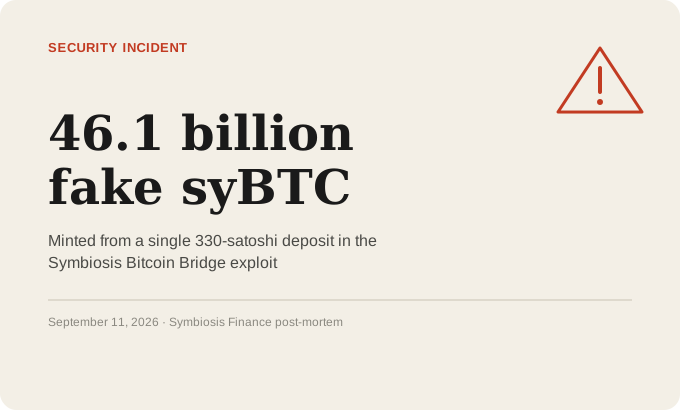
How Did a Hacker Create 46 Billion Fake Bitcoin in the Symbiosis Exploit? Decodes Bitcoin Hacker With WEEX Now
How two Symbiosis bridge bugs let a hacker mint 46.1 billion unbacked syBTC, drain Bitcoin pools and expose critical bridge risks.
This Cycle May Not Be Led by Bitcoin?
Bitcoin, Sports, and Politics: Predictive Markets Target $10 Trillion
Exclusive Interview with CK Zheng of ZX Squared Capital: How a Wall Street Risk Control Expert Accurately Grasped Market Trends and Outperformed Bitcoin Returns by Double
The End of the Blank Prompt: Why Trading AI Needs a Playbook
Bankless Ventures Partner Claims ZEC Will Attract Bitcoin Funds in 2026
US Bond Market 'Meltdown'... Why Are Interest Rates Soaring?
Sam Price: The Impact of Cryptocurrency Legislation on Market Dynamics


