
MU Stock Down 34% at 5.75x Forward Earnings: Cheap or Trap?

 Prefer us on Google
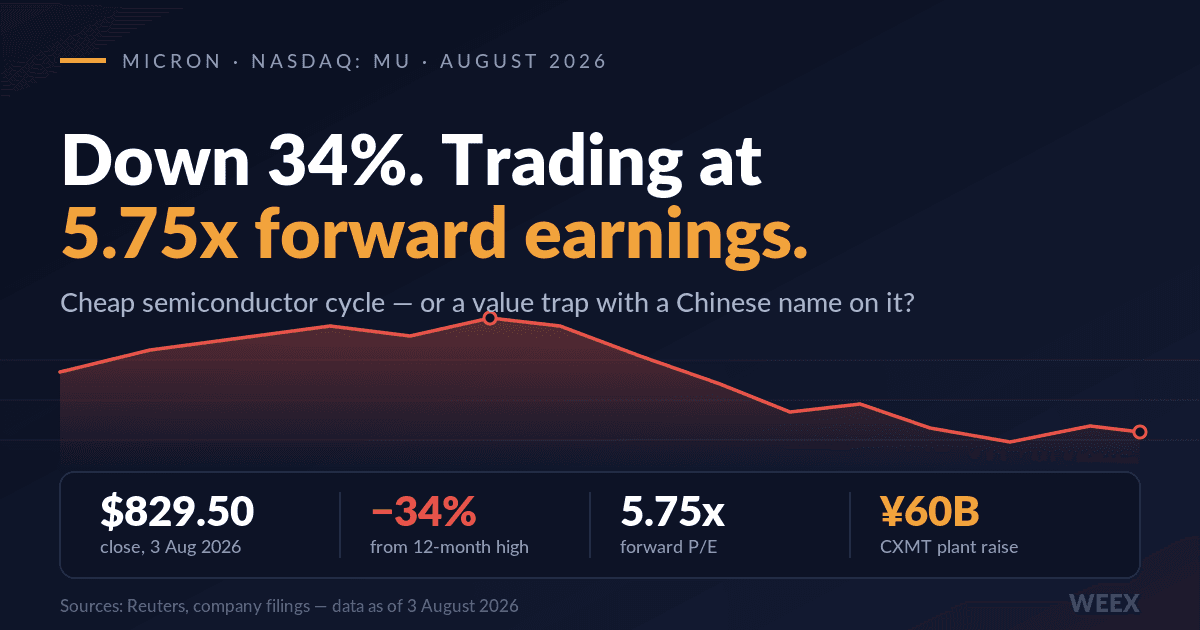
MU stock closed at $829.50 on August 3, 2026 — up 0.79% on the day, but roughly 34% below the $1,255 high it set inside the same 12 months. The company that produced those shares just reported the best quarter in its history. That gap between the tape and the income statement is the whole story right now, and most coverage of MU stock is still describing the rally that ended in July.
Here is what actually changed, what the selloff is pricing, and the one number that makes MU stock look either absurdly cheap or dangerously late in the cycle — depending on an assumption almost nobody states out loud.
Why MU Stock Fell 34% From Its High
The trigger is specific and datable. On August 3, 2026, Reuters reported that ChangXin Memory Technologies (CXMT) — China's largest DRAM maker — is in funding talks to build a second memory plant in Beijing's Yizhuang district, seeking roughly 60 billion yuan to expand 12-inch wafer capacity. The report followed CXMT's $8.6 billion IPO in July. Micron fell in pre-market, dragged SK Hynix with it, and the selling spilled into Intel, AMD and Marvell.
That was the accelerant, not the cause. MU stock fell more than 25% across July. Two things did the damage: Apple CEO Tim Cook publicly signalling that Apple wants more memory suppliers and has been testing CXMT product, and a broad unwind in semiconductor positioning that took the Roundhill Memory ETF (DRAM) down more than 33% from its own high.
The counter-argument arrived in the same fortnight and got less attention. Samsung reported record quarterly revenue and warned that memory tightness could run into 2028. Cook described the memory price surge as a "100-year flood," and Amazon's Andy Jassy flagged "exceptionally higher memory costs" — both of which are bearish for Apple and Amazon margins and unambiguously bullish for the company selling the memory. MU stock jumped roughly 18% on July 30 on exactly that read.
So the market is not confused about the facts. It is arguing about duration.
MU Stock by the Numbers: August 3, 2026
| Metric | Value (as of Aug 3, 2026 close) |
|---|---|
| Price / day change | $829.50, +0.79% |
| Day's range | $770.10 – $836.62 |
| 52-week range | $105.46 – $1,255.00 |
| Drawdown from high | ~34% |
| Market cap | $936.83B |
| Revenue (ttm) | $90.27B |
| Net income (ttm) | $50.47B |
| Trailing P/E | 18.71 |
| Forward P/E | 5.75 |
| Beta | 2.14 |
| Analyst consensus | Strong Buy (45 analysts), $1,507.38 average target |
| Next earnings | Sep 22, 2026 |
Source: NASDAQ consolidated data via StockAnalysis, August 3, 2026 close. Prices move; treat every figure here as a snapshot, not a level.
For context on the operating side: fiscal Q3 2026, reported June 24, produced $41.46 billion of revenue — up 346% year over year and roughly 24% above Micron's own $33.5 billion guidance — with non-GAAP EPS of $25.11 and GAAP gross margin near 85%. Management guided fiscal Q4 to about $50 billion. Micron also disclosed 16 Strategic Customer Agreements carrying take-or-pay terms and contracted price bands, with reporting around the quarter putting roughly $100 billion of future revenue under contracted minimum pricing.
Is the CXMT Threat Actually Priced In?
This is where the analysis usually stops at "China competition is bad for Micron." The more useful question is when Chinese supply can touch the revenue Micron has already sold.
| CXMT milestone | Status, Aug 3, 2026 | Realistic effect on Micron |
|---|---|---|
| $8.6B IPO | Completed July 2026 | Funds expansion; adds no wafers yet |
| Second Beijing fab (Yizhuang) | In funding talks, ~¥60B sought | Build plus ramp — 2028 at the earliest |
| Shanghai HBM back-end packaging | Targeting production by end-2026 | Qualification cycles push volume to 2027+ |
| Apple qualification testing | Reported ongoing | Commodity DRAM and NAND first, not HBM |
The right-hand column is inference from standard fab construction and customer-qualification timelines, not Micron or CXMT guidance. Read it as a framework, not a forecast.
The point that follows is the one the selloff underweights: CXMT's credible supply arrives in commodity DRAM before it arrives in HBM, and Micron's take-or-pay agreements sit in front of that window. Chinese capacity is a genuine long-term threat to memory's pricing floor. It is a much weaker threat to the specific dollars Micron has already contracted at agreed minimums through the AI buildout. The market repriced a 2028 risk against a 2026 earnings stream.
Why MU Stock Trades at 5.75x Forward Earnings
Now the number that matters, and the caveat that goes with it.
A forward P/E of 5.75 on a $936 billion company is not normal. It is not a value screen error either — it is the arithmetic of a $50 billion quarterly revenue guide annualised against a price that has already fallen a third. Taken at face value, MU stock is priced as if the next twelve months of earnings are close to the last ones the company will ever earn at this level.
Here is the discipline to apply. Memory stocks always look cheapest at the top of the cycle. That is not a cliché; it is a structural feature. Operating leverage means peak-cycle EPS is enormous, so the P/E collapses precisely when the risk of a downturn is highest. In 2018 and again in 2022, Micron traded at single-digit forward multiples months before earnings fell by more than half. A 5.75x multiple tells you the market does not believe those earnings are durable. It does not tell you the market is wrong.
The honest framing: MU stock is cheap against contracted, visible revenue and expensive against any normalised mid-cycle earnings estimate. Which of those two you weight is the entire investment decision, and no valuation ratio resolves it for you.
What Would Break the MU Stock Bull Case
Watch outcomes, not headlines. These are the specific things that would confirm or kill the thesis.
| Signal | Bullish read | Bearish read |
|---|---|---|
| Sep 22 earnings and FY27 guide | Q4 lands near $50B, SCAs extended | Guide flattens or contract terms soften |
| DRAM and NAND contract pricing | Prices hold into Q4 negotiations | Sequential declines resume |
| CXMT HBM qualification | Slips past 2027 | Lands at a tier-one customer early |
| Hyperscaler capex commentary | AI buildout budgets raised again | Any hint of digestion or pause |
| Apple supplier diversification | Limited to commodity parts | Extends into high-value memory |
Micron's next report is September 22, 2026. Between now and then, the stock trades on secondhand information — Samsung and SK Hynix prints, hyperscaler capex remarks, and Chinese policy leaks. That is a recipe for continued 5–10% daily swings in a stock with a beta of 2.14.
Trading MU Stock Exposure Without a Broker
For traders who want two-sided exposure rather than a long-only position, the drawdown has made the instrument choice matter more than the direction call. Cash equity gives ownership but only trades US hours, which is a real problem when the catalysts are Korean earnings and Chinese policy reports landing overnight.
USDT-settled products close that gap. MU-USDT perpetual futures on WEEX trade around the clock with long and short direction and leverage up to 100x, settled in stablecoins with no brokerage account or bank wire. The trade-off is unambiguous: these track MU's price and confer no shares, no dividends and no voting rights. If that distinction is unfamiliar, read what MUUSDT actually represents before sizing anything.
The practical warning for this specific setup: high leverage into a 34% drawdown is how traders get liquidated being directionally right. A stock that moved 18% in one session on July 30 can take out a thin margin buffer in both directions inside a week. Size for a 2.14 beta and overnight gap risk, not for conviction. For a longer-horizon view of where this cycle could land, the MU price scenarios through 2030 are worth reading with the same skepticism.
The Bottom Line on MU Stock
MU stock is not falling because Micron is executing badly. It is falling because the market decided in late July that it can see the end of the cycle, and it started discounting that end against a company still printing record numbers. The 5.75x forward multiple is the market's estimate of how temporary those numbers are.
The strongest argument for the bulls is timing: CXMT cannot meaningfully supply HBM before 2027, and Micron has roughly $100 billion contracted at minimum prices in the meantime. The strongest argument for the bears is history: memory has never been re-rated as a secular growth business for long, and every previous attempt ended with the multiple being right and the earnings being wrong. September 22 is when that argument gets its next real data point.
Want to take a position on either side before then? MU-USDT perpetuals on WEEX let you trade the view 24/7 — review the contract specs and set your risk limits first.
FAQ
1. Why is MU stock falling if Micron just had record earnings?
The selloff is about future pricing, not past results. Reports on August 3, 2026 that China's CXMT is funding a second Beijing DRAM fab, plus Apple's stated interest in more memory suppliers, convinced the market that the memory shortage has a visible end date. Micron's fiscal Q3 revenue of $41.46 billion is already in the price; what's being repriced is 2027 and 2028.
2. Is MU stock cheap at a 5.75x forward P/E?
It is cheap against contracted revenue and not obviously cheap against normalised mid-cycle earnings. Memory stocks routinely trade at single-digit forward multiples at cycle peaks because operating leverage inflates peak EPS. The low multiple is the market's judgment that current earnings are temporary — treat it as a question, not an answer.
3. How far is MU stock from its all-time high?
MU stock closed at $829.50 on August 3, 2026, roughly 34% below the $1,255.00 top of its 52-week range. The stock fell more than 25% during July alone after a year in which it also traded as low as $105.46.
4. When does Micron report earnings next?
September 22, 2026. That report covers fiscal Q4, which management guided to approximately $50 billion in revenue, and it is the first hard read on whether the Strategic Customer Agreements are holding their contracted price bands.
5. Can I trade MU stock exposure without a US brokerage account?
Yes. USDT-settled instruments such as MU-USDT perpetual futures give long or short exposure to MU's price 24/7 using stablecoin collateral. They are derivatives — you get price exposure only, with no equity, dividends or voting rights, plus funding costs and liquidation risk that cash shares do not carry.
6. Is the CXMT threat to Micron real or overblown?
Both, on different timeframes. CXMT's expansion is real and well-funded after an $8.6 billion IPO, and it pressures commodity DRAM pricing over the long run. But fab construction and HBM customer qualification take years, which makes it a 2027–2028 issue rather than a 2026 one — while Micron's contracted book sits inside that window.
Risk Warning
Memory equities are among the most volatile large caps in the market, and MU stock carries a beta of 2.14 with a 52-week range spanning $105.46 to $1,255.00 — a reminder that both directions can move violently. MU-USDT perpetual futures and tokenized stock products track Micron's price but grant no equity ownership, dividends, or voting rights, and leveraged positions add funding costs and liquidation risk that can close a position well before a thesis plays out. Overnight gap risk is elevated here specifically because the catalysts — Samsung and SK Hynix results, Chinese capacity reports, hyperscaler capex remarks — land outside US market hours when off-hours liquidity is thinnest and spreads are widest. Stock-linked crypto products may also carry counterparty, liquidity, and regulatory risk, and availability varies by jurisdiction. Crypto and crypto-settled products are volatile and can result in partial or total loss of capital. Never trade with more than you can afford to lose, and review all contract specifications before opening a position. This article is information only and is not investment advice.
This content is provided for general informational purposes only and doesn't constitute financial, investment, legal, or tax advice. Any events, rewards, online promotions, or related information mentioned herein should not be considered a recommendation, solicitation, or invitation to purchase, sell, trade, or otherwise deal in any crypto assets. Crypto assets are highly volatile and may result in loss. The availability of WEEX services, products, and related events may vary by region. You are responsible for ensuring that your participation is in accordance with applicable local laws and regulations.
You may also like

SMS 2FA vs Authenticator App: Which Is Actually Safer?

What Is 2FA? A Beginner's Guide

MU Stock Price Targets Range From $800 to $2,500: What the Widest Analyst Gap in Memory Stocks Reveals
MSTF Stock and the $100 Billion Azure Milestone: What Crossing This Threshold Actually Changes

Will Microsoft Stock Surpass Apple's Market Cap Within 18 Months? What the Prediction Requires

AMD Stock vs Nvidia Stock: Who Is Winning the AI Chip Race Heading Into Q2 Earnings?
AMD Stock Before August 4 Earnings: What the Helios Ramp and Data Center Crossing $6.5 Billion Actually Mean

AMD Stock Is Down 18% From Its Peak Into Earnings: Is the Setup Attractive or Risky?

PLTR Stock and Alex Karp's "Forget Consensus": What the CEO's Otherworldly Claim Actually Means for Investors
PLTR Stock Jumps 15% After Q2 Earnings: What 93% Revenue Growth and 149% Commercial Surge Actually Mean

PLTR Stock Price Prediction 2026-2027: Can Palantir Reach $200 After the Q2 Blowout?

Oil Prices and Bitcoin: Why a 9% Crude Crash Didn't Lift BTC
SpaceX Stock Faces Its Biggest Test: 911 Million Shares Unlock
How Yen Strength and Weakness Move Bitcoin: The FX–Crypto Relationship Explained
Samsung Stock Price Prediction 2026-2027: Can Samsung Reach $250 After the July Selloff?
Is Samsung Stock a Buy After Falling 30% From Its All Time High? What the July Selloff Left Behind
Samsung Stock and the 99.7% Problem: When One Business Unit Drives Everything
KOSPI Price Prediction 2026-2027: Can the Index Recover to 7,000 After Its Worst Month Since 2008?
WEEX Exchange: Complete Introduction for Taiwan Users (2026)
GPU Token on BNB Chain: The Memecoin Priced in Tokenized NVIDIA
Is WEEX a Scam? Safety, Regulation and Withdrawals Explained (2026)
How to Identify Fake WEEX Websites and Customer Service Impersonators
Samsung and SK Hynix Are Half the KOSPI: Why That Concentration Is Now the Market's Biggest Problem
KOSPI Falls 5% as Samsung and SK Hynix Each Drop 9%: What Is Happening to South Korea's Stock Market?
SK Hynix Stock Is Down 35% in July: Is the Worst Finally Over?
South Korea Apologizes for SK Hynix Leveraged ETFs: What It Means for SKHA SKHN Holders

SK Hynix Stock Price Targets Range From $152 to $355: What the Widest Analyst Gap in the Sector Reveals
SK Hynix Stock Has 70% Upside According to UBS: Should You Listen After the July Selloff?
Top Forex Brokers Ranked in 2026: What the Rankings Actually Measure and What They Miss
What Is Broker Trading? A Beginner's Guide to Trading Through a Broker
SMS 2FA vs Authenticator App: Which Is Actually Safer?
What Is 2FA? A Beginner's Guide
MU Stock Price Targets Range From $800 to $2,500: What the Widest Analyst Gap in Memory Stocks Reveals
MSTF Stock and the $100 Billion Azure Milestone: What Crossing This Threshold Actually Changes
Will Microsoft Stock Surpass Apple's Market Cap Within 18 Months? What the Prediction Requires
AMD Stock vs Nvidia Stock: Who Is Winning the AI Chip Race Heading Into Q2 Earnings?


