
SpaceX Stock Faces Its Biggest Test: 911 Million Shares Unlock

 Prefer us on Google
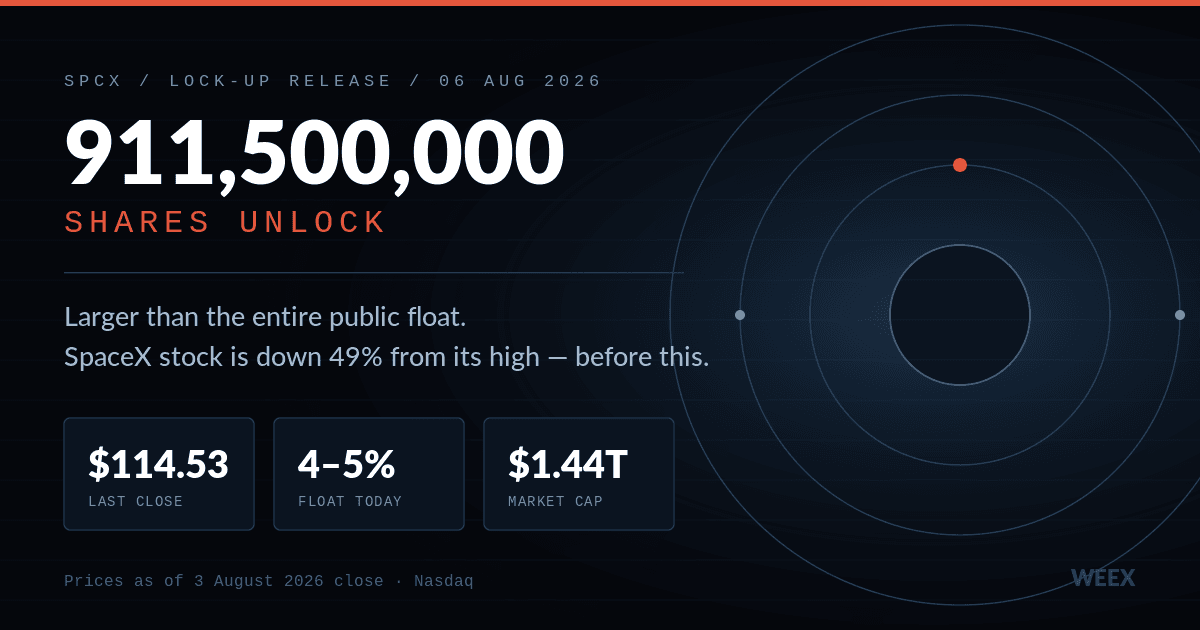
SpaceX stock (NASDAQ: SPCX) closed at $114.53 on August 3, 2026 — about 15% below its $135 IPO price and 49% below the $225.64 intraday high it printed four days after listing. That drawdown is not really an argument about rockets. It is an argument about supply.
On August 4, SpaceX reports its first quarterly results as a public company. Two trading days later, on August 6, the first lock-up tranche releases up to 911.5 million shares. Against a public float that currently sits at roughly 4–5% of shares outstanding, that single unlock is larger than the entire tradable market. Everything else in the SpaceX stock story — Starlink subscriber growth, the $1.44 trillion market cap, Morgan Stanley's $300 target — is being priced through that one mechanical fact right now.
This piece walks the unlock arithmetic, the full release calendar through December, what Q2 has to show, and how the crypto-side instruments (SPCXX spot and SPCX perpetuals) behave differently from the Nasdaq listing during exactly this kind of event.
Where SpaceX stock trades after a 49% drawdown
The post-IPO round trip has been unusually fast even by 2026 standards. SPCX priced at $135, opened at $150, closed its first session at $160.95, ran to $225.64 on June 16 — and then gave all of it back and more, bottoming at $107.01 on July 28 before a modest bounce.
| SpaceX stock (SPCX) | Level | Date |
|---|---|---|
| IPO price | $135.00 | June 12, 2026 |
| First-day close | $160.95 (+19%) | June 12, 2026 |
| All-time intraday high | $225.64 | June 16, 2026 |
| All-time low | $107.01 | July 28, 2026 |
| Last close | $114.53 | August 3, 2026 |
| Market capitalization | ~$1.44 trillion | August 3, 2026 |
| Consensus 12-month target | $236.71 (range $62–$800) | August 2026 |
Two things stand out. First, the stock is below its IPO price — early institutional allocations are underwater, which changes who is willing to hold through an unlock. Second, the analyst target range runs from $62 to $800. A 13x spread between the bull and bear case is not a forecast; it is an admission that nobody has a reliable model for this company yet. That is precisely why the first earnings print matters more than usual.
Why SpaceX stock fell before its first earnings report
The July slide ran seven consecutive sessions and was not driven by news out of Starbase. Three forces stacked:
Supply anticipation. Traders positioned ahead of August 6 rather than after it. Selling pressure that arrives before a known unlock is the market doing its job — it is also why the event itself sometimes produces a relief rally.
A valuation with no margin for error. SpaceX posted a $4.9 billion net loss in 2025. At a $1.44 trillion cap, the stock prices near-flawless execution across three businesses that behave nothing alike: launch (profitable, capacity-constrained), Starlink (growing fast, monetizing worse per user), and an AI/compute arm that consumes cash.
Sector rotation. Enthusiasm for commercial space cooled broadly through July, and SPCX — the largest and newest name in the group — absorbed the most of it.
The better reading is that this is a float-and-supply repricing wearing the costume of a fundamentals debate. The fundamentals question gets answered August 4. The supply question does not get answered until December.
The August 6 unlock: 911 million shares against a 5% float
Here is the arithmetic that most coverage skips.
At $114.53 and a $1.44 trillion market cap, SpaceX has roughly 12.6 billion shares outstanding. A public float of 4–5% works out to about 500–630 million shares actually trading. The August 6 tranche releases up to 911.5 million shares — worth roughly $116 billion.
That means the newly sellable supply is roughly 1.5 to 1.8 times the size of the entire existing float. No unlock in market history has carried that ratio at this scale.
Three qualifications keep this from being a doom number:
- Eligible to sell is not the same as selling. Insiders holding shares acquired at a fraction of $114 have tax, concentration and signalling reasons to stagger exits. Historically only a minority of an unlock tranche hits the tape in the first week.
- SpaceX deliberately staggered the schedule. Rather than one 180-day cliff, the company spread releases across roughly 16 dates. That design exists specifically to avoid a single supply flood.
- The unlock is fully known. Markets front-run scheduled supply. Seven red days into the event is evidence of that already happening.
What experienced operators actually watch on a day like August 6 is not the headline share count — it is the borrow rate, the first-hour volume relative to the 20-day average, and whether the stock holds the $107.01 July low. A break of that level on heavy volume changes the character of the move from "digesting supply" to "price discovery downward."
SpaceX stock lockup schedule through December 2026
The full release calendar, as disclosed and reported through late July 2026:
| Date | Release | Notes |
|---|---|---|
| Aug 4, 2026 | Q2 earnings (after close) | Trigger event for the first tranche |
| Aug 6, 2026 | Up to 20% of restricted holdings — ~911.5M shares | ~$116B; largest single unlock on record |
| Aug 31, 2026 | ~7% tranche | Rolling release begins |
| Sep 10, 2026 | ~7% tranche | — |
| Sep 25, 2026 | ~7% tranche | — |
| Oct 10, 2026 | ~7% tranche | — |
| Oct 25, 2026 | ~7% tranche | — |
| Two days after Q3 earnings | ~28% tranche | Largest post-August release |
| Early December 2026 | All remaining 180-day shares | Final employee lock-up expiry |
| June 12, 2027 | Elon Musk's ~6.4B shares | One-year lock, unaffected by the above |
Musk's stake sitting outside the entire 2026 calendar is the single most stabilising feature of this structure. Roughly half the share count cannot legally move until mid-2027 — which is also why float scarcity has been exaggerating moves in both directions since June.
What Q2 earnings must prove to justify $1.44 trillion
Consensus going into the August 4 print:
| Metric | Q1 2026 (actual) | Q2 2026 (consensus) |
|---|---|---|
| Total revenue | $4.69B | $6.82B |
| Connectivity (Starlink) | — | $3.83B (+17.5% QoQ) |
| AI segment | $818M | $2.18B |
| Launch services | — | ~$835M (+35%) |
| EBITDA | — | $2.05B |
| Adjusted EPS | — | –$0.23 |
The number that deserves the most attention is not revenue. Starlink reached 10.3 million subscribers across 164 countries as of March 31, 2026 — up 105% year over year from 5.0 million. Over the same stretch, average revenue per user fell from about $86 a month to $66.
Subscriber growth doubling while ARPU drops 23% is a business trading volume for price. It works if incremental capacity is nearly free and churn stays low. It stops working the moment satellite replacement capex outruns the marginal subscriber's contribution. Watch the Starlink gross margin line and the capex guide far more closely than the top-line beat or miss.
How to trade SpaceX stock exposure without a US brokerage
Not everyone can open a Nasdaq-enabled account, and the SpaceX story is now a 24/7 news flow attached to a market that closes at 4pm ET. That gap is where the crypto-side instruments live.
WEEX lists two distinct SpaceX products, and they are not interchangeable:
| Feature | SPCX (Nasdaq) | SPCXX/USDT spot | SPCX/USDT perpetual |
|---|---|---|---|
| What it is | Real equity | Tokenized tracking certificate | USDT-margined derivative |
| Backing | Direct share ownership | 1:1 underlying shares in regulated custody | Index-referenced, no share backing |
| Issued on | — | Solana (SPL) | — |
| Voting rights | Yes | No | No |
| Leverage | Margin via broker | None (spot) | Up to 20x |
| Trading hours | Nasdaq sessions | 24/7 | 24/7 |
| Funding cost | None | None | Periodic funding rate |
SPCXX went live on WEEX on June 12, 2026 at 15:00 UTC — the same day as the IPO. Per the SPCXX listing details, it is an xStock issued on Solana and backed 1:1 by underlying shares held with a regulated custodian. It gives price exposure. It does not make you a SpaceX shareholder, and it pays no dividend. If that distinction is unfamiliar, the mechanics are covered in WEEX's explainer on tokenized US stocks.
The trap most traders walk into around an unlock: SPCX itself stops trading when Nasdaq closes, but SPCXX and the SPCX perpetual keep pricing through nights and weekends. August 6 is a Thursday. Any repositioning that happens Friday evening through Sunday shows up in the tokenized instruments first, on thinner liquidity, and then gaps into Monday's cash session. Wide stops and reduced size around the weekend are not caution — they are the correct response to a market that is open when its reference asset is not.
Is SpaceX stock a buy into the unlock?
The honest answer is that August 4 and August 6 are two separate bets and most people conflate them.
The earnings print is a fundamentals question: does the Starlink monetization curve support a $1.44 trillion valuation? The unlock is a mechanical question: how much of 911.5 million eligible shares actually hits a float of ~570 million?
You can be right about SpaceX as a company and still lose money owning SpaceX stock through August, because supply does not care about your thesis for the six weeks it takes to clear. Traders who want the fundamentals exposure without the supply exposure generally wait for the December schedule to complete. Traders who want to express a view on the unlock itself use defined-risk sizing and treat the $107.01 July low as the line that decides which regime the stock is in.
What nobody should do is buy SpaceX stock at 49% off the high purely because it is 49% off the high. The high was set on four days of float scarcity and IPO euphoria. It was never a valuation — it was a supply accident, and the supply accident is currently being corrected in the other direction.
FAQ
1. Why is SpaceX stock falling in 2026?
SPCX fell from $225.64 (June 16) to $107.01 (July 28) mainly on supply anticipation ahead of the August 6 lock-up expiry, plus valuation reassessment after a $4.9 billion net loss in 2025 and a broad cooling in commercial space names. It closed at $114.53 on August 3, 2026.
2. When do SpaceX shares unlock?
The first and largest tranche — up to 911.5 million shares, roughly $116 billion — releases on August 6, 2026, two trading days after the maiden earnings report. Rolling ~7% tranches follow on August 31, September 10, September 25, October 10 and October 25, a ~28% tranche lands two days after Q3 earnings, and the remaining 180-day shares free up in early December 2026. Elon Musk's ~6.4 billion shares stay locked until June 12, 2027.
3. How big is the August 6 unlock compared with the SpaceX float?
At a ~$1.44 trillion market cap and $114.53 per share, roughly 12.6 billion shares are outstanding, with a float of about 4–5% — some 500 to 630 million shares. The 911.5 million share release is therefore about 1.5 to 1.8 times the entire existing float.
4. Can I buy SpaceX stock without a US brokerage account?
Not the actual equity. You can hold price exposure through tokenized instruments: SPCXX/USDT on WEEX is a Solana-issued xStock backed 1:1 by shares in regulated custody, and SPCX/USDT is a USDT-margined perpetual with up to 20x leverage. Neither confers ownership, voting rights or dividends.
5. What is the difference between SPCX and SPCXX?
SPCX is the Nasdaq-listed equity. SPCXX is a tokenized tracking certificate that follows the SpaceX share price on-chain and trades 24/7. SPCXX holders have economic price exposure only — no shareholder status, no vote, no dividend, and exposure to the custodian and issuer behind the token.
6. What should I watch in SpaceX's first earnings report?
Starlink gross margin and capex guidance matter more than the revenue headline. Subscribers grew 105% year over year to 10.3 million as of March 31, 2026, while ARPU fell from roughly $86 to $66 a month — a volume-for-price trade that only works if capacity costs stay contained.
Risk Warning
SpaceX stock and every instrument referenced here carry substantial risk of partial or total loss. SPCX has moved 49% peak-to-trough within seven weeks of listing and trades below its IPO price; a newly public company with three unprofitable-to-marginal business lines and no earnings history offers no valuation floor.
Specific risks around this event: the August 6 release makes roughly 1.5–1.8x the current float sellable, and actual insider selling volume is unknowable in advance. Tokenized products such as SPCXX add custodian, issuer and redemption risk on top of equity risk — you hold a claim on a structure, not a share, with no voting rights, no dividends and no shareholder protections. Perpetual futures add liquidation risk, funding costs, and index-tracking risk; at up to 20x leverage a 5% adverse move can wipe a position. Because tokenized and perpetual markets trade 24/7 while Nasdaq does not, positions held over weekends face gap risk with no ability to hedge in the underlying. Availability of these products varies by jurisdiction. Nothing here is investment advice — size positions on the assumption you can be right on the company and still wrong on the timing.
This content is provided for general informational purposes only and doesn't constitute financial, investment, legal, or tax advice. Any events, rewards, online promotions, or related information mentioned herein should not be considered a recommendation, solicitation, or invitation to purchase, sell, trade, or otherwise deal in any crypto assets. Crypto assets are highly volatile and may result in loss. The availability of WEEX services, products, and related events may vary by region. You are responsible for ensuring that your participation is in accordance with applicable local laws and regulations.
You may also like

SMS 2FA vs Authenticator App: Which Is Actually Safer?

What Is 2FA? A Beginner's Guide

MU Stock Price Targets Range From $800 to $2,500: What the Widest Analyst Gap in Memory Stocks Reveals
MSTF Stock and the $100 Billion Azure Milestone: What Crossing This Threshold Actually Changes

Will Microsoft Stock Surpass Apple's Market Cap Within 18 Months? What the Prediction Requires

AMD Stock vs Nvidia Stock: Who Is Winning the AI Chip Race Heading Into Q2 Earnings?
AMD Stock Before August 4 Earnings: What the Helios Ramp and Data Center Crossing $6.5 Billion Actually Mean

AMD Stock Is Down 18% From Its Peak Into Earnings: Is the Setup Attractive or Risky?

PLTR Stock and Alex Karp's "Forget Consensus": What the CEO's Otherworldly Claim Actually Means for Investors
PLTR Stock Jumps 15% After Q2 Earnings: What 93% Revenue Growth and 149% Commercial Surge Actually Mean

PLTR Stock Price Prediction 2026-2027: Can Palantir Reach $200 After the Q2 Blowout?
MU Stock Down 34% at 5.75x Forward Earnings: Cheap or Trap?

Oil Prices and Bitcoin: Why a 9% Crude Crash Didn't Lift BTC
How Yen Strength and Weakness Move Bitcoin: The FX–Crypto Relationship Explained
Samsung Stock Price Prediction 2026-2027: Can Samsung Reach $250 After the July Selloff?
Is Samsung Stock a Buy After Falling 30% From Its All Time High? What the July Selloff Left Behind
Samsung Stock and the 99.7% Problem: When One Business Unit Drives Everything
KOSPI Price Prediction 2026-2027: Can the Index Recover to 7,000 After Its Worst Month Since 2008?
WEEX Exchange: Complete Introduction for Taiwan Users (2026)
GPU Token on BNB Chain: The Memecoin Priced in Tokenized NVIDIA
Is WEEX a Scam? Safety, Regulation and Withdrawals Explained (2026)
How to Identify Fake WEEX Websites and Customer Service Impersonators
Samsung and SK Hynix Are Half the KOSPI: Why That Concentration Is Now the Market's Biggest Problem
KOSPI Falls 5% as Samsung and SK Hynix Each Drop 9%: What Is Happening to South Korea's Stock Market?
SK Hynix Stock Is Down 35% in July: Is the Worst Finally Over?
South Korea Apologizes for SK Hynix Leveraged ETFs: What It Means for SKHA SKHN Holders

SK Hynix Stock Price Targets Range From $152 to $355: What the Widest Analyst Gap in the Sector Reveals
SK Hynix Stock Has 70% Upside According to UBS: Should You Listen After the July Selloff?
Top Forex Brokers Ranked in 2026: What the Rankings Actually Measure and What They Miss
What Is Broker Trading? A Beginner's Guide to Trading Through a Broker
SMS 2FA vs Authenticator App: Which Is Actually Safer?
What Is 2FA? A Beginner's Guide
MU Stock Price Targets Range From $800 to $2,500: What the Widest Analyst Gap in Memory Stocks Reveals
MSTF Stock and the $100 Billion Azure Milestone: What Crossing This Threshold Actually Changes
Will Microsoft Stock Surpass Apple's Market Cap Within 18 Months? What the Prediction Requires
AMD Stock vs Nvidia Stock: Who Is Winning the AI Chip Race Heading Into Q2 Earnings?


