
Oil Prices and Bitcoin: Why a 9% Crude Crash Didn't Lift BTC

 Prefer us on Google
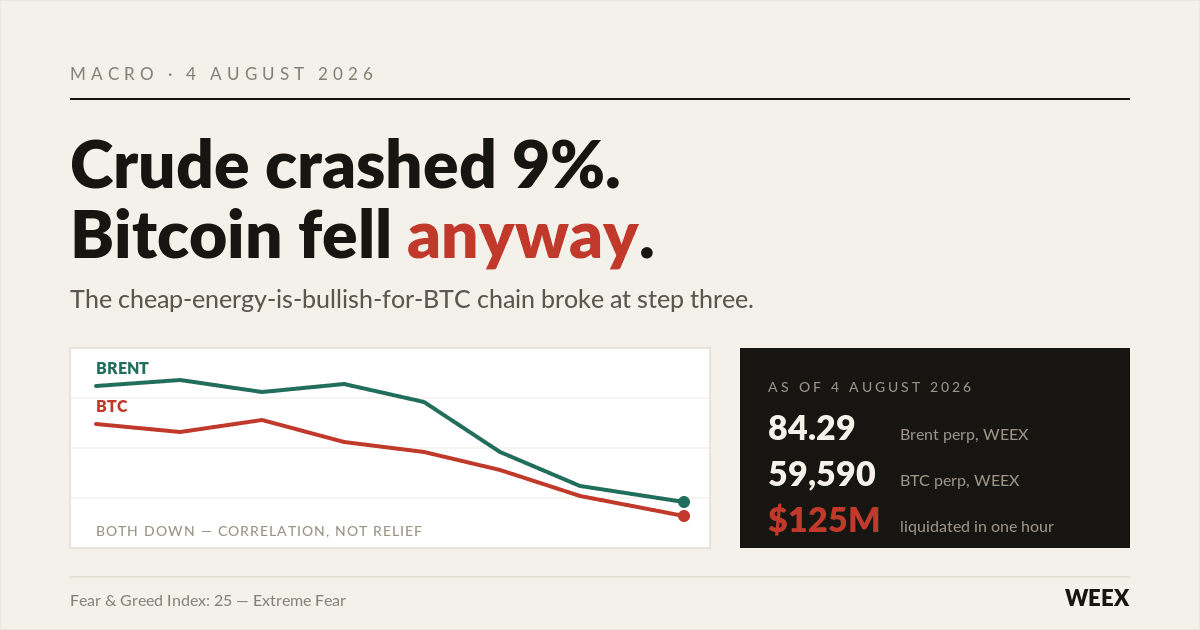
Crude collapsed on peace headlines this week. Bitcoin was supposed to be the beneficiary. It wasn't.
On August 3, 2026, WTI fell as much as 9% intraday and broke below $80 a barrel after President Trump called off a planned military strike on Iran and said fresh talks with Tehran would begin. Brent dropped in tandem, and as of August 4 the Brent perpetual on WEEX (BZ-USDT) was quoted at 84.29 — down from above $90 five days earlier. OPEC+ added to the slide by lifting production quotas about 188,000 barrels per day from September, completing the unwind of a layer of voluntary cuts introduced in 2023.
Textbook macro says this is a gift to Bitcoin. Cheaper energy cools inflation, a cooler inflation print frees the Fed to cut, and rate cuts push liquidity toward the long-duration end of the risk curve where crypto lives. Instead, Bitcoin broke below $63,000, triggered roughly $125 million of liquidations in a single hour, and as of August 4 the BTC-USDT perpetual on WEEX printed 59,590.5. The Crypto Fear & Greed Index sat at 25 — Extreme Fear.
That gap between what should have happened and what did is the interesting part, and most explainers on how oil prices affect Bitcoin skip it entirely. They describe the rising-oil case and stop.
How oil prices affect Bitcoin: the four-step chain
The link between crude and crypto is indirect. Oil does not trade against BTC; it trades against the Fed's reaction function, and BTC trades against that.
| Step | Mechanism | Direction when oil falls |
|---|---|---|
| 1. Energy input cost | Fuel feeds transport, production, food, utilities | Headline inflation pressure eases |
| 2. Policy expectations | Softer CPI path widens room for cuts | Rate-cut odds rise |
| 3. Liquidity and real yields | Lower real yields make cash less rewarding | Capital rotates out on the risk curve |
| 4. Crypto beta | BTC is the high-beta end of that curve | Bullish, in theory |
Every step is real. The problem is that steps 1 through 3 run on a schedule measured in weeks — the next CPI print, the next FOMC meeting — while step 4 reprices in seconds. Crypto gets the shock before it gets the benefit.
The Fed's target range is currently 3.50%–3.75%, with no cuts delivered in 2026. As of July 28, CME FedWatch put roughly 54% odds on a 25 basis point cut at the September meeting. A single week of cheaper crude does not settle that question; it just removes one argument against cutting. Markets need confirmation from actual inflation data, and that data does not arrive for weeks.
Why the Bitcoin oil trade failed this week
Three things overrode the macro logic.
Positioning was long and leveraged. The liquidation cascade tells you what the book looked like: traders were positioned for upside, price broke a short-term support level, and forced closes did the rest. When leverage is the marginal price-setter, a bullish macro headline is irrelevant until the flush is finished. The oil crash did not cause the selloff — it arrived during one.
A crude collapse is ambiguous, not clean. Falling oil from easing supply fear is disinflationary and constructive. Falling oil because global demand is deteriorating is a growth warning. This week's move was mostly the first kind, driven by a shelved strike and an OPEC+ supply increase, but markets rarely separate the two in real time. Traders sold first.
Correlation ran through equities, not commodities. Bitcoin has traded with roughly 85% correlation to the Nasdaq-100 during 2026's oil spikes, behaving like a high-beta tech proxy rather than an inflation hedge. When Asian semiconductor names faded and the AI trade wobbled, BTC followed the equity tape — and the equity tape was not celebrating cheap oil. Anyone reading crude as their primary crypto signal was watching the wrong screen. The relationship between US equity futures and crypto risk appetite is usually the faster tell.
Does cheaper oil eventually mean higher Bitcoin?
Usually, yes — with a lag, and only if the disinflation is confirmed.
The transmission from energy prices to crypto runs through liquidity, and liquidity moves when policy moves, not when a headline crosses. This is the same mechanism that makes quantitative easing supportive of Bitcoin: falling real yields and a softer dollar are what actually pull capital toward high-beta assets. Cheap crude is one input into that, not a substitute for it.
Two paths from here:
| Scenario | What has to happen | Likely BTC read |
|---|---|---|
| Disinflation confirmed | Crude holds in the low $80s, next CPI cools, September cut priced above 70% | Oil signal turns supportive with a multi-week lag |
| Peace premium unwinds | Talks stall, Hormuz stays contested, Brent reclaims $90 | Inflation risk returns, rate-cut odds fade, pressure resumes |
| Demand scare | Crude keeps falling on weak growth data rather than supply news | Falling oil becomes bearish for BTC, not bullish |
The third row is the one traders underweight. There is a level below which cheap oil stops being relief and starts being a recession signal, and at that point the correlation flips sign.
Oil and Bitcoin on the same screen: what the WEEX tape showed
One practical advantage of trading both markets on a single venue is that the divergence is visible without switching platforms. Here is what the two perpetuals looked like as of August 4, 2026.
| Contract | Underlying | Last price (Aug 4, 2026) | Max leverage | Expiry |
|---|---|---|---|---|
| BZ-USDT | Brent crude | 84.29 | Up to 100× | None (perpetual) |
| BTC-USDT | Bitcoin | 59,590.5 | Up to 400× | None (perpetual) |
The leverage column explains a lot of this week's asymmetry. Crypto perpetuals carry materially higher maximum leverage than the commodity contract sitting next to them, which means a given headline produces a larger forced-flow response in BTC than in crude. When de-risking headlines hit, the more leveraged book unwinds harder — regardless of which direction the fundamental story points.
Both contracts are USDT-margined, never expire, and settle a funding payment on a fixed schedule rather than rolling quarterly. That removes roll friction but adds a recurring carry cost that matters if you hold a macro view for weeks rather than hours.
What traders usually miss in the oil and Bitcoin relationship
The common error is treating crude as a leading indicator for crypto. It is not. It is an input to an input.
Watch the chain instead of the commodity: crude feeds the inflation print, the print feeds rate-cut odds, and rate-cut odds feed liquidity. If any link in that chain is broken — sticky core inflation, a hawkish Fed, a dollar that refuses to soften — the oil move never reaches Bitcoin. Traders who sized positions on the oil headline alone this week found that out at the liquidation price.
The second error is ignoring seasonality and positioning. Bitcoin has averaged a 10% decline in August over the past four years. Entering a leveraged long in a historically weak month, into an Extreme Fear reading, on the strength of a macro signal that takes weeks to confirm, is a timing problem dressed up as a thesis.
The more useful framing: cheap oil improves the odds of a friendly rate path in Q4. It does not tell you what BTC does this week. Those are different trades and they deserve different position sizes.
What matters most from here
Rank the drivers honestly. Bitcoin's near-term path depends on leverage clearing and equity risk appetite stabilizing, not on where Brent settles. Crude matters at the two-to-three-month horizon, through the inflation print and the Fed. If BTC reclaims and holds the $63,000–$64,000 zone, the market has probably absorbed the flush and can start pricing the disinflation benefit. If it stays capped below, the oil story is simply not the operative one yet.
The trade that actually reflects this week's macro shift is the one in crude itself — a shelved strike and an OPEC+ supply increase are direct, dated, and priced. The Bitcoin leg is a bet on the second-order effect, and second-order effects arrive late.
Ready to trade the macro chain rather than guess at it? WEEX lists Brent crude and Bitcoin perpetuals side by side, so you can position on the commodity leg, the crypto leg, or the spread between them from one account.
FAQ
1. Do oil prices and Bitcoin move together?
Not reliably. There is no stable correlation between crude and BTC. The link is indirect and runs through inflation expectations and rate policy, so it appears strongly in some regimes and disappears in others — particularly when crypto-specific leverage, ETF flows, or regulation dominate.
2. Why did Bitcoin fall when oil crashed on August 3, 2026?
Positioning was long and leveraged, and a break of short-term support triggered roughly $125 million in liquidations within an hour. Crypto was also tracking a weak equity tape rather than the commodity move. The disinflationary benefit of cheaper crude takes weeks to show up in CPI data and Fed pricing.
3. Is falling oil always bullish for crypto?
No. Oil falling because supply fear eased is generally supportive. Oil falling because global demand is weakening is a growth warning, and in that case risk assets including Bitcoin usually fall with it. The cause of the move matters more than the direction.
4. How can I trade Brent crude and Bitcoin on the same platform?
WEEX lists BZ-USDT (Brent crude) and BTC-USDT perpetual futures, both USDT-margined with no expiry. Maximum leverage differs sharply between them — up to 100× on the crude contract and up to 400× on Bitcoin — so identical notional exposure requires very different margin and risk settings.
5. What should I watch instead of the oil price to trade Bitcoin?
The next CPI release, CME FedWatch odds for the September FOMC meeting, the dollar index, and perpetual funding rates. Those sit closer to Bitcoin in the transmission chain than crude does and will move BTC first.
Risk Warning
Crypto assets are highly volatile and can lose part or all of their value. Perpetual futures on both crude and Bitcoin are leveraged products: adverse moves can trigger liquidation well before your macro view plays out, and higher maximum leverage on crypto contracts means faster liquidation, not more opportunity. Funding payments accrue against positions held over multiple settlement periods and can erode a correct directional call. Geopolitical headlines reprice oil in seconds and gap risk applies to both markets. Prices and rate-cut probabilities cited here are as of August 4, 2026 and change continuously. WEEX services and product availability vary by region. Nothing here is investment advice — size positions to notional exposure, not to posted margin, and trade only with capital you can afford to lose.
This content is provided for general informational purposes only and doesn't constitute financial, investment, legal, or tax advice. Any events, rewards, online promotions, or related information mentioned herein should not be considered a recommendation, solicitation, or invitation to purchase, sell, trade, or otherwise deal in any crypto assets. Crypto assets are highly volatile and may result in loss. The availability of WEEX services, products, and related events may vary by region. You are responsible for ensuring that your participation is in accordance with applicable local laws and regulations.
You may also like

SMS 2FA vs Authenticator App: Which Is Actually Safer?

What Is 2FA? A Beginner's Guide

MU Stock Price Targets Range From $800 to $2,500: What the Widest Analyst Gap in Memory Stocks Reveals
MSTF Stock and the $100 Billion Azure Milestone: What Crossing This Threshold Actually Changes

Will Microsoft Stock Surpass Apple's Market Cap Within 18 Months? What the Prediction Requires

AMD Stock vs Nvidia Stock: Who Is Winning the AI Chip Race Heading Into Q2 Earnings?
AMD Stock Before August 4 Earnings: What the Helios Ramp and Data Center Crossing $6.5 Billion Actually Mean

AMD Stock Is Down 18% From Its Peak Into Earnings: Is the Setup Attractive or Risky?
PLTR Stock and Alex Karp's "Forget Consensus": What the CEO's Otherworldly Claim Actually Means for Investors
PLTR Stock Jumps 15% After Q2 Earnings: What 93% Revenue Growth and 149% Commercial Surge Actually Mean

PLTR Stock Price Prediction 2026-2027: Can Palantir Reach $200 After the Q2 Blowout?
MU Stock Down 34% at 5.75x Forward Earnings: Cheap or Trap?
SpaceX Stock Faces Its Biggest Test: 911 Million Shares Unlock
How Yen Strength and Weakness Move Bitcoin: The FX–Crypto Relationship Explained
Samsung Stock Price Prediction 2026-2027: Can Samsung Reach $250 After the July Selloff?
Is Samsung Stock a Buy After Falling 30% From Its All Time High? What the July Selloff Left Behind
Samsung Stock and the 99.7% Problem: When One Business Unit Drives Everything
KOSPI Price Prediction 2026-2027: Can the Index Recover to 7,000 After Its Worst Month Since 2008?
WEEX Exchange: Complete Introduction for Taiwan Users (2026)

GPU Token on BNB Chain: The Memecoin Priced in Tokenized NVIDIA
Is WEEX a Scam? Safety, Regulation and Withdrawals Explained (2026)
How to Identify Fake WEEX Websites and Customer Service Impersonators
Samsung and SK Hynix Are Half the KOSPI: Why That Concentration Is Now the Market's Biggest Problem
KOSPI Falls 5% as Samsung and SK Hynix Each Drop 9%: What Is Happening to South Korea's Stock Market?
SK Hynix Stock Is Down 35% in July: Is the Worst Finally Over?
South Korea Apologizes for SK Hynix Leveraged ETFs: What It Means for SKHA SKHN Holders

SK Hynix Stock Price Targets Range From $152 to $355: What the Widest Analyst Gap in the Sector Reveals
SK Hynix Stock Has 70% Upside According to UBS: Should You Listen After the July Selloff?
Top Forex Brokers Ranked in 2026: What the Rankings Actually Measure and What They Miss
What Is Broker Trading? A Beginner's Guide to Trading Through a Broker
SMS 2FA vs Authenticator App: Which Is Actually Safer?
What Is 2FA? A Beginner's Guide
MU Stock Price Targets Range From $800 to $2,500: What the Widest Analyst Gap in Memory Stocks Reveals
MSTF Stock and the $100 Billion Azure Milestone: What Crossing This Threshold Actually Changes
Will Microsoft Stock Surpass Apple's Market Cap Within 18 Months? What the Prediction Requires
AMD Stock vs Nvidia Stock: Who Is Winning the AI Chip Race Heading Into Q2 Earnings?


