
NEAR Protocol HSP-029 Vote: Can a 36% Issuance Cut Affect NEAR Price?

 Prefer us on Google


NEAR Protocol is approaching a major governance deadline as its community considers HSP-029, a proposal to gradually reduce the network's maximum annual token issuance rate from 2.5% to 1.6%.
The NEAR HSP-029 vote is scheduled to close on November 2, 2026, at 16:48 UTC. If approved and subsequently implemented, the change would lower the rate at which new NEAR tokens enter circulation while also reducing the amount of newly issued tokens available for staking rewards.
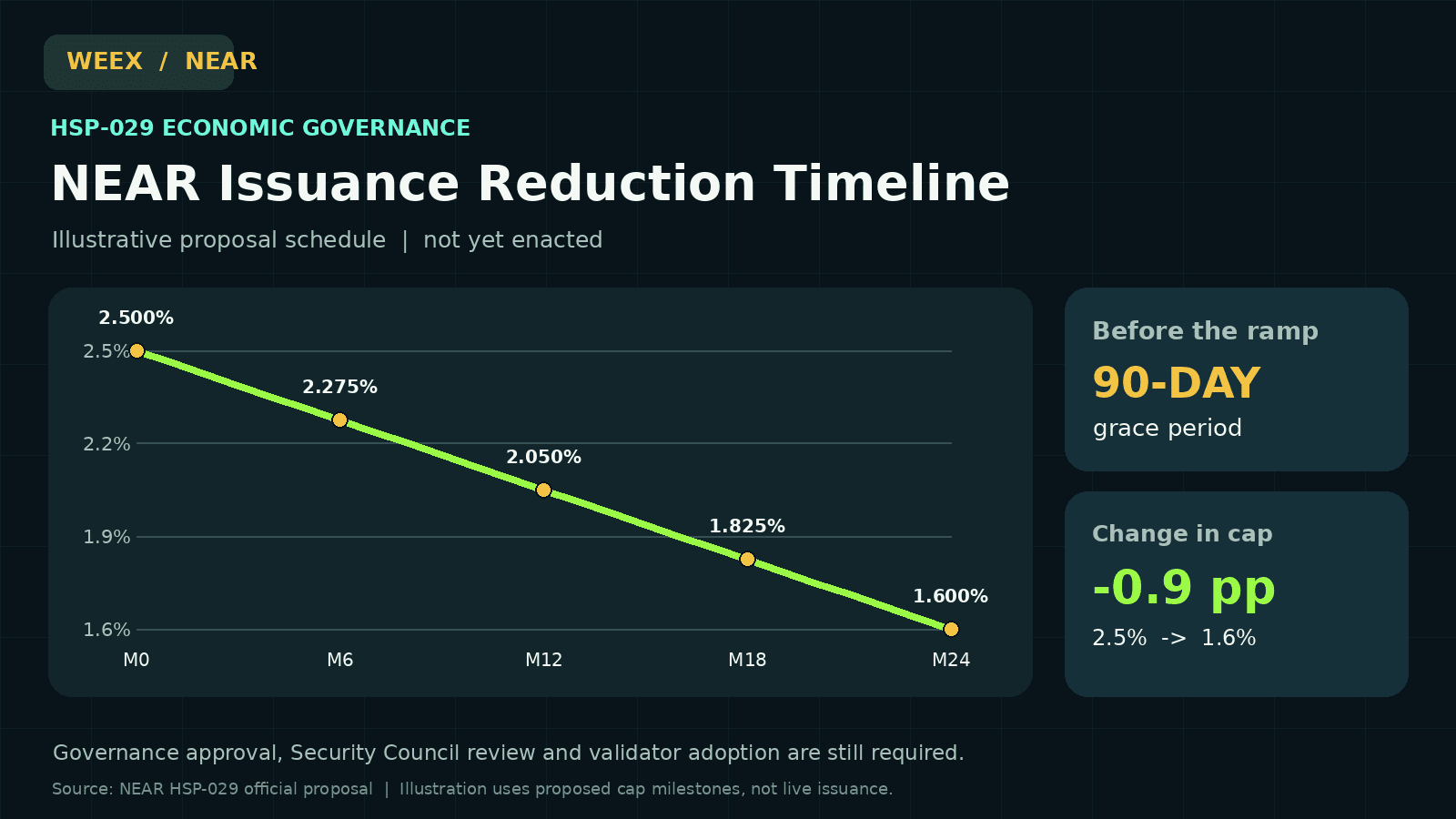
The proposal represents a 36% relative reduction in the maximum annual issuance rate, but it does not call for an immediate supply cut or the destruction of existing tokens. Instead, it proposes a gradual adjustment over 24 months following a 90-day grace period.
For investors following NEAR HSP-029, the central question is whether slower supply growth could improve the network's long-term tokenomics without weakening incentives for validators and stakers.
In this article, we examine the proposal's economic assumptions, its potential effect on staking rewards, the governance process and the implications for the NEAR price. We also explain how users can access the NEAR/USDT spot market on WEEX.
What Is the NEAR HSP-029 Governance Proposal?
HSP-029 is an economic governance proposal submitted to NEAR's House of Stake by Sal Ternullo of SVRN on October 7, 2026.
According to the official NEAR governance proposal, the plan would lower the protocol's maximum annual issuance rate from 2.5% to a target of 1.6%.
Rather than introducing a new monetary system, the proposal focuses on changing a single issuance parameter. The existing allocation of newly issued tokens would remain approximately 90% for staking participants and 10% for the protocol treasury.
The proposal does not establish a new spending program, introduce a separate emissions mechanism or redistribute existing token balances.
How Much Would NEAR Issuance Decline?
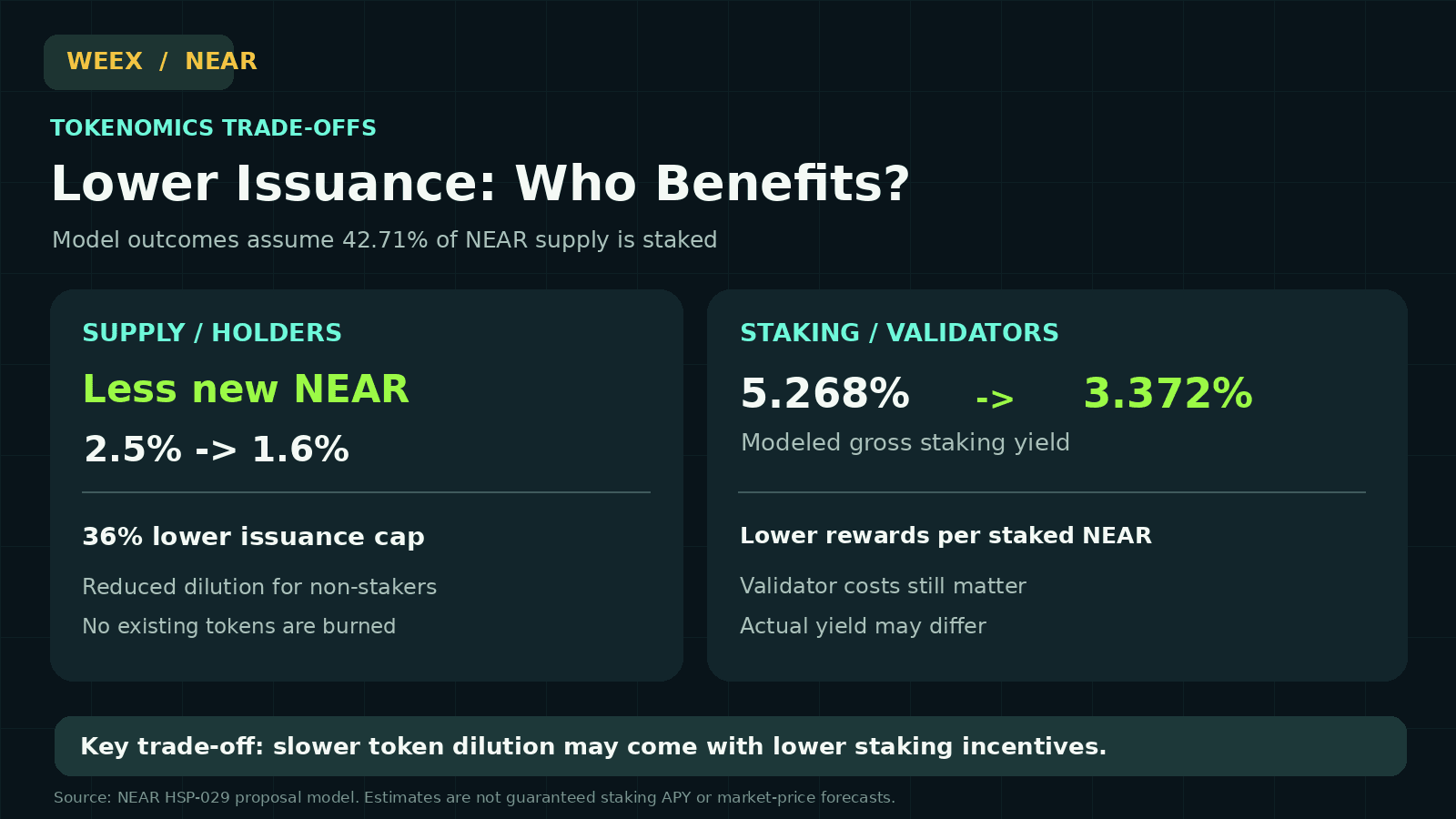
The difference between 2.5% and 1.6% is 0.9 percentage points, equivalent to a 36% reduction relative to the current maximum issuance rate.
Under the proposal's reference assumptions, daily issuance would decrease from approximately 89,517 NEAR to 57,291 NEAR after the full adjustment.
The proposal also estimates that the new schedule could avoid approximately 11.8 million NEAR in issuance over two years and 66.1 million NEAR over six years compared with maintaining the existing rate.
These figures are model projections, not tokens that have already been removed from circulation. Actual future supply will depend on the implemented protocol rules and network conditions.
When Would the New Issuance Rate Take Effect?
Even if the governance proposal is approved, the maximum issuance rate would not immediately fall to 1.6%.
The proposed process includes several stages:
- Governance approval: The House of Stake proposal must complete the relevant decision process.
- Additional review and validator adoption: Network stakeholders must coordinate the required protocol upgrade.
- 90-day grace period: The network would retain the existing issuance parameters during a transition period.
- 24-month adjustment: The maximum annual issuance rate would decline gradually until reaching the proposed 1.6% target.
The distinction between voting and implementation is important. A governance decision can authorize a change, but the new monetary parameters only become effective after the necessary implementation steps.
Why Does NEAR Want to Reduce Token Issuance?
The main objective of HSP-029 is to reduce long-term supply dilution while maintaining incentives for network security.
In proof-of-stake networks, newly issued tokens help compensate participants who stake assets and validators who maintain network operations.
However, continued issuance also increases the total token supply. Holders who do not stake may see their proportional ownership of the network diluted as additional tokens are created.
A lower issuance rate would slow that process.
Reducing Dilution for NEAR Holders
Under the existing issuance framework, new tokens enter circulation over time through protocol rewards.
For holders who do not stake, this additional supply can reduce their percentage ownership of the total token supply, even if their wallet balance remains unchanged.
By reducing maximum annual issuance, HSP-029 aims to limit the rate of dilution.
This is different from a token burn. A lower issuance rate means fewer new tokens would be created under the revised schedule; it does not remove tokens already held by users.
Creating a More Predictable Tokenomics Model
HSP-029 also emphasizes a predictable, gradual schedule.
Instead of changing issuance abruptly, the proposal would adjust the parameter over a two-year period. This is intended to give validators, staking services, exchanges and other participants time to adapt.
A predictable issuance schedule may help participants understand the network's future supply mechanics.
However, predictable supply growth alone does not determine a cryptocurrency's market valuation. Demand, network usage and the broader investment environment remain important.
Balancing Token Supply and Network Security
Lower issuance can benefit non-staking holders by reducing dilution, but newly issued tokens also fund staking incentives.
That creates a trade-off.
If rewards decline too far, some validators may find operating infrastructure less economically attractive. In a proof-of-stake network, validator participation is an important component of security and decentralization.
The challenge for NEAR is therefore to lower unnecessary issuance without making it significantly more difficult for validators to sustain their operations.
How Would HSP-029 Affect NEAR Staking Rewards?
Lower issuance generally means fewer newly created NEAR tokens are available to distribute as staking rewards.
The HSP-029 proposal includes a model illustrating how this could affect gross staking yields over the proposed 24-month adjustment period.
Using a measured staking participation rate of 42.71%, the proposal estimates that gross staking yield could decrease from approximately 5.268% to 3.372% by the end of the adjustment.
The model provides the following reference points:
| Adjustment Period | Maximum Annual Issuance | Modeled Gross Staking Yield |
|---|---|---|
| Starting rate | 2.500% | 5.268% |
| Month 6 | 2.275% | 4.622% |
| Month 12 | 2.050% | 4.320% |
| Month 18 | 1.825% | 3.847% |
| Month 24 | 1.600% | 3.372% |
Source: HSP-029 proposal model. Estimates assume a constant staking participation rate and should not be treated as guaranteed future APY.
Does Lower Issuance Mean Every Staker Earns Less?
Not necessarily by the same amount.
Individual staking returns can vary depending on validator commissions, network participation, validator performance and other conditions.
For example, when a larger proportion of the network's supply is staked, rewards are distributed among more staked tokens. Changes in participation can therefore influence the yield available to each staked token.
The HSP-029 figures provide a model for evaluating the proposed policy rather than a fixed prediction of every user's future return.
What Are the Risks for Smaller Validators?
One concern raised during the governance discussion is whether lower staking rewards could make it harder for smaller validators to cover operating costs.
Validators must maintain infrastructure and meet network requirements. Their revenue can depend on commissions, delegated stake and rewards earned from their own staked tokens.
The proposal's analysis indicates that some smaller operators could lose economic self-sufficiency under the lower issuance schedule.
Critics have also questioned whether the proposal sufficiently accounts for changes in staking participation, treasury funding and validator diversity.
In a public response on the NEAR governance forum, validator organization Everstake called for additional analysis of network security and the potential consequences for smaller validators.
These concerns do not automatically invalidate the proposal, but they show why a tokenomics reform must be evaluated beyond its effect on supply growth.
-- Price
Could the NEAR Issuance Reduction Push NEAR Price Higher?
The possibility of slower token supply growth may attract interest from cryptocurrency investors, particularly those who evaluate tokenomics when comparing blockchain projects.
If demand for NEAR remains stable or increases while the rate of newly issued supply declines, the change could support a more favorable supply-demand balance than the existing issuance schedule.
However, a lower issuance rate does not guarantee a higher NEAR price.
The relationship between token supply and market value is influenced by several additional factors.
Supply Growth Is Only One Part of the Equation
Reducing annual issuance limits the creation of new tokens relative to the current policy.
But a cryptocurrency's price depends on the interaction between available supply and market demand.
Demand may be affected by network activity, developer adoption, ecosystem applications, institutional interest and broader market liquidity.
If demand weakens substantially, a lower issuance rate may not be sufficient to prevent a price decline.
Staking Participation Could Change
Lower rewards may influence how holders decide to allocate their NEAR.
Some participants might continue staking because of their long-term involvement in the network. Others may reconsider the opportunity cost of locking tokens if alternative uses become more attractive.
Changes in staking participation could alter the supply available in liquid markets and affect the network's economic structure.
The effects are difficult to predict because staking decisions also depend on NEAR's market price, validator commissions and ecosystem developments.
Market Sentiment and Broader Crypto Conditions
NEAR trades within a broader cryptocurrency market affected by Bitcoin movements, changes in liquidity, investor risk appetite and macroeconomic developments.
A positive governance outcome may attract attention, but a short-term price reaction does not necessarily reveal the proposal's long-term economic consequences.
Similarly, a negative market reaction would not automatically mean the supply reform had failed.
For investors evaluating the NEAR price outlook, it is more useful to monitor governance execution, staking participation, actual network issuance and ecosystem demand together.
What Happens After the NEAR HSP-029 Vote?
The HSP-029 vote is scheduled to close on November 2, 2026, at 16:48 UTC.
The final outcome should be checked through the official House of Stake governance page, rather than inferred from preliminary vote counts or market reactions.
If the proposal receives the required approval, the network would still need to complete the additional review and validator upgrade process before the revised issuance schedule could become active.
If the Proposal Is Approved
Approval would provide a basis for progressing toward implementation.
The relevant stakeholders would need to coordinate the upgrade, confirm the activation process and observe the transition period before the issuance rate begins its gradual decline.
Market participants should distinguish the approval date from the date when the protocol parameter actually changes.
If the Proposal Is Rejected or Delayed
If HSP-029 does not receive the necessary approval, the proposed reduction would not proceed under its current terms.
The network could continue operating under its existing issuance framework while stakeholders consider alternative proposals.
A delayed or unsuccessful vote would not necessarily end discussions about NEAR tokenomics, validator incentives or long-term supply policy.
Key Indicators to Monitor
The most useful follow-up indicators include the final governance result, validator upgrade adoption, the effective issuance schedule and changes in staking participation.
Observers may also evaluate whether the network maintains sufficient validator diversity as the economics evolve.
Together, these measures provide a more complete assessment of HSP-029 than NEAR price movements alone.
What Is NEAR Protocol, and Why Does Its Tokenomics Matter?
NEAR Protocol is a layer-1 blockchain designed to support decentralized applications and blockchain-based services.
Its ecosystem includes infrastructure for developers, staking participation and applications that interact with digital assets and multiple blockchain networks.
NEAR is the network's native token. It is used in the ecosystem for purposes that include transaction fees and participation in staking-related activities.
Tokenomics refers to the rules governing a cryptocurrency's supply, issuance, distribution and incentives.
For proof-of-stake networks, tokenomics is closely connected to validator economics because newly issued tokens can help finance the participants responsible for network operations.
The HSP-029 proposal reflects NEAR's effort to reassess that balance as its ecosystem develops.
A reduction in maximum issuance may improve the supply outlook for non-staking holders, but the longer-term outcome also depends on whether the network continues to attract users, applications and economically sustainable validators.
How to Buy NEAR on WEEX
Users following the NEAR HSP-029 governance vote may also want to understand how NEAR spot trading works.
WEEX provides a NEAR/USDT spot market, where eligible users can exchange USDT for NEAR under the platform's trading rules.
The following steps explain the standard spot trading process.
Step 1: Create or Log In to Your WEEX Account
Visit WEEX and sign in to your account.
New users should complete any required registration and identity verification procedures. Before using the trading service, confirm that the relevant product is available in your region and that your account meets the applicable conditions.
Step 2: Prepare USDT for Spot Trading
Check your available USDT balance in the appropriate account.
If you need to transfer funds to WEEX, review the supported deposit networks and carefully confirm the receiving address before making a transaction.
Available purchase or deposit methods may differ depending on your location and account eligibility.
Step 3: Open the NEAR/USDT Spot Market
Navigate to the NEAR/USDT spot trading page on WEEX.
The trading interface provides access to the relevant market information, including the order entry panel and available trading options.
Before placing an order, review the quoted price, market liquidity and trading conditions.
Step 4: Choose a Market or Limit Order
A market order attempts to buy NEAR using the best available sell orders in the order book. It prioritizes execution but may experience slippage during volatile market conditions.
A limit order allows you to specify the maximum price you are willing to pay. The order will execute only if matching liquidity becomes available at the specified price or better.
For a more detailed explanation, read the WEEX Learn article on market orders versus limit orders.
Step 5: Review and Confirm the Trade
Enter the intended order amount and review the estimated total, applicable trading fees and order details.
If you decide to proceed, submit the order and monitor its status through the trading interface.
After execution, the resulting NEAR balance can be checked in the relevant asset section.
Spot trading involves purchasing or selling the underlying digital asset available on the market. It is different from opening a leveraged perpetual futures position, although both products involve market risk.
Conclusion
The NEAR HSP-029 proposal represents a potentially significant change to the network's long-term monetary policy.
By proposing a reduction in maximum annual token issuance from 2.5% to 1.6%, the reform aims to slow supply dilution and establish a more predictable issuance schedule.
However, lower issuance also means lower newly created staking rewards under the proposal's model, creating important questions about validator economics and network security.
For the NEAR price outlook, the supply-side implications are worth monitoring, but they do not guarantee a positive market reaction. Demand, liquidity, staking participation and broader market conditions remain essential factors.
The next important developments are the final governance result, the required implementation steps and any subsequent changes to the network's issuance and staking metrics.
As NEAR continues to develop its tokenomics framework, the balance between sustainable supply growth and effective network incentives will remain central to the discussion.
FAQ
1. What Is the NEAR HSP-029 Proposal?
NEAR HSP-029 is a governance proposal to reduce the network's maximum annual token issuance rate from 2.5% to 1.6% over a 24-month adjustment period following a 90-day grace period. The proposal aims to lower supply dilution while retaining the existing allocation of newly issued tokens between staking participants and the treasury.
2. When Does the NEAR HSP-029 Vote End?
The vote is scheduled to close on November 2, 2026, at 16:48 UTC. Users should verify the final result through the official House of Stake governance interface, as approval and actual protocol implementation are separate stages.
3. Will NEAR Staking Rewards Decrease if HSP-029 Passes?
The proposal's model estimates that gross staking yield could decline from approximately 5.268% to 3.372% over the full adjustment period, assuming a constant staking participation rate of 42.71%. Actual returns will depend on network conditions, validator commissions and other factors.
4. Will Reducing NEAR Inflation Increase NEAR Price?
Not necessarily. Lower issuance could reduce future supply dilution, but the NEAR price also depends on demand, ecosystem growth, trading liquidity and broader cryptocurrency market conditions. HSP-029 does not guarantee a price increase.
5. How Can Beginners Buy NEAR on WEEX?
Eligible users can access the NEAR/USDT spot market on WEEX, prepare a USDT balance, choose a market or limit order and review the transaction before confirming it. Users should understand trading fees, slippage and market risk before placing an order.
This content is provided for general informational purposes only and doesn't constitute financial, investment, legal, or tax advice. Any events, rewards, online promotions, or related information mentioned herein should not be considered a recommendation, solicitation, or invitation to purchase, sell, trade, or otherwise deal in any crypto assets. Crypto assets are highly volatile and may result in loss. The availability of WEEX services, products, and related events may vary by region. You are responsible for ensuring that your participation is in accordance with applicable local laws and regulations.
You may also like
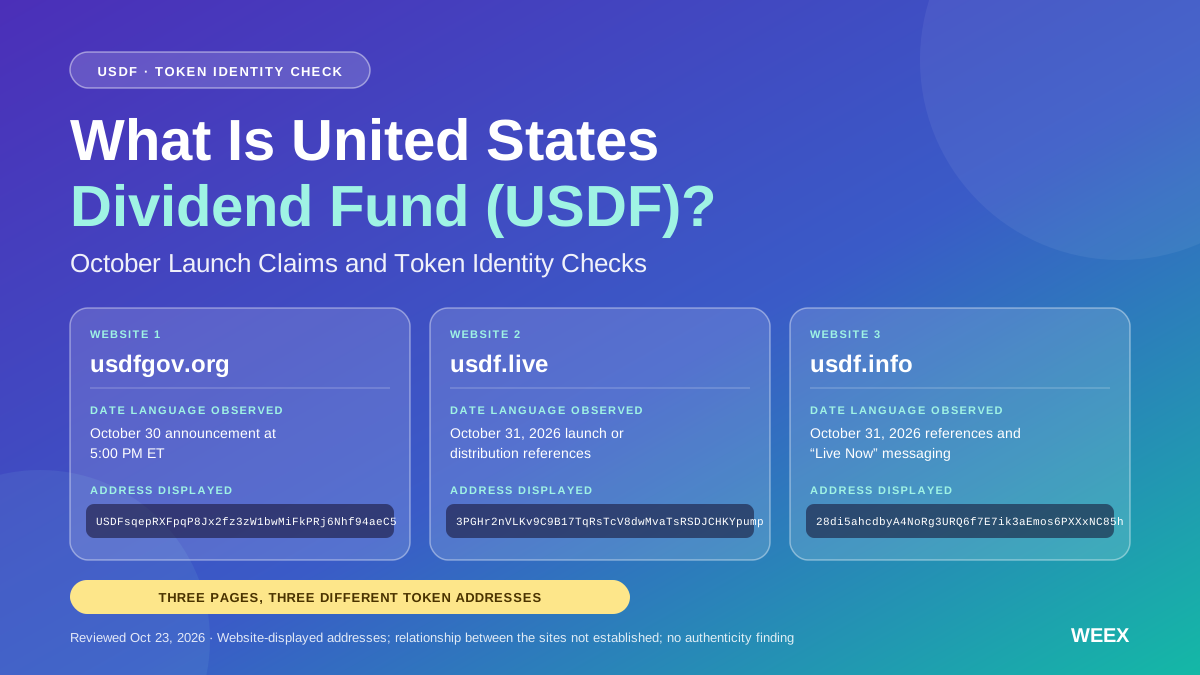
What Is United States Dividend Fund (USDF)? October Launch Claims and Token Identity Checks
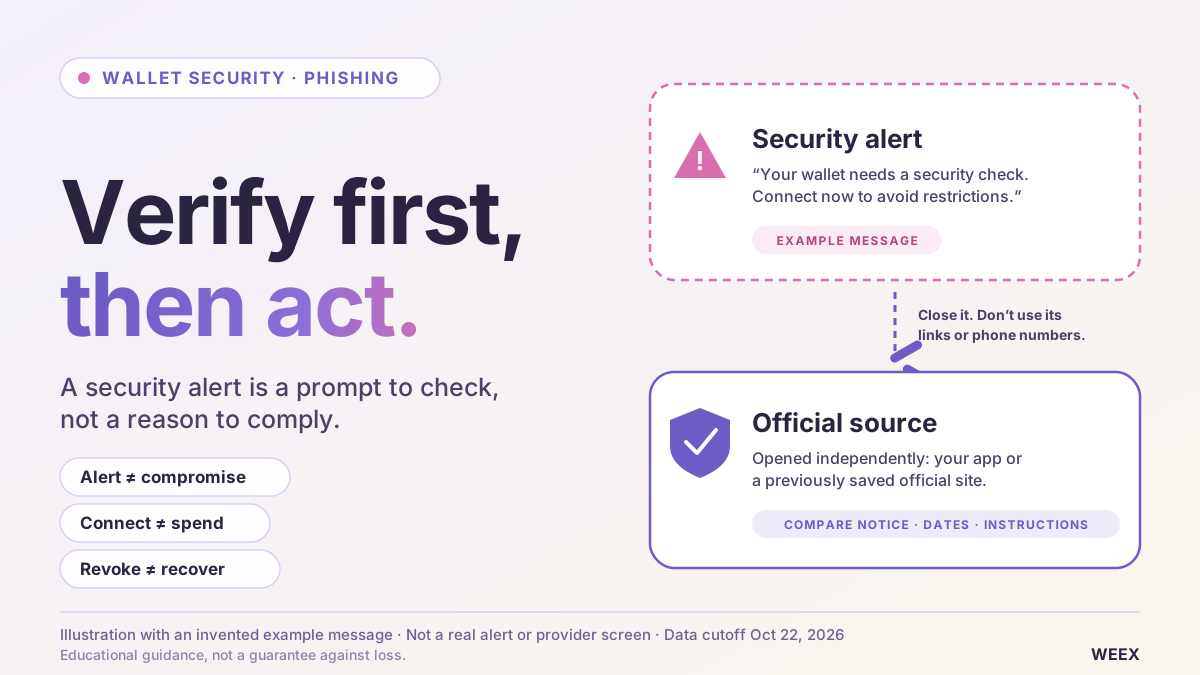
Is Your Crypto Wallet Safe? How to Verify Security Alerts and Spot Phishing
What Is HeyElsa (ELSA) Crypto and How Does It Work?
Best Crypto Leverage Trading Platform: Things to Compare Before You Choose an Exchange
Is RSI a Good Indicator? How the Relative Strength Index Works, Its Limits and How Traders Use It
Bitcoin Price After Hot CPI: Why BTC Is Pinned Near $82,000
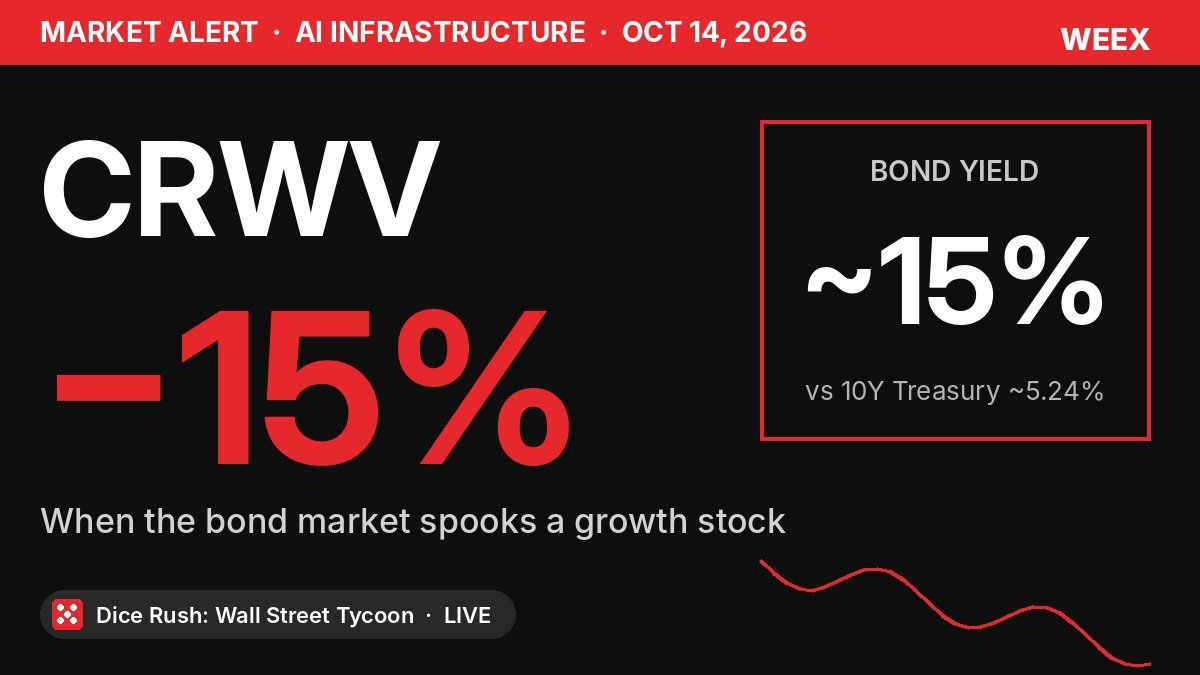
CoreWeave Stock Plunges 15%: Why a Bond Yield Spooked CRWV
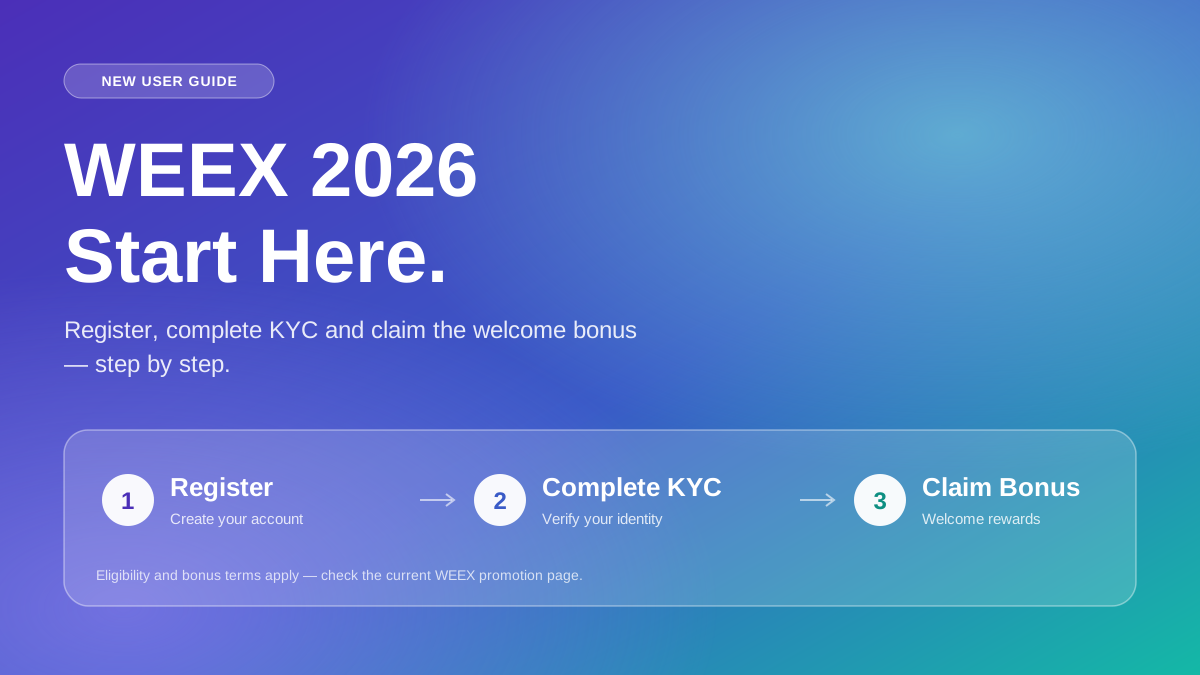
WEEX 2026 New User Guide: Register, Complete KYC, and Claim the Welcome Bonus (Step-by-Step)

WEEX Convert Guide: How to Swap Crypto on Web and App and What the Quote Really Means
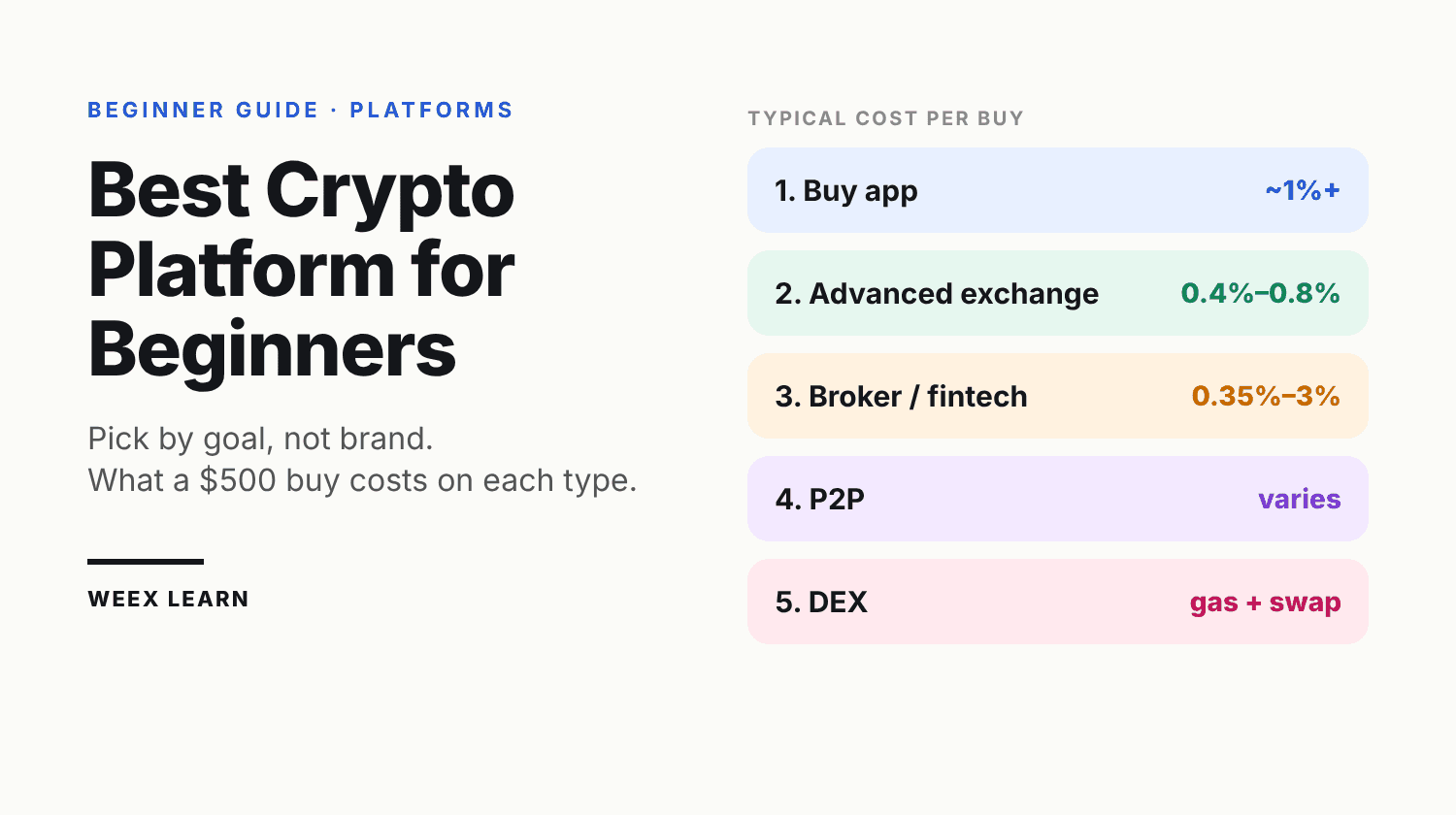
Best Crypto Platform for Beginners: Pick by Goal, Not Brand
Best Cold Wallet Crypto for Beginners: 5 Picks Under $150

Best Crypto Broker for Beginners: What to Check in Fees, Regulation, Security and Support Before You Deposit
Best Crypto Wallet for Beginners 2025: Pick by What You Will Do
Crypto Funding Rate: Who Pays, What It Costs, What It Signals

How to Use an APR Boost on WEEX Auto Earn Without Wasting It
Anonymous Crypto Wallet: What Each One Hides and Where It Fails
What Is a Blockchain Node? Types, 2026 Counts, and Real Costs
Taiwan Stock Market Nears 50,000: Can the TAIEX Break the Milestone After the Holiday?
How to Buy USDT in Thailand: Payment Methods, Fees and Transfer Checks
WEEX Broker Models: Strategy Bots, Copy Trading and Sub-Exchanges
WEEX API Key Setup: How to Connect a Third-Party Platform Safely

How to Become a WEEX Broker: Application, API Setup and Go-Live
What Is WEEX Broker? API Program, Commissions and How It Works
What Is Orca (ORCA) Crypto? The Solana DEX, USDY Liquidity, and the ORCA Name Confusion
WEEX TOKEN2049 Day 1 Live Preview: Booth, MBTI and AI Demo
RSI Indicator Settings: What 7, 9, 14 and 21 Did on BTC Charts
Best Crypto Apps for Beginners: The Five Features That Actually Matter on Your Phone
Stock Market Crash Risk in 2026: The Warning Signs Worth Watching
What Is Blockchain and How Does It Work? A Transaction Traced
How to Buy Crypto with PayPal: The Custody Catch Most Beginners Miss
What Is United States Dividend Fund (USDF)? October Launch Claims and Token Identity Checks
Is Your Crypto Wallet Safe? How to Verify Security Alerts and Spot Phishing
What Is HeyElsa (ELSA) Crypto and How Does It Work?
Best Crypto Leverage Trading Platform: Things to Compare Before You Choose an Exchange
Is RSI a Good Indicator? How the Relative Strength Index Works, Its Limits and How Traders Use It
Bitcoin Price After Hot CPI: Why BTC Is Pinned Near $82,000





