
What Is Blockchain and How Does It Work? A Transaction Traced

 Prefer us on Google


A blockchain is a shared digital ledger that thousands of independent computers keep identical copies of, where new records are bundled into blocks and each block is locked to the one before it with cryptography. That's the short answer to "what is blockchain and how does it work." The longer answer is easier to grasp by watching one payment move through the system — so this guide follows a single transfer from the moment you press "send" to the point where reversing it becomes practically impossible, then compares how Bitcoin, Ethereum, and Solana handle the same job.
Blockchain in One Paragraph
Think of a spreadsheet that no single company owns. Everyone running the software holds a full copy. Anyone can propose a new row, but rows are only added in batches (blocks), and a batch is only accepted if the network agrees it follows the rules. Each block carries a fingerprint — a hash — of the previous block, so changing an old record would change its fingerprint and break every block after it. That chaining is where the name comes from, and it's why blockchain records are treated as tamper-evident.
Three properties fall out of that design:
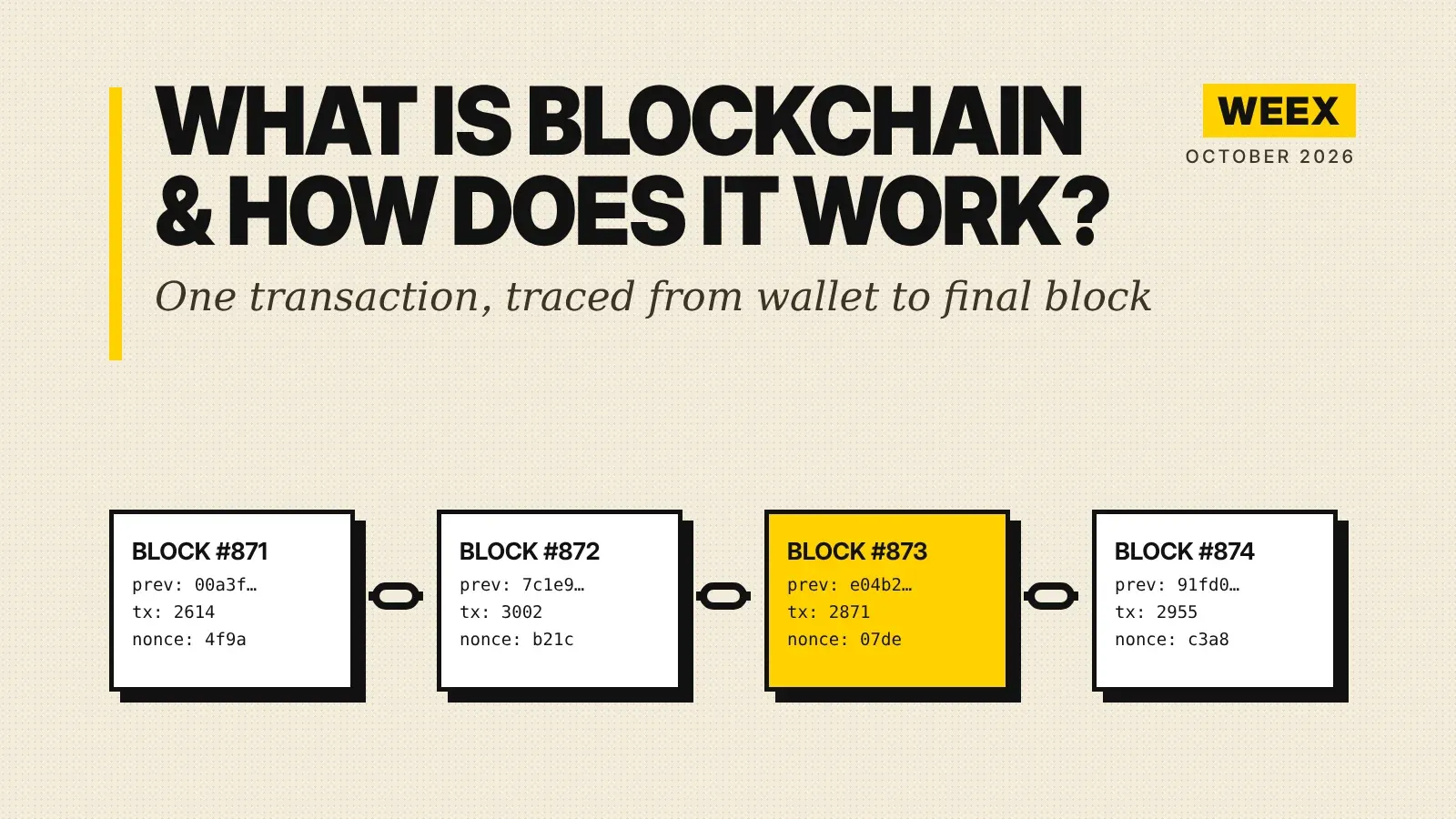
- No central operator. Nodes check each other's work instead of trusting a bank or server.
- Append-only history. You can add records, but rewriting old ones would require redoing the network's work or controlling most of its stake.
- Public verifiability. On public chains like Bitcoin and Ethereum, anyone can download the history and check every balance.
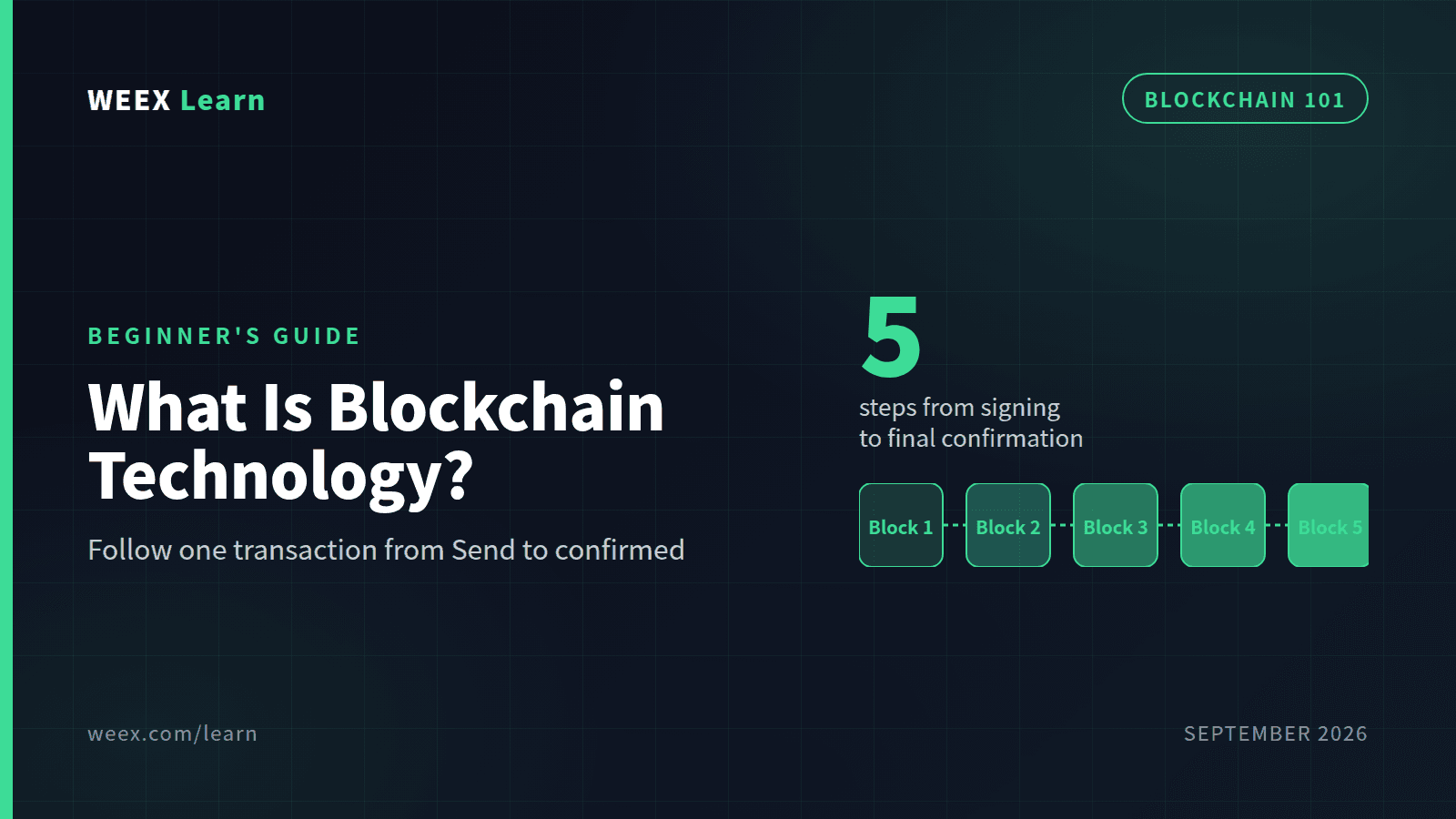
How Blockchain Works: One Transaction, Six Steps
Say you send 0.01 BTC to a friend. Here's what happens.
- You sign the transaction. Your wallet builds a message — "move these coins to this address" — and signs it with your private key. The signature proves you own the coins without revealing the key.
- It's broadcast to the network. Your wallet sends the signed transaction to a few nodes, which pass it to their peers. Within seconds, thousands of nodes have a copy.
- Nodes check it. Each node verifies the signature, confirms the coins haven't already been spent, and checks the fee. Valid transactions wait in a holding area called the mempool.
- A block producer picks it up. On Bitcoin, miners pick transactions (usually highest fee first), bundle them into a candidate block, and race to find a hash below the network's difficulty target. That race is proof of work.
- The block is added and shared. The winning miner broadcasts the block. Other nodes verify every transaction and the proof, then append it to their copy. The miner collects the block reward — 3.125 BTC since the April 2024 halving — plus fees.
- Confirmations pile up. Each new block built on top makes your transaction harder to reverse. Many exchanges wait for several confirmations before crediting large Bitcoin deposits.
Notice what never happened: no bank approved the payment, and no one could block it as long as it followed the rules and paid a competitive fee.
Proof of Work vs. Proof of Stake: How Blocks Get Agreed
Step 4 is where blockchains differ most. The job is the same — decide who adds the next block and make cheating expensive — but the cost is paid in different ways.
Proof of work (Bitcoin) makes miners spend real electricity. Rewriting history means redoing that work faster than the rest of the network combined, which is economically out of reach on a chain Bitcoin's size. Bitcoin retunes difficulty every 2,016 blocks to keep the average block time near ten minutes.
Proof of stake (Ethereum since September 2022) has validators lock up capital — 32 ETH per validator — instead of burning energy. Validators who sign conflicting blocks can have part of their stake destroyed ("slashed"). The cost of cheating is the capital at risk rather than the electricity spent.
Neither is "better" in every sense. Proof of work has the longer security record; proof of stake uses far less energy and settles faster.
-- Price
How Long a Blockchain Transaction Takes to Settle
The same transfer feels very different depending on the chain. Approximate figures under normal conditions:
- Bitcoin: a new block roughly every 10 minutes. One confirmation is often enough for small amounts; around six confirmations (about an hour) is a common bar for large sums.
- Ethereum: a slot every 12 seconds, so inclusion is quick. Formal finality — where reversing a block would require destroying a huge amount of staked ETH — arrives after two epochs, roughly 13 minutes.
- Solana: slots of about 400 milliseconds, so transactions show up almost instantly; stronger finality follows within seconds.
The trade-off is visible here. Faster chains usually ask more of their validators' hardware, which tends to mean fewer people can run a node. Slower chains keep node requirements low, which keeps verification widely distributed.
What Blockchain Can't Do
Most explainers stop at the benefits. A few limits matter just as much:
- It can't verify the real world. A blockchain proves a record wasn't changed after it was written — not that it was true when written. Supply-chain or property records are only as honest as whoever enters them.
- It isn't anonymous by default. Bitcoin and Ethereum are pseudonymous. Every transfer is public, and addresses can often be linked to people.
- Mistakes are hard to undo. Send to the wrong address and there's no customer service to reverse it.
- Code can fail. Programs that run on blockchains — smart contracts — execute exactly as written, bugs included. Many large crypto losses came from contract flaws rather than broken chains.
Why Blockchain Matters Beyond Cryptocurrency
Money was the first use case because it's the clearest test: two strangers settle value without trusting each other or a middleman. The same design now underpins stablecoins, tokenized stocks and bonds, and on-chain lending. The pattern to watch is simple — blockchain earns its place where several parties need one shared record and none of them wants another to control it. Where one trusted party already exists, an ordinary database usually wins.
To see the two largest blockchains in action, check the live Bitcoin price and network overview and the Ethereum page on WEEX. Watching how each asset trades is a practical next step once you understand what blockchain is and how it works underneath.
FAQ
1. What is blockchain in simple words?
A blockchain is a shared record book copied across many computers. New entries are added in linked batches called blocks, and changing old entries would break the links, so tampering is easy to spot.
2. Who controls a blockchain?
On public blockchains, no single party. Rules are enforced by software that thousands of independent nodes run, and changes need broad agreement from developers, node operators, and miners or validators.
3. Can a blockchain be hacked?
Attacking the ledger of a large chain like Bitcoin is extremely costly. Most losses come from weaker points around it — stolen keys, phishing, exchange breaches, and buggy smart contracts.
4. Is blockchain the same as Bitcoin?
No. Bitcoin is one cryptocurrency that runs on its own blockchain. Blockchain is the underlying technology, also used by Ethereum, Solana, and thousands of other networks.
This content is provided for general informational purposes only and doesn't constitute financial, investment, legal, or tax advice. Any events, rewards, online promotions, or related information mentioned herein should not be considered a recommendation, solicitation, or invitation to purchase, sell, trade, or otherwise deal in any crypto assets. Crypto assets are highly volatile and may result in loss. The availability of WEEX services, products, and related events may vary by region. You are responsible for ensuring that your participation is in accordance with applicable local laws and regulations.
You may also like
Stock Market Crash Risk in 2026: The Warning Signs Worth Watching
How to Buy Crypto with PayPal: The Custody Catch Most Beginners Miss
What Is STOCKER? Stockereum, Stock-Paired Meme Tokens, and Risks
XRP Upgrade Update: XRPL Batch Slips to Oct 9 and What Changes

What Is Coinbase Wrapped HYPE (cbHYPE)? How It Works on Base, 1:1 Backing, Risks, and HYPE Conversion
Is QNT a Stock or Crypto? Quant (QNT) and Quantinuum Stock Are Not the Same Asset
No KYC Crypto Wallet: 6 Picks and 5 Places Your ID Still Leaks
What Is Quant (QNT) Crypto? How Overledger Works, QNT Utility, and Token Supply Explained
Best Decentralized Crypto Wallet for Beginners: What Self-Custody Really Asks of You
Does a Negative Funding Rate Mean a Short Squeeze Is Coming?

Best Crypto Exchange for Beginners 2026: What Actually Matters When Choosing One

Best Crypto Cold Wallet 2026: Top Picks Matched to How You Hold
How to Connect Phantom Wallet to a Solana DApp
How to Install and Set Up Phantom Wallet
Funding Rate Crypto: What BTC and ETH Are Paying Right Now

INTC Stock Surged 14%: Intel Only Has Enough Chips for Half Its Clients
XPL Unlock on Sept 25: How to Long or Short Plasma Futures Safely
Bitcoin Funding Rate After a $648M Short Squeeze: What Longs Pay
What Is Blockchain Technology? Follow One Transaction to See
How Does Mining Actually Work on Pi Network?
What Is Pi Network? A Complete Beginner's Guide
How to Look Up a Wallet Address and Transaction History
Funding Rate Explained: How Perpetual Futures Fees Hit Your PnL

PENGU Airdrop on WEEX: Get 10 USDT in PENGU Before October 6
BTC Futures Trading on WEEX: Claim BTC Rewards Before Sep 25
What Is a Funding Rate? How Perpetual Futures Charge Longs and Shorts
How Does WEEX KYC Verification Work? A Taiwan User Guide
Macro Protocol (MTP): Listing Status and a Safe Verification Guide
Lumentum (LITE) Perpetual Futures: Why 25x Leverage Is the Limit
Lisk Chain Shutdown October 31: How to Move LSK Safely
Stock Market Crash Risk in 2026: The Warning Signs Worth Watching
How to Buy Crypto with PayPal: The Custody Catch Most Beginners Miss
What Is STOCKER? Stockereum, Stock-Paired Meme Tokens, and Risks
XRP Upgrade Update: XRPL Batch Slips to Oct 9 and What Changes
What Is Coinbase Wrapped HYPE (cbHYPE)? How It Works on Base, 1:1 Backing, Risks, and HYPE Conversion
Is QNT a Stock or Crypto? Quant (QNT) and Quantinuum Stock Are Not the Same Asset




