
55 million ZETA to be destroyed, ZetaChain continues to operate after shutdown announcement

 Prefer us on Google


Original |Odaily Planet Daily ( @OdailyChina )
*Author |Golem ( @web3_golem )*
The date and specific mechanism for migrating ZETA to Solana have finally been established. On November 7, the ZetaChain community passed the second governance proposal regarding the migration of ZETA to Solana with 100% approval.
The proposal indicates that ZetaChain L1 will officially cease operations at block height 20,755,000 (expected around December 9, 2026), and staking rewards will stop at the same snapshot height. ZetaScan will remain available and provide a read-only RPC archive node, running until October 31, 2027.
On the same day, users can claim ZETA on Solana at a 1:1 ratio on ZetaHub, with no deadline and no fees (including SOL); a single signature is all that is needed for a successful migration. The ZETA balance in exchanges will be converted by the exchanges without any action required from users.
Meanwhile, on December 9, ZetaChain's private AI product focused on the crypto field, ZetaLabs, will also launch.
ZetaLabs will extend ZetaChain's interoperability concept into the AI field, integrating AI large models, contextual memory, proxy payments, and real-time market data sources into one platform while keeping user data encrypted. According to official disclosures, over 120,000 users have already joined the waiting list, indicating strong community anticipation for the product.
Previously, Odaily Planet Daily analyzed why shutting down L1 would be beneficial for ZetaChain (Related reading: "Why Shutting Down L1 Would Be Beneficial for ZetaChain?"). The improvement in ZETA token economics, combined with the launch of the new product ZetaLabs, makes the transformed ZetaChain impossible for the market to ignore.
ZETA Achieves Deflation, Value Capture Logic Upgraded from "Gas" to "Token"
Destroying 55 million ZETA, official commitment not to sell newly unlocked tokens in 2027
According to the second governance proposal for migrating ZETA to Solana, the total supply of ZETA tokens will be reduced after the migration is completed, with approximately 55 million ZETA to be destroyed from the base of 2.1 billion.
The token destruction comes from the validator incentive distribution (which accounts for 10% of the total supply, i.e., 210 million ZETA). Since ZetaChain L1 is about to be completely shut down, there will no longer be incentives for network validators. By the time ZetaChain L1 officially shuts down, the issuance of validator tokens will be approximately 155 million, so the remaining 55 million ZETA that have not been issued will be destroyed.
After the migration, these 55 million ZETA will be stored in a destruction reserve controlled by the ZetaChain Foundation on Solana and will be destroyed monthly starting in 2027, with one-twelfth (approximately 4.6 million ZETA) destroyed each month on fixed dates. By the end of 2027, the total supply of ZETA will be reduced to 2.045 billion (initial supply minus destroyed amount), meaning that from 2027 onwards, ZETA will become a deflationary token.
At the same time, according to the token unlocking plan at ZetaChain's TGE in 2024, all ZETA allocations for core contributors and investors (a total of 44.91 million) will be fully unlocked by January 1, 2027.
ZETA Token Unlocking Schedule
Additionally, ZetaChain officially commits not to sell any newly unlocked ZETA from the foundation in 2027 (from user growth pools, ecosystem growth funds, protocol treasury, and liquidity incentives), further reducing the circulation of ZETA in the market.
Upgrading from Gas Value to Token Value
After the migration is completed, the utility of the ZETA token will undergo significant changes.
In the past, ZETA existed as the Gas fee for the ZetaChain L1 network, capturing the value of network activity and ecological development, relying solely on staking incentives to reduce market sell pressure. The fragility of this token value capture logic lies in the fact that once network activity is low or the ecosystem is sluggish, users' willingness to hold ZETA declines, leading to a drop in the token's value, which in turn reduces investors' willingness to stake, trapping ZETA's value in a "death spiral".
After the migration is completed, this situation will change, and the value capture logic of ZETA will upgrade from "blockchain Gas" to a token with actual utility value as an "AI product Token".
Starting from the first quarter of 2027, users will be able to use ZetaLabs Premium without paying, simply by locking ZETA, which still belongs to the users; in addition to supporting USDC stablecoin and bank card purchases for AI credits, users can also choose to pay with ZETA tokens; at the same time, ZETA will continue to serve as the governance token for ZetaLabs, allowing users to vote with ZETA to decide which markets, data sources, and AI models ZetaLabs will support in the future.
In summary, the future ZETA will have practical value in three aspects: AI membership subscription, Token purchase, and project governance. To access more advanced AI features, users will naturally have a real demand to lock or purchase ZETA, thereby reducing the circulation of ZETA in the market and increasing some actual buying demand.
Of course, the foundation for this new value cycle of ZETA is users' willingness to lock or spend ZETA to use ZetaLabs.
ZetaLabs: A Private AI Assistant Designed for Crypto Users
Currently, there is a wave of using AI Agents in the crypto field, but there is still a significant gap between ordinary AI products and the actual needs of crypto users.
For example, AI cannot timely access real-time market data, struggles to understand users' past on-chain operations, and cannot directly connect to various services in the crypto ecosystem. Users often need to switch back and forth between market platforms, on-chain browsers, AI chatbots, and various trading tools.
The emergence of ZetaLabs is aimed at changing this situation.
ZetaLabs is a private AI application launched by ZetaChain on Solana, specifically designed for crypto users. In addition to integrating multiple AI large models and real-time market data, its biggest feature is connecting users' privacy memories, on-chain behaviors, and market information, allowing AI to not only answer questions but also truly understand the needs of crypto users.
ZetaLabs has better encryption adaptability and aligns more with the usage habits of crypto users. Currently, over 120,000 users have joined the waiting list for ZetaLabs, and once ZetaLabs officially launches, it is expected to deliver impressive results.
Own Context Like Having a Wallet
Privacy is the foundation of ZetaLabs.
Most AI products on the market currently send users' contextual memories to large model vendors, meaning users do not actually own their own "memories". Especially for crypto users, there is a risk of leaking their wallet addresses, asset statuses, and investment strategies.
With ZetaChain's encrypted memory technology, ZetaLabs will encrypt users' chat records, research, and contextual memories, making it impossible for even ZetaChain officials to read this information. When interacting with the AI large model, the model will only receive the minimum information necessary to answer questions, without access to users' entire history.
ZetaLabs also inherits ZetaChain's interoperability concept, turning users' contextual memories into an asset that can be taken anywhere. No AI platform should have the right to revoke, censor, or seize users' contextual memories. ZetaLabs allows users to transfer the same encrypted memory between AI platforms like ChatGPT, Claude, Grok, etc., without leaking any private information.
The memory of ZetaLabs is not limited to users' chat records with AI; ZetaLabs also features a Bloom function that can turn users' on-chain operation records into private memories, encrypted by the users themselves. This means that users' on-chain activities are no longer just scattered transaction records in different blockchain explorers but can become important context for AI to understand users.
For crypto users, whether it is past projects they participated in, on-chain operations they conducted, or long-term trading habits, all can be consolidated through Bloom. AI can thus understand questions by combining users' historical activities instead of starting from scratch with each conversation.
Crypto Radar Provides Real-Time Personalized Information
Another major pain point for crypto users using ordinary AI is that data always has a certain lag and inaccuracy, severely affecting investment decisions. On ZetaLabs, users can ask AI questions about cryptocurrencies, perpetual contracts, prediction markets, stocks, and commodities in plain language, and AI will respond based on real-time market data.
ZetaLabs also comes with a crypto radar that can provide personalized market information in real-time based on users' contextual memories, helping users filter out content related to their areas of interest from a vast amount of market information.
This feature is not simply aggregating market news onto one page but attempts to have AI provide more targeted market information based on users' areas of interest and historical context. Although a general AI Agent could also accomplish this task, it would still require a significant amount of time, tokens, and data for training, which poses a considerable challenge for ordinary crypto users.
At the same time, ZetaLabs supports the x402 protocol, making it easy to integrate with other AI Agents, automatically purchasing on-chain micropayment services as needed, and calling data, APIs, and related capabilities provided by other Agents or service providers.
The Benefits of ZetaChain Will Materialize in 30 Days
On December 9, ZetaLabs will officially launch with the above initial features. In Q1 2027, according to the official roadmap, ZetaLabs will also undergo more upgrades, such as the Premium version releasing in-depth research reports for specific markets, sending any on-chain transaction record to AI for concise analysis, adding tokenized stocks and market sentiment analysis, linking personal contextual memories to more applications, and exploring AI quantitative strategies...
In 30 days, the new token economics of ZETA and the new product narrative will enter the realization phase. From connecting chains in the past to connecting AI now, the story of ZetaChain continues.
-- Price
This content is provided for general informational purposes only and doesn't constitute financial, investment, legal, or tax advice. Any events, rewards, online promotions, or related information mentioned herein should not be considered a recommendation, solicitation, or invitation to purchase, sell, trade, or otherwise deal in any crypto assets. Crypto assets are highly volatile and may result in loss. The availability of WEEX services, products, and related events may vary by region. You are responsible for ensuring that your participation is in accordance with applicable local laws and regulations.
You may also like
Countdown to Migration to Solana: ZetaChain to Launch Financial AI Platform ZetaLabs

ZetaChain token holders approve migration to Solana

ZetaChain Proposes L1 Shutdown Amid Solana Migration, Plans to Burn 55 Million ZETA
ZetaChain Proposes Migration Mechanism and Timeline to Solana

How will ZetaChain advance its new AI layout in the "Great Migration" to the Solana ecosystem?

Layer 1 Faces 'Survival of the Fittest' Era... ZetaChain and Harmony Ride on Solana and Ethereum
Zcash Foundation disowns ZRC-20 and CASH token

ZetaChain, Linera, Switchboard Cease Operations
ZetaChain's AI Application Anuma Surpasses 200,000 Users

ZetaChain Introduces Anthropic's Claude Opus 5, Offers Free Access to ZETA Stakers

AI girlfriend apps generate 427.3 million dollars in consumer spending
The ZetaChain vulnerability was reported in advance by white hats but was ignored, ultimately leading to a $334,000 attack incident
ZetaChain: Previously targeted vulnerability attacks did not result in user fund losses, mainnet patch has been deployed

ZetaChain: Previous targeted attacks did not affect user funds, mainnet patch has been deployed
ZetaChain was attacked, exploiting a vulnerability that may stem from a defect in the GatewayZEVM call function

ZetaChain announced that the GatewayEVM contract has been attacked and cross-chain transactions have been suspended
RootData: ZETA will unlock tokens worth approximately $2.38 million in one week

Ceres Partners with SBI Holdings for Capital and Business Alliance

Sequoia Capital Plans to Invest in AI Holding Group Sequence

Hong Kong pushes for round-the-clock trading of digital assets
AI Startup Quietly Develops Its Own Procurement Chips

Joint Venture Ode Supported by Anthropic's Private Equity Advances AI-Based Fee Model
Startup Voya Energy Proposes Solution to Replace Noisy Diesel Generators in Data Centers

Pony Ma's Latest Internal Speech Exposed! Using AI to Improve Efficiency in Core Business, Exploring AI Native and New Battlefields
Intel and SK Hynix Launch Solution to Break AI Inference Bottleneck
Canaan turns to Bitcoin holdings as mining machine sales fall 96%

Chinese AI Companies Seek to Secure Overseas Nvidia Computing Power Amid Concerns Over US Access Restrictions
a16z: Welcome to the B2A Economy Era! After Decades of Blocking Bots, Companies Now Line Up to Please Them
SK Group Executives Hold Meeting from 12th to 14th to Discuss Semiconductor, AI, and Energy Business Strategies
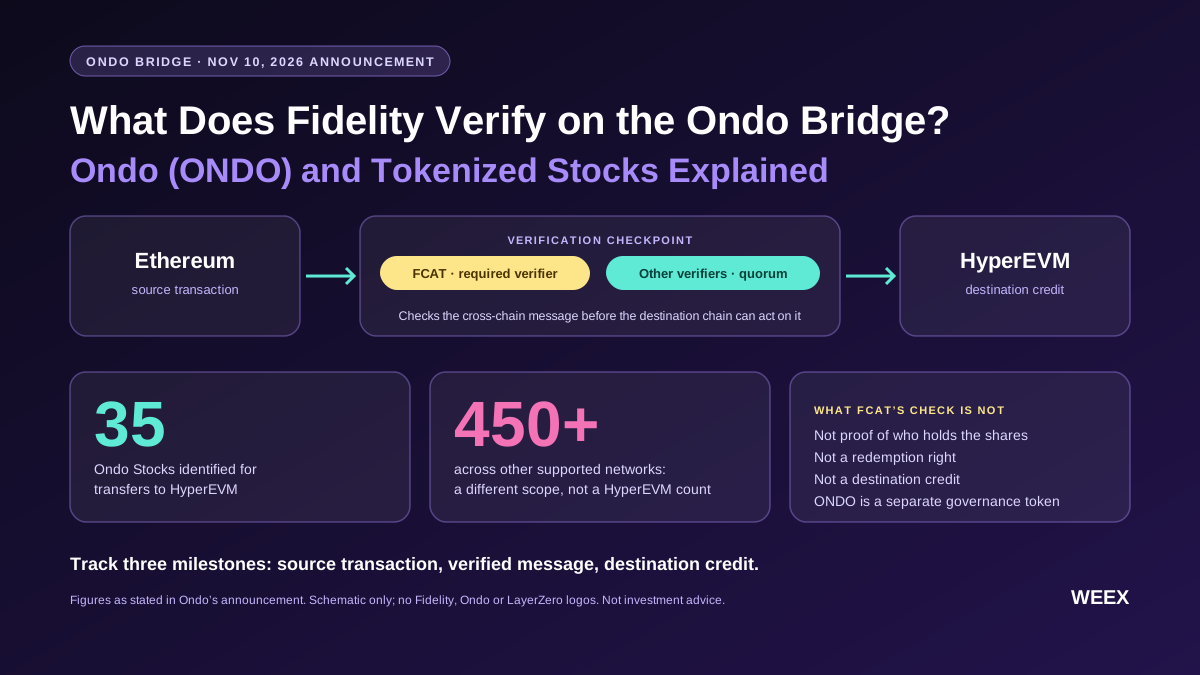
What Does Fidelity Verify on the Ondo Bridge? Ondo (ONDO) and Tokenized Stocks Explained
Learn what Fidelity’s FCAT verifies on the Ondo Bridge, how to check a tokenized stock transfer, and why Ondo Stocks differ from the ONDO token.
Countdown to Migration to Solana: ZetaChain to Launch Financial AI Platform ZetaLabs
ZetaChain token holders approve migration to Solana
ZetaChain Proposes L1 Shutdown Amid Solana Migration, Plans to Burn 55 Million ZETA
ZetaChain Proposes Migration Mechanism and Timeline to Solana
How will ZetaChain advance its new AI layout in the "Great Migration" to the Solana ecosystem?
Layer 1 Faces 'Survival of the Fittest' Era... ZetaChain and Harmony Ride on Solana and Ethereum
Latest articles





Latest coin listings on WEEX


