
Behind the Nvidia Scandal, AI Sector Hides Upward Opportunities

 Prefer us on Google


Special Report: Nvidia Announces CEO Jensen Huang Resigns, CFO Colette Kress Appointed Interim CEO
Jensen Huang has stepped down. Following a series of damaging news reports exposing multiple personal affairs and entanglements with company employees, Huang resigned as CEO of Nvidia. This undoubtedly deals a heavy blow to Huang personally; in the short term, it will also plunge Nvidia into turmoil while influencing Washington's policy direction towards China.
This crisis reveals Nvidia's extremely high and completely unhedged key person risk, which has already caused actual impacts. Nvidia's management structure is almost unprecedented: a full 60 executives report directly to Huang. He has never established a succession plan, and the company has not cultivated a group of management talents capable of quickly taking over top positions with public influence.
This key person risk also transmits outward to the entire AI investment track. Huang is almost ubiquitous: advocating for American technological discourse while also being the chief architect of the AI capital and hardware ecosystem. If Nvidia is likened to the "central bank of AI," then Huang is the president.
Mohamed El-Erian, chief economic advisor at Allianz Group, posted on X platform the night before Huang's resignation: "This is not an ordinary CEO, not an ordinary company, not an ordinary industry, and not an ordinary era." He believes the negative impact of the event is difficult to confine to just one company.
However, if Nvidia can weather this storm, this incident may actually become a significant boon for the company and even the entire industry.
In the future, investors and analysts will no longer view Nvidia through the lens of a legendary founder like Edison. Without Huang, the cult of personality around visionary founders will dissipate, and the market will focus solely on financial data and business logic. If the data and logic remain solid and persuasive, the foundation of the AI sector may appear even more robust. The ability to perform well without a star figure can indeed demonstrate the strength of the team.
Of course, the premise is that Nvidia can truly achieve this.
Apple serves as a good reference: after experiencing Steve Jobs' departure, return, and eventual handover to Tim Cook. After Jobs' first departure, the iPhone manufacturer lost its direction until his return saved the company, after which he passed the baton to Cook. Cook operates steadily but is ultimately not Jobs. (Former President Trump once suggested Nvidia recruit the "retired" Apple CEO Cook.)
Huang may be a visionary who single-handedly drove the AI revolution, but after his exit, Nvidia and the entire AI industry must continue to move forward, just as Apple developed beyond Jobs during the Cook era. (Using Jobs as a comparison raises a question: is there a possibility for Huang to return in the future?)
Setting aside the "dark day" for Nvidia and even the American tech industry, Dan Ives of Yorkville stated: "In the AI revolution race, the American tech industry still significantly leads China; this incident may further intensify competition and an arms race between the two countries."
Optimistic individuals believe that the ecosystem built by Huang will not dissipate with his departure.
There are also viewpoints suggesting that in terms of the fate of the AI industry, Huang's personal importance is less than the ideas and operational culture he shaped at Nvidia.
Fundstrat analyst Kenton Feng referenced the development of Disney after the death of Walt Disney as a historical case in a report on Thursday. The company fell into a slump shortly after the founder's death; however, Disney's business philosophy and new revenue streams continued to thrive, and other companies have emulated its theme park and animation models, with former Disney employees founding many successful studios.
"The company that Huang built laid a crucial foundation for the AI era," Feng stated, "but whether he is still in position or not, the market's demand logic for AI will not change; the entire industry has now grown and is fully capable of continuing to push forward.",
-- Price
This content is provided for general informational purposes only and doesn't constitute financial, investment, legal, or tax advice. Any events, rewards, online promotions, or related information mentioned herein should not be considered a recommendation, solicitation, or invitation to purchase, sell, trade, or otherwise deal in any crypto assets. Crypto assets are highly volatile and may result in loss. The availability of WEEX services, products, and related events may vary by region. You are responsible for ensuring that your participation is in accordance with applicable local laws and regulations.
You may also like
Forget the "Magnificent Seven." Berkshire Hathaway Could Be the Better Long-Term Bet.
Apple Is the World’s Largest Company, and Nvidia Is Second. Here’s What $10,000 Invested in Each Today Could Be Worth by the End of Next Year.
TSMC’s Terrific Growth Clearly Shows That the Chip Sell-Off Is Overdone. Here Are the Best Stocks to Buy Hand Over Fist
From Private Key Protection to Systematic Defense: How Crypto Rebuilds Security and Trust in the AI Era?

How These 5 Apparel and Footwear Stocks Differ
100 believers, 10 ETH: How should early-stage crypto projects raise funds?

Bitcoin: ECB Scrutinizes Retail Sentiment on Reddit Using AI
Patch Released for Ethereum Gloas Fork
US Treasuries Face Largest Weekly Sell-Off Since Trump Tariffs as Market Bets on Fed Rate Hike
Who Will Succeed Nvidia as the Next 'Victim' After the Democrats Take Control of Both Houses?
Anthropic Yet to Go Public, Crypto Players Already Cashing In
Interpretation of FATF Report on Scam Compound Funds: Virtual Assets Become Core Money Laundering Channels
How Much Is Anthropic Really Worth?
Research Reveals 3D Spatial Navigation Map of Hand in the Brain to Aid Brain-Machine Interface Development
Michael Dempsey: Crypto Venture Capital Stagnates, Talent Shifts to AI
Yen Fluctuations Highlight Current Trading Difficulties, Investors Have Huge Divergence on Long-term Outlook
Bloom Energy vs. Constellation Energy: On-Site Power or Grid Power, Which Wins the Data Center?
Former Polychain Partner Launches Startup: Enters Tokenized Real Estate, Secures $50 Million Seed Round Funding to Create the 'S&P 500' of Real Estate
Seminar: The History of Hyperliquid and On-Chain Finance Guest: Takuya Fujita (11/18 19:30 @ Gentosha)
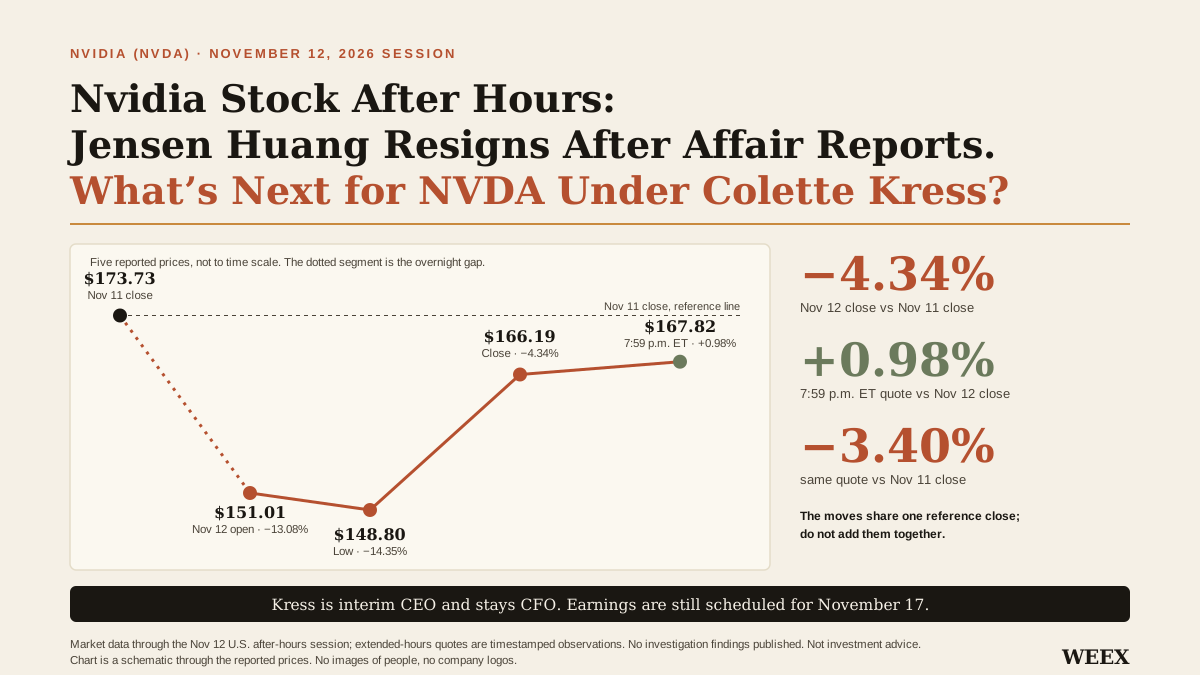
Nvidia Stock After Hours: Jensen Huang Resigns After Affair Reports. What’s Next for NVDA Under Colette Kress?
Nvidia fell 4.34% after Jensen Huang resigned, then rose 0.98% after hours. See what Colette Kress’s appointment means for NVDA and November 17 earnings.
Jensen Huang's Sudden Departure Raises Questions: Did the White House Intervene? Is a Return Possible?
In-Depth Interview | Fu Peng: I Have No Faith in BTC
Cerebras Conference Call: Secures Major Deal with Microsoft, HBM Shortage Becomes an Opportunity, WSE-5 Chip to Enter Mass Production Next Summer
SoundHound AI Stock Is Down Almost 60% in 2026, but Wall Street Thinks It Can Soar 155% By the End of 2027. Here’s Why It Could Be One of the Best Buys Amid the Tech Sell-Off.
What is being said at the tables: the market begins to see 2027 as an all-or-nothing scenario
Kalshi Negotiates New Round of Financing, Valuation Expected to Reach $65 Billion

Republican Senator Wants to Freeze AI Data Center Boom as Congress Pushes to Expand It
Why the Path to Quantum Resistance Runs Uphill for Bitcoin Wallet Makers
Pimco CEO Warns: AI Companies Risk Borrowing "Too Much" ($10 Trillion)

Silver ETF vs. Silver Miners ETF: Which Has Held Up Better This Year?
Forget the "Magnificent Seven." Berkshire Hathaway Could Be the Better Long-Term Bet.
Apple Is the World’s Largest Company, and Nvidia Is Second. Here’s What $10,000 Invested in Each Today Could Be Worth by the End of Next Year.
TSMC’s Terrific Growth Clearly Shows That the Chip Sell-Off Is Overdone. Here Are the Best Stocks to Buy Hand Over Fist
From Private Key Protection to Systematic Defense: How Crypto Rebuilds Security and Trust in the AI Era?
How These 5 Apparel and Footwear Stocks Differ
100 believers, 10 ETH: How should early-stage crypto projects raise funds?
Latest articles


Latest coin listings on WEEX


