
From Private Key Protection to Systematic Defense: How Crypto Rebuilds Security and Trust in the AI Era?

 Prefer us on Google




As attackers begin to target employee identities, internal permissions, and supply chains, merely having a good private key is no longer sufficient to form a complete security defense.
For over a decade, the security narrative in the crypto industry has been encapsulated in a classic slogan: "Not your keys, not your coins."
Whether ordinary users or institutional practitioners, there has been a long-standing assumption of a linear security logic—as long as you securely write down your mnemonic offline, buy a hardware wallet, or entrust your assets to a leading compliant platform, security is guaranteed.
However, a series of recent high-profile security incidents are shattering this illusion of single-point defense.
On one side, attackers are starting to leverage AI, social engineering, and software supply chain vulnerabilities to bypass traditional security measures and directly infiltrate corporate internal systems; on the other side, even cold wallets and hardware wallets, which are considered relatively secure, may become new attack vectors due to issues with internal permission management, device circulation, and third-party vendors.
In the context of AI dramatically changing attack and defense methods, the security boundaries of the crypto industry are being redefined. It can be said that from trading platforms to hardware wallet manufacturers, the entire industry seems to be forming a new consensus:
The competition in crypto security has shifted from who is better at protecting private keys to who can establish a more complete, verifiable, and resilient security system (see also: "As hackers use AI more efficiently, how does the arms race of 'spear and shield' in Web3 upgrade?").
I. Private Keys Are Important, But No Longer Everything
If we look back at past security incidents in the crypto industry, the most common risks are nothing more than private key leaks, mnemonic theft, phishing websites, and smart contract vulnerabilities.
These issues have certainly not disappeared, but attackers are seeking more and more covert entry points, especially after the rapid proliferation of AI tools, as traditional security boundaries are changing.
The security incident at Binance on October 29 is a typical case to observe this change.
According to Binance's preliminary investigation, attackers gradually infiltrated the wallet development team's work environment through tampered software installers, fake job interviews, and malicious code, subsequently using infected employee devices and internal AI tools to further obtain credentials with container deployment permissions, ultimately reaching the wallet signing service and initiating unauthorized on-chain transactions.
The entire process lasted for months, involving social engineering, software supply chains, employee terminals, and internal permissions. The attackers did not directly breach Binance's wallet system; instead, they obtained a foothold to access the company's internal systems and key permissions through a multi-stage infiltration chain.
This also indicates that attackers do not necessarily need to directly obtain private keys; as long as they can abuse the calling permissions of key signing services, they can still cause significant asset losses.
Even if private keys are protected using an MPC (Multi-Party Computation) mechanism, it does not mean that the entire signing system is inherently secure, because MPC addresses how to manage keys in a distributed manner and how to complete signatures without reconstructing the private key fully, but it does not automatically resolve who has the authority to initiate a signature, which authorizations can be executed, and how to promptly revoke abnormal authorizations.
In other words, key security and permission security are two protective mechanisms that need to coexist.
Taking the Ledger incident as another example, its chips, operating systems, and servers were not compromised; the issue occurred during the distribution phase after the device left the manufacturer's control, and users could still encounter attacks during the purchase and initialization stages.
When looking at these incidents together, a common change can be observed: attackers are increasingly inclined to exploit trust relationships between different systems rather than just seeking isolated technical vulnerabilities.
This also means that the crypto industry needs to redefine security boundaries, shifting from protecting a single asset to protecting the entire asset lifecycle; from focusing on whether a particular device or system is secure to examining the complete trust chain among personnel, software, devices, and permissions.
However, it is worth noting that in the face of these changes, the industry has not merely remained at the level of risk discussion.
II. From Binance to Ledger: How Is the Crypto Industry Upgrading Its Security Defenses?
After a series of recent security incidents, trading platforms, hardware wallet manufacturers, security agencies, and regulatory bodies have begun to push adjustments from their respective segments.
When looking at these actions together, several noteworthy changes in crypto security can be observed.
1. Binance and Coinbase: From Protecting Keys to Protecting the Entire Signing and Fund Transfer Process
After the Binance incident, the platform rebuilt the affected wallet system and internal AI tools in the new environment, replaced related employee devices, disabled compromised credentials and access tokens, and conducted further security checks on employee terminals.
At the same time, Binance has strengthened risk control for wallet services and AI-driven anomaly detection, and plans to introduce independent security agencies to conduct further reviews of the incident's causes, internal permissions, and related protective systems.
These measures may seem scattered, but they are actually targeting the same issue: how to prevent attackers from continuing to exploit existing permissions to access higher-risk asset operations once they have entered the internal system?
A similar approach can also be found in Coinbase's recently disclosed asset protection system.
On November 4, Coinbase published an article detailing its customer asset security architecture, stating that over 99% of customer assets are stored in cold wallets, while also revealing a complete set of fund transfer control mechanisms.
For example, in terms of key management, Coinbase employs a distributed key protection mechanism to avoid single-point private key exposure; during the allocation process between hot and cold wallets, strict transfer speed and amount limits are set, and suspicious operations are identified through anomaly behavior monitoring.
They also provide a reference model: where assets are stored is certainly important, but who can initiate transfers, under what conditions signatures are allowed, and whether operations can be stopped in a timely manner during anomalies also determine the overall security level of the system.
This is essentially the core logic of Defense in Depth.
No single link is assumed to be absolutely secure; rather, even if a particular employee's device is compromised or a certain permission is abused, other protective mechanisms should still be capable of limiting the spread of the attack.
2. Ledger and Trezor: Security Begins to Extend to Production, Circulation, and Delivery Phases
Changes in the hardware wallet sector are also representative.
After the recent hardware implantation incident, Ledger began to adjust the device management requirements for authorized distribution channels, requiring relevant authorized dealers and distributors to suspend sales in Southeast Asia and Hong Kong, and to conduct device sampling inspections and inventory checks.
At the same time, Ledger further clarified that dealers are not allowed to resell returned devices, even if the packaging appears intact; devices should not continue to be placed on open shelves or display areas but should be stored in back storage areas and delivered only when users make a purchase.
These measures also indicate that the boundaries of hardware security are expanding, essentially reducing the opportunities for attackers to access and modify devices.
Trezor's adjustments are even more direct.
On November 12, Trezor announced the latest investigation results, confirming that three Trezor Safe 5 devices sold through the implicated dealer CryptoBilis had hardware implants; at the same time, Trezor announced that it had reduced its authorized dealer network by about 80% and required the remaining partners to comply with stricter procurement, storage, and device access management rules.
In terms of products, Trezor released firmware version 2.13.1 on November 11, incorporating protective measures against the identified implanted modules, preventing them from continuing to read screen information.
This also reflects a change in hardware security governance, namely that security is no longer just about whether the product is reliable when it leaves the factory, but also about whether manufacturers can continuously manage supply chain risks and provide effective detection, remediation, and user remedy measures after issues arise.
For wallet manufacturers, this means managing not just chips and firmware but the entire product lifecycle.
3. From CZ's Security Alliance Initiative to Regulatory Efforts: Industry Collaboration Is Forming Actual Capabilities
In addition to internal security upgrades, another noteworthy direction is cross-platform collaboration.
After the Binance incident, CZ publicly called for the crypto industry to establish a security alliance to promote security intelligence sharing, cross-security audits, and more efficient tracking and emergency handling of stolen funds.
This actually reflects a long-standing contradiction in the crypto industry: while blockchain assets can flow rapidly across platforms and chains, security defenses are often dispersed among different exchanges, wallet manufacturers, security companies, and on-chain analysis institutions.
If one platform discovers an abnormal address, it does not mean that other platforms can immediately recognize it; if a security team masters new attack characteristics, it does not mean that the entire industry can promptly update its protective strategies.
This reflects a different defensive model from traditional enterprises building their own security teams: connecting the security research, threat monitoring, and emergency response capabilities dispersed among different institutions so that attack information can be recognized, shared, and utilized more quickly.
Of course, cross-platform collaboration does not mean that all companies should unconditionally share internal system information or have the power to freeze user assets at will.
How to establish clear boundaries between security intelligence sharing, commercial confidentiality protection, and user asset autonomy also requires further improvement.
But at least it can be seen that crypto security is gradually moving from relatively isolated corporate self-protection to collaborative defense involving security agencies, platforms, and communities.
It is noteworthy that after the Binance incident, the Financial Services Commission (FSC) of South Korea urgently convened the Financial Supervisory Service, the Korea Financial Security Institute, and major virtual asset trading platforms to inspect the asset custody and security protection situation of exchanges.
One focus is to reassess the proportion of assets stored in cold wallets by exchanges. According to South Korea's current "Virtual Asset User Protection Act," exchanges must store at least 80% of the economic value of user assets in cold wallets.
However, after this incident, regulatory agencies further required exchanges to consider increasing the proportion of cold wallets while strengthening 24/7 monitoring of deposits and withdrawals, reserve fund management, wallet signing approval, and administrator permission control.
This indicates that regulatory bodies are also beginning to realize that the security of exchanges cannot rely solely on post-incident compensation; it also requires preemptive asset isolation and operational restrictions to minimize the losses that a single attack can cause.
III. What New Security Standards Do Crypto Products Need in the AI Era?
If we connect these recent industry actions, we can see that they are gradually forming a more complete security logic.
Binance restructures its internal systems and permissions, Coinbase emphasizes multi-signature control, Ledger and Trezor tighten their supply chains, and the entire industry promotes cross-platform emergency collaboration, while South Korean regulators further strengthen around-the-clock monitoring and incident accountability.
Crypto products need to rebuild their security systems from at least the following aspects.
1. From Private Key Security to Full-Link Permission Security
Private keys remain the core of digital asset security, but they should not be the entirety of the security system.
For trading platforms, it is necessary to protect keys, signature services, administrator accounts, development environments, and production deployment permissions simultaneously; for wallet products, it is essential to clearly distinguish between key management, transaction construction, transaction authorization, and final signing.
Especially as AI Agents begin to access wallets, trading accounts, and on-chain applications, permission management will become even more critical.
An Agent that can read market data and check balances should not inherently have the authority to transfer assets; an Agent that can assist users in constructing transactions does not mean it can complete signing without additional authorization.
A reasonable design should allocate the minimum permissions according to task needs, separating querying, transaction construction, transaction approval, and final signing; set up independent confirmation mechanisms for high-risk operations, such as out-of-band confirmations, Passkeys, or multi-authorizations; all authorizations should have clear scopes, validity periods, and revocation mechanisms; maintain verifiable audit records for critical operations.
In simple terms, AI can help users accomplish more tasks, but it should not gain unrestricted control over assets. This is not only a security requirement for AI Agents but also a permission standard that the entire crypto product ecosystem needs to establish in the future.
2. From One-Time Audits to Continuous Verification
In the past, many crypto products relied on smart contract audits, code reviews, or hardware security certifications to prove their security to users. While these efforts are undoubtedly important, the problem is that audits typically only cover specific times, specific code versions, and specific scopes.
A product that has passed a smart contract audit does not mean that subsequent upgraded code is free of issues; a hardware wallet that has passed chip security testing does not guarantee it will not be tampered with during storage and transportation.
Therefore, future security systems need to shift from one-time audits to continuous verification.
3. From Point Protection to Depth Defense
No single technology can solve all security problems.
MPC can reduce the risk of single-point key leakage but cannot automatically prevent erroneous authorizations; cold wallets can lower the risk of remote attacks but cannot completely eliminate internal operation and supply chain risks; hardware wallets can isolate private keys but cannot identify all malicious transactions on behalf of users.
Thus, a truly mature security architecture requires different layers of protection mechanisms to complement each other.
For example, using anti-phishing identity authentication methods at the identity layer to reduce the risk of account and employee credential theft; adopting least privilege, temporary authorization, and multi-person approval at the permission layer to avoid a single identity holding complete control; enhancing terminal security, hardware integrity checks, and trusted boot mechanisms at the device layer; simulating, risk-identifying, and clearly displaying transaction content at the transaction layer to avoid users completing signatures without understanding the transaction intent; reducing the likelihood of funds being transferred all at once at the asset layer through cold wallets, MPC, multi-signatures, limits, and anomaly monitoring; establishing emergency pause, permission revocation, incident reporting, and cross-platform collaboration mechanisms at the response layer.
4. From "Trust the Brand" to "Security Can Be Verified"
For ordinary users, security has a long-standing issue: information asymmetry.
Users find it difficult to know how a wallet manages private keys, cannot directly judge whether the internal permissions of an exchange are reasonable, and cannot personally check the chips, firmware, and supply chains of hardware wallets.
Therefore, security products cannot rely solely on brand reputation or marketing slogans to establish trust; what is more important in the future is to make security mechanisms as transparent and verifiable as possible.
For example, trading platforms need to continuously disclose asset reserves, custody structures, and key security mechanisms; wallet manufacturers need to publicly disclose private key management principles, code audit situations, vulnerability response processes, and version update records; hardware wallet manufacturers need to allow users to verify device sources, firmware integrity, and official sales channels.
5. Returning to User Asset Control: The Value and Responsibility of Non-Custodial Wallets
After discussing so many security mechanisms, there is still a question worth rethinking:
If exchanges, wallet manufacturers, hardware devices, and third-party services can all become attack entry points, how should ordinary users choose their asset management methods?
This is also the long-standing value of non-custodial wallets. Compared to centralized trading platforms, the core difference of non-custodial wallets lies in asset control.
In centralized trading platforms, users typically need to go through the platform's account system, internal wallet system, and the platform's signing process to complete asset operations. The security of users' assets depends not only on their own account protection but also on the platform's internal permissions, custody architecture, employee management, and operational mechanisms.
In non-custodial wallets, users manage their private keys or mnemonic phrases themselves, and wallet service providers do not directly hold the authority to transfer user assets. Structurally, this means there is one less layer of trust required in asset custody, which also reduces the custody risks associated with platforms holding user assets centrally.
However, this does not mean that non-custodial wallets are immune to all attacks.
Users may still encounter phishing websites, malicious contracts, false authorizations, device infections, and mnemonic phrase leaks, requiring users to pay more attention to their key management and transaction security.
Therefore, for non-custodial wallets, what is truly worth continuous improvement is the security experience throughout the entire usage process, centered around user autonomy.
This also reflects a more complete security philosophy.
-- Price
Final Thoughts
From Binance's internal permission failures to Ledger and Trezor's hardware supply chain risks, and the exchanges re-evaluating the proportion of cold wallets, a series of recent events remind us that the standards upon which the crypto industry has built its security trust need further upgrades.
Private keys are still important, but they are no longer everything.
The future security competition will occur simultaneously across multiple levels, including cryptography, software supply chains, AI permission management, hardware design, asset custody, and emergency response.
For the entire industry, rebuilding trust cannot rely solely on a one-time security audit, a reserve proof, or a statement that "user assets are unaffected."
Security is the premise of trust, and verifiable, sustainable, and accountable security is the foundational infrastructure that the crypto industry truly needs to establish to move to the next stage.
This content is provided for general informational purposes only and doesn't constitute financial, investment, legal, or tax advice. Any events, rewards, online promotions, or related information mentioned herein should not be considered a recommendation, solicitation, or invitation to purchase, sell, trade, or otherwise deal in any crypto assets. Crypto assets are highly volatile and may result in loss. The availability of WEEX services, products, and related events may vary by region. You are responsible for ensuring that your participation is in accordance with applicable local laws and regulations.
You may also like

How These 5 Apparel and Footwear Stocks Differ

100 believers, 10 ETH: How should early-stage crypto projects raise funds?

Bitcoin: ECB Scrutinizes Retail Sentiment on Reddit Using AI

Patch Released for Ethereum Gloas Fork

US Treasuries Face Largest Weekly Sell-Off Since Trump Tariffs as Market Bets on Fed Rate Hike

Who Will Succeed Nvidia as the Next 'Victim' After the Democrats Take Control of Both Houses?

Anthropic Yet to Go Public, Crypto Players Already Cashing In

Interpretation of FATF Report on Scam Compound Funds: Virtual Assets Become Core Money Laundering Channels

How Much Is Anthropic Really Worth?
Research Reveals 3D Spatial Navigation Map of Hand in the Brain to Aid Brain-Machine Interface Development

Michael Dempsey: Crypto Venture Capital Stagnates, Talent Shifts to AI
Yen Fluctuations Highlight Current Trading Difficulties, Investors Have Huge Divergence on Long-term Outlook

Bloom Energy vs. Constellation Energy: On-Site Power or Grid Power, Which Wins the Data Center?

Former Polychain Partner Launches Startup: Enters Tokenized Real Estate, Secures $50 Million Seed Round Funding to Create the 'S&P 500' of Real Estate
Seminar: The History of Hyperliquid and On-Chain Finance Guest: Takuya Fujita (11/18 19:30 @ Gentosha)
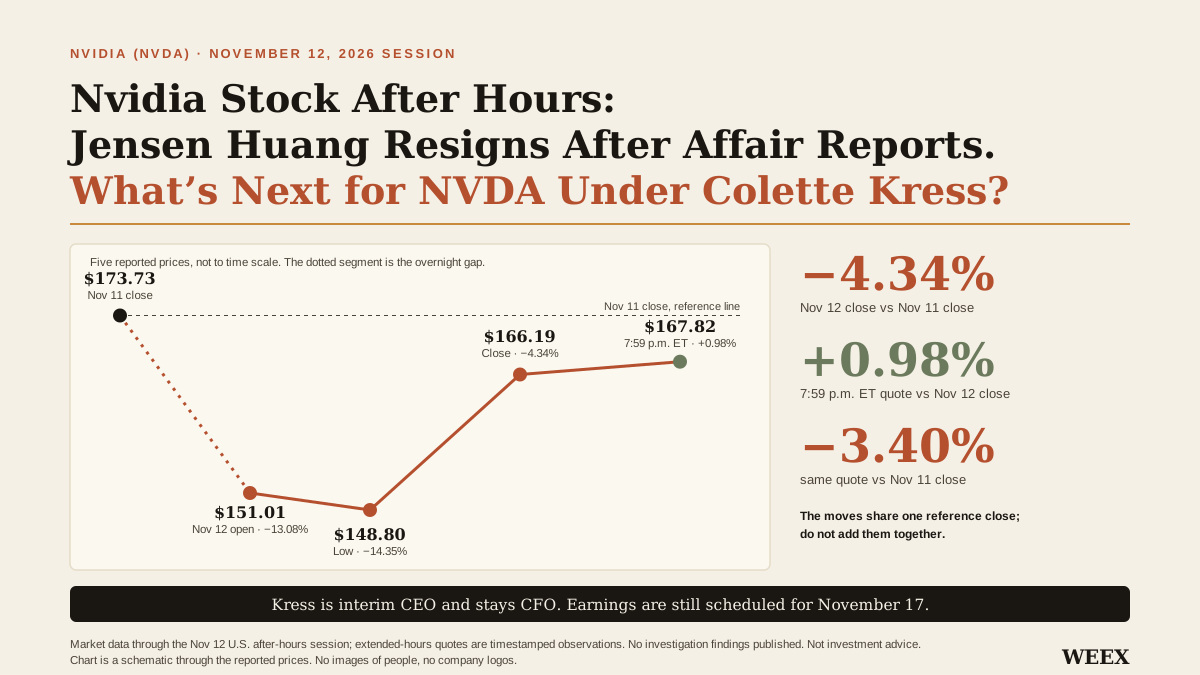
Nvidia Stock After Hours: Jensen Huang Resigns After Affair Reports. What’s Next for NVDA Under Colette Kress?
Nvidia fell 4.34% after Jensen Huang resigned, then rose 0.98% after hours. See what Colette Kress’s appointment means for NVDA and November 17 earnings.

Jensen Huang's Sudden Departure Raises Questions: Did the White House Intervene? Is a Return Possible?
In-Depth Interview | Fu Peng: I Have No Faith in BTC

Cerebras Conference Call: Secures Major Deal with Microsoft, HBM Shortage Becomes an Opportunity, WSE-5 Chip to Enter Mass Production Next Summer

SoundHound AI Stock Is Down Almost 60% in 2026, but Wall Street Thinks It Can Soar 155% By the End of 2027. Here’s Why It Could Be One of the Best Buys Amid the Tech Sell-Off.
What is being said at the tables: the market begins to see 2027 as an all-or-nothing scenario

Kalshi Negotiates New Round of Financing, Valuation Expected to Reach $65 Billion

Republican Senator Wants to Freeze AI Data Center Boom as Congress Pushes to Expand It

Why the Path to Quantum Resistance Runs Uphill for Bitcoin Wallet Makers
Pimco CEO Warns: AI Companies Risk Borrowing "Too Much" ($10 Trillion)

Silver ETF vs. Silver Miners ETF: Which Has Held Up Better This Year?

Why AMD Shares Are Surging and What a $10,000 Investment in the Stock Could Be Worth in 3 Years
Cardano Academy launches practicum with on-chain credentials
Warren Buffett Doesn't Follow His Own S&P 500 Advice. Should You?

A $776 Car Payment Is a Warning for Ford and General Motors
How These 5 Apparel and Footwear Stocks Differ
100 believers, 10 ETH: How should early-stage crypto projects raise funds?
Bitcoin: ECB Scrutinizes Retail Sentiment on Reddit Using AI
Patch Released for Ethereum Gloas Fork
US Treasuries Face Largest Weekly Sell-Off Since Trump Tariffs as Market Bets on Fed Rate Hike
Who Will Succeed Nvidia as the Next 'Victim' After the Democrats Take Control of Both Houses?
Latest articles


Latest coin listings on WEEX


