
Cardano Academy launches practicum with on-chain credentials

 Prefer us on Google


Cardano Academy has partnered with Andamio to launch a practicum that lets participants submit a build or pitch and claim a credential recorded on Cardano after a reviewer accepts their work.
Summary
- Participants submit a build or pitch for review before claiming an on-chain credential.
- No wallet or ADA is needed to sign up, according to the launch announcement.
- The program joins existing Academy courses, certification exams, and university education partnerships.
The Cardano Foundation announced the Cardano Academy Practicum in a Nov. 12 X post, describing a submission-based program for people putting their ideas or development work forward for assessment.
The Cardano Academy has partnered with @andamio_teams to launch the Cardano Academy Practicum.
Submit your build or pitch. Once a reviewer accepts it, claim a credential recorded on Cardano.
No wallet or ada needed to sign up. pic.twitter.com/NJ7MhKTS2O --- Cardano Foundation (@Cardano_CF) November 12, 2026
Its announcement sets out a sequence: submit the work, receive a reviewer's acceptance, then claim the credential. Registration itself does not require participants to hold Cardano's native ADA token or arrive with a cryptocurrency wallet.
Cardano Academy credentials follow a review of submitted work
A project build and a pitch are both eligible submission formats under the Foundation's announcement. The credential becomes claimable once a reviewer accepts the submission, placing assessment between the participant's work and the blockchain record.
The launch post's wallet requirement is specific to signing up. It does not describe the arrangements for holding a credential after approval, the transaction costs involved in claiming one, or whether those costs are covered for participants.
Andamio's developer documentation describes a credential process covering commitments, assessment, and claims. The platform provides tools for issuing credentials, checking which credentials a holder owns, and restricting application features based on those holdings.
Organizations can create a course or project with an identifier published on-chain and define what its credentials represent. Developers can build verification tools, directories and dashboards around existing credentials without owning the underlying course or project, according to Andamio.
The platform describes its infrastructure as live on Cardano mainnet. Its published tools cover courses, lessons, assignments, project tasks and contributors, alongside the transactions used to record activity on the network.
Academy offers exam certifications and course-completion badges
The Foundation's Academy website says its education offering serves more than 10,000 learners. Its existing options include on-demand technical and business courses, organizational masterclasses, professional certification, and access to course materials.
Within its certification program, the Foundation distinguishes badges earned through certified exams from those awarded for finishing business or technical courses. Certified badges go to learners who pass exams at authorized Pearson VUE test centers.
Other badge categories cover Venture Hub participation, masterclasses, and academic programs at participating universities. The Foundation uses Credly for sharing credentials and describes its badges as carrying metadata that can be checked online.
The refreshed Cardano Blockchain Certified Associate course has 26 units covering distributed ledgers, cryptography, consensus and Cardano's architecture. Its published syllabus includes governance through delegated representatives, staking, transaction models and scaling approaches such as Hydra and Mithril.
The associate course is self-paced and online, with its 2026 course page describing just under four hours of learning. It identifies software engineers, IT decision-makers, lecturers, researchers and students among its intended audience, alongside candidates preparing for the separate Pearson VUE certification exam.
Course topics include public-key encryption, digital signatures and the differences between account-based and unspent transaction output systems. Learners study how distributed nodes validate transactions and compare proof-of-work with proof-of-stake consensus, including Cardano's Ouroboros protocol family.
University programs include 25 sponsored places and UCLA coursework
On Oct. 22, the Foundation announced that the Academy would teach Cardano fundamentals in the University of Nicosia's Blockchain and Digital Assets course and sponsor 25 advanced-track places, as crypto.news previously reported.
The university lists Feb. 8, 2027, as the course's next starting date. Its introductory track runs through eight weeks, while advanced participants continue through week 12. Cardano's teaching contribution covers the network's fundamentals and extended unspent transaction output model.
In the United States, a September agreement with UCLA Anderson School of Management's Venture Accelerator provides for Academy content and coursework beginning in 2027. The material will enter Blockchain Cryptocurrency Applications in Business and Finance, taught by Alex Nascimento.
The agreement includes five sponsored fellowships for selected early-stage companies in UCLA Accelerate. According to the Foundation's announcement, fellows will receive funding, mentorship, and access to the Cardano ecosystem. Sponsorship of the 2027 UCLA Draper Innovation Showcase forms another part of the arrangement.
Earlier institutional training efforts included a March 2025 education partnership with SERPRO, Brazil's state-owned government technology provider. The announced program would bring Academy training to its 8,000 employees, including more than 2,000 developers, alongside cooperation on blockchain innovation and public-sector digital infrastructure.
-- Price
This content is provided for general informational purposes only and doesn't constitute financial, investment, legal, or tax advice. Any events, rewards, online promotions, or related information mentioned herein should not be considered a recommendation, solicitation, or invitation to purchase, sell, trade, or otherwise deal in any crypto assets. Crypto assets are highly volatile and may result in loss. The availability of WEEX services, products, and related events may vary by region. You are responsible for ensuring that your participation is in accordance with applicable local laws and regulations.
You may also like

Rongchang Biologics and Vor Bio Sign RC298 License Agreement Amendment, Securing $56 Million Upfront Payment
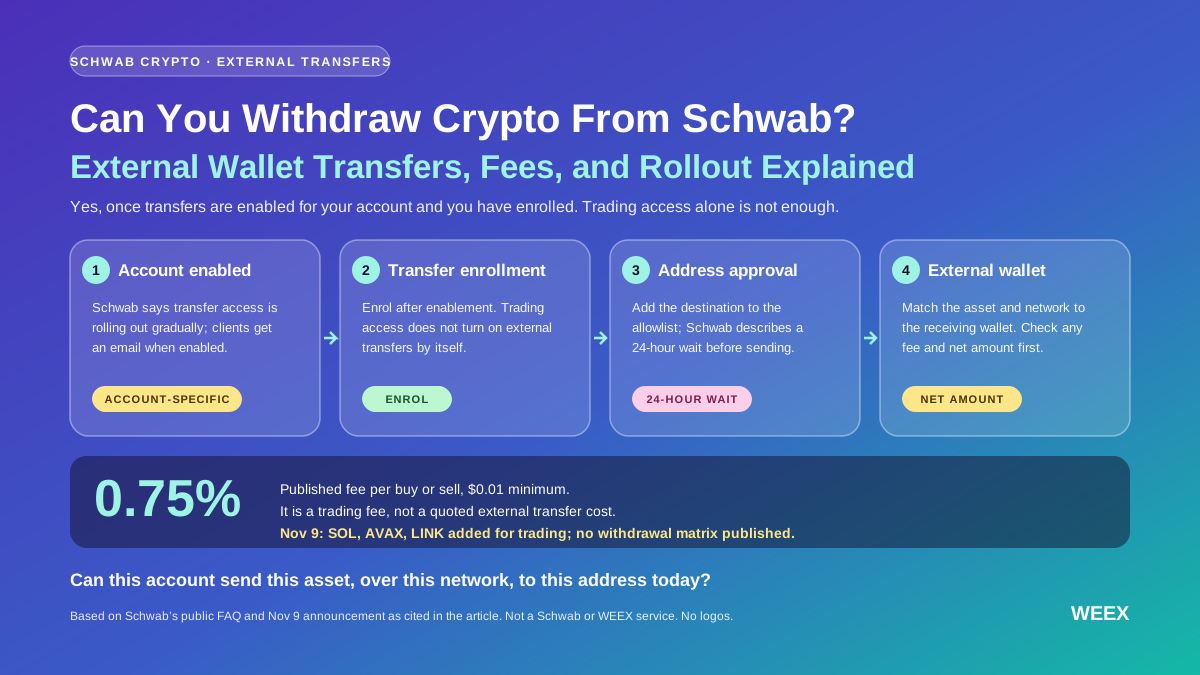
Can You Withdraw Crypto From Schwab? External Wallet Transfers, Fees, and Rollout Explained
Find out when Schwab Crypto allows external wallet withdrawals, how the 24-hour address wait works, and why the 0.75% trading fee is separate.

AI Startup Quietly Develops Its Own Procurement Chips

Countdown to Migration to Solana: ZetaChain to Launch Financial AI Platform ZetaLabs

End of Circle's CCTP V1: Which Cases Require Migration for USDC Transfers?

Democrats may rewrite CLARITY Act and dare Trump to veto it, Giancarlo says

ASEAN to Establish Oil Product Sharing Reserve Mechanism with Japan's Support

Hedera Council adds Apex Group, servicer of $3.5T in assets
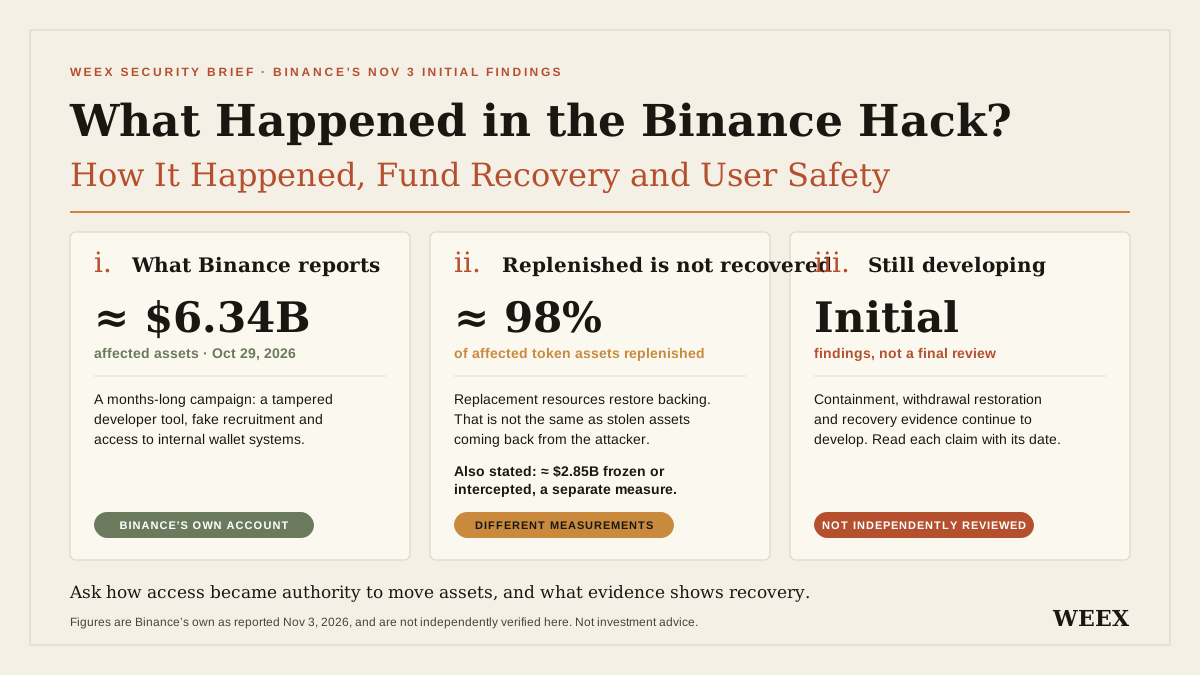
What Happened in the Binance Hack? How It Happened, Fund Recovery and User Safety
What happened in the Binance hack? Review the attack timeline, latest fund replenishment, recovery limits and practical steps to protect your account.

Tata Power Plans to Sign Agreement with Four States Allowing Power Prices to Be Linked to Coal Costs

AI Agents Do More Than Just Place Orders: The Next Entrepreneurial Opportunity Lies in Matching and Trust
NVIDIA Scandal Shakes the Internet! How Should Cryptocurrency Be Divided After a Divorce with a Tech Tycoon?

Bundesbank President Says Economic Recovery Faster Than Expected, Structural Reforms Needed

Immutable Chain's Transition to OP Stack: What Changes for Users
Ledger CEO faces backlash after saying everybody will be hacked at some point

WEEX 11.11 Shopping Fest: Buy BTC and Unlock Up to 888 USDT in Rewards
NEAR AI Discloses SGLang Security Incident and Revokes Exposed API Keys

The Art of Trading: How They Profit from Arbitraging USDE Stocks

VARA Is Not a Panacea: Dubai's Crypto Payments Still Depend on the Central Bank

a16z Frontier Partner: Agents Should Rebuild Uber-like Transaction Networks

Poland's Parliament Votes 240-202 To Let Officials Freeze Crypto Before Court Review
WEEX P2P now supports ILS, BHD, OMR & QAR —Merchant Recruitment Now Open

Cryptocurrency Security Checklist: Four Lessons from Phemex Safety Hub Vol. 05–08
Ondo Claims $4B in Tokenized Assets as RWA Market Gains Institutional Depth

DTCC Launches Tokenization Service: What Can Investors Actually Do?

The catch in recovering a hacked crypto wallet: the thief may still have a key

Bitcoin Remains Strong: Why $76,000 is the Level That Matters Now
Peter Schiff Criticizes Strategy's Bitcoin Purchases

iPhone Attack Kit 'DarkSword' Suspected of Being Misused for Cryptocurrency Theft, Bitquery Identifies Approximately $4.06 Million in Stolen Funds

Financial and Political Crisis in Paraguay: How the Ueno Bank Explosion Triggered the President's Resignation
Rongchang Biologics and Vor Bio Sign RC298 License Agreement Amendment, Securing $56 Million Upfront Payment
Can You Withdraw Crypto From Schwab? External Wallet Transfers, Fees, and Rollout Explained
Find out when Schwab Crypto allows external wallet withdrawals, how the 24-hour address wait works, and why the 0.75% trading fee is separate.
AI Startup Quietly Develops Its Own Procurement Chips
Countdown to Migration to Solana: ZetaChain to Launch Financial AI Platform ZetaLabs
End of Circle's CCTP V1: Which Cases Require Migration for USDC Transfers?
Democrats may rewrite CLARITY Act and dare Trump to veto it, Giancarlo says
Latest articles




Latest coin listings on WEEX


