
Bull Market Gains, Bear Market Losses: How to Calculate Taxes on Cryptocurrency Investments?

 Prefer us on Google




Author: Jiang Heng
"I initially invested 100,000 yuan, and after all the ups and downs over the years, my account only has 80,000 left. Why am I still receiving a tax self-check reminder? Do I really have to pay taxes even after losing money?"
This is the biggest confusion for many seasoned players who have experienced both bull and bear markets.
In the bull market, assets once soared to hundreds of thousands, with countless trades, staking, pitfalls, and even liquidation along the way, yet in the end, they still lost 20,000 yuan. When receiving a self-check reminder from the tax department, most people's first reaction is: subtract the ending balance from the initial investment, resulting in a net loss of 20,000 yuan. How could there be taxable income?
Unfortunately, the "final profit and loss of personal total assets" and "legally taxable income realized annually" are two completely different concepts in tax law.
To clarify whether you need to pay taxes and how much, you must reassemble every transaction, coin swap, loss, and identity status from the past few years. Of course, the reverse is also true—tax authorities will not simply add up all your transaction records and force you to pay taxes.
In recent years, tax authorities have continued to strengthen their focus on the declaration of overseas income. For holders of cryptocurrency assets involving overseas trading platforms and cross-border capital flows, it is also necessary to re-examine historical transaction records to check for any income that needs to be declared according to the law.
1. Why Calculate Previous Earnings When You Clearly Lost Money?
Let’s take a simple example (the following are hypothetical scenarios used solely to illustrate the calculation logic; there are currently no unified tax rules for cryptocurrency transactions in our country):
● 2019: You invested 100,000 yuan to buy cryptocurrency A.
● 2021: The bull market arrives, and asset A rises to 300,000 yuan. You choose to sell, making a profit of 200,000 yuan. Then, you invest all 300,000 yuan into asset B.
● 2022: The bear market hits, and asset B plummets, ultimately selling for only 80,000 yuan, resulting in a loss of 220,000 yuan.
After several years of trading, the initial investment of 100,000 yuan has dwindled to 80,000 yuan, resulting in a total loss of 20,000 yuan.
At this point, you might wonder: since I ultimately didn’t make any money, why should I consider paying taxes?
The issue lies in the fact that whether you ultimately made a profit or not is not the same as whether a past transaction generated taxable income.
Referring back to the example above, in 2021, you sold asset A for 300,000 yuan, which generated a profit of 200,000 yuan. Assuming that this transaction is legally treated as "capital gains" and that the 100,000 yuan purchase cost can be substantiated, without considering other deductions, the tax amount calculated at a 20% tax rate would be:
(300,000 yuan - 100,000 yuan) × 20% = 40,000 yuan.
However, in 2022, you incurred a loss of 220,000 yuan from your investment in asset B. Although this loss is real, it does not mean you can directly offset it against the taxes owed from the profit made in 2021.
The reason is straightforward: tax authorities need to assess each transaction and applicable rules separately; you cannot simply look at whether you made or lost money over the years. For transactions treated as capital gains, it is typically necessary to separately calculate the transfer income, original value, and reasonable expenses. The gains realized in the previous year cannot simply be wiped out by a loss in the following year.
Of course, the 40,000 yuan mentioned above is just a hypothetical calculation to illustrate the issue and does not imply that all cryptocurrency transactions are uniformly taxed at 20%. Whether taxes need to be paid, what rules apply, and whether related losses can be deducted all need to be assessed based on specific transaction circumstances and current legal regulations.
Therefore, if you have experienced multiple rounds of bull and bear markets and want to clarify whether there are tax issues with your historical transactions, the first step is not to subtract the current account balance from the initial capital but to clearly organize each past purchase, sale, coin swap, and loss, and then determine which transactions may involve tax obligations.
Only by first clarifying the accounts can you further determine how taxes should be calculated and whether additional payments are necessary.
2. How to Organize Complex Transaction Records? The First Table Only Restores "Asset Facts"
When faced with high-frequency, cross-chain, multi-platform small transactions, the first step is not to directly calculate taxes but to create a pure asset movement table.
Take stock of your exchange accounts, hardware wallets, and on-chain addresses. List them out by cryptocurrency:
● How many coins were there at the beginning?
● Increases: deposits, salaries, purchases, airdrops, staking rewards.
● Decreases: sales, withdrawals, transfers, protocol consumption.
● Verify the end quantity.
Professional Operation Points:
Price fluctuations listed separately: Price increases and decreases are unrealized gains or losses; as long as you haven’t sold or swapped, the quantity of coins hasn’t changed, so it’s not a tax event.
Internal transfers not double-counted: Withdrawing from Binance to a wallet is an internal transfer and should not be counted again. However, if it involves cross-chain bridges or wrapped tokens (like converting ETH to wETH), you need to pay attention to whether the rights to the assets have materially changed.
What if the accounts don’t match? If there’s a discrepancy in the accounts, do not just write down "other income" to force a balance! The discrepancy may be due to forgotten fees, rebase mechanisms, or internal exchanges at the exchange. If you hastily label an unclear discrepancy as "income," you are essentially solidifying a potential tax basis for yourself.
3. Reconstructing the Evidence Chain for Cryptocurrency Assets Using the "Three-Layer Draft Method"
Given the high complexity of cryptocurrency transactions (including missing historical data from CEX, dense interactions on DEX, cross-chain bridges, and DeFi combinations), simple tables cannot meet verification requirements. In practice, when sorting through complex transactions, we rely on the "three-layer draft restoration method" to establish compliant drafts that can withstand scrutiny for holders:
First Layer: What Happened
First, record verifiable facts:
● On which day did you pay how much to the platform?
● What assets were bought or sold, and what were the quantities and prices?
● Which account or address did the assets transfer to or from?
● What were the records of platform transactions, deposits, withdrawals, and fees?
Materials that may be used include bank statements, platform-exported orders, exchange account records, on-chain transaction hashes, and contract interaction records.
Different materials can prove different content: bank statements can prove payment of funds but may not independently prove which batch of assets was purchased; on-chain hashes can prove that a corresponding transaction occurred but may not independently prove how much was paid in RMB.
Second Layer: Why Did This Asset Come In and Why Did It Go Out?
Similarly, for an incoming transaction, the economic relationship may be entirely different.
For example, if a developer receives USDT as payment for work, it is necessary to understand their relationship with the payer; for transfers between personal accounts, it needs to be verified whether the assets have always belonged to the same person; for customer payments, it is also necessary to distinguish between personal income and payments collected on behalf of the company.
Freezing, theft, and selling at a loss should also be recorded separately. If a platform temporarily stops withdrawals, it does not necessarily prove that all assets in the account are unrecoverable; it should be assessed in conjunction with platform announcements, creditor claims, liquidation, and actual distribution situations.
Third Layer: How to Explain Tax Issues?
After clarifying the facts and transaction relationships, research each item:
● Which item might the income belong to?
● In which year did the acquisition or disposal occur?
● What evidence supports the original value and reasonable expenses?
● Has it been declared, and is there any double counting?
● What other facts and evidence have not been clarified?
Each amount that needs to be explained should correspond as much as possible to contracts, orders, platform records, bank statements, or on-chain records. If any link cannot be verified, list the issues that need verification; do not use guesses to fill it in with a definite number.
For example, if someone receives token development compensation and sells it a year later, it may be necessary to separately study the acquisition of the compensation and the subsequent disposal, paying attention to the value connection between the two, avoiding only looking at the final cash out, and also avoiding indiscriminately double counting the same economic amount.
-- Price
4. Historical Costs and Identity Determination: Cannot Apply a Uniform Assumption
When sorting through years of cryptocurrency transaction records, in addition to clarifying how much was earned or lost each year, there are two issues that cannot be overlooked: what tax identity did you belong to that year? Can the cost of the purchased assets still be proven?
1. Tax identity changes, tax rules may differ
If you have lived or worked abroad for an extended period in recent years or traveled between different countries and regions, you need to recheck your tax residency status for each year.
Because the living situation in different years may affect the scope of personal income tax obligations. Determining whether one is a tax resident of China requires considering whether there is a residence in China, the number of days lived in that year, and other factors, rather than simply looking at what passport one holds or whether one has an overseas visa.
At the same time, tax residency status and the source of income are two different issues. Even if using overseas exchanges, it cannot be directly assumed that the related income is overseas income.
Therefore, one cannot take the identity situation of a certain year and directly apply it to all past years. For those involving cross-border residence or income, it is also necessary to assess based on specific circumstances and applicable tax treaties.
2. How to Prove the Cost of Coins Bought Years Ago?
Another common issue is: the coins are still there, or they were sold long ago, but the purchase records from that year can no longer be found.
For instance, you may find bank statements showing transfers to exchanges from years ago, but they may not specifically prove how many assets were purchased with that money; on-chain transaction records can prove that assets were transferred from one wallet to another, but usually cannot independently prove how much was spent at the time of purchase.
In this case, it is necessary to combine bank statements, exchange orders, deposit and withdrawal records, and on-chain transaction records to reconstruct the purchase price, transaction quantity, and asset flow as accurately as possible.
If the same cryptocurrency was bought in multiple batches and sold in different batches, the cost calculation will be even more complex.
Some foreign tax software defaults to using the first-in, first-out (FIFO) method or average cost method to calculate gains, but these methods cannot be directly equated to the unified calculation rules recognized by Chinese tax authorities. When it comes to specific tax audits, it is necessary to explain how costs are determined and what the basis for the calculation method is, based on transaction circumstances, available evidence, and applicable regulations.
Ultimately, the key to historical cost verification is not to randomly choose an algorithm to balance the accounts but to ensure that every purchase, sale, and cost is verifiable.
5. Regarding the Collection Deadline: Does It Mean You Don’t Have to Worry After 3 Years?
Many people have heard that "the tax collection period is generally 3 years, with special circumstances extending to 5 years," and think that records before 2020 don’t need to be looked at. This understanding is very dangerous!
What situations are subject to the 3-year/5-year limit? If you were not intentionally evading taxes but simply unaware of the rules and did not declare, the collection period is indeed generally 3 years (5 years in special circumstances). However, this needs to be determined by specific documents and facts; you cannot simply say "I didn’t report back then" and apply it directly.
Tax evasion has no time limit: If it is determined that there was intentional concealment or provision of false materials, tax authorities can pursue tax payments without time limits.
Old records are still "life-saving evidence" today: Even if the tax payment from 2019 has exceeded the collection period, you still need the purchase records from 2019! Because if you want to prove in 2021 that your cost was 100,000 yuan, you must provide the purchase proof from 2019. Erasing old accounts often harms yourself.
6. Proactively Correcting Does Not Equal Volunteering, Nor Does It Mean "Exemption from Penalties"
When hearing about someone voluntarily correcting their taxes, many people's first reaction is, "Will I go to jail?" or "Once I correct it, will everything be fine?"
Paying taxes is just correcting tax records: Voluntarily paying taxes is an administrative compliance action; it does not imply that you have committed a crime and cannot be directly equated with "volunteering" in criminal law.
"First-time tax payment exemption from criminal liability" is conditional: According to judicial interpretations, if tax evasion occurs and the tax payment, late fees, and penalties are fully paid within the specified period according to the notice issued by the tax authority before the public security agency files a case, criminal liability may indeed not be pursued (provided that there have been no criminal penalties for tax evasion or two or more administrative penalties within five years).
Late fees and penalties are two different matters: Tax payments are the principal, late fees are charged daily (annualized at no less than a certain rate), and penalties are punitive. In the table, be sure to separate them clearly; do not mix them all into "tax rate."
(Note: The State Administration of Taxation has published a unified "Administrative Penalty Discretionary Standards," which will officially take effect on November 1, 2026. Matters handled before this date still need to be assessed based on specific documents and the applicability of new and old rules.)
7. Correction Timeline and Verification Loop
When organizing correction arrangements, it is advisable to separately record the statutory declaration nodes and the actual correction paths:
For example, if you are involved in overseas income for the year 2025, the statutory declaration deadline is usually June 30, 2026. Now that this window has passed, if you find that you previously failed to report, you should not delay until 2027 but should quickly organize materials and proactively verify the correction path.
8. Conclusion
Cryptocurrency transactions often span multiple platforms, wallets, and years, and after experiencing several rounds of bull and bear markets, historical accounts inevitably become complex. However, complexity does not mean it cannot be clarified. By organizing transaction records, restoring asset flows, verifying historical costs, and analyzing each item in conjunction with the actual situation and legal regulations of each year, it is still possible to gradually clarify past transaction situations and potential tax risks.
The purpose of sorting historical transactions is not simply to calculate a tax amount that needs to be paid but to restore the true transaction facts, clarifying the nature of each income, cost, and loss. Those that need to be declared and handled according to the law should be processed in a timely and compliant manner; those that should not be double-counted or misidentified should also have sufficient evidence and basis to explain. Only by clarifying the accounts and explaining the facts can one more safely address historical tax issues.
This content is provided for general informational purposes only and doesn't constitute financial, investment, legal, or tax advice. Any events, rewards, online promotions, or related information mentioned herein should not be considered a recommendation, solicitation, or invitation to purchase, sell, trade, or otherwise deal in any crypto assets. Crypto assets are highly volatile and may result in loss. The availability of WEEX services, products, and related events may vary by region. You are responsible for ensuring that your participation is in accordance with applicable local laws and regulations.
You may also like
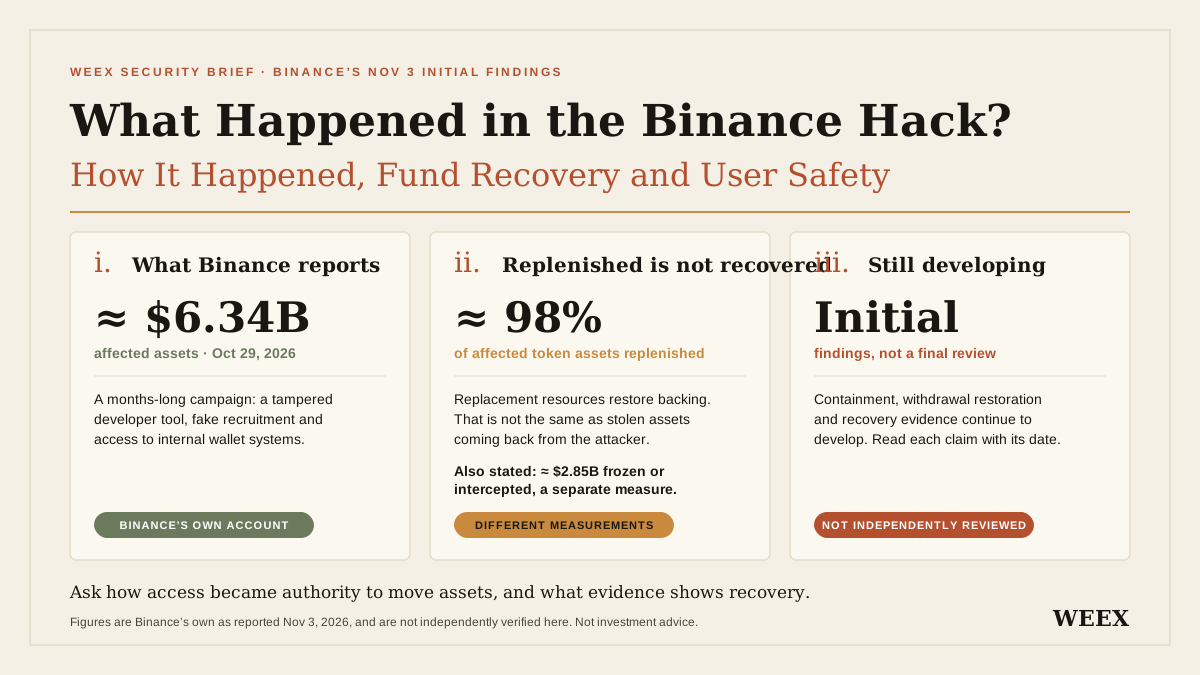
What Happened in the Binance Hack? How It Happened, Fund Recovery and User Safety
What happened in the Binance hack? Review the attack timeline, latest fund replenishment, recovery limits and practical steps to protect your account.

CPI Higher Than Expected in the U.S.: What It Means for Investors

Crypto ATM Fees: How Much Bitcoin (BTC) Do You Get for $100?
See how much Bitcoin $100 buys at a crypto ATM. Compare two sample quotes, calculate the all-in cost, and learn which fees not to count twice.

Stablecoins: French People Stock Up on Self-Custody According to Chainalysis

Datachain Supports Mitsui Sumitomo Bank's On-Chain Financial Infrastructure Technology Review

Poland's Parliament Votes 240-202 To Let Officials Freeze Crypto Before Court Review

Visa adds Monad as stablecoin settlement run rate tops $25B

Algorithmic Trading and Cryptocurrencies: How Do Robots React to Volatility?

Cryptocurrency Anarchism Lacks Commitment, Coordination, and Reputation, Not New Tokens

Enza Closes $6 Million Funding Round to Develop Payment Infrastructure

Financial Commission to Manage Stock Market Volatility with Sidecars and High-Frequency Trading Checks

Solana's Former DEX Leader Prepares to Go All In on US Stocks

U.S. DOJ files for forfeiture of 456602 USDT linked to romance scams

Dunamu Vice Chairman Kim Hyung-nyeon Completes Tokenized Stock Technology Preparation and Expects Regulatory Approval

Bitso Business Says Stablecoin Payment Volume Now Runs Above $150B Annualized

ICE Investment, L2 Launch, and 1000x Leverage Mechanism: The Iterative Path of Hyperliquid's On-Chain Finance

Broadridge Says Blockchain Repo Platform Processed $7.6T in October
Coldcard’s $116M exploit sparks fresh clash over NVK’s defense

FATF Plans Closer Scrutiny of Countries With Weak Virtual Asset Controls

Red Code: Why Your Bitcoin Depends on Other People's Debts for AI

Formation Files with SEC to Operate Tokenized Securities Trading Venue on Solana

Why Wall Street can use Ethereum without betting on ETH

Polygon wants to move 70 million POL without the wallet holders’ signatures

Real Buyers or Internal Transfers? A Review of This Week's Nine Major Token Movements to Help You Identify False Whale Narratives

Did Strategy buy Bitcoin? Saylor reignites speculation

DTCC Launches Tokenization Service: What Can Investors Actually Do?

A New Chapter in the History of Rug Pulls in Crypto

Gopax Halts Operations Amid Hacking Threats, Binance Breached: A Test for Exchange Security

Hut 8 Expands AI Campus Commitments While Funding Buybacks With Bitcoin Sales

Vitalik Buterin Believes Slowing Down Computing Power Expansion is More Beneficial than Harmful
What Happened in the Binance Hack? How It Happened, Fund Recovery and User Safety
What happened in the Binance hack? Review the attack timeline, latest fund replenishment, recovery limits and practical steps to protect your account.
CPI Higher Than Expected in the U.S.: What It Means for Investors
Crypto ATM Fees: How Much Bitcoin (BTC) Do You Get for $100?
See how much Bitcoin $100 buys at a crypto ATM. Compare two sample quotes, calculate the all-in cost, and learn which fees not to count twice.
Stablecoins: French People Stock Up on Self-Custody According to Chainalysis
Datachain Supports Mitsui Sumitomo Bank's On-Chain Financial Infrastructure Technology Review
Poland's Parliament Votes 240-202 To Let Officials Freeze Crypto Before Court Review
Latest articles


Latest coin listings on WEEX


