
ETH Burn Rate Fails to Keep Up with Issuance, Is Vitalik Starting to Discuss Value Storage?

 Prefer us on Google



Author: Biteye
On November 8, Vitalik @VitalikButerin posted a lengthy thread on X, revisiting the source of ETH's value.
In the past, Ethereum has maintained the narrative of Ultrasound Money: an active ecosystem boosts Gas consumption, and the continuous burning of transaction fees not only offsets inflation but could even lead ETH into deflation.
However, Vitalik believes that fee burning has never been a reliable valuation floor. This is because a large portion of past transaction fees came from speculative activities within the crypto market, and once the market declines, the income from burning will also shrink.
He still supports retaining EIP-1559, but even if the future burning amount falls short of 10% of new issuance for a long time, there is no need to regret it. Pursuing higher fees solely to maintain significant burning could actually harm Ethereum's decentralization and long-term development.
This raises a question: If the logic of "the more prosperous the applications, the more burning, the more valuable the tokens" is no longer reliable, what can the continuously issued public chain tokens rely on to support their valuation?
How much do mainstream public chains issue and burn each year?
Most PoS public chains need to issue tokens to reward validators while reducing supply through fee burning. Different issuance and burning rules also determine the actual supply changes of each public chain.
1. BTC: Halving every four years, inflation rate continues to decline.
BTC's supply rules are the simplest, with a total cap of about 21 million coins. Currently, each block rewards 3.125 BTC, and with an average of one block produced every ten minutes, approximately 164,300 new coins are issued each year, resulting in an annual supply inflation rate of about 0.82%.
2. ETH: Supply growth has been very low since the Merge, but has recently accelerated.
After The Merge in 2022, new issuance of ETH significantly decreased, with a cumulative supply growth of about 1.37% since the Merge.
EIP-1559 burns all base fees, but with the popularity of L2 and declining Gas fees, the burning amount in the last 30 days only offset about 3.2% of new issuance, challenging the previous deflation narrative.
3. SOL: Continuous issuance, but inflation rate will gradually decline.
Solana's initial annual inflation rate is 8%, decreasing by 15% each year, with a long-term target of 1.5%.
During the Meme craze in 2024, the daily burning amount once exceeded 10,000 SOL; in January 2025, the burning amount offset about 23% of new issuance.
However, after the implementation of SIMD-0096, priority fees all go to validators, burning only 50% of the base fees. Subsequently, the daily burning amount dropped to about 700 SOL.
4. BNB: Does not rely on continuous issuance, but reduces total supply through burning.
BNB does not have continuous issuance; it reduces supply through quarterly Auto-Burn and BEP-95 real-time Gas burning, with a target total of 100 million coins.
In the first four quarterly burns before 2026, about 6.2 million BNB were burned. Auto-Burn determines the burning amount based on the coin price and block production, while BEP-95 burns part of the network fees.
5. TRX: The more active stablecoin transfers are, the more may be burned.
TRON issues TRX through block rewards while burning the Energy and Bandwidth resource fees paid by users.
However, users can also obtain resources through staking or leasing. Therefore, even if USDT transfer volumes increase, the TRX burning amount may not necessarily increase in tandem.
6. AVAX: Has both a supply cap and fee burning.
AVAX has a total supply cap of 720 million coins, issuing new tokens to reward validators, while all fees from the main network X, C, and P chains are burned.
As of early November 2026, approximately 474 million coins have been minted, of which about 114 million were staking rewards, and approximately 5.18 million coins were burned, still insufficient to offset new issuance.
7. SUI: No unlimited issuance, the real concern is unlocking.
SUI has a fixed total of 10 billion coins, with circulating supply mainly increasing as tokens unlock.
Its Storage Fund locks part of the storage fees and compensates validators through staking rewards. Deleting data can recover most of the fees, with the unreleased portion remaining in the fund, reducing freely circulating supply but not permanently burning.
If we value based on the burning amount, how much is the public chain worth?
In the discussion, Vitalik revisited a once-popular "burning valuation" model:
Token Valuation = Annual Burning Amount ÷ Discount Rate
Assuming a public chain burns tokens worth 1 billion USD annually, calculated at a 4% discount rate, the theoretical valuation would be about 25 billion USD.
However, Vitalik immediately pointed out that this so-called "valuation floor" is not reliable.
Taking ETH as an example, Ethereum burned about 1.48 million ETH in 2022, worth about 3.6 billion USD; while by November 8, 2026, the cumulative burn was only about 19,200 ETH, worth about 43 million USD.
If we simply annualize this year's burning amount to about 50 million USD, using the same discount rate, the theoretical valuation would be only about 1.25 billion USD, while the market cap of ETH during the same period was about 270 billion USD.
The difference exceeds 200 times, exposing the limitations of the model itself.
Other public chains also face similar valuation issues.
Fee income is not stable. The past high burning amounts mainly came from speculative activities like NFTs, and as the market cools, income also declines, making it difficult to view it as a long-term stable cash flow.
Burning is just one way of value distribution for public chains. The priority fees of SOL go to validators, and the resource rents of TRX may become the income for stakers; this economic value will not all be reflected in token burning.
Therefore, while the burning amount can measure part of the value capture, it cannot serve as a unified valuation standard for all public chains.
From fee burning to value storage, is ETH's valuation logic changing?
If fee burning cannot serve as a reliable valuation basis, where else can ETH's long-term value come from?
Vitalik places greater importance on Ethereum's decentralization, censorship resistance, open-source nature, privacy, and security. He specifically mentioned that in an era of rapid AI development, systems that can run stably for a long time without being controlled by a single entity may become more precious.
However, there are also many doubts:
ETH already has a market cap of hundreds of billions of USD, which clearly cannot be fully explained by fee income. Its demand as an on-chain collateral asset, transaction medium, and native asset of financial infrastructure may also create a currency premium.
ETH does not have a fixed supply cap, and issuance rules can be adjusted through protocol upgrades. If it wants to compete in the value storage market with BTC, it must answer one question: What gives ETH the same long-term trust in terms of supply rules and monetary policy?
Fee burning can at least be calculated, while the currency premium brought by value storage is much harder to find a unified valuation standard.
Narratives can change, but the market ultimately needs a reason to explain why it is willing to hold ETH for the long term.
In Conclusion
In recent years, Crypto has been pursuing higher transaction volumes, lower fees, and a more prosperous on-chain ecosystem.
But as fees decrease and burning amounts struggle to support valuations, public chains are beginning to rethink the value sources of their native tokens.
Vitalik's renewed focus on value storage may also signal a shift in the valuation logic of public chains.
However, as more public chains begin to emphasize scarcity, security, and long-term consensus, is the market really willing to pay a currency premium similar to BTC for them?
But if the application scale of public chains grows tenfold in the future while fee income continues to decline, what can native tokens rely on to maintain their value?
-- Price
This content is provided for general informational purposes only and doesn't constitute financial, investment, legal, or tax advice. Any events, rewards, online promotions, or related information mentioned herein should not be considered a recommendation, solicitation, or invitation to purchase, sell, trade, or otherwise deal in any crypto assets. Crypto assets are highly volatile and may result in loss. The availability of WEEX services, products, and related events may vary by region. You are responsible for ensuring that your participation is in accordance with applicable local laws and regulations.
You may also like

Ethlabs Suggests Delaying Hoodi Testnet Fork Date, External Audit Expected to be Released Before November 16
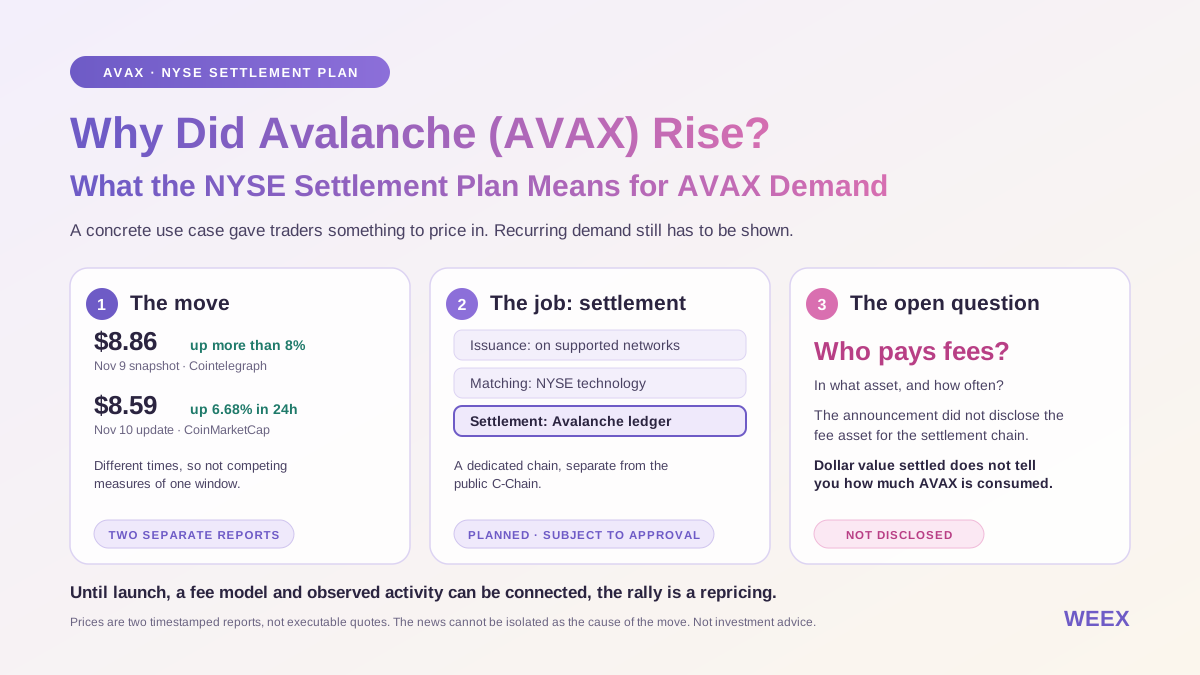
Why Did Avalanche (AVAX) Rise? What the NYSE Settlement Plan Means for AVAX Demand
See why Avalanche (AVAX) rallied after the NYSE settlement announcement, how the dedicated chain would work, and what could create demand for AVAX.
How to Resolve Data Center Controversies? This U.S. State Wants to Tokenize Computing Power to Share Benefits with Residents

Wall Street Morning Briefing: Market Soars on Oil Prices and AI Recovery, Nvidia Falls Alone, Data Centers Become Political Regulation Focus, CPI Lacks Year-on-Year Comparison Adds Variables

Ethereum's 2028 Challenge: Quantum Resistance Roadmap Hits Release Bottleneck
Understanding the DEX 'Hyperliquid': A Practical Workshop|Japan Digital Economy Federation

Envision Star River Base Completed in One Year with 120MW Capacity at One-Fifth the Cost of Similar U.S. Projects
AI Data Centers Are Buying Used Jet Engines as New Power Turbines Take Six Years

Crypto: Ethereum Prepares Two Solutions to Protect Its Smart Contracts

Heating by Mining Bitcoin? Finnish Families Are Trying This 'Free' Heating

Elysium Mainnet Launches with Block Time of 100 Milliseconds and Arrival Time of Approximately 300 Milliseconds

Samsung Etching Process Formulas Flow to Lam Research Korea

Raycash Launches on Ethereum Mainnet, Offering Privacy Stablecoin Payments and Yield Features

South Korean Deputy Prime Minister Says AI Data Center Regulation Needs Observation After U.S. Midterm Elections

Ave.ai Supports Elysium Ecosystem, Opens Cross-Chain and On-Chain Trading Capabilities
Who Will Bear the Cost of Delays in AI Data Centers?
Ethereum Releases Gas Repricing EIP Draft

Ethereum Developers Call for Halt to Gelmsterdam Upgrade

Vitalik: High Intervention Governance Needed for Fee Burn, May Drive Up Gas Prices

Anthropic Acquires $3.4 Billion Gas Power Equipment

Google buys Crusoe's data center in Wyoming for $17 billion

EIP-8037 state-gas rules force Ethereum dApps to rewrite billing

Stablecoins offer sub-cent payments, Armstrong says, as critics flag risks

Democratic Party's AI Regulation Push Revealed: Plans for Intensive Legislation and Strict Scrutiny of Tech Giants

Ethereum Foundation Reminds Contract Developers to Self-Check Impact of Glamsterdam Gas Adjustments
Breaking Down Bitcoin Trends: What Determines the True Value of L1?
Yushu and PetroChina Jointly Establish Industrial Embodied Intelligence Company with Kunlun Manufacturing Holding 60%
ZetaChain Proposes L1 Shutdown Amid Solana Migration, Plans to Burn 55 Million ZETA
SemiAnalysis: Musk Breaks Through Again, How SpaceX Competes for the World's Largest AI Cloud?
What is Qtum (QTUM)? A Proof-of-Stake Smart Contract Chain
Ethlabs Suggests Delaying Hoodi Testnet Fork Date, External Audit Expected to be Released Before November 16
Why Did Avalanche (AVAX) Rise? What the NYSE Settlement Plan Means for AVAX Demand
See why Avalanche (AVAX) rallied after the NYSE settlement announcement, how the dedicated chain would work, and what could create demand for AVAX.
How to Resolve Data Center Controversies? This U.S. State Wants to Tokenize Computing Power to Share Benefits with Residents
Wall Street Morning Briefing: Market Soars on Oil Prices and AI Recovery, Nvidia Falls Alone, Data Centers Become Political Regulation Focus, CPI Lacks Year-on-Year Comparison Adds Variables
Ethereum's 2028 Challenge: Quantum Resistance Roadmap Hits Release Bottleneck
Understanding the DEX 'Hyperliquid': A Practical Workshop|Japan Digital Economy Federation
Latest articles


Latest coin listings on WEEX


