
From Coinbase to Wall Street: Digital Asset Custody Enters a New Phase of Institutionalization

 Prefer us on Google



Custody is evolving from a simple asset safekeeping service into an important trust layer connecting institutional funds, on-chain finance, and the digital economy.
Written by: Cobo
In November, the global digital asset infrastructure sector welcomed a landmark compliance milestone.
After 13 months of review and conditional approval received in April this year, the Office of the Comptroller of the Currency (OCC) officially granted Coinbase an unconditional National Trust Bank Charter, allowing its subsidiary, Coinbase National Trust Company, to commence operations.
For a crypto-native enterprise that carries substantial institutional assets, this not only signifies further expansion of business development space but also reflects that digital asset custody is gaining a clearer institutional positioning within the traditional financial system.
If we broaden our perspective, this is not an isolated event.
Since the end of 2025, several leading institutions, including Circle, Ripple, BitGo, Fidelity Digital Assets, and Paxos, have successively advanced or been approved for OCC national trust bank charters; at the same time, the regulatory framework in the U.S. surrounding crypto asset custody, stablecoin issuance, and bank participation in on-chain operations continues to improve.
A series of developments point to a trend: Digital asset custody is gradually upgrading from early-stage professional support services in the crypto industry to becoming an essential infrastructure connecting traditional finance and the on-chain economy.
With the development of stablecoin payments and AI Agents, the role of custody will extend beyond mere asset safekeeping to encompass the rights of use, trading permissions, and execution management of digital assets.
I. Saying Goodbye to "Marginal Narratives": Custody Becomes the Legal Foundation for Mainstream Institutional Entry
To understand the significance of Coinbase's OCC approval, it is essential to clarify what kind of license this is.
The OCC is a federal financial regulatory agency under the U.S. Department of the Treasury, responsible for overseeing national banks, federal savings associations, and related institutions. Coinbase's approval is for establishing a National Trust Company, which is distinctly different from commercial banks that can fully engage in deposit and loan services.
National trust banks primarily operate around trust, asset custody, and related businesses, and are subject to federal oversight by the OCC, meaning Coinbase can conduct relevant trust business under a clearer federal regulatory framework, providing institutional clients with custody services that have greater institutional certainty.
From Coinbase's application documents, its planned custody services have already surpassed traditional cold wallet storage.
For instance, Prime Vault utilizes Multi-Party Computation (MPC) technology to provide different clients with corresponding independent on-chain addresses, achieving secure storage and isolated management of digital assets; Prime Custody supports clients in conducting relevant transactions within the custody system, ensuring that assets remain within a qualified custody framework during trading.
Additionally, Coinbase plans to integrate operations across different business entities, allowing custody clients to further access services such as staking, financing, and trading, while exploring payment and on-chain smart contract interactions.
This reflects a noteworthy change: Institutions now require not just a vault for storing digital assets, but a complete service system that covers asset storage, management, trading, and operations.
Coinbase is not the only company developing in this direction.
As mentioned at the beginning, in December 2025, the OCC conditionally approved national trust bank applications from five digital asset-related institutions, including Circle, Ripple, BitGo, Fidelity Digital Assets, and Paxos.
Subsequently, relevant approvals have made progress, with Ripple announcing on October 26, 2026, that it received final approval from the OCC to establish Ripple National Trust Bank; on November 6, Coinbase National Trust Company also officially completed its establishment and became effective.
From the initial state-level trust licenses to entering the federal regulatory framework, and then to different digital asset companies successively applying for national trust bank charters, the industry is witnessing a clearer path of institutional development.
Behind this trend lies a broader change in regulatory policies:
- In March 2025, the OCC issued Interpretive Letter 1183, reiterating that federally regulated banks can engage in crypto asset custody, specific stablecoin-related activities, and participate in distributed ledger network validation, while eliminating the previous requirement for prior non-objection from regulatory agencies for related businesses;
- In May of the same year, the OCC further clarified that federally regulated banks can buy and sell crypto assets they custody based on customer instructions, and can outsource some custody and execution services to third parties, provided they meet third-party risk management requirements;
- In October 2026, the OCC released final rules implementing the GENIUS Act, further regulating the issuance, reserve assets, redemption, risk management, auditing supervision, and certain custody activities of payment stablecoins, with the relevant rules set to take effect on January 18, 2027;
Although these developments involve banking operations, trust licenses, and stablecoin regulation, they all point in one direction: Digital assets are gradually being incorporated into a more mature and clear financial regulatory and service system.
For institutional participants, a gradually clearer regulatory path helps reduce the uncertainty of business implementation, and professional custody services are bound to become an important infrastructure for institutions entering this market.
II. From Points to Planes: What Kind of Security System Does Institutional Custody Need?
If regulatory licenses address whether custody service providers can operate under a clear institutional framework, then the technology and operational systems address whether institutions can truly trust them to manage their assets.
For institutions, the risks faced in digital asset custody are far more complex than those of ordinary users saving private keys. For example, an exchange, fund management institution, or cross-border payment platform often involves multiple business departments, different types of assets, and complex capital flow processes.
Therefore, institutional custody not only needs to ensure the security of private keys but must also clarify asset ownership, operational permissions, transaction approvals, and risk responsibilities, establishing a complete security system covering assets, keys, permissions, and operations.
First is the issue of asset control and isolation.
Institutions need to clearly distinguish between their own assets and client assets, ensuring that asset ownership, accounting records, and actual on-chain holdings correspond with each other. At the same time, clear rules for asset allocation and usage need to be established to avoid unauthorized asset transfers or improper use.
Second is permission management and transaction risk control.
Within an institution, asset management typically involves multiple roles, including finance, trading, risk control, operations, and management—who can create wallets? Who can initiate transfers? Who has the authority to approve large transactions? Which operations must undergo multi-person authorization?
These questions must be constrained by both technology and systems, as institutional wallets usually need to support multi-level role permissions, multi-person approvals, address whitelists, transaction limits, and automated approvals based on business rules; for businesses involving smart contract interactions, checks must be conducted on target contracts, calling parameters, and potential risks before transaction signing, to avoid unauthorized operations directly entering the on-chain execution phase.
Finally, there is auditing, operations, and risk management.
Institutions need to continuously monitor asset status, transaction records, and capital flows, and possess capabilities for risk monitoring, abnormal transaction handling, internal auditing, disaster recovery, and security incident response.
From key generation, backup, and recovery to permission changes, transaction signing, and capital allocation, every key operation should leave traceable records. Only when the technical architecture, permission management, and operational systems form a complete closed loop can institutions truly establish a sustainable asset security system.
This means that mature digital asset custody is essentially a comprehensive system composed of cryptographic technology, permission governance, risk management, and operational systems.
III. Where Will Next-Generation Custody Infrastructure Go?
For financial institutions, trading platforms, and enterprise clients truly at the forefront of business, obtaining compliant business access is just the starting point; whether they can safely and efficiently manage funds in a complex on-chain environment ultimately depends on the engineering capabilities of underlying wallets and custody infrastructure.
Because the custody logic of traditional trust banks is essentially "static"—assets enter cold storage, and delivery is completed through low-frequency, manually assisted processes; however, when a modern financial institution, exchange, Web3 company, or cross-border payment platform truly operates its business on-chain, it often faces complex challenges that traditional bank architectures cannot directly support:
- Multi-chain fragmentation and high-frequency concurrency: Stablecoins and institutional assets are distributed across dozens of heterogeneous public chains, and enterprises need millisecond-level API responses to support thousands of automated deposits, withdrawals, aggregations, and settlements daily, rather than offline approvals taking hours or even days;
- Balancing autonomy and security: Not all institutions wish to entrust their private keys 100% to a single third-party black box for safekeeping. Beyond fully compliant custody, some institutions may prefer to adopt MPC (Multi-Party Computation) threshold signature technology to achieve institutional self-holding and multi-party collaborative control of private key shards, eliminating single points of failure while retaining ultimate control over funds;
- Fine-grained enterprise-level internal controls: Managing an institutional treasury involves complex financial permissions, which need to be embedded within the wallet's underlying programmable risk control engine to automatically intercept transactions "before signing," rather than relying solely on post-audit;
These high-frequency, complex practical demands compel wallet and custody systems to possess more comprehensive permission governance, risk control strategies, and automated operational capabilities.
At the same time, the development of stablecoin payments and tokenized assets is also expanding the service boundaries of custody infrastructure.
Whether it is tokenized funds, bonds, or other real-world assets, their issuance, holding, transfer, and settlement require a reliable asset management system. Asset on-chain does not automatically eliminate custody, ownership, and compliance issues in traditional finance; rather, it may require these capabilities to be realized in a more transparent and programmable manner in the on-chain environment.
More long-term imaginative is the participation of AI Agents in digital asset management and financial activities.
In the past, wallets were designed specifically for human users, who held private keys and actively initiated transactions through front-end interfaces, confirming each operation manually. However, in the Agentic Economy, an increasing number of on-chain operations will be automatically completed by Agents 24/7. If complete private keys or unrestricted wallet control are directly handed over to AI Agents, it clearly poses severe security risks:
For instance, will the Agent transfer assets without restrictions? Will it interact with malicious smart contracts? Could it execute unintended transactions due to model hallucinations, prompt injections, or external command manipulations?
This is essentially an extension of the institutional custody concept in the intelligent agent economy, as the objects managed by custody infrastructure extend from private keys and assets themselves to identities, permissions, and execution strategies, necessitating the establishment of a verifiable, constrained, and traceable asset usage permission system.
From this perspective, institutional custody, MPC wallets, stablecoin payments, and Agent wallets are essentially different scenarios revolving around the same core capability—to manage and efficiently utilize digital assets under safe, compliant, and controllable conditions.
-- Price
Final Thoughts
The final approval of Coinbase's National Trust Charter by the OCC provides an important institutional footnote for the development of the digital asset custody industry.
From the gradual clarification of the regulatory framework to the continuous improvement of institutional custody systems, and the new asset management demands brought by stablecoin payments and the intelligent agent economy, digital asset infrastructure is undergoing an evolution from technology-driven to a collaborative development of institutions, technology, and business.
Especially in the recent context of global market volatility, it proves that digital asset infrastructure has not become isolated; rather, it is rapidly completing compliance reshaping, becoming an integral part of the modern financial system.
For institutions, whether digital assets can be securely held, effectively managed, and efficiently utilized will directly impact their depth and breadth of participation in on-chain finance; for infrastructure service providers, future value lies in helping clients establish a complete system covering asset storage, permission governance, transaction execution, and business operations.
As more and more financial activities shift on-chain, and as more assets begin to be autonomously called by software and agents, secure, compliant, and programmable asset control capabilities will become an indispensable underlying support for digital finance.
After all, finance can become more open, and assets can become more programmable, but regardless of who uses the assets, trust and control must always exist.
This content is provided for general informational purposes only and doesn't constitute financial, investment, legal, or tax advice. Any events, rewards, online promotions, or related information mentioned herein should not be considered a recommendation, solicitation, or invitation to purchase, sell, trade, or otherwise deal in any crypto assets. Crypto assets are highly volatile and may result in loss. The availability of WEEX services, products, and related events may vary by region. You are responsible for ensuring that your participation is in accordance with applicable local laws and regulations.
You may also like

US 401(k) Rule Proposal Allows Cryptocurrency Allocation, Barriers for Altcoins

Countdown to Migration to Solana: ZetaChain to Launch Financial AI Platform ZetaLabs

End of Circle's CCTP V1: Which Cases Require Migration for USDC Transfers?

Kaspa developer targets ownerless prediction market by end-2026

XRPL lending protocol gains validator support as vault vote advances

US card debt hits $1.29 trillion as Bitcoin loans expose a collateral divide

CryptoQuant: Bitcoin Analyst Sentiment Significantly Bearish, Index Drops to -1.8σ

How Much CPO Demand Will NVIDIA's Rubin Ultra Generate? Bernstein: Optical Value of Single Pod Increases Fivefold

Pump.fun Data Review: Why the Current Meme Market Has Become a 'Harvesting Game'?

As Protocols Move Back to the Mainnet, How Does Ethereum's Value Logic Change?

As Whales Embrace ETFs, Security Anxiety in the Crypto World is Spreading
How Much Revenue Can Anthropic Generate for Every $1 Spent on Computing Power?

WEEX 11.11 Shopping Fest: Buy BTC and Unlock Up to 888 USDT in Rewards

Bitget UEX Daily Report | Inflation Surprises and Pressures US Stocks; Nvidia Falls Over 5%; Gold Drops Below $4100 (November 11, 2026)

How Much Net Buying Power Will ETH Lose When Bitmine Stops Buying?
LlamaRisk Proposes to Narrow Aave V3 Core Collateral Asset Range, Involving $1.33 Billion in Collateral

Algorithmic Trading and Cryptocurrencies: How Do Robots React to Volatility?

Cardano’s police evidence system could bring 1.5 million annual transactions

Confidence at Zero! Goldman Sachs Interprets Hedge Fund Positions: 'Surrender Liquidation', Largest Loss Since the Pandemic

47% Top Tax Rate Approaches: Seven Tax Reduction Strategies for Australian Crypto Investors
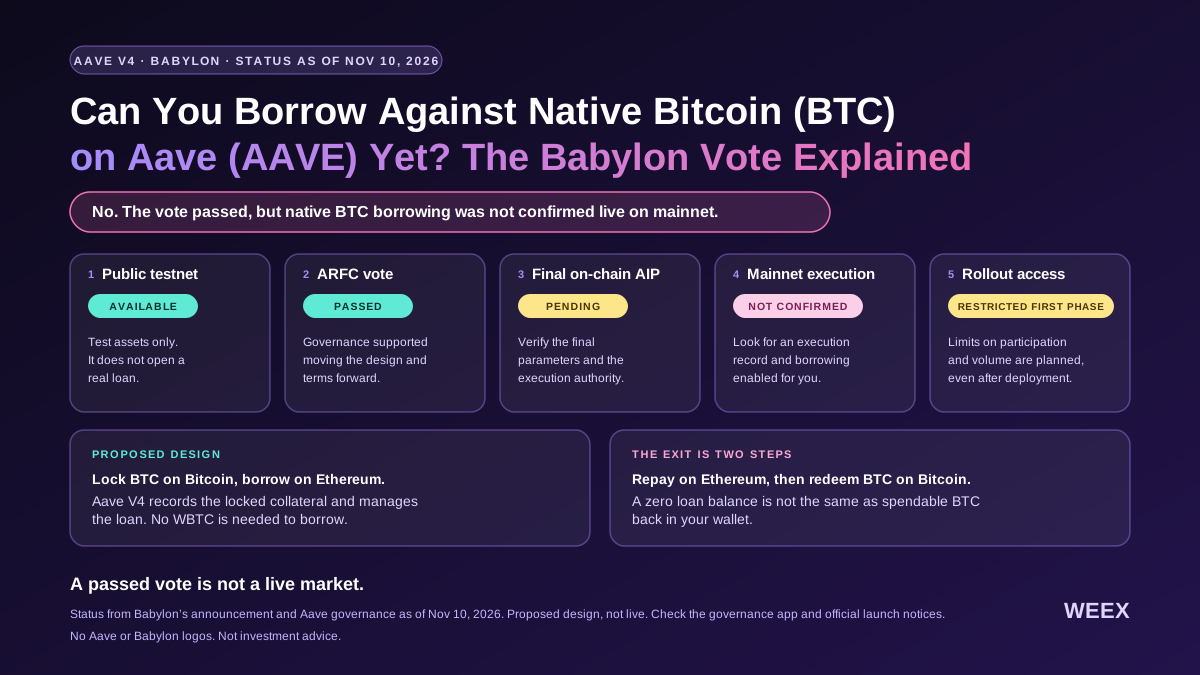
Can You Borrow Against Native Bitcoin (BTC) on Aave (AAVE) Yet? The Babylon Vote Explained
Can you borrow against native Bitcoin on Aave yet? See what the Babylon vote approved, what still needs to launch, and how BTC liquidation would work.

PIEVERSE Price Up Nearly 80% in a Week: Futures Activity, the November 14 Unlock and What Is Confirmed
PIEVERSE rose about 79% in seven days with futures volume far above spot. See what is confirmed about the November 14 unlock and the WEEX Lucky Eggs campaign.

Hong Kong Approves Crypto Asset Reporting Rules - Fintech World

NVDA Stock Falls 4.3% After Board Opens Investigation: What Is Confirmed and What Is Not
NVDA closed at $178.67 on November 9, 2026, down about 4.3%, after Nvidia’s board confirmed an independent investigation. Other claims come from media reports. WEEX’s Lucky Eggs campaign runs until November 25.

Chainalysis Report: Why Did Western Europe Withstand the Global Crypto Market Chill?

Four Security Strategies from the Wallet Theft Incident

Global Outage: Your Cryptos Are Not Disappearing

Did Strategy buy Bitcoin? Saylor reignites speculation

A New Chapter in the History of Rug Pulls in Crypto

From Binance Incubator to Nasdaq: Injective's Eight Years
US 401(k) Rule Proposal Allows Cryptocurrency Allocation, Barriers for Altcoins
Countdown to Migration to Solana: ZetaChain to Launch Financial AI Platform ZetaLabs
End of Circle's CCTP V1: Which Cases Require Migration for USDC Transfers?
Kaspa developer targets ownerless prediction market by end-2026
XRPL lending protocol gains validator support as vault vote advances
US card debt hits $1.29 trillion as Bitcoin loans expose a collateral divide
Latest articles


Latest coin listings on WEEX


