
Cisco Q1 FY2027 Earnings: $18.5B Revenue, $9B AI Outlook and CSCO Stock Reaction

 Prefer us on Google

Introduction
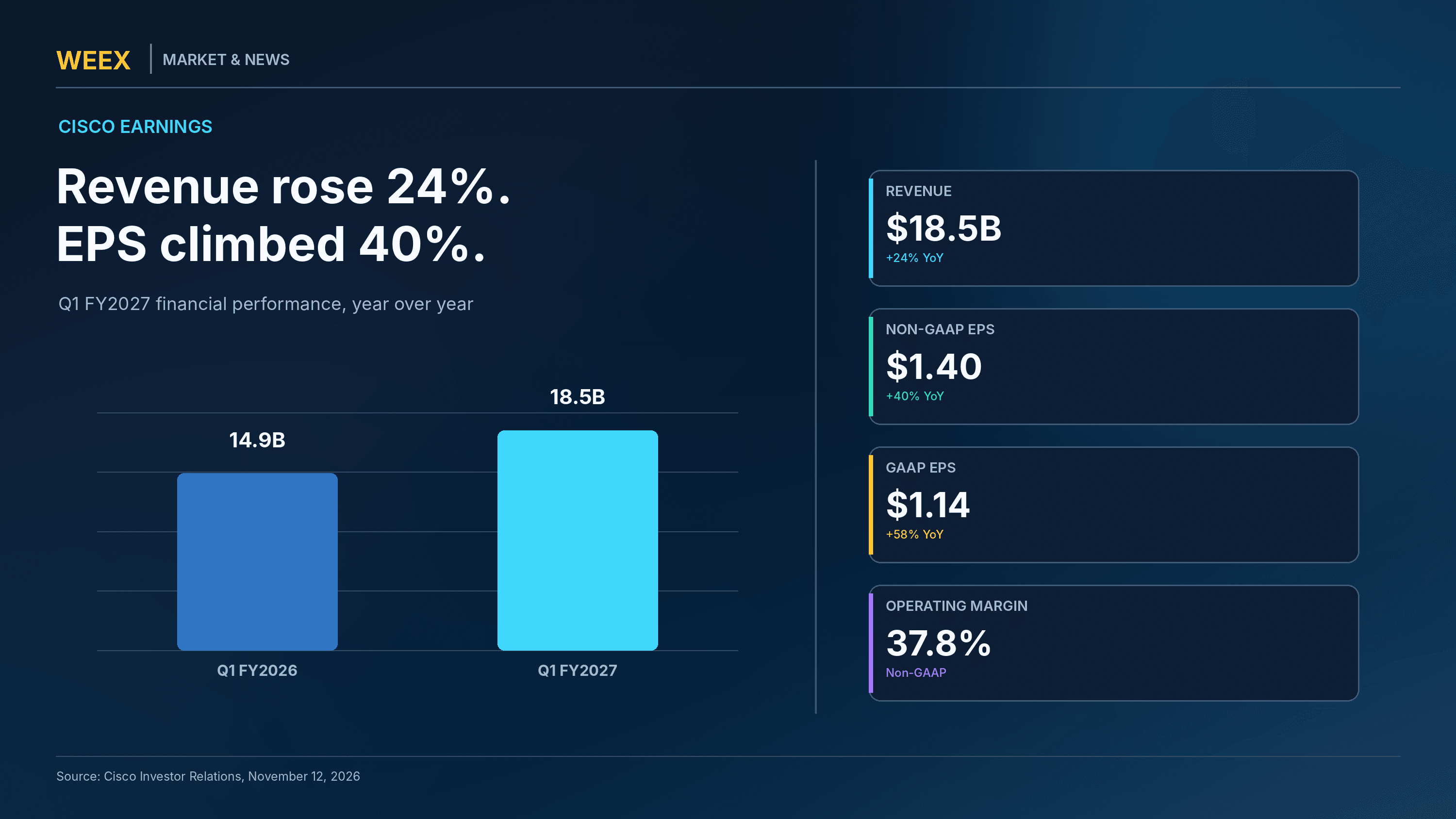
Cisco Q1 FY2027 earnings delivered one of the networking giant's strongest financial performances in more than a decade. Cisco Systems (NASDAQ: CSCO) reported record quarterly revenue of $18.5 billion on November 12, 2026, representing 24% year-over-year growth, while adjusted earnings per share reached $1.40. The company also raised its full-year revenue outlook and projected $9 billion in fiscal 2027 AI infrastructure revenue from hyperscale customers, highlighting its growing exposure to the artificial intelligence infrastructure market.
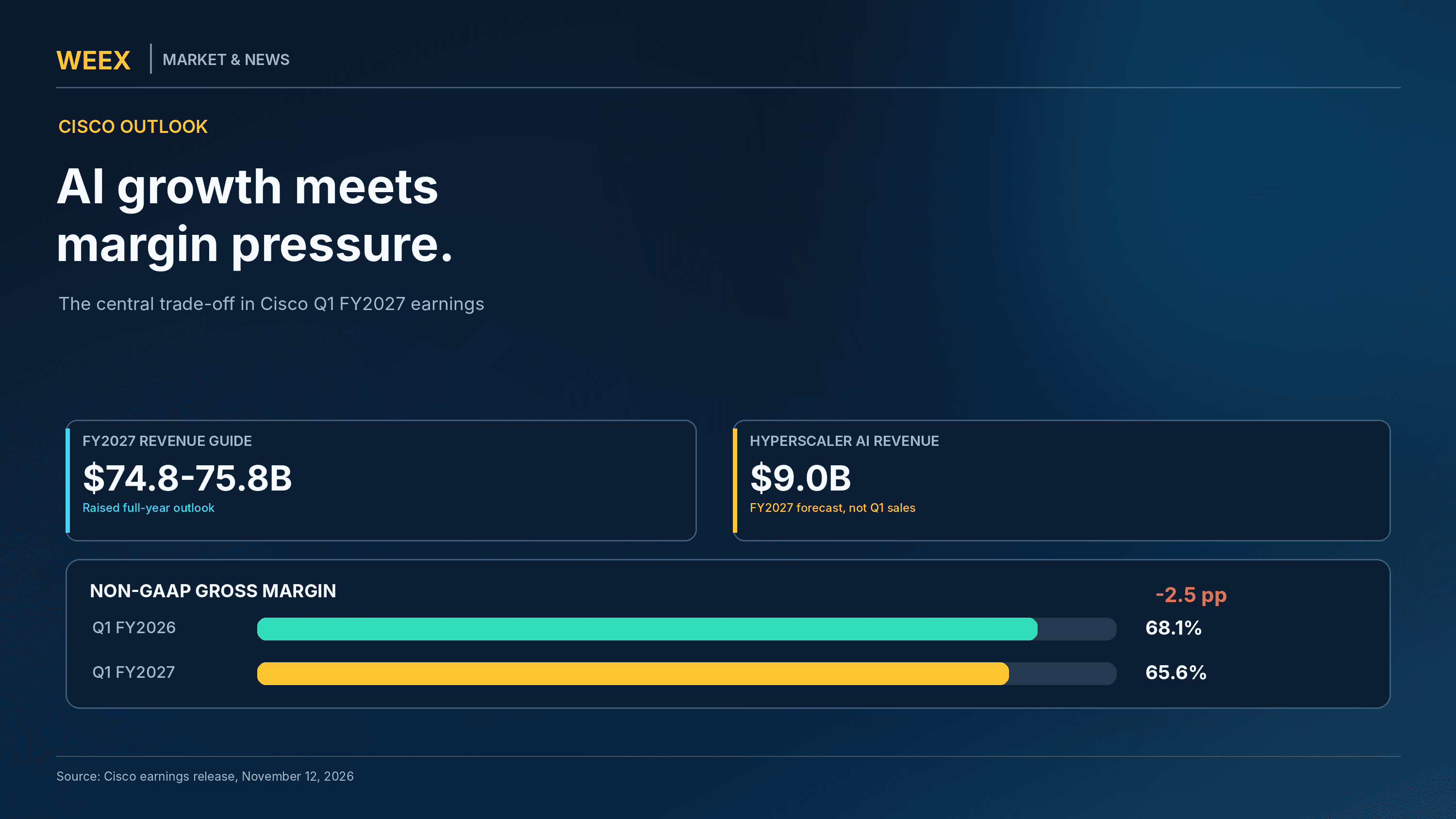
The central question following Cisco Q1 FY2027 earnings is whether the company's accelerating networking demand can support sustained profit growth. Cisco's Networking segment expanded 43% year over year, driven by demand across traditional infrastructure and high-speed AI networking. However, non-GAAP gross margin declined from 68.1% to 65.6%, reflecting pressure from product mix and higher component costs. This creates an important tension: Cisco is selling more infrastructure into the AI investment cycle, but not every additional dollar of revenue carries the same profitability.
For investors reviewing Cisco Q1 FY2027 earnings, the results also illustrate why an earnings beat does not always produce a straightforward stock-price reaction. A November 13 WEEX market snapshot showed a closed-market CSCO stock-related reference price of 101.72 USDT and a perpetual futures quotation of 101.82 USDT, with the futures market reporting a 1.12% rolling 24-hour gain. Those quotations describe different products and timestamps, not the exact return of Nasdaq-listed Cisco shares. This article examines the financial results, AI infrastructure growth, margin pressure, revised guidance, and what market participants should monitor next.
What Did Cisco Report in Q1 FY2027?
Cisco released its fiscal first-quarter results after the U.S. market closed on November 12, 2026. The reporting period ended October 24, and both revenue and adjusted earnings exceeded the company's previous guidance. Cisco characterized the results as its strongest revenue and non-GAAP earnings-per-share growth in more than 15 years, reflecting a significant acceleration for a business traditionally associated with mature enterprise networking markets.
The company reported GAAP net income of approximately $4.6 billion and diluted GAAP EPS of $1.14. Under its non-GAAP reporting framework, adjusted net income reached approximately $5.6 billion, producing EPS of $1.40. These figures cannot be used interchangeably: GAAP results follow standardized accounting requirements, while non-GAAP results exclude specified expenses and adjustments. When comparing analyst expectations or management guidance, investors must use the corresponding earnings measure.
Cisco Q1 FY2027 Financial Results
| Financial Metric | Q1 FY2027 | Q1 FY2026 | YoY Change |
|---|---|---|---|
| Revenue | $18.5B | $14.9B | +24% |
| GAAP Net Income | $4.6B | $2.9B | +59% |
| GAAP Diluted EPS | $1.14 | $0.72 | +58% |
| Non-GAAP Net Income | $5.6B | $4.0B | +39% |
| Non-GAAP Diluted EPS | $1.40 | $1.00 | +40% |
| GAAP Operating Margin | 30.2% | — | Current quarter |
| Non-GAAP Operating Margin | 37.8% | — | Current quarter |
| Operating Cash Flow | $4.4B | $3.2B | +36% |
Source: Cisco Investor Relations — Q1 FY2027 Earnings Release, November 12, 2026. Values rounded as published; percentage changes follow Cisco's reported figures.
The relationship between revenue growth and earnings growth is particularly important. Revenue increased 24%, while adjusted EPS grew 40%, suggesting that Cisco generated operating leverage as its sales expanded. The company reported a non-GAAP operating margin of 37.8%, supported by expense discipline despite pressure on gross margins.
This does not mean profitability improved across every measure. Gross margin and operating margin describe different parts of the income statement. A company can experience weaker product-level profitability while achieving stronger overall operating results if operating expenses grow more slowly than revenue.
Why Is Cisco's AI Infrastructure Business Growing So Quickly?
The most strategically important element of Cisco's earnings report is its expanding role in the infrastructure required to connect AI computing systems. Training and operating large AI models depends not only on GPUs but also on networking equipment that moves data between computing nodes, servers, storage systems, and data centers.
As AI clusters become larger, networking performance can increasingly affect the productivity of expensive computing hardware. High-bandwidth Ethernet connections, low-latency switching, and reliable data-center infrastructure help reduce bottlenecks that would otherwise leave computing resources underutilized.
Cisco benefits from this trend through its networking hardware, software, and related services. The company reported that Networking revenue grew 43% year over year in the fiscal first quarter. It also raised its full-year expectation for AI infrastructure revenue from hyperscale customers to approximately $9 billion, compared with $4 billion in fiscal 2026.
What Does the $9 Billion AI Revenue Target Actually Mean?
Cisco's $9 billion figure is a fiscal 2027 forecast for AI infrastructure revenue associated with hyperscale customers, not revenue already generated during the first quarter. Treating it as a quarterly achievement or a confirmed amount already collected would materially misrepresent the announcement.
The forecast implies an increase of approximately $5 billion from the reported fiscal 2026 level. In percentage terms, the targeted growth would be about 125%, assuming the company's stated figures are achieved. That represents a much faster growth rate than Cisco's total company revenue, suggesting that AI-related networking is becoming an increasingly important contributor to incremental sales.
However, the forecast should also be assessed against the company's margin structure. AI infrastructure projects can require expensive components, including memory and specialized networking hardware. Demand may be strong without allowing suppliers to preserve the same gross margins they earned on previous product mixes.
The fundamental question is whether Cisco can convert the increased demand into durable operating profit and cash flow, rather than simply increasing shipment volumes.
-- Price
Why Did Cisco's Gross Margin Decline Despite Record Revenue?
Cisco's non-GAAP gross margin declined to 65.6% from 68.1% in the year-earlier quarter, a reduction of 2.5 percentage points. Management and subsequent reporting pointed to factors including product mix and higher memory or component costs, even as the company benefited from stronger demand.
This development matters because revenue acceleration can conceal changes in the profitability of the products being sold. A business may increase revenue rapidly by supplying hardware in high demand, but the associated margin can narrow if production costs rise or customers purchase a larger proportion of lower-margin products.
Cisco's Growth and Margin Trade-Off
| Indicator | FY2026 Q1 | FY2027 Q1 | Interpretation |
|---|---|---|---|
| Quarterly Revenue | $14.9B | $18.5B | Substantial sales expansion |
| Non-GAAP Gross Margin | 68.1% | 65.6% | Down 2.5 percentage points |
| Non-GAAP EPS | $1.00 | $1.40 | Up 40% |
| Networking Revenue Growth | — | +43% YoY | Strong infrastructure demand |
| FY2027 Hyperscaler AI Revenue Forecast | — | $9B | Full-year projection, not quarterly sales |
Source: Cisco Q1 FY2027 earnings release and accompanying company guidance.
A simple calculation highlights the trade-off. Applying a 68.1% gross margin to $18.5 billion of revenue would produce approximately $12.60 billion of gross profit. Applying the reported 65.6% margin produces approximately $12.14 billion. The illustrative difference is around $463 million on the same revenue base.
This comparison does not establish a realized loss relative to management's plan, because Cisco's actual product mix and operating environment changed. It shows how even a relatively small percentage-point movement in margins becomes financially significant at the scale of Cisco's quarterly revenue.
Cisco's higher operating profitability suggests that other business factors helped offset gross-margin pressure. Future earnings reports will show whether stronger scale and operational efficiency can continue to compensate for component inflation.
How Much Did Cisco Raise Its FY2027 Guidance?
Cisco raised its fiscal 2027 revenue outlook to $74.8 billion–$75.8 billion, compared with its previous range of $72.2 billion–$73.4 billion. It also increased non-GAAP EPS guidance to $5.47–$5.53 from $5.05–$5.11.
The higher forecast indicates that management expects the stronger demand environment to extend beyond one quarter. Guidance changes are particularly relevant because stock valuations depend on expected future performance rather than only completed results.
Cisco FY2027 Guidance: Before vs. After Earnings
| Metric | Previous Guidance | Updated Guidance | Midpoint Change |
|---|---|---|---|
| FY2027 Revenue | $72.2B–$73.4B | $74.8B–$75.8B | +$2.5B |
| FY2027 Non-GAAP EPS | $5.05–$5.11 | $5.47–$5.53 | +$0.42 |
| FY2027 Hyperscaler AI Infrastructure Revenue | $7.5B | $9.0B | +$1.5B |
| Q2 FY2027 Revenue | — | $18.0B–$18.2B | New guidance |
| Q2 FY2027 Non-GAAP EPS | — | $1.34–$1.36 | New guidance |
Sources: Cisco Q1 FY2027 Earnings Release and Reuters' November 12 earnings coverage. Midpoint changes are calculated from disclosed ranges.
At the midpoint, Cisco's annual revenue forecast increased from $72.8 billion to $75.3 billion, a rise of approximately 3.4%. The midpoint of non-GAAP EPS guidance increased from $5.08 to $5.50, an improvement of approximately 8.3%.
The larger proportional increase in expected earnings than in expected revenue reinforces management's operating-leverage argument. Nevertheless, guidance remains conditional on customer orders, supply-chain conditions, competitive dynamics, and execution over the remaining fiscal quarters.
Why Did CSCO Stock-Related Prices Differ From Futures After Earnings?
Cisco's earnings were released after the regular U.S. stock market closed, meaning investors following stock-linked products and derivatives may have encountered different price references during the reporting window.
A WEEX market snapshot recorded on November 13 at approximately 10:27 Beijing Time displayed a CSCO stock-related reference price of 101.72 USDT marked as closed. Roughly 26 seconds later, the CSCO perpetual futures market was quoted at 101.82 USDT, with a rolling 24-hour change of +1.12%.
WEEX CSCO Market Snapshot — November 13
| Observation | Value | Interpretation |
|---|---|---|
| CSCO Stock-Related Reference | 101.72 USDT | Closed-market reference quotation |
| CSCO Perpetual Futures | 101.82 USDT | Derivatives-market quotation |
| Futures 24-Hour Change | +1.12% | Rolling futures-market change |
| Quotation Difference | 0.10 USDT | Futures above reference |
| Difference Relative to Reference | Approximately 0.10% | Calculated, not a share return |
Source: WEEX internal promotional snapshot, November 13, 2026, approximately 10:27 Beijing Time. Difference calculated as (101.82 − 101.72) ÷ 101.72 × 100.
The small numerical difference between these quotations does not prove that the two products have identical economics. A stock-linked reference price can be marked closed outside its trading window, while the corresponding perpetual futures contract may reflect active market expectations, funding mechanics, liquidity, and order-book conditions.
It is also important not to use the +1.12% futures change as the confirmed after-hours return of Nasdaq-listed CSCO shares. A rolling futures percentage and a regular-session equity return measure different products over potentially different periods.
Readers can explore WEEX's guide to when U.S. stock tokens can be traded for additional information about session-related pricing differences.
What Should CSCO Investors Watch After the Earnings Beat?
The first indicator is whether Cisco can sustain accelerated networking growth. The company currently benefits from strong hyperscaler infrastructure demand, but the long-term outlook will depend on continued orders, deployment schedules, customer concentration, and the competitive environment for AI networking.
The second is gross-margin performance. Cisco has demonstrated that it can expand adjusted earnings faster than revenue, yet persistent component-cost pressure could eventually constrain profitability. Investors should compare future results with the company's non-GAAP gross-margin guidance of 65%–66% for the second quarter.
The third is whether the $9 billion fiscal-year AI infrastructure target translates into realized sales and cash flow. A higher outlook is encouraging, but the quality of growth matters: collected revenue and sustained margins provide stronger evidence than order announcements alone.
Finally, investors should monitor Cisco's cash generation and capital allocation. The company generated $4.4 billion in operating cash flow during the first quarter and returned approximately $3.7 billion to shareholders through dividends and share repurchases. Those figures provide useful context for evaluating the durability of its business model.
How to Buy and Trade Cisco (CSCO) on WEEX
WEEX offers stock-related trading products that allow eligible users to gain exposure to Cisco Systems (NASDAQ: CSCO) using USDT. Users can access CSCO-linked spot products and perpetual futures, although these instruments differ from purchasing ordinary Cisco shares through a traditional brokerage.
Step 1: Create a WEEX Account and Deposit USDT
Visit the WEEX official website and register for an account, or log in if you already have one. Complete any required identity verification and deposit USDT using a supported payment or transfer method. Before proceeding, confirm that your account is eligible to access the relevant stock-related products and that sufficient funds are available.
Step 2: Open the CSCO Trading Page
Navigate to the WEEX CSCO/USDT Stock Trading page to review the available quotation, order book, and trading conditions. Check whether the market is currently accepting orders, particularly when the underlying U.S. equity market is closed. WEEX stock-related products provide price exposure under their product terms rather than direct ownership of Cisco common shares.
Step 3: Place Your Order and Monitor Your Position
Select Buy, enter the desired quantity, and choose an available order type, such as a limit order. Review the order price, total USDT amount, and applicable fees before confirming. Once the order is executed, monitor your holdings and market movements through your WEEX account.
Experienced traders can alternatively visit CSCO/USDT Perpetual Futures to review derivatives exposure, subject to current trading availability. Futures positions involve margin requirements, funding payments, and potential liquidation risks, making them different from stock-related spot products.Conclusion
Cisco's Q1 FY2027 earnings demonstrate a significant acceleration in the company's business, supported by AI infrastructure investment and expanding demand for networking equipment. Revenue reached $18.5 billion, adjusted EPS increased 40%, and management raised its annual outlook, including a $9 billion forecast for hyperscaler AI infrastructure revenue.
The strongest interpretation is not simply that Cisco beat earnings expectations. It is that the company may be entering a higher-growth period while facing a more demanding cost environment. Networking revenue growth and operating leverage support the investment case, whereas gross-margin compression and supply-chain pressures remain measurable risks.
For CSCO investors, the next questions are whether Cisco converts its AI networking forecast into realized revenue, how margins evolve as demand expands, and whether its updated fiscal-year guidance remains achievable. The financial results are confirmed; future stock-price performance remains uncertain.
FAQ
1. What were Cisco's Q1 FY2027 earnings results?
Cisco reported record revenue of approximately $18.5 billion, up 24% year over year, for the quarter ended October 24, 2026. GAAP diluted EPS was $1.14, while non-GAAP diluted EPS was $1.40. The results were announced on November 12, 2026.
2. Is Cisco's EPS $1.14 or $1.40?
Both figures are correct under different accounting measures. Cisco reported GAAP diluted EPS of $1.14 and non-GAAP adjusted diluted EPS of $1.40. The figures should not be mixed when comparing results with analyst expectations or previous guidance.
3. Why did Cisco raise its AI revenue forecast to $9 billion?
Cisco cited strong demand from hyperscale customers investing in AI data-center infrastructure. The $9 billion figure represents its expectation for fiscal 2027 AI infrastructure revenue from those customers, not revenue already recognized during the first quarter.
4. Why could Cisco's stock reaction differ from its earnings growth?
Stock prices reflect future expectations, valuation, market conditions, and profitability risks in addition to reported earnings. Cisco's strong growth was accompanied by a decline in non-GAAP gross margin. Different market instruments, including stock-linked tokens and perpetual futures, can also display different quotations and trading-hour behavior.
5. Can I trade CSCO on WEEX?
WEEX provides CSCO-related stock-token and perpetual futures market pages, subject to current availability and account eligibility. Stock tokens are synthetic assets linked to Cisco's price performance rather than direct ownership of Nasdaq shares, while futures contracts involve additional margin and liquidation risks.
This content is provided for general informational purposes only and doesn't constitute financial, investment, legal, or tax advice. Any events, rewards, online promotions, or related information mentioned herein should not be considered a recommendation, solicitation, or invitation to purchase, sell, trade, or otherwise deal in any crypto assets. Crypto assets are highly volatile and may result in loss. The availability of WEEX services, products, and related events may vary by region. You are responsible for ensuring that your participation is in accordance with applicable local laws and regulations.
You may also like

Are Bitcoin Lightning Wallets Safe? 5 Security Warnings Since August

How to Buy ANT Stock on Day One: What Is Confirmed

Anthropic IPO: ANT Date, Price Range and Valuation

Jensen Huang Comeback Reports: Petition, War Room and Nvidia’s Response
Nvidia Earnings Date: Nov. 17, 2026 After the Bell, in Every Zone
Nvidia Earnings Preview: Q3 Results Land Days After Huang's Exit

Powell Speech Bitcoin: Why Warsh, Not Powell, Moves BTC in 2026
Fed Rate Cut December 2026? Why Markets Now Price a Hike Instead
Fed Rate Decision Bitcoin: How BTC Reacted to Every 2026 Call

Nebius Cuts 2026 Revenue Outlook: Are Data Center Delays a Threat to NBIS?

BTC Staking in a Crash: What It Protects and What It Does Not

WXT Burn Q3 2026: WEEX to Burn 65,228,631 WXT on November 16

ACKET Token Surges 1,000% After Jensen Huang Resigns: What Is Confirmed

Why Did Nebius Stock Crash Despite 571% Revenue Growth? NBIS Q3 Earnings Explained

Bitcoin Falls Toward $70K: ETF Outflows, Liquidations and What Happens Next
December FOMC Meeting 2026: Dec. 8-9 Rate Hike, 25 or 50 Bps?
CPI Release Date: Next Report Dec. 10, 2026 at 8:30 a.m. ET
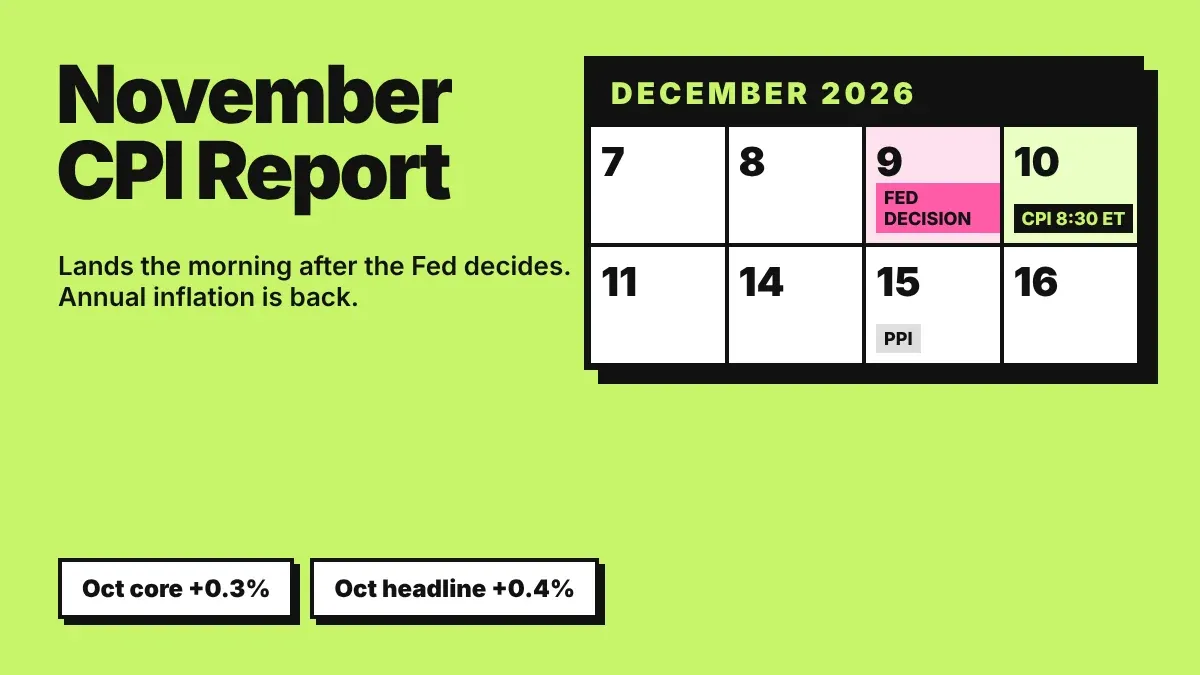
November CPI Report: Dec. 10 Release Lands After the Fed Decides

Midterm Election Results Crypto: Who Now Controls Crypto Policy

Midterm Elections Bitcoin Price: What 2014, 2018 and 2022 Show

Is Staking Crypto Worth It? What You Earn on WEEX Staking

MSCI Removes Strategy (MSTR): Will Index Selling Pressure Bitcoin?
DTCC Brings Tokenized Securities to Solana: Will SOL Demand Rise in 2027?

Jensen Huang Resigns as NVIDIA CEO: What Happens to NVDA Stock Next?

Rocket Lab's 100th Electron Launch: November 14 Window, Mission Details and RKLB Stock Outlook

What Is Project Faro? The $270M Bank Stablecoin Plan Explained

Stablecoin Supply Falls $14.2B in 30 Days: What It Means for Bitcoin
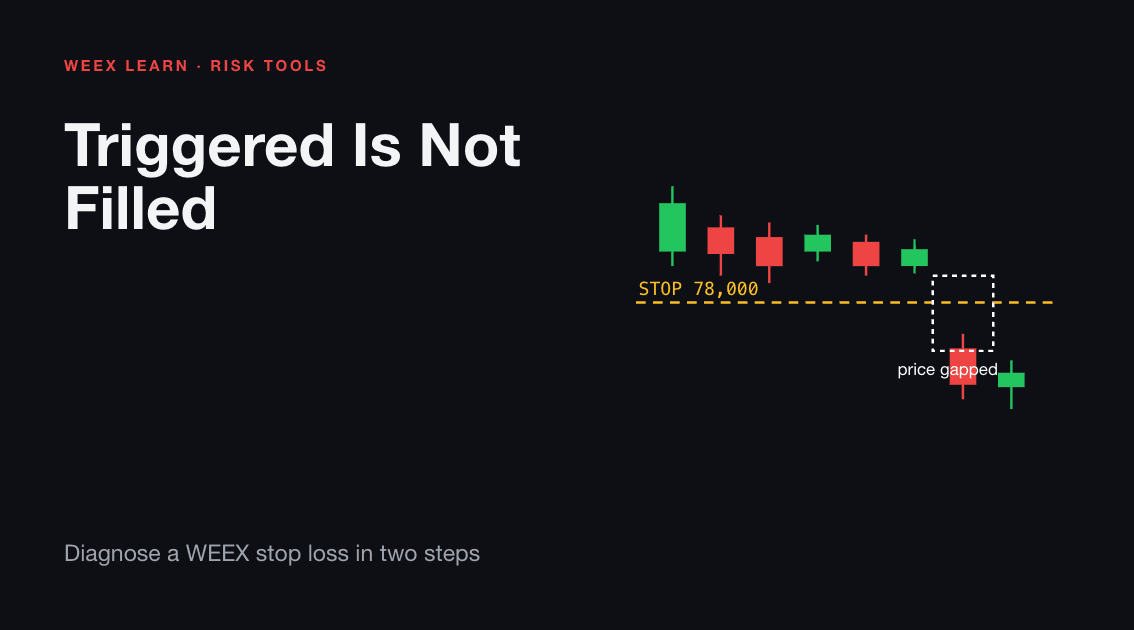
Binance Hack: $6.3B Laundering Trail and Recovery Progress
Is Strategy (MSTR) Being Removed From the MSCI Index? What Happens After November 30

Beginner-Friendly Crypto Exchanges With Simple Interfaces Ranked
Are Bitcoin Lightning Wallets Safe? 5 Security Warnings Since August
How to Buy ANT Stock on Day One: What Is Confirmed
Anthropic IPO: ANT Date, Price Range and Valuation
Jensen Huang Comeback Reports: Petition, War Room and Nvidia’s Response
Nvidia Earnings Date: Nov. 17, 2026 After the Bell, in Every Zone
Nvidia Earnings Preview: Q3 Results Land Days After Huang's Exit


